
That Steady Line of Ants From Your Brick Wall? Here’s What It Means
Ants in a brick wall are one of the most common summer pest problems for Massachusetts homeowners — and one of the most misunderstood.
If you’re seeing ants marching in and out of your mortar joints, here’s the quick answer:
How to get rid of ants in a brick wall:
- Identify the species — small pavement ants vs. larger carpenter ants require different approaches
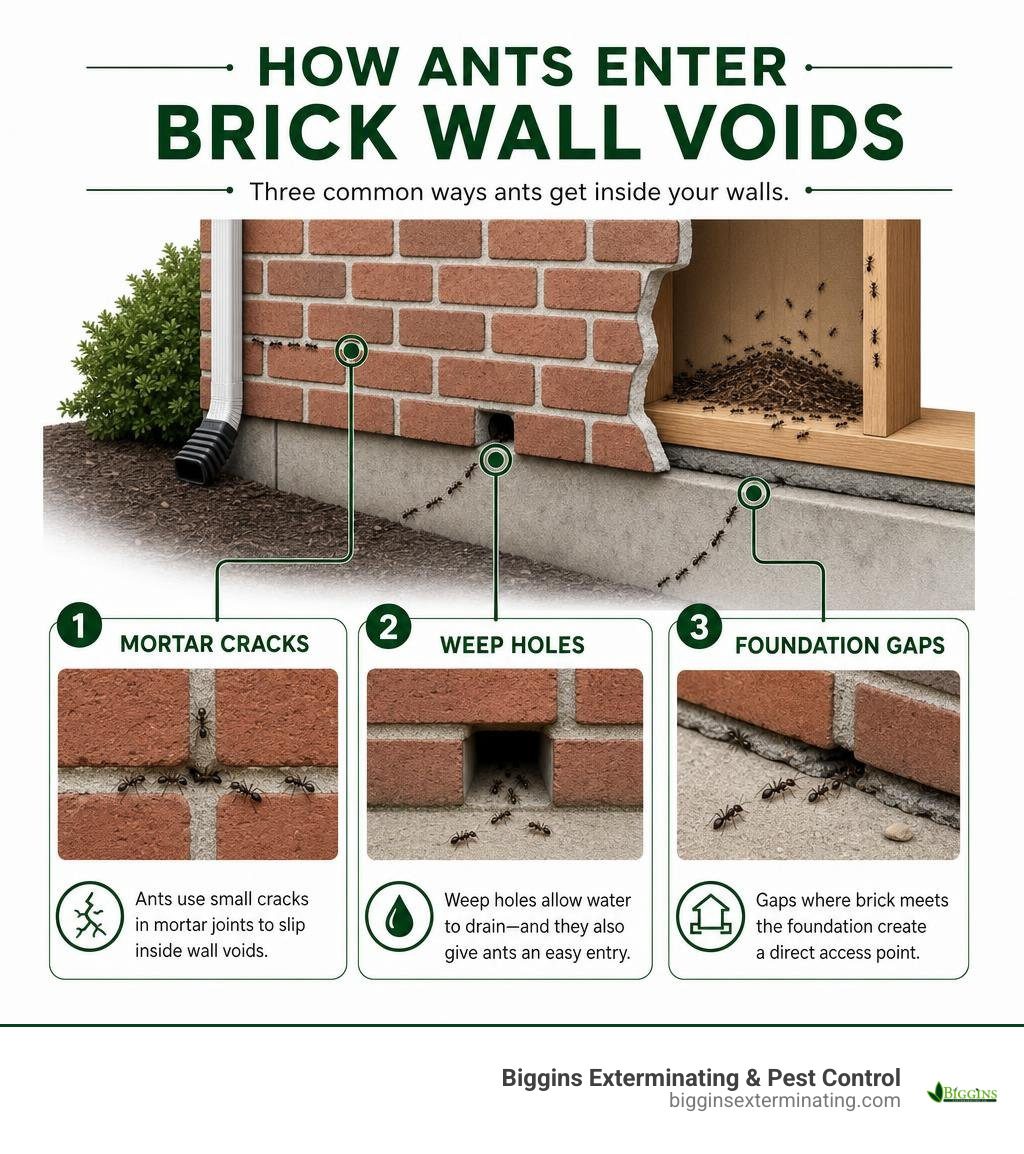
- Locate entry points — look for trails leading into mortar cracks, weep holes, or foundation gaps
- Use slow-acting bait — place non-repellent bait near active trails so workers carry it back to the colony
- Treat wall voids — professional-grade dust or foam injected into the cavity reaches the hidden nest
- Seal entry points — only after ant activity has stopped completely
- Call a professional — if ants persist after two weeks, or if you suspect carpenter ants
Don’t spray the ants directly. Repellent sprays can scatter the colony and create new satellite nests deeper in your walls.
Brick walls attract ants for a simple reason: they offer exactly what a colony needs — stable warmth, protected cavities, and moisture near the foundation. What looks like a minor nuisance on the outside can mean hundreds or thousands of ants nesting inside your wall voids.
This is especially common during summer in Massachusetts, when ant colonies are at peak activity and actively expanding into new nesting sites.
I’m Stephen Biggins, owner of Biggins Exterminating Co., and over more than 40 years of pest control work in Wilmington, MA and surrounding communities, ants in brick wall structures are something our team deals with every season. If you want to know exactly what’s going on inside your walls — and how to fix it for good — this guide will walk you through it.
Easy ants in brick wall glossary:
Why Ants Target Brick and Masonry Structures
When we think of ants, we usually picture them building mounds in the dirt or marching across a kitchen counter. But brick homes offer a highly attractive three-dimensional environment that acts like a luxury condo for a growing colony.
Many homeowners ask us, “How can insects live in solid brick?” The secret is that they aren’t actually eating or tunneling through the brick itself. Instead, they exploit the tiny gaps, structural voids, and aging mortar joints that hold the brickwork together. According to School of Bugs’ guide on brickwork ants, ants will actively enlarge hairline cracks in aging cement or mortar by biting away at crumbling material to create customized entryways.

Thermal Mass and Microclimates
One of the primary reasons brick homes are so attractive to ants is a physical property called thermal mass. Bricks are incredible at absorbing heat from the summer sun during the day and slowly radiating that warmth back out during the cool Massachusetts nights.
This creates a highly stable, warm microclimate inside the wall cavities. For an ant colony, temperature control is everything. Warmth accelerates the development of ant eggs and larvae, allowing the colony to grow at a much faster rate. During our late spring and summer visits in towns like Burlington and Lexington, we frequently find that brick walls facing south or west — which receive the most sunlight — harbor the largest and most active ant populations.
Moisture and Foundation Traps
While warmth is crucial, survival is impossible without moisture. Brick foundations and wall cavities are notorious for trapping moisture. Brick is a porous material; it naturally absorbs water from rain and humid air.
Furthermore, modern brick veneer construction requires “weep holes” — small gaps left in the bottom row of bricks to allow trapped moisture to escape from behind the wall. While these holes are essential for preventing wood rot, they serve as open highways for foraging pests.
Water pooling from misdirected gutters, heavy summer storms, or dense garden mulch right against the brickwork creates a high-humidity zone. When ants find this damp, protected environment, they quickly set up shop. To learn more about managing these indoor moisture issues, check out our Indoor Ant Control Guide.
Common Species Found Nesting in Brickwork
Not all ants you see on your brickwork are the same. Successfully removing them depends entirely on knowing exactly who has moved in. Different species have unique nesting habits, food preferences, and potential to cause damage. For a deep dive into the scientific behaviors of these pests, you can consult the University Extension guide on wall-nesting ants.
Below is a quick-reference table comparing the two most common culprits we encounter in Middlesex County brickwork:
| Feature | Pavement Ants (Tetramorium immigrans) | Carpenter Ants (Camponotus pennsylvanicus) |
|---|---|---|
| Size | Very small (1/8 to 1/16 inch) | Large (1/4 to 1/2 inch) |
| Color | Reddish-brown to dark brown/black | Dull black, sometimes dark red |
| Primary Nest Location | Under concrete slabs, driveways, mortar joints | Moist, decaying wood; hollow wall voids |
| Signs of Activity | Small piles of sand/dirt near mortar cracks | Coarse sawdust-like “frass” piles |
| Structural Threat | Low (nuisance/mortar erosion) | High (destroys wooden framing behind brick) |
Pavement Ants
The most common culprit behind ants in brick wall complaints is the pavement ant (Tetramorium immigrans). These tiny, reddish-brown to black ants are famous for building those familiar little dirt mounds between sidewalk cracks. However, they are equally comfortable nesting along building foundations and inside the mortar joints of brick walls.
Pavement ant colonies can grow quite large, often containing up to 10,000 workers and multiple queens. Because they are so small, they can squeeze through gaps as narrow as 1 millimeter. When they nest inside a brick wall, they often push out tiny piles of sand, soil, and debris from the mortar joints, leaving a telltale sign on your patio or foundation ledge.
Carpenter Ants
If pavement ants are a minor nuisance, carpenter ants (Camponotus pennsylvanicus) are a major threat. These large, dull-black ants are highly active during the Massachusetts summer. While they prefer to establish their parent colonies in moist, decaying wood outdoors (like old tree stumps or firewood piles), they regularly establish “satellite” colonies inside heated wall voids.
A mature carpenter ant colony can contain between 10,000 and 50,000 workers. While they do not eat wood, they chew through it to excavate smooth, polished galleries for their nests. If your brick veneer is attached to a wooden frame, carpenter ants nesting in the wall voids can slowly compromise the structural wood studs behind the brick. If you suspect these large black invaders have targeted your home, take a look at our guide on the Signs of a Carpenter Ant Infestation in Your House.
How to Get Rid of Ants in Brick Wall Cavities
Getting rid of ants that have established themselves deep inside a brick wall requires a strategic, multi-step approach known as Integrated Pest Management (IPM). Simply spraying the ants you see on the outside of the brick will not solve the problem. In fact, it often makes it worse.
Identifying Ants in Brick Wall Cavities
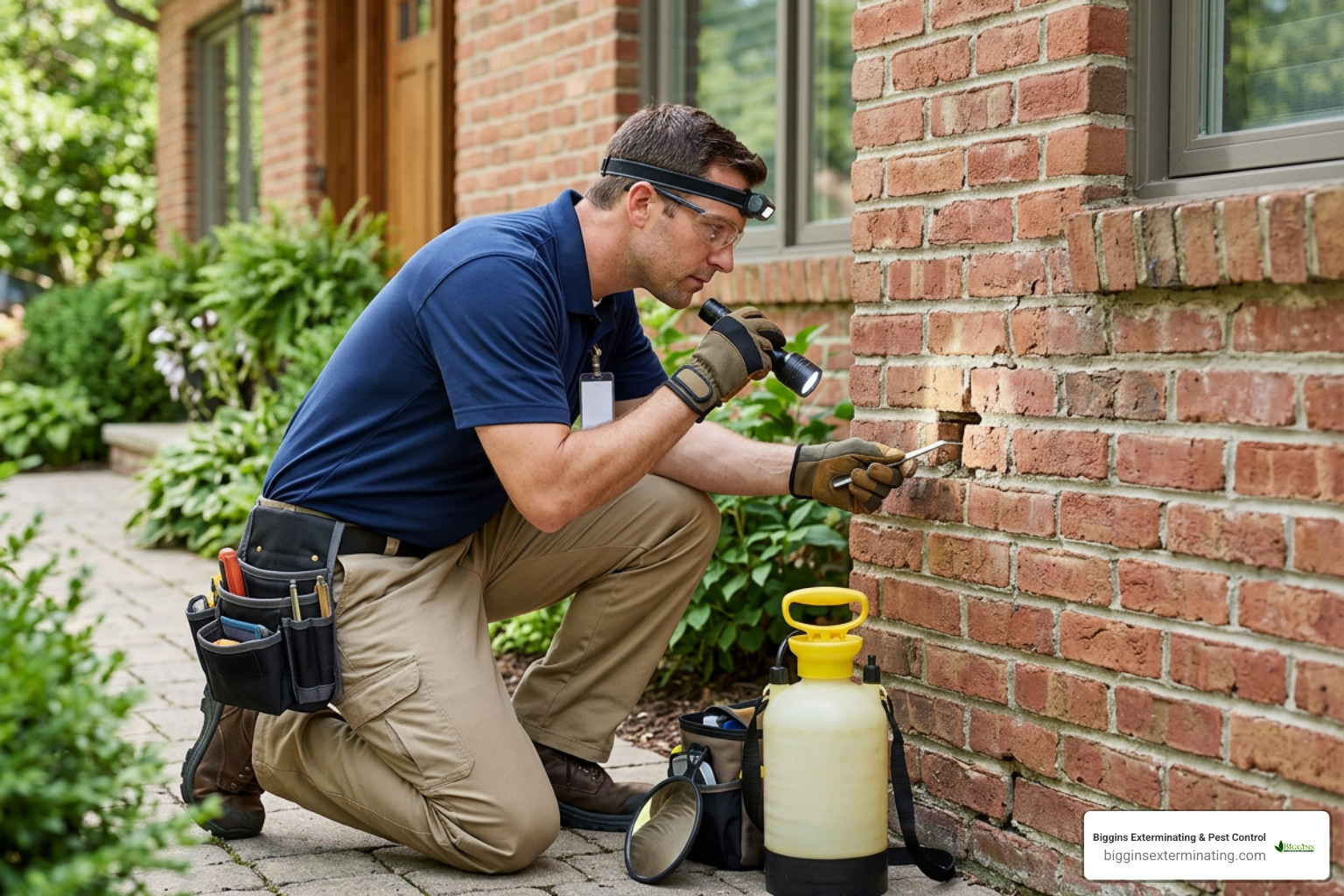
The first step in any successful eviction plan is inspection. You need to determine exactly where the ants are entering and what kind of damage might be occurring.
- Watch the “Commute” Pattern: Grab a flashlight and observe the brickwork at dusk or early night, when ants are most active. Watch where the foraging trails disappear into the brick. This will pinpoint the exact mortar cracks or weep holes they are using.
- Look for Excavated Dust: Pavement ants will push out fine sand and soil. Carpenter ants will leave behind “frass” — piles of coarse sawdust mixed with insect body parts. If you clean these piles away and they reappear within a few days, you have an active nest directly above that spot.
- Listen to the Walls: Large carpenter ant colonies make an audible rustling sound inside the wall as they move and excavate. You can often hear this by placing your ear against the interior drywall or using a stethoscope. Tapping on the wall can stimulate this rustling behavior.
- For more tips on tracking down these hidden nests, read our guide on How to Find a Carpenter Ant Nest.
Professional Solutions for Ants in Brick Wall Voids
Because the heart of the colony is protected by inches of brick and mortar, surface treatments are ineffective. Professional pest control technicians use specialized tools and formulations to target the wall voids directly:
- Void Injection (Drill and Treat): This is one of the most effective methods for treating cavity walls. A technician will drill tiny, inconspicuous holes through the mortar joints (typically every 2 to 3 bricks) or through interior baseboards. A specialized dry insecticidal dust or expanding foam is then injected directly into the wall cavity. This creates a highly effective barrier that coats the nesting area without requiring you to tear down drywall.
- Non-Repellent Insecticides: Unlike consumer sprays that ants can smell and avoid, professional-grade non-repellent liquid treatments (such as fipronil-based products) are completely undetectable to ants. Workers walk through the treated zone, pick up the active ingredient, and pass it throughout the entire colony via grooming and feeding.
- Systemic Gel Baits: Placing slow-acting gel baits near active trails allows the worker ants to do the hard work for us. They eat the sweet or protein-rich bait, carry it back deep into the brickwork, and feed it to the queens and larvae, eliminating the colony from the inside out.
To understand how we customize these treatments for local homes, see The Ultimate Guide to Professional Carpenter Ant Removal.
Why DIY Treatments Often Fail
We often meet homeowners in Billerica and Woburn who have spent weeks trying to fight ants in brick wall structures using store-bought sprays or home remedies. Here is why those DIY attempts usually fall short:
- The “Iceberg” Effect: A typical aerosol spray only kills the 10% of the colony that is currently foraging on the outside of the brick. The remaining 90%, including the queens and developing larvae, remain completely safe deep inside the wall.
- Colony Budding: Certain ant species, like pavement ants, will react to harsh chemical sprays by splitting their colony. When they sense a threat, the queens will scatter in different directions, creating multiple new satellite nests inside your walls and making the infestation much wider and harder to control.
- Sealing Too Early: A common mistake is using mortar or caulk to plug up a hole as soon as you see ants coming out of it. If you seal the entry point while the colony is still alive, you simply trap them inside. They will quickly find or chew a new exit route — which is often inside your living room, kitchen, or electrical outlets.
- To learn how to permanently eliminate these colonies without causing them to scatter, read our article on How to Get Rid of Carpenter Ant Nests Forever.
Frequently Asked Questions
Can ants cause structural damage to brick walls?
Pavement ants and other small masonry-nesting ants cannot chew through solid brick or cured concrete. However, over several years, their constant excavation of loose sand and aging mortar can weaken the joints, leading to water intrusion and accelerated crumbling.
The real structural threat comes from carpenter ants. If your home has a brick veneer over wood framing, carpenter ants will move from the brick cavity into the structural wood studs, floor joists, and sheathing. Under favorable conditions, they can excavate wood at rates of up to 1 inch per week, eventually causing thousands of dollars in structural damage.
How do I know if the ants are carpenter ants?
You can identify carpenter ants by their size and the debris they leave behind. Carpenter ants are much larger than pavement ants, measuring between 1/4 and 1/2 inch in length. They are typically dull black.
The most definitive sign is their “frass.” Because carpenter ants do not eat wood, they must push their nesting debris out of the galleries. If you find piles of coarse sawdust containing shredded insect parts and empty pupal cases near your baseboards or brick exterior, you are dealing with carpenter ants.
What is the average cost of professional ant extermination?
Based on publicly available internet data, the average cost of professional ant extermination ranges widely depending on the severity of the infestation, the size of the structure, and the specific species involved.
A standard localized treatment for a minor pavement ant issue might range from $150 to $350, while an extensive, multi-step structural treatment for a massive carpenter ant infestation nesting deep within wall voids can range from $450 to $1,200 or more. Please note that these are average industry costs based on public internet data and do not represent Biggins Exterminating’s actual pricing.
Conclusion
Dealing with ants in brick wall voids can be incredibly frustrating. Because these clever pests nest deep within the structural cavities of your home, surface sprays and quick DIY fixes simply cannot reach the heart of the colony.
At Biggins Exterminating Co., we believe in doing things the right way. We are a local, family-owned and operated pest control company with over 40 years of trusted, high-quality service right here in Massachusetts. We don’t believe in forcing our customers into expensive, unnecessary yearly contracts. Instead, we offer reliable, contract-free services backed by solid warranties to ensure your complete satisfaction.
If you live in Andover, Bedford, Billerica, Burlington, Lexington, North Reading, Tewksbury, Wilmington, or Woburn, and you’re tired of watching ants march across your brickwork, let us take care of it for you.
Contact us today to schedule your inspection, and let our family help protect yours. Learn more about our customized solutions by visiting our Effective Ant Control page.
