Why a Carpenter Ant Professional Service Is Worth It Before the Damage Gets Worse
Getting a carpenter ant professional service is the most effective way to protect your home from one of the most destructive insects in Massachusetts. Carpenter ants don’t eat wood — they tunnel through it to build nests, quietly weakening your home’s structure over months or years before most homeowners even notice.
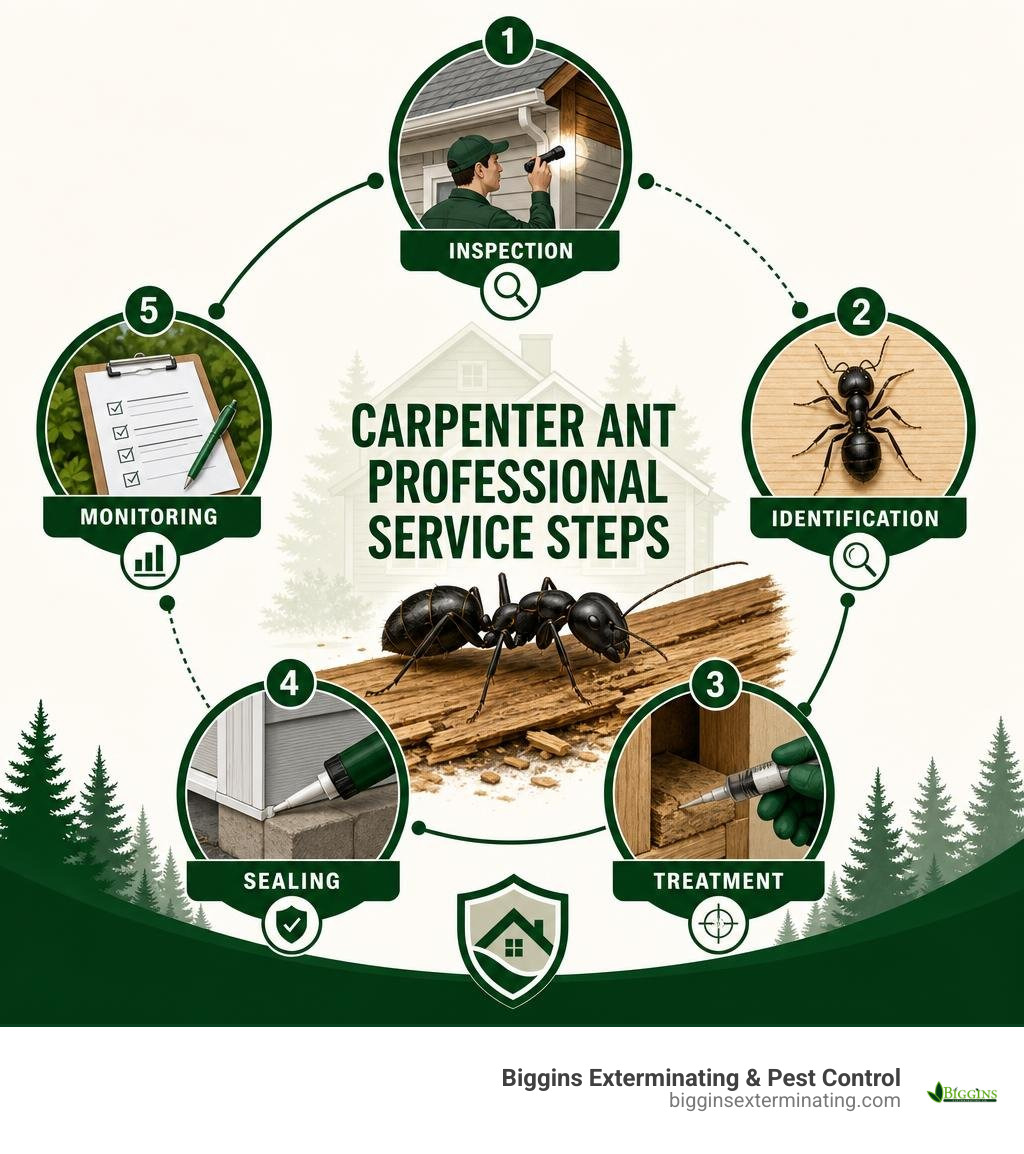
Here’s what a carpenter ant professional service typically includes:
- Thorough inspection — locating parent and satellite colonies inside and outside your home
- Species identification — confirming carpenter ants vs. other ant species
- Targeted treatment — baits, non-repellent insecticides, and dust applications in wall voids
- Entry point sealing — preventing future access
- Follow-up monitoring — confirming the colony is fully eliminated
If you’re seeing large black ants indoors, piles of fine sawdust near wood surfaces, or hearing faint rustling inside walls — especially at night — there’s a good chance a colony is already active in your home. The longer you wait, the more extensive the damage and the more costly the repair.
Carpenter ants are particularly common in Massachusetts, where wooded surroundings, moisture, and older home construction create ideal conditions for infestations throughout the warmer months.
I’m Stephen Biggins, owner of Biggins Exterminating Co., a family-owned Massachusetts pest control company serving Wilmington and surrounding communities since 1982. With over 40 years of hands-on experience providing carpenter ant professional service to homeowners across the region, I’ve seen how quickly a small ant problem can become a serious structural one. Let’s walk through everything you need to know to protect your home.
Carpenter ant professional service terms simplified:
Understanding the Threat: Carpenter Ants vs. Other Pests
To properly address an ant issue in your home, we must first understand exactly what we are dealing with. In Massachusetts, we encounter several ant species, including pavement ants, odorous house ants, and the notorious carpenter ant.
Pavement ants are tiny—about an eighth of an inch long—and typically nest under driveways or concrete slabs. Odorous house ants are also small and are famous for emitting a sweet, rotten-coconut-like smell when crushed. Carpenter ants, on the other hand, are the giants of the local ant world. Adult workers range from a quarter-inch to upwards of a half-inch in length, while the queens can easily reach an inch. They are typically jet-black, though some species found in New England can have a reddish-brown thorax.
The most critical distinction, however, is how they interact with your home. Unlike termites, which actually eat and digest wood cellulose, carpenter ants do not consume wood. Instead, they are wood excavators. They use their powerful mandibles to chew through wood, carving out clean, smooth galleries and tunnels to expand their nesting sites.
Because their habits and the risks they pose are so different from other pests, mistaking them for termites or harmless house ants can lead to costly delays.
| Feature | Carpenter Ants | Termites |
|---|---|---|
| Body Shape | Pinched waist (three distinct body segments) | Broad waist (thick, uniform body) |
| Antennae | Elbowed or bent | Straight and beaded |
| Wings (Swarmers) | Front wings are longer than hind wings | All four wings are of equal size and shape |
| Wood Interaction | Excavate smooth tunnels; do not eat wood | Consume wood; leave mud tubes and rough damage |
| Evidence Left Behind | Piles of clean, sawdust-like “frass” | Mud tubes, soil in wood, hollowed-out timber |
This excavation process is what makes carpenter ants so hazardous to residential properties. Over time, as a colony grows, they hollow out structural supports, window sills, door frames, and subfloors. For more information on how these pests operate and how they are safely removed, explore The Ultimate Guide to Professional Carpenter Ant Removal.
Signs of an Active Infestation in Your Home
Because carpenter ants do their dirtiest work hidden inside wall voids and structural timbers, you have to know what clues to look for. During the warm summer months of July 2026, active colonies are at their peak foraging and nesting capacity, making this the most likely time for you to spot the warning signs.

Keep an eye and ear out for these four telltale signs of an active infestation:
- Sawdust-Like Frass: Because carpenter ants do not eat wood, they have to put the carved-out wood somewhere. They push this debris out of small kick-out holes in the wood. This material, known as “frass,” looks like fine piles of sawdust and often contains insect parts, dirt, and dead ants. You will typically find these piles on the floor beneath door frames, window sills, or along baseboards.
- Faint Chewing Sounds: If a colony has established itself inside your walls, you might actually hear them. When the house is quiet at night, a mature colony can produce a soft, rustling or crinkling sound—similar to cellophane being crinkled—as they chew through wood and move through their galleries.
- Winged Swarmers Indoors: Seeing large, winged ants inside your home is a major red flag. These are “swarmers” (winged reproductives) looking to start new colonies. Because carpenter ant colonies typically take about five years to mature before they start producing swarmers, seeing them indoors almost always indicates that a well-established, mature parent nest is located somewhere inside or very close to your home’s structure.
- Foraging Workers in Living Areas: While seeing one or two ants outdoors is normal, seeing large black ants consistently marching across your kitchen counters, bathroom floors, or sinks means they have found a reliable pathway into your living space.
When to Seek a Carpenter Ant Professional Service
It is easy to downplay a few ants in the kitchen, but a carpenter ant infestation is rarely a localized issue. These pests operate using a network of nests. The main “parent” colony—which houses the queen, eggs, and young larvae—requires high moisture levels to survive and is usually located outdoors in decaying tree stumps, firewood piles, or rotting logs.
Once the parent colony grows, they establish “satellite” colonies. These satellite nests contain thousands of worker ants, pupae, and mature winged swarmers. Because these older ants do not require the same high humidity levels, they easily migrate indoors, nesting in dry wall voids, hollow doors, insulation, and structural framing.
If you are noticing any of the signs listed above, it is time to call in a carpenter ant professional service. Trying to ignore the problem or waiting for winter to resolve it will only lead to further wood excavation and compromise your home’s structural integrity. To learn more about how we target these complex colony networks, read our guide on Pest Control for Carpenter Ants.
Why DIY Treatments Fail and Professional Solutions Succeed
When homeowners spot ants, their first instinct is often to head to the local hardware store for a can of chemical spray. Unfortunately, when dealing with carpenter ants, DIY sprays almost always make the problem worse.
Most over-the-counter sprays are “repellent” insecticides. When you spray them on visible foraging ants, it kills a few on contact, but the surviving ants quickly detect the chemical barrier. In response, the colony undergoes a process called “budding” or scattering. The ants panic, cut off contact with the sprayed area, and split into multiple smaller satellite nests deeper inside your walls, spreading the infestation to new parts of your home.
A carpenter ant professional service succeeds because we use advanced, non-repellent liquid treatments and specialized baiting systems. Non-repellent products are completely undetectable to the ants. When foraging workers walk through the treated perimeter, they do not die immediately. Instead, they carry the active ingredient back to the hidden nests on their bodies.
Through a natural social behavior called trophallaxis (the sharing of food and fluids between colony members), the insecticide is passed systematically from worker to worker, eventually reaching the queen. Once the queen is eliminated, the entire colony collapses.
Furthermore, professional technicians have the specialized equipment required to inject insecticidal dusts directly into wall voids, electrical outlets, and plumbing penetrations where satellite nests hide, ensuring complete eradication without scattering the pests.
What to Expect From a Carpenter Ant Professional Service
When we arrive at your property, we don’t just start spraying. Effective extermination requires a strategic, scientific approach.
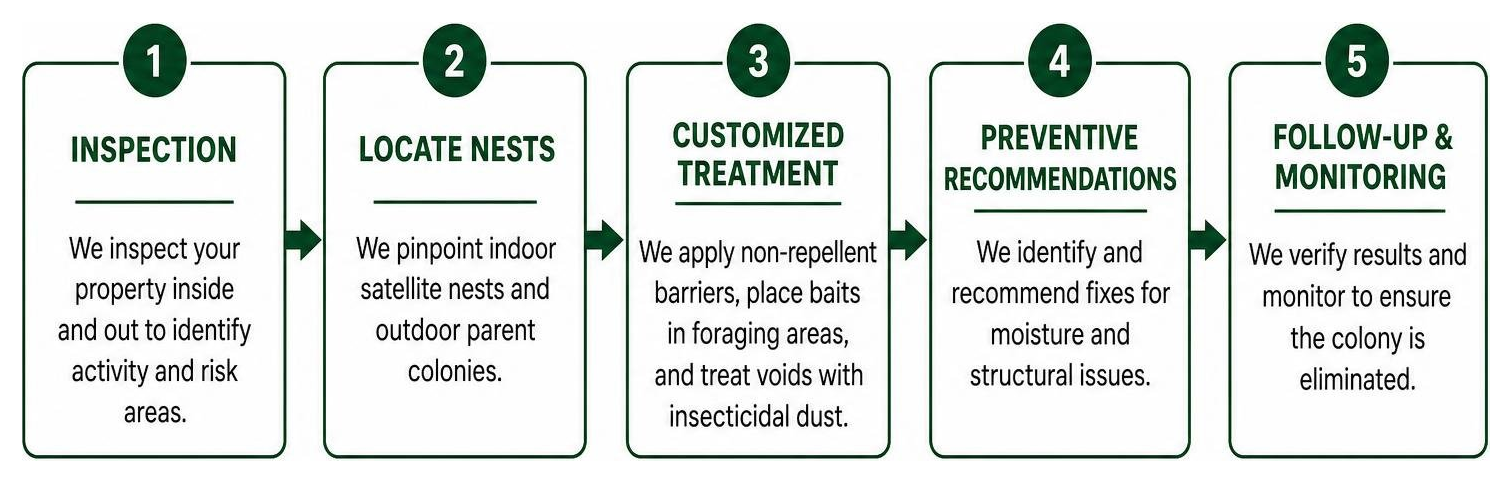
Our professional process includes:
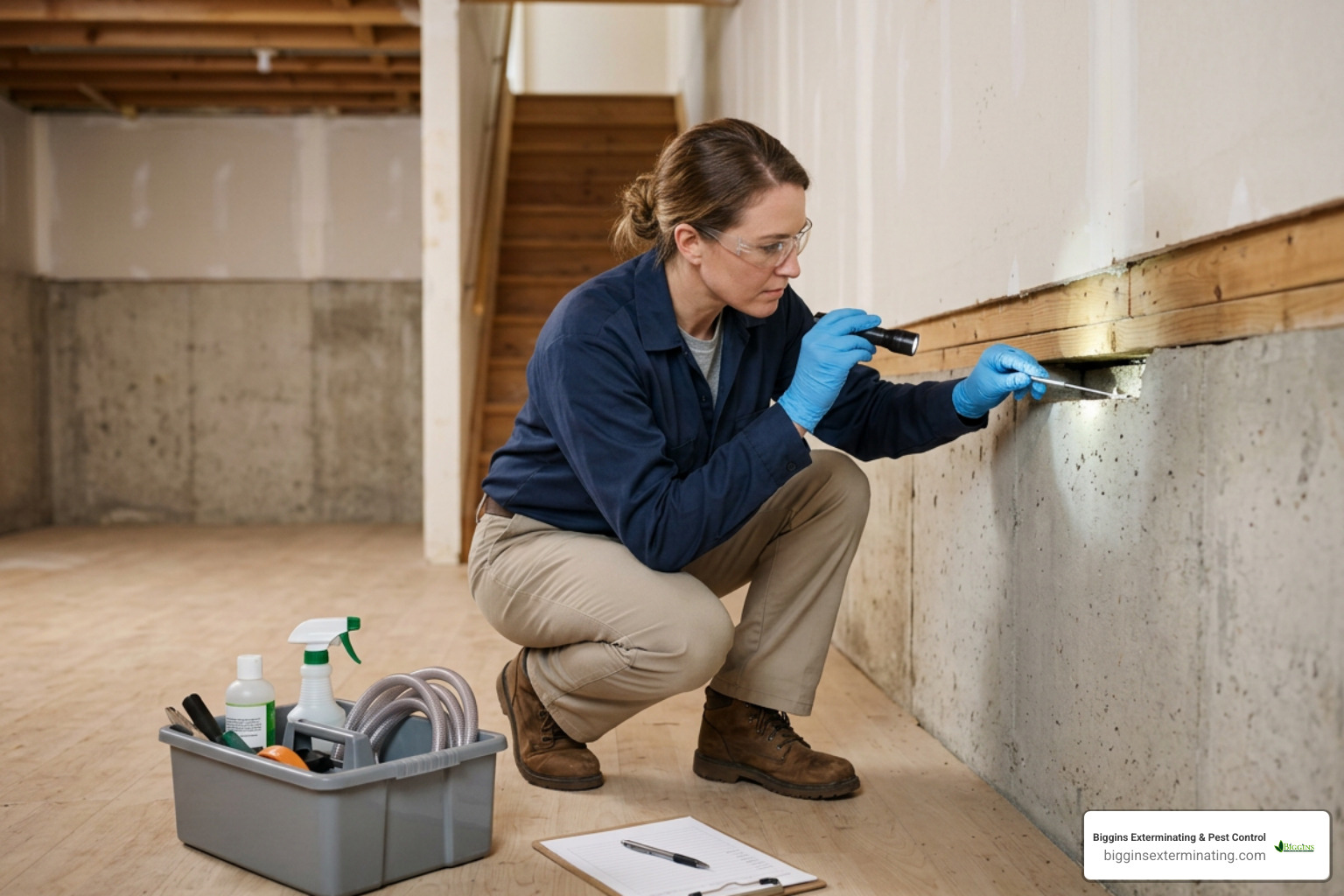
- A Meticulous Inspection: We interview you to understand where you’ve seen activity, and then we trace ant trails back to their source. We inspect both the interior and exterior, looking at high-risk areas like crawl spaces, attics, deck attachments, and trees touching the roofline.
- Locating the Nests: We pinpoint the location of both the indoor satellite nests and the outdoor parent colonies.
- Customized Treatment Plan: We design a targeted treatment plan using non-repellent liquid barriers around your foundation, specialized baits in foraging pathways, and dust applications in dry wall voids.
- Preventive Recommendations: We identify structural issues, such as roof leaks, plumbing drips, or wood-to-soil contact, that are attracting the ants in the first place, helping you keep them out for good.
For a deeper dive into how we locate and eliminate nests, check out our resource on the Best Exterminator for Carpenter Ants.
Choosing a Carpenter Ant Professional Service in Massachusetts
When it comes to protecting your home, local knowledge matters. Massachusetts has unique weather patterns, older historic homes, and heavily wooded residential areas that make our local communities prime real estate for carpenter ants.
At Biggins Exterminating & Pest Control, we are a family-owned and operated company with over 40 years of local experience. We understand the specific construction styles and pest pressures of our service areas. We are proud to serve the following Massachusetts towns:
- Wilmington, MA: Our home base. If you need local help, look into our specialized carpenter-ant-control-treatment-exterminator-wilmington-ma options.
- Andover, MA: Surrounded by beautiful woods, Andover homes frequently face heavy carpenter ant pressure. Learn about our local Andover MA Carpenter Ant Treatments $20 OFF services.
- Billerica, MA: Protect your property with our targeted Billerica MA Carpenter Ant Treatments $20 OFF – Security Pest Control plans.
- Burlington, MA: Keep your suburban home safe with our carpenter-ant-control-treatment-exterminator-Burlington-ma programs.
- Lexington, MA: Historic Lexington homes require careful, experienced care. See our carpenter-ant-control-treatment-exterminator-lexington-ma – Security … solutions.
- North Reading, MA: We offer specialized, local protection including North Reading MA Carpenter Ant Treatments $25 OFF .
- Tewksbury, MA: Don’t let ants undermine your structure. Check out our Carpenter Ant Extermination Tewksbury MA – NW Pest Control options.
- Woburn, MA & Bedford, MA: We provide comprehensive residential inspections and treatments across both of these active communities.
We also work in tandem with trusted regional partners, such as Discreet Pest and Wildlife Services, Inc. , to ensure local homeowners have access to the highest level of pest and wildlife management. Ready to secure your home? Schedule a Carpenter Ant Pest Control Inspection with our team today.
The Cost of Professional Extermination and Prevention
When considering a carpenter ant professional service, it is helpful to understand the general market costs. Based on publicly available internet data, the average cost for a professional carpenter ant treatment can vary widely depending on the size of your home, the severity of the infestation, and whether the treatment is a one-time service or part of an ongoing pest management plan.
On average, a standard professional treatment ranges from $250 to $450 for minor, localized infestations. However, because carpenter ant colonies can be incredibly extensive—sometimes involving multiple satellite nests hidden deep within structural walls—severe or long-standing infestations requiring comprehensive wall-void injections, extensive exterior perimeters, and multi-visit warranties can range anywhere from $150 to $1,500 or more.
Please note: These figures are average market costs based on publicly available internet data and do not represent the actual pricing of Biggins Exterminating.
To keep your long-term costs down, prevention is key. Once we eliminate the active colonies, we recommend taking the following steps to keep your home ant-free:
- Eliminate Moisture: Fix roof leaks, dripping pipes, and clogged gutters immediately. Carpenter ants are highly attracted to soft, moisture-damaged wood.
- Trim Vegetation: Keep tree branches, shrubs, and bushes trimmed back at least 6 to 12 inches from your roof and siding. Ants use these branches as bridges to bypass ground-level treatments.
- Seal Entry Points: Use silicone caulk to seal gaps around utility lines, window frames, doors, and foundation cracks.
- Manage Outdoor Wood: Store firewood at least 20 feet away from your home and elevate it off the ground. Remove old tree stumps and decaying logs from your yard.
For more strategic advice on keeping these wood-destroying pests out of your home, read our guide on Pest Control for Carpenter Ants.
Frequently Asked Questions About Carpenter Ants
Navigating a pest issue can bring up a lot of questions. Here are some of the most common inquiries we receive from local homeowners.
Do carpenter ants bite humans and are they dangerous?
Yes, carpenter ants can bite. Because of their large size and powerful mandibles (which they use to chew through solid wood), their bites can break human skin and be quite painful. However, they do not possess a venomous sting, and they do not carry diseases. Their bites are generally harmless and can be treated with basic first aid. The real danger they pose is not to your physical health, but to the structural integrity of your home.
How long does it take to eliminate a carpenter ant colony?
With professional, non-repellent treatments, you will typically see a drastic reduction in ant activity within 24 to 48 hours. However, completely eliminating an entire colony—including the queen and hidden satellite nests—usually takes anywhere from a few days to a couple of weeks. The exact timeline depends on the size of the colony, the number of satellite nests, and how easily the ants can access the bait or treated zones.
Are professional carpenter ant treatments safe for pets?
Yes, when applied by licensed professionals. We utilize highly targeted application methods, placing baits and dusts deep inside wall voids and cracks where pets cannot reach them. For perimeter liquid treatments, we use low-toxicity products that are completely safe for dogs and cats once the application has fully dried (typically within 1 to 2 hours). We always walk you through the safety precautions before we begin any treatment.
Conclusion
A carpenter ant infestation is not a problem that will solve itself. Left untreated, these industrious pests will continue to excavate the wooden framing of your home, leading to sagging floors, warped door frames, and expensive structural repairs.
At Biggins Exterminating & Pest Control, we believe in providing honest, high-quality, and reliable service. As a local, family-owned company with over 40 years of experience serving Wilmington and the surrounding Massachusetts communities, we don’t force you into long-term contracts. We stand behind our work, offering robust warranties and ensuring your complete satisfaction.
Don’t let these destructive pests make themselves at home. Schedule a Carpenter Ant Pest Control Inspection with us today, and let our family protect yours.