Why a Carpenter Ant Monitoring Program Can Save Your Home
A carpenter ant monitoring program is a structured, ongoing inspection process that detects carpenter ant activity early — before these wood-excavating pests cause serious structural damage to your home.
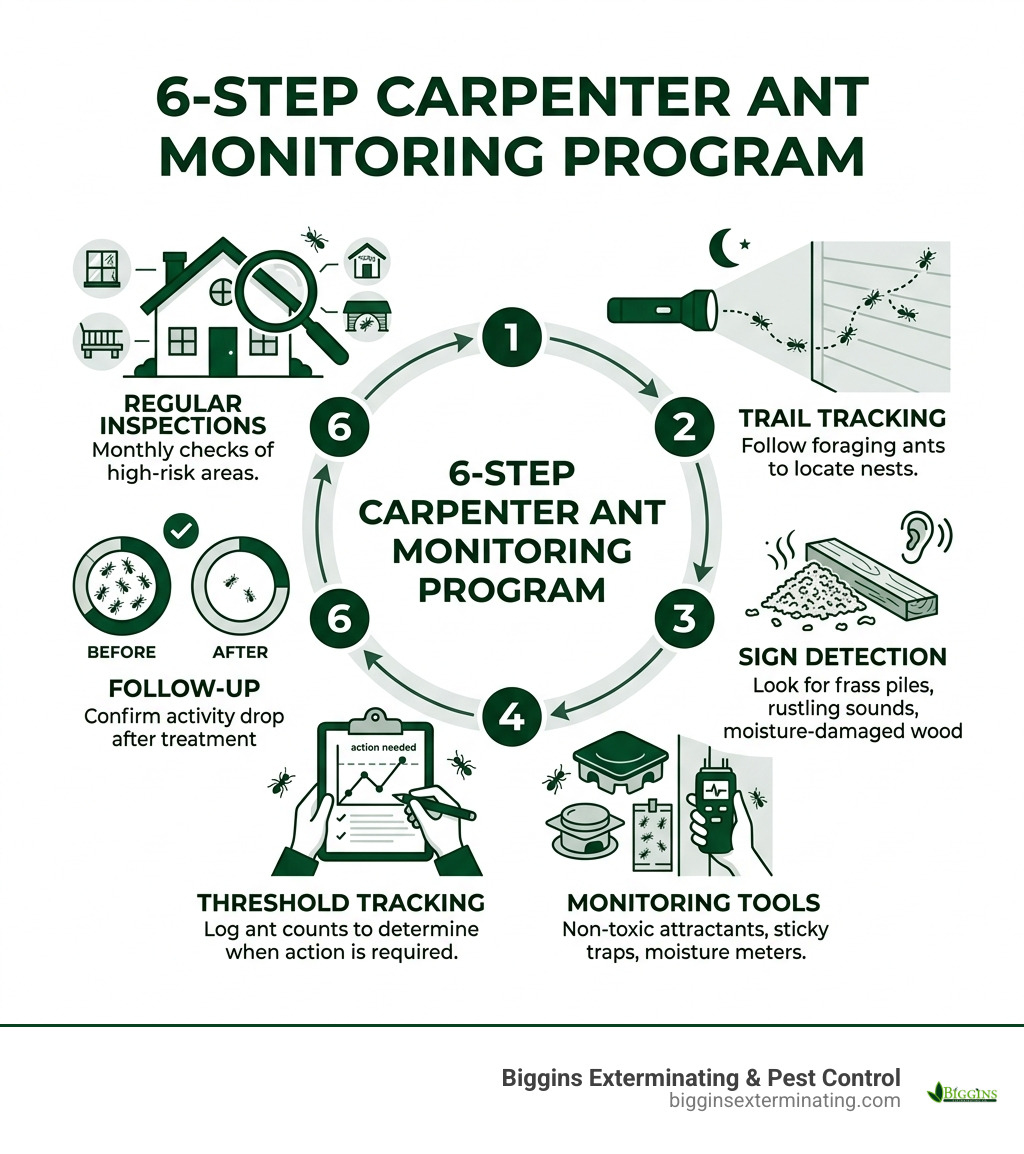
Here’s what an effective program includes:
- Regular inspections — Monthly checks of high-risk areas (windows, eaves, decks, crawl spaces)
- Trail tracking — Following foraging ants, especially after sundown, to locate nests
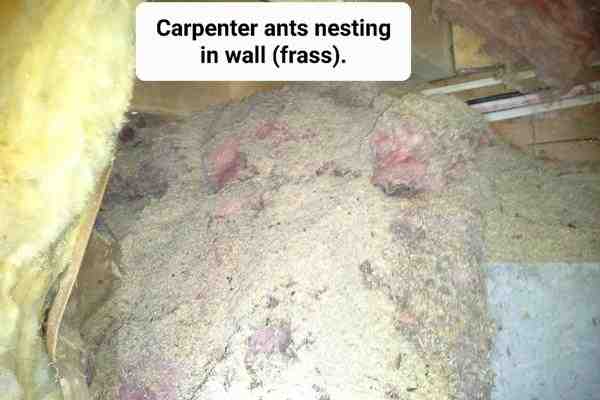
- Sign detection — Looking for sawdust piles (frass), rustling sounds, and moisture-damaged wood
- Monitoring tools — Non-toxic attractants, sticky traps, and moisture meters to pinpoint activity
- Threshold tracking — Logging ant counts to know when action is needed
- Follow-up evaluation — Confirming that activity has dropped after treatment
Carpenter ants are one of the most destructive pests a Massachusetts homeowner can face. Unlike termites, they don’t eat wood — they excavate it, carving out smooth galleries to build their nests. The result is the same: weakened beams, damaged window frames, and compromised structural integrity.
What makes them especially tricky is that a mature colony can hold up to 10,000 individuals, yet only 10–15% of workers ever venture outside the nest at any given time. Most of the damage happens out of sight, deep inside your walls or beneath your roof eaves — long before you notice anything is wrong.
In Massachusetts, carpenter ants become active in spring, typically emerging as early as late March or April. If you’re seeing them inside your home right now, there’s a good chance a colony has already been established nearby — possibly for years.
Early detection is everything. The longer a colony goes undetected, the more expensive the repairs.
I’m Stephen Biggins, owner of Biggins Exterminating Co., a family-owned pest control company serving Wilmington, MA and surrounding communities since 1982 — and over four decades of hands-on experience has taught me that a proactive carpenter ant monitoring program is far more effective than waiting for an infestation to become obvious. In the sections below, I’ll walk you through exactly how to build and maintain one that works.
Carpenter ant monitoring program basics:
Understanding the Threat: Identification and Biology
To run a successful carpenter ant monitoring program, you first need to know exactly what you are looking for. We often see homeowners in Wilmington and Burlington mistake these pests for termites, but the differences are clear once you know the markers.
Identification: Ants vs. Termites
The most important step is learning How to Distinguish Carpenter Ants from Termites. Carpenter ants have a distinct “pinched” waist with a single node (a small bulge) between the thorax and abdomen. Their backs (thorax) are evenly rounded and smooth, whereas other ants might have uneven or bumpy profiles.
Another key identifier is their antennae, which are “elbowed” or bent. Termites, by contrast, have straight, bead-like antennae and a broad waist. If you see wings, check the size: carpenter ants have two pairs of wings of unequal length, while termite wings are all the same size. For more on wings, see our guide on Do Carpenter Ants Have Wings.
Biology and Colony Structure
According to the Biology and Management of Carpenter Ants, these ants are polymorphic, meaning the workers in a single colony come in various sizes, ranging from 1/4 to 5/8 of an inch.
A colony doesn’t just appear overnight. It typically takes 6 to 10 years for a colony to reach maturity, at which point it contains over 2,000 workers and begins producing “swarmers” (winged reproductives). These swarmers are often the first sign a homeowner sees, but they indicate a very well-established nest. A fully mature colony can house up to 10,000 individuals.
One of the most fascinating—and frustrating—parts of their biology is their nocturnal nature. Carpenter ants are most active at night, emerging about 15 minutes after sundown. They are incredible foragers, traveling up to 200 yards from their nest to find food, often following the same chemical trails year after year.
Step-by-Step Guide to a Carpenter Ant Monitoring Program
Monitoring isn’t just about looking for a stray ant on the kitchen counter. It’s a systematic search for the “source.” To effectively Find Carpenter Ant Nest locations, you have to understand their nesting hierarchy.
Parent Nests vs. Satellite Colonies
Carpenter ants usually operate a “hub and spoke” system. The parent nest is almost always outdoors in a high-moisture environment, like a rotting tree hole, stump, or stack of firewood. This is where the queen lives and where the eggs are laid.
Satellite colonies are what we usually find inside Massachusetts homes. These don’t require the same high moisture levels as the parent nest because they only house older larvae, pupae, and workers. They are often found in wall voids, hollow doors, or behind insulation.
How to Monitor Like a Pro
- Moisture Detection: Use a moisture meter to find “hot spots.” Carpenter ants love damp wood because it’s easier to excavate. Focus on chimneys, window sills, and under sinks.
- Trail Following: If you see an ant, don’t squish it! Follow it. Using the Carpenter Ant Baits Complete Guide, you can use non-toxic attractants like honey or sugar water to encourage them to show you their trail.
- Visual Signs: Look for “frass.” This is a sawdust-like material that consists of wood shavings and insect parts. Since they don’t eat the wood, they have to kick it out of their tunnels, creating small piles.
- Acoustic Monitoring: In a quiet house, you can actually hear a large colony. They make a dry, rustling sound, often described as “crinkling cellophane,” as they move within the wood.
Comparison: Indoor vs. Outdoor Nesting Signs
| Feature | Indoor Satellite Nest | Outdoor Parent Nest |
|---|---|---|
| Primary Sign | Swarmers emerging from walls | Large ants on tree trunks |
| Material | Frass (sawdust) near baseboards | Wood shavings at base of trees |
| Moisture | Leaky pipes, window condensation | Rotting stumps, firewood, tree holes |
| Activity | Late-night foraging in kitchens | Permanent trails through grass |
Establishing Your Carpenter Ant Monitoring Program Schedule
Timing is everything in Massachusetts pest control. As of April 2026, we are right in the middle of the peak emergence season.
- Spring (March – June): This is the high-alert phase. Swarmers are most likely to appear now. You should conduct a thorough inspection at least once a month.
- Summer (July – September): Foraging is at its peak. This is the best time for “night watches.” Step outside 15 minutes after sundown with a flashlight and inspect the foundation and large trees.
- Winter (October – February): While they usually hibernate, seeing an ant indoors during a Massachusetts winter is a major red flag. It almost certainly means you have a Carpenter Ant Infestation in House that has found a warm enough spot to stay active.
Evaluating the Success of Your Carpenter Ant Monitoring Program
How do you know if your carpenter ant monitoring program is working? We use a “threshold” system.
In an Integrated Pest Management (IPM) approach, we generally use the 10-ant rule. If you see 10 or more ants in a specific trail or area, or if you see any winged swarmers indoors, the threshold for professional treatment has been met.
Success is measured by:
- Reduction in sightings: A steady decline in foraging ants over 30 to 60 days.
- Bait Consumption: If you are using baits, seeing the ants take the bait back to the nest is a win.
- Zero Swarmers: The absence of winged ants the following spring is the ultimate sign of a dead colony.
For more on long-term management, check out our Exterminate Carpenter Ants Ultimate Guide.
Advanced Monitoring Techniques and Tools
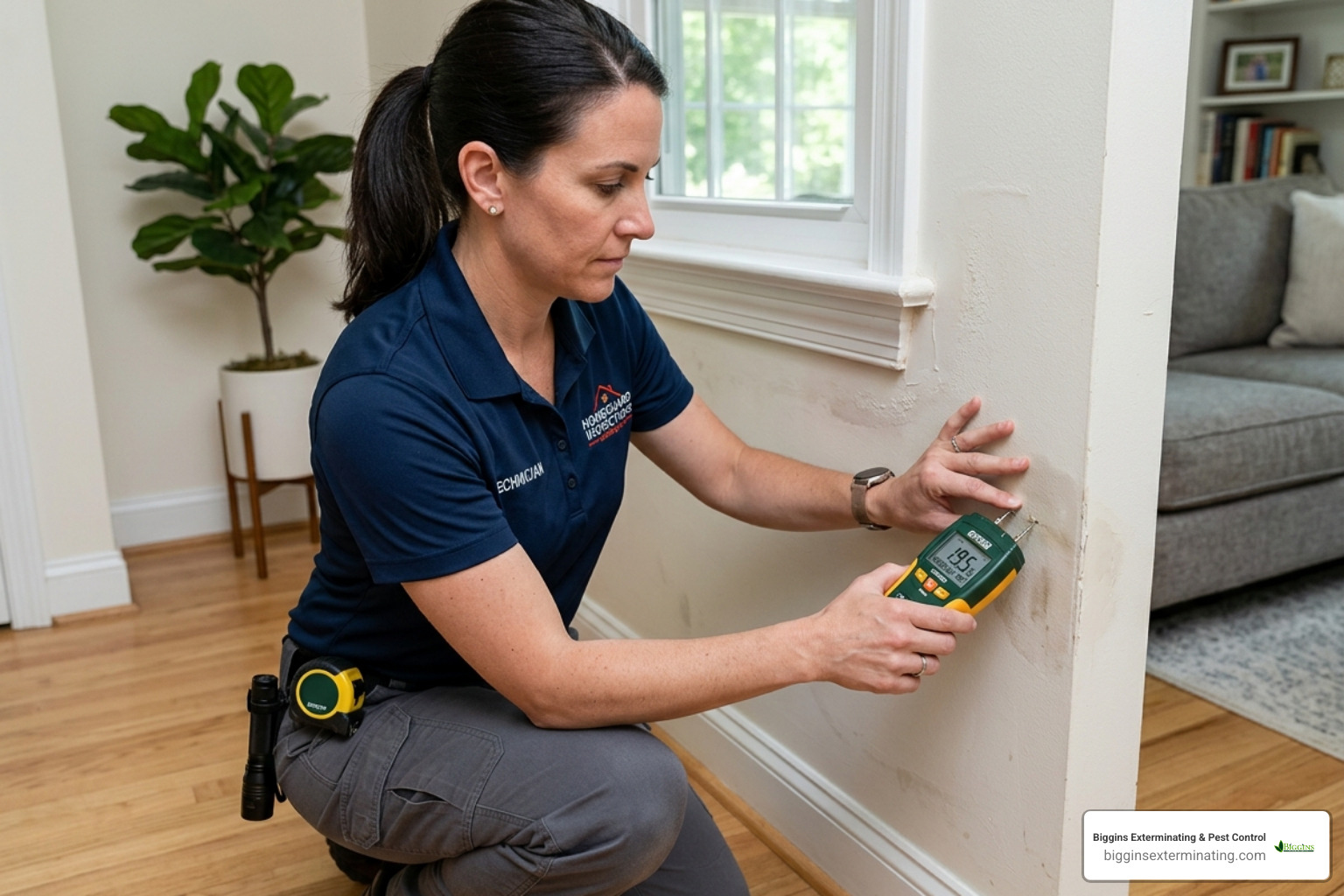
At Biggins Exterminating, we use professional-grade tools that go beyond the naked eye. If you are serious about your carpenter ant monitoring program, consider these additions:
- Moisture Meters: Essential for finding the damp wood that attracts parent and satellite nests.
- Thermal Imaging: This can sometimes detect the heat signatures of large colonies hidden behind drywall.
- Acoustic Sensors: High-sensitivity microphones that can pick up the “cellophane” rustling sounds of a nest in a wall void.
- Pheromone Lures & Sticky Traps: While carpenter ants are finicky, placing sticky traps along suspected “man-made guides” (like the edge of a foundation or a baseboard) can help you track their population density.
- Honey Cards: Placing a small amount of honey or jelly on a card near a suspected entry point is a classic monitoring trick to see if foragers are active in that specific area.
If you have Ants in Attic Insulation, these tools are particularly helpful, as it’s often difficult to see trails in thick fiberglass or cellulose.
Integrating Monitoring into an IPM Strategy
Monitoring is only one piece of the puzzle. The goal of a carpenter ant monitoring program is to inform your prevention and treatment steps. This is the core of Integrated Pest Management (IPM).
Prevention Steps
- Moisture Control: Fix leaky gutters, dripping pipes, and grading issues.
- Vegetation Trimming: Ensure no tree branches or shrubs touch your house. Ants use these as “bridges” to bypass your foundation.
- Firewood Storage: Store firewood at least 20 feet away from the house and up off the ground.
- Sealing Entry Points: Use caulk to seal gaps where utility lines enter the home.
For a deeper dive, read our Carpenter Ant Prevention Ultimate Guide.
The IPM Workflow
- Inspect: Use your monitoring schedule to find the problem.
- Identify: Confirm it’s a carpenter ant and not a termite.
- Exclude: Seal the home and fix moisture issues.
- Treat: Use targeted baits or dusts rather than broad sprays.
- Monitor: Continue your program to ensure the ants don’t return.
Frequently Asked Questions
What are the common mistakes in carpenter ant monitoring?
The biggest mistake we see in places like Andover and Lexington is homeowners only looking for ants during the day. Carpenter ants are 10 to 20 times more active at night! Another mistake is “spray and pray.” If you just spray the ants you see, you are only killing 10% of the colony. You must find the nest. Finally, don’t ignore swarmers. If you see winged ants indoors, you have a structural problem that needs immediate attention.
How much does a professional monitoring program cost?
Based on publicly available internet data, the average cost for a professional carpenter ant monitoring program and maintenance plan ranges from $150 to $600 annually. However, for complex properties or severe historical infestations, high-end specialized monitoring can exceed $1,800. Please note these are market averages and not the specific pricing of Biggins Exterminating.
When should I call a professional for monitoring?
If you see sawdust (frass) appearing in the same spot repeatedly, if you see swarmers (winged ants) inside your home, or if you can hear rustling in your walls, it’s time to call in the experts. Professional Carpenter Ant Pest Control Products are often more effective and safer than over-the-counter options when applied by a licensed technician.
Conclusion
A carpenter ant monitoring program isn’t just a “set it and forget it” task—it’s an investment in your home’s future. By catching activity early, you avoid the structural repairs that can cost thousands of dollars.
At Biggins Exterminating & Pest Control, we’ve spent over 40 years protecting homes in Wilmington, MA and the surrounding North Shore and Merrimack Valley communities. As a family-owned business, we pride ourselves on being reliable and effective. We don’t believe in locking our neighbors into long-term contracts; instead, we earn your trust through quality service and real results.
Whether you are in Andover, Bedford, Billerica, Burlington, Lexington, North Reading, Tewksbury, Wilmington, or Woburn, we are here to help you secure your home against carpenter ants.
Ready to start your professional monitoring journey? Carpenter Ant Pest Control is our specialty. Contact us today for an inspection you can count on.