
Why Massachusetts Homes Are Vulnerable to Mice Every Winter
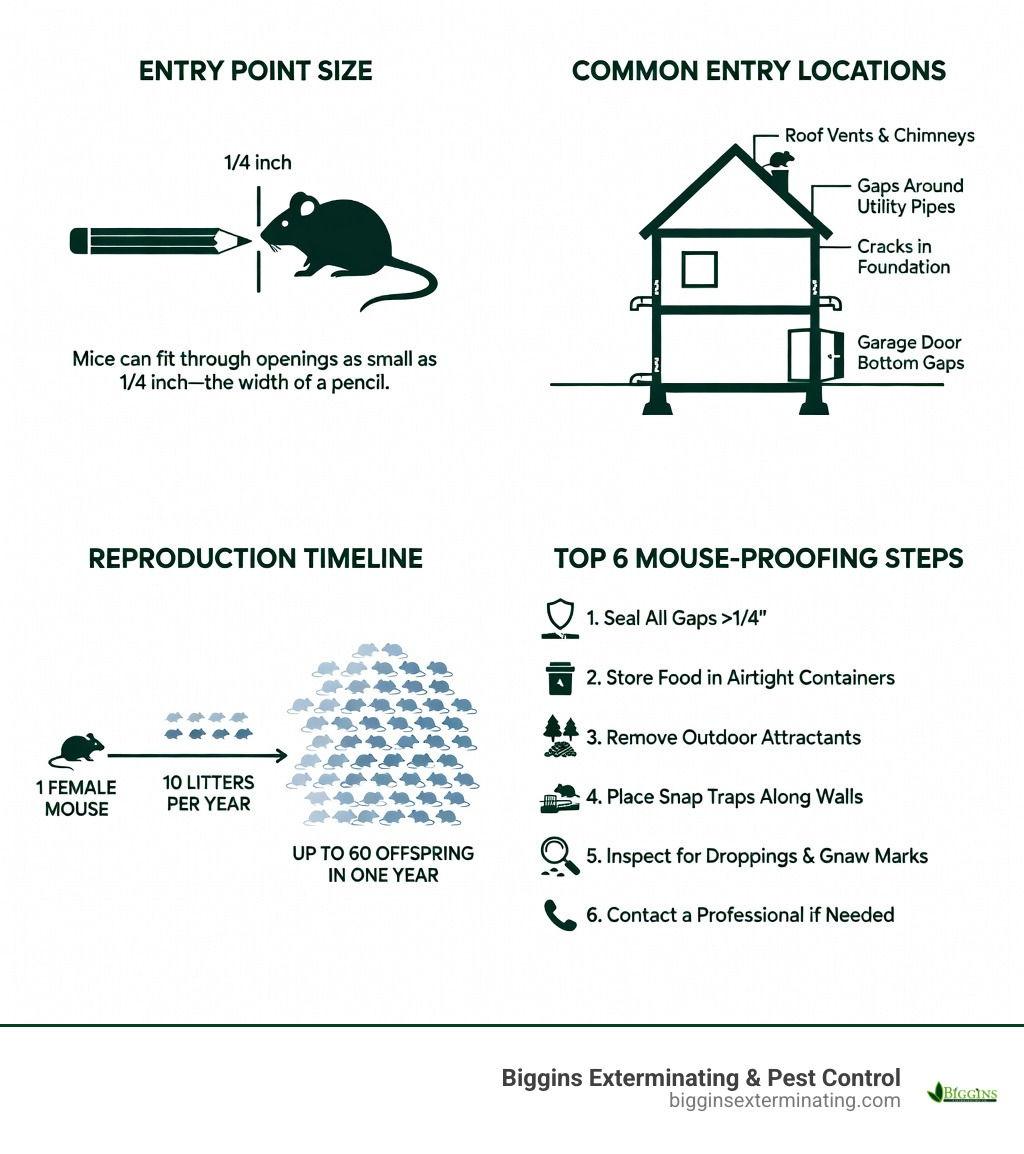
How to mouse proof your house is something every homeowner in Massachusetts should know before the cold weather hits. Here’s a quick summary of the most effective steps:
- Seal all entry points larger than 1/4 inch using steel wool, copper mesh, or hardware cloth
- Eliminate food sources by storing food in airtight containers and securing garbage bins
- Remove outdoor attractants like woodpiles, bird feeders, and overgrown shrubs near the foundation
- Set snap traps along walls in areas where mice are active
- Inspect regularly for new gaps, droppings, or gnaw marks — especially in fall and winter
- Call a professional if signs of infestation persist
When temperatures drop across Wilmington, Burlington, and the rest of Eastern Massachusetts, mice stop being an outdoor problem and start becoming your problem. They’re not picky about how they get in. A crack in your foundation, a gap around a pipe — if it’s bigger than a pencil width, a mouse can squeeze right through.
And once one mouse finds a warm spot with food nearby, more will follow. A single female can produce up to 10 litters a year. That’s a small problem that turns into a big one, fast.
I’m Stephen Biggins, owner of Biggins Exterminating Co., and I’ve spent over 40 years helping Massachusetts homeowners figure out exactly how to mouse proof your house before an infestation takes hold. In this guide, I’ll walk you through every practical step to keep mice out — for good.
Identifying the Signs of a Mouse Infestation
Before you can effectively implement a plan on how to mouse proof your house, you need to know if the “enemy” has already breached the perimeter. Mice are nocturnal, meaning they do most of their heavy lifting while you’re asleep. You might not see them, but they certainly leave a trail.
Common Red Flags
- Droppings: These are usually the first sign. Mouse droppings are about the size of a grain of rice, dark, and pointed at the ends. You’ll often find them in kitchen cabinets, pantries, or along baseboards.
- Gnaw Marks: Mice have teeth that never stop growing, so they chew on everything to keep them filed down. Look for small chew marks on food packaging, wooden baseboards, or even electrical wiring.
- Nighttime Scratching: If you hear faint scurrying or scratching sounds in the walls or ceiling at night, it’s likely not a ghost—it’s a rodent looking for nesting material.
- Musky Odors: An established infestation often comes with a distinct, stale, ammonia-like smell from mouse urine.
- Grease Rubs: Mice tend to follow the same paths along walls. Over time, the oils in their fur leave dark, greasy smudge marks on baseboards and near holes.
- Pet Alerts: If your cat or dog is suddenly obsessed with a specific corner of the kitchen or is pawing at the bottom of the stove, they’ve likely caught a scent you haven’t.
If you are seeing these signs, it’s time to learn more about how to find mice and where they are hiding in your Massachusetts home.

How to Mouse Proof Your House by Sealing Entry Points
The most important lesson in how to mouse proof your house is the “1/4 inch rule.” A mouse can fit through any opening the size of a dime or the width of a standard pencil. If you can poke a pencil into a hole, a mouse can squeeze its way through.
The Exclusion Strategy
To keep them out, we use a process called “exclusion.” This means physically blocking their way in using materials they can’t chew through. While mice can chew through wood, plastic, and even some types of vinyl, they generally can’t get through metal or masonry.
- Steel Wool and Copper Mesh: These are excellent for stuffing into small gaps around pipes or in foundation cracks. Mice hate the feeling of these metals on their teeth and will stop chewing. To make it permanent, we recommend securing the mesh with silicone caulk or spray foam so they can’t simply pull it out.
- Hardware Cloth: For larger vents or openings, use 1/4-inch galvanized hardware cloth (wire mesh).
- Door Sweeps: Many mice simply walk in through the front door—or more accurately, under it. Install heavy-duty, rodent-proof door sweeps on all exterior doors, including the garage.
For more detailed strategies on structural defense, you can read our guide on house mice control. You can also find excellent resources on How to Seal Up to Prevent Rodents from the CDC to ensure your family stays healthy.
Where to Check for Entry Points
Don’t just look at eye level. Mice are world-class climbers and can run up the side of a brick house or scurry across utility lines.
- Kitchen Cabinets: Check behind the kickplates and where the plumbing comes through the floor or wall.
- Appliance Vents: Dryer vents and stove exhausts are common highways for rodents.
- Pipe Penetrations: Look under sinks and behind toilets.
- Attic Soffits and Rooflines: Mice can enter through gaps in the eaves or where different roof sections meet.
- Basement Rim Joists: This is where the wooden structure of your house meets the concrete foundation. It’s a prime spot for cracks to develop.
Key Sealing Materials for Mouse Proofing
When we go out to homes in Wilmington or Woburn, we carry a specific toolkit. If you’re doing this yourself, make sure you have:
- Sheet Metal: Great for patching large holes in siding or floorboards.
- Cement or Mortar: Essential for fixing cracks in the foundation.
- 16-Gauge Wire Mesh: Strong enough to resist the most determined gnawers.
- Expanding Foam: Use this only as a secondary sealer to hold steel wool in place; never use foam alone, as mice will chew right through it.
Eliminating Attractants Inside and Outside
Sealing the house is half the battle. The other half is making sure they don’t want to come inside in the first place. Mice aren’t moving into your Lexington home for the decor; they want food and a warm place to sleep.
How to Mouse Proof Your House with Proper Food Storage
If you leave a bag of dog food open in the mudroom, you’re basically putting out a “Welcome” mat.
- Airtight Containers: Transfer all dry goods—cereal, flour, sugar, and crackers—into hard plastic, glass, or metal containers with tight-sealing lids.
- Pet Food Security: Don’t leave pet food out overnight. Store the bulk bag in a galvanized metal bin with a lid.
- Crumb Removal: A single crumb is a feast for a mouse. Sweep your floors daily and wipe down countertops every evening.
- High-Shelf Storage: While mice can climb, keeping food on higher wire shelving makes it slightly less accessible than things sitting on the floor of a pantry.
For more on managing your indoor environment, check out our page on pest-mouse-control/.
Managing Your Massachusetts Yard
Your yard is the “staging area” for an indoor invasion. If your landscaping is overgrown, mice have plenty of places to hide while they look for a way into your foundation.
- The 100-Foot Rule: Ideally, you want to keep woodpiles and compost bins at least 100 feet away from your house. If that’s not possible in your Burlington or Billerica yard, get them as far away as you can.
- Woodpile Elevation: Keep firewood stacked at least one foot off the ground. This prevents mice from nesting in the bottom layer.
- Bird Feeder Placement: Birdseed is a major rodent magnet. Move feeders away from the house and use squirrel guards to prevent seed from spilling onto the ground.
- Shrub Trimming: Trim all bushes and shrubs so they are at least a foot away from the house walls. This creates a “dead zone” that mice are hesitant to cross because they feel exposed to predators.
- Debris Removal: Clear out piles of leaves, old tires, or abandoned equipment where rodents could nest.
For more seasonal advice, see our winter-mouse-prevention-101-expert-tips-from-exterminators/.
Ongoing Vigilance and Professional Support
Mouse proofing isn’t a “one and done” task. Houses settle, new cracks form, and mice are persistent. We recommend doing a full walkthrough of your home every fall as the temperatures start to dip.
If you’ve tried the DIY route and you’re still seeing droppings or hearing noises, it’s time to call in the experts. At Biggins Exterminating, we don’t just set traps; we look at the big picture. We identify the root cause of why they are there and provide natural-mice-extermination-tips/ alongside professional exclusion methods.
Why Professional Exclusion is Superior to DIY Rodenticides
Many homeowners’ first instinct is to buy a box of poison (rodenticides). However, we strongly advise against this for several reasons:
- Secondary Poisoning: If a mouse eats poison and then goes outside where a hawk, owl, or even your neighbor’s cat eats it, that predator can be poisoned too.
- Safety for Pets and Kids: Even “safe” bait stations can be risky if not handled by a professional.
- Foul Odors: When a mouse eats poison, it doesn’t leave the house to die. It crawls deep into your walls or under your floorboards. The smell of a decaying rodent can linger for weeks and is nearly impossible to remove without cutting into the drywall.
- Ineffectiveness: Poison kills the mice that are there, but it doesn’t stop new ones from entering.
Professional exclusion—the kind we provide at Biggins—is a permanent solution that focuses on keeping the animals out, which is much more humane and effective in the long run. If you are looking for a pest control specialist, ensure they focus on IPM (Integrated Pest Management). You can learn more in our mice-rodent-control-ultimate-guide/.
Safe Cleanup and Long-Term Maintenance
If you find a nest or a large amount of droppings, don’t just grab a broom. Mice can carry diseases like Hantavirus, which can become airborne if you stir up dry droppings.
Safe Cleanup Protocol
- Wear PPE: Use rubber or vinyl gloves and a well-fitting mask.
- Disinfect First: Spray the droppings or nest with a bleach solution (1 part bleach to 10 parts water). Let it soak for at least 5 minutes.
- No Dry Sweeping: Use a paper towel to pick up the wet material and dispose of it in a sealed plastic bag.
- Mop the Area: Clean the surrounding floor with disinfectant.
For a full breakdown of safe practices, visit our mice-pest-control/ page.
How to Mouse Proof Your House Long-Term
- Annual Inspections: Check your foundation every spring and fall.
- Weather Seal Updates: Replace worn-out weather stripping on windows and doors.
- Professional Monitoring: Many of our clients in Andover and North Reading prefer a seasonal check-up to ensure their “fortress” is still secure.
Keep our keeping-your-home-mouse-proof-a-winter-pest-control-checklist/ handy for your next home maintenance day.
Frequently Asked Questions about Mouse Proofing
How small of a hole can a mouse actually fit through?
A mouse can fit through a hole as small as 1/4 inch in diameter. A good rule of thumb is that if a ballpoint pen or a pencil can fit in the gap, a mouse can too.
What is the fastest way to get rid of mice in a house?
The fastest way to eliminate an active population is through the use of classic snap traps. When placed correctly along mouse runways (usually against walls), they provide immediate results. However, this must be done in conjunction with sealing entry points, or you will just be trapping new mice as they arrive.
Are natural repellents like peppermint oil effective?
While mice dislike the smell of peppermint and clove oil, these are generally not effective as a standalone solution. A hungry mouse will happily run past a peppermint-scented cotton ball to get to a bag of crackers. They are best used as a supplement to physical exclusion and sanitation.
Conclusion
Learning how to mouse proof your house is one of the best investments you can make in your home’s health and safety. From sealing tiny cracks with steel wool to managing your yard in Wilmington or Tewksbury, every small step helps build a barrier against these persistent pests.
At Biggins Exterminating & Pest Control, we’ve been the trusted name in Massachusetts rodent control for over 40 years. We are a family-owned company that treats your home like our own. Whether you’re in Andover, Bedford, or Lexington, we provide reliable, contract-free services with a focus on long-term results and customer satisfaction.
Don’t let mice take over your winter. Contact Biggins Exterminating for expert mouse control today and let us help you mouse proof your house for good!
