
The Silent Threat to Your Home: Carpenter Ants Wood Damage Explained
Carpenter ants wood damage is one of the most underestimated threats to a Massachusetts home’s structural integrity — and by the time most homeowners notice it, the damage has already been going on for months or even years.
Quick Answer: What You Need to Know About Carpenter Ant Wood Damage
- Carpenter ants do not eat wood — they tunnel through it to build nests
- They prefer moist, water-damaged wood, but will expand into dry, sound wood over time
- Key signs include coarse sawdust (frass), small kickout holes, and rustling sounds in walls
- A mature colony can hold 10,000–50,000 ants and take 3–6 years to fully develop
- Their presence almost always signals an underlying moisture problem in your home
- Left untreated, they can cause serious structural damage to load-bearing wood
Here in Massachusetts, carpenter ants are most active from late spring through summer — which means July is prime time for an infestation to be silently growing inside your walls, roof lines, or crawl spaces. For homeowners in Wilmington, Andover, Burlington, and surrounding towns, this is the season to pay close attention.
The tricky part? Most of the damage happens out of sight. You might spot one large black ant on your kitchen counter and think nothing of it. But that single ant could be a scout from a colony of thousands already nesting somewhere inside your home.
I’m Stephen Biggins, owner of Biggins Exterminating & Pest Control. With over 40 years of hands-on experience dealing with carpenter ants wood damage across Massachusetts, I’ve seen how quickly a small infestation can quietly hollow out a home’s structural timbers. In this guide, I’ll walk you through everything you need to know — from spotting the early signs to understanding when it’s time to call a professional.
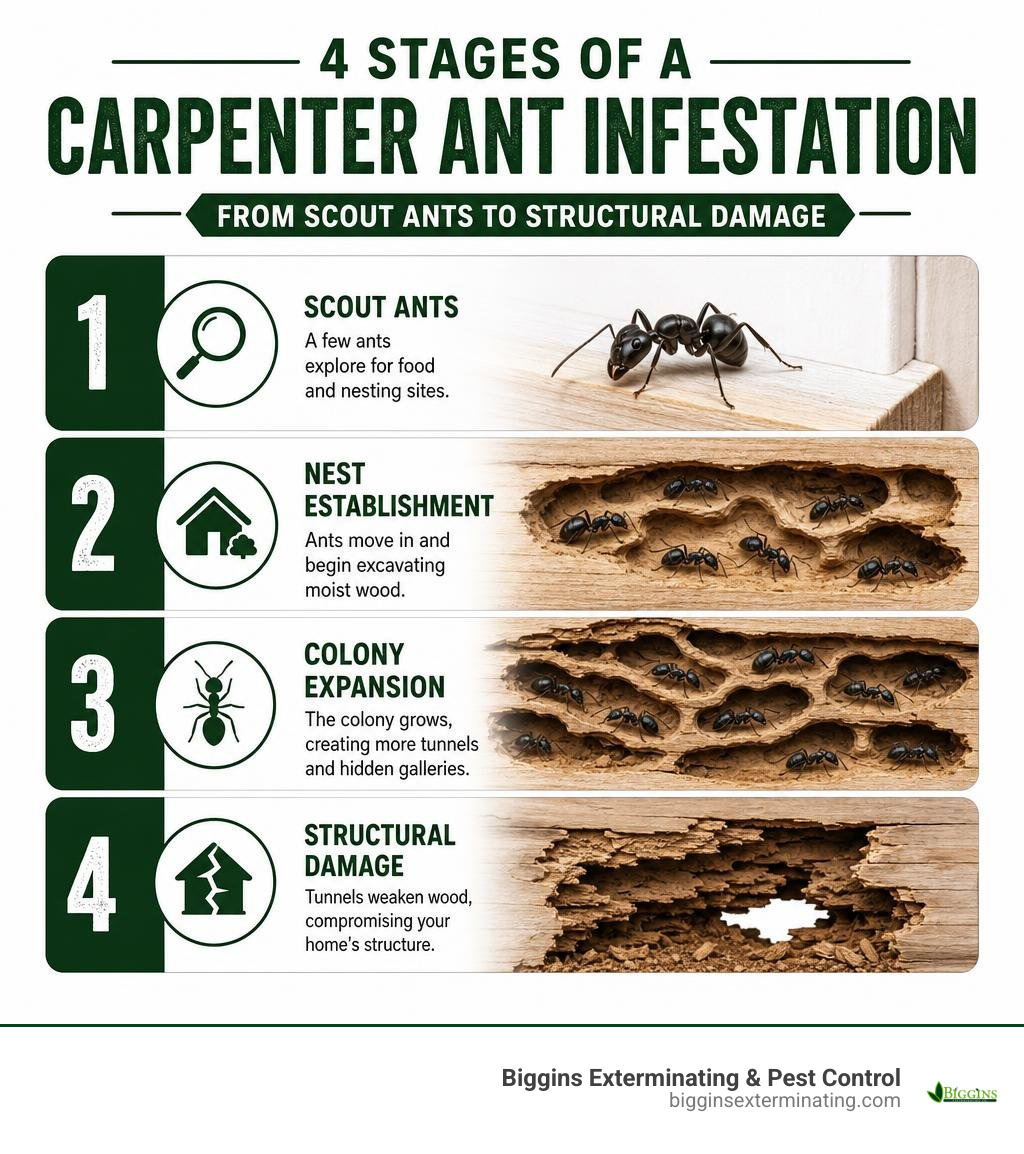
Essential carpenter ants wood damage terms:
Do They Eat It? The Truth About Carpenter Ants Wood Damage
One of the most common myths we hear in the pest control industry is that carpenter ants (belonging to the genus Camponotus) eat wood just like termites do.
Let’s clear this up right now: carpenter ants do not eat wood. They gain absolutely zero nutritional value from cellulose. Instead, they are master excavators. They use their powerful mandibles to chew through wood solely to carve out nesting galleries where they can raise their young and expand their colony.
These ants actually feed on plant juices, nectar, sweets, and honeydew produced by aphids outdoors. When they find their way inside a Massachusetts home, they will happily raid your pantry for sugary syrups, pet food, and grease. But when it comes to your structural timbers, they are strictly using them as a free construction site.
This excavating behavior is why Carpenter Ants – Ant Pests are so destructive. They don’t stop chewing once they’ve settled in; as the colony grows, they must continuously hollow out more wood to make room for thousands of new members.
How Carpenter Ants Excavate Wood
Unlike termites, which leave behind messy, mud-caked tunnels, carpenter ants are notorious “clean freaks.” When they chew through wood, they carefully remove all debris from their nesting galleries.
As they excavate, they polish the inside of the wood until the galleries are completely smooth with a sandpaper-like texture. To keep their living quarters clean, they create tiny “window holes” (also known as kickout holes) in the wood. They use these openings to push out unwanted debris, including wood shavings, dead ants, and leftover food scraps.
While carpenter ants can eventually chew through perfectly dry, sound wood, they almost always start their work in moisture-damaged wood. Wood that has been softened by roof leaks, plumbing drips, or wood-rotting fungi is much easier for them to excavate. Once they establish a foothold in these softened areas, they can easily expand their galleries into the surrounding healthy, dry structural framing.
Carpenter Ants vs. Termites: Key Differences
It is incredibly common for homeowners to confuse carpenter ant activity with termite damage. However, the way these two pests interact with wood is completely different.
Termites eat the wood, leaving behind thin, messy mud tubes and galleries packed with soil and fecal debris. Drywood termites also leave behind highly uniform, six-sided fecal pellets. Carpenter ants, on the other hand, leave their galleries pristine and smooth, pushing their irregular, fibrous wood shavings completely out of the nest.
Understanding these differences is critical when trying to evaluate the threat to your home. You can learn more about these distinctions in our guide on the 5 Key Differences Carpenter Ants vs Termites.
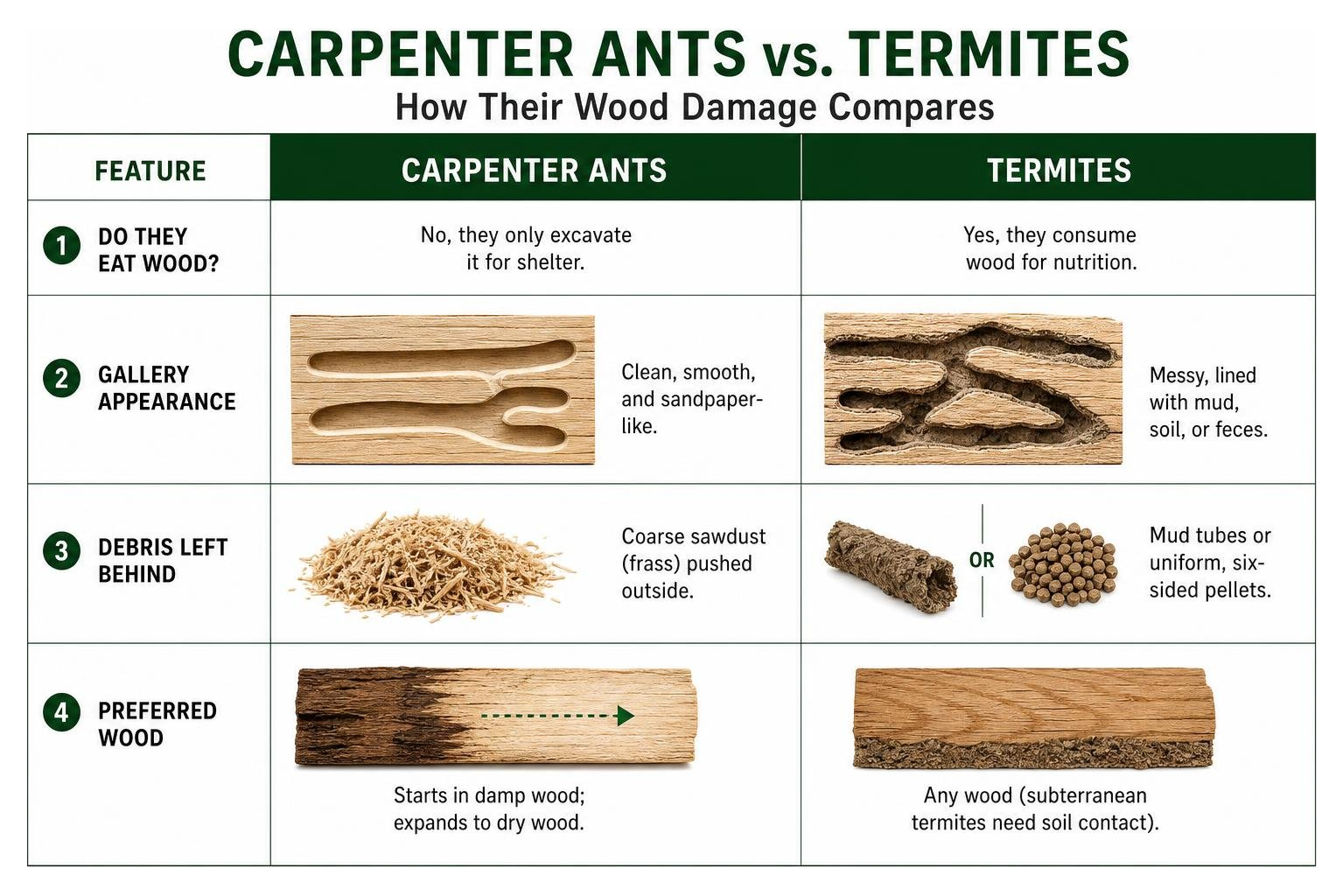
Here is a quick look at how their wood-damaging habits compare:
| Feature | Carpenter Ants | Termites |
|---|---|---|
| Do they eat wood? | No, they only excavate it for shelter. | Yes, they consume wood for nutrition. |
| Gallery Appearance | Clean, smooth, and sandpaper-like. | Messy, lined with mud, soil, or feces. |
| Debris Left Behind | Coarse sawdust (frass) pushed outside. | Mud tubes or uniform, six-sided pellets. |
| Preferred Wood | Starts in damp wood; expands to dry wood. | Any wood (subterranean termites need soil contact). |
Early Warning Signs of an Active Infestation
Because carpenter ants do their dirty work deep inside your walls, detecting an infestation early requires a bit of detective work. Waiting until you see visible structural sagging is a recipe for a massive repair bill.
In the heat of summer, carpenter ant activity peaks. If you live in our Massachusetts service area — including Wilmington, Andover, Billerica, Burlington, Lexington, North Reading, Tewksbury, or Woburn — keep a close eye out for these early warning signs.
The first sign is often the presence of scout ants. It is a little-known industry fact that only 10% to 15% of a carpenter ant colony’s workers are ever outside the nest foraging for food at any given time. If you see one or two exceptionally large black ants wandering across your kitchen floor or bathroom vanity, do not assume they just wandered in from the yard. These are scouts looking for food and water sources, and they are highly likely connected to a larger nest hidden nearby.
Another subtle sign is faint rustling sounds coming from inside your walls, ceilings, or hollow doors. When a carpenter ant colony is disturbed, or when they are actively chewing through wood, they click their mandibles together. This produces a distinct, dry rustling sound that sounds remarkably like crinkling cellophane. If you tap on a suspect wall void or windowsill and hear a soft, dry rustling sound in response, you are likely listening to thousands of active ants.
Identifying Carpenter Ant Frass (Sawdust)
The single most definitive physical sign of a carpenter ant nest inside your home is the presence of frass. Because these ants do not eat wood, they must eject their chewed-up wood shavings from the nest.
What does carpenter ant frass look like? It resembles coarse, fibrous sawdust, very similar to the shavings you get from sharpening a wooden pencil. Unlike clean sawdust from a construction project, however, carpenter ant frass is almost always mixed with:
- Fragmented insect parts (heads, legs, and wings from the pests they’ve eaten)
- Dead worker ants
- Small bits of dirt or insulation materials
You will typically find these small, loose piles of sawdust directly beneath kickout holes, window sills, door frames, or joists in dark, undisturbed areas like crawl spaces, unfinished basements, and attics.
The Threat of Winged Swarmers in Summer
If you see large, winged ants crawling on your windows or flying around your home during the summer, you are looking at reproductive swarmers.
A carpenter ant colony does not produce these winged males and females overnight. In fact, a colony must reach maturity — which typically takes 3 to 6 years and requires a population of at least 2,000 to 10,000 workers — before it begins producing swarmers.
Seeing these flying ants indoors is a major warning sign. It means you aren’t dealing with a brand-new, small pest problem; you are dealing with an established, mature colony that has been operating inside or very close to your home for years. If you want to know more about identifying these winged invaders, check out our resource on Do Carpenter Ants Have Wings.
Structural Risks: Can Carpenter Ants Destroy Your Home?
The short answer is yes, carpenter ants can cause severe structural damage to your home, but they do it much more slowly than termites.
While subterranean termites can compromise structural wood in a matter of months, a carpenter ant colony takes years to inflict significant structural damage. However, because they are so quiet and hard to detect, they are often left completely ignored. Over several years, their continuous chewing can quietly destroy load-bearing beams, wall studs, floor joists, and sill plates.
When structural timbers are hollowed out, their ability to support your home’s weight is compromised. This long-term neglect can lead to sagging ceilings, sloped floors, stuck doors and windows, and a massive threat to your home’s equity.
Parent Nests vs. Satellite Nests
To understand how these pests expand and destroy a home, you have to understand their colony structure. A single carpenter ant colony is often split into two distinct types of nests: parent nests and satellite nests.
- The Parent Nest: This is the primary home of the colony. It contains the queen ant, eggs, and very young larvae. Because the queen and eggs are highly sensitive to dry conditions, the parent nest is almost always located outdoors in a highly moist environment, such as a rotting tree stump, a decaying log, or a damp woodpile.
- Satellite Nests: Once the parent colony grows too large, the worker ants will establish satellite nests. These nests contain worker ants, older larvae, pupae, and winged swarmers. Unlike the parent nest, satellite nests do not require high levels of moisture. They are frequently established inside homes — in dry wall voids, attics, hollow doors, and behind insulation.
A single outdoor parent nest can support multiple indoor satellite nests. This means that simply killing the ants you see inside your house will not solve the problem. If the outdoor parent nest is left alive, it will continuously send new workers inside to rebuild the satellite nests and continue the carpenter ants wood damage.
Hidden Areas Prone to Carpenter Ants Wood Damage
Carpenter ants are highly opportunistic. When they move indoors, they seek out areas that are dark, warm, and close to moisture. Some of the most common structural areas where we find extensive damage include:
- Roof Lines and Eaves: Water damage from clogged gutters or ice dams softens the wood along your roof line, making it a prime target for satellite nests.
- Wall Voids and Insulation: Carpenter ants love nesting in synthetic foam insulation and fiberglass batts. It is warm, dry, and incredibly easy for them to hollow out.
- Windowsills and Door Frames: Rainwater frequently pools in these areas if they aren’t properly sealed, leading to wood rot that invites ants.
- Chimney Flashing and Skylights: Faulty flashing allows slow, hidden water leaks to run down interior framing, creating the perfect damp environment for excavation.
Locating and Tracking the Nest
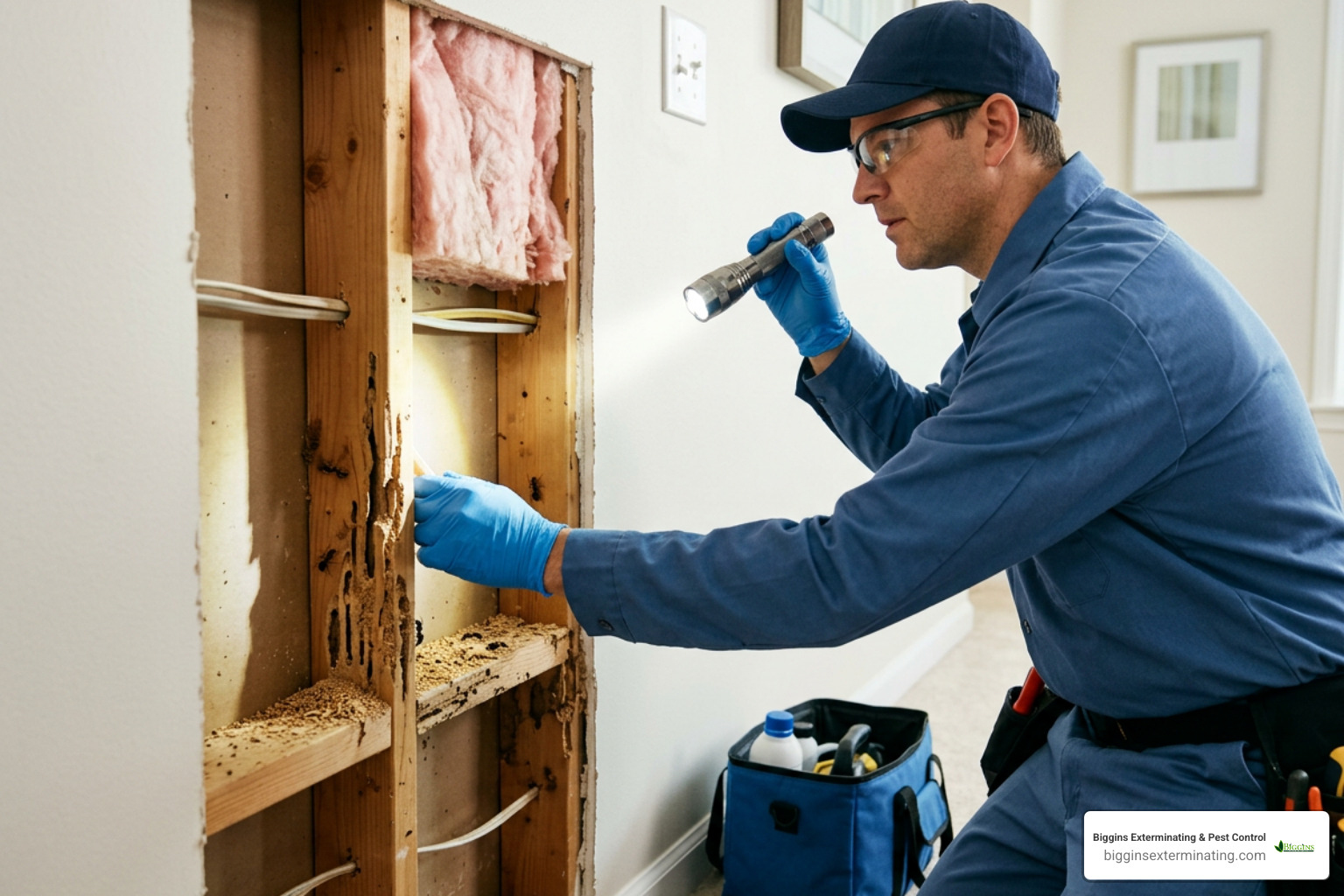
Finding a carpenter ant nest is often the hardest part of the entire eradication process. Because the ants travel back and forth between parent and satellite nests, spraying the visible ants you see on your kitchen counter is completely useless. To get rid of them permanently, you must Find Carpenter Ant Nest locations and treat them directly.
Nighttime Tracking and Acoustic Detection
Carpenter ants are primarily nocturnal. Their peak activity hours are between sunset and midnight, which is when they leave their nests to forage for food.
If you want to track them, grab a flashlight and head outside after dark. Look along your foundation walls, sidewalks, and garden hoses. Carpenter ants are creatures of habit and will follow the exact same chemical scent trails night after night. They can forage up to 300 feet (100 yards) from their nest, so be prepared to follow them across your yard, sometimes leading back to an old oak tree or a neighbor’s firewood pile.
You can also use a “sweet treat” to track them. Place a small drop of honey, sugar water, or maple syrup in an area where you’ve seen activity. Once the ants find it and fill up, they will walk in a straight, direct line back to their hidden nest, showing you exactly where the entry point is.
Don’t forget to listen, too. If you suspect a nest is hidden behind a specific wall or windowsill, tap the wood firmly. Put your ear close to the surface (or use a stethoscope if you have one) and listen for that classic “crinkling cellophane” rustling sound as the disturbed colony reacts.
Why DIY Treatments Often Fail
Many homeowners try to tackle a carpenter ant problem using retail aerosol sprays or bug bombs. Unfortunately, this almost always makes the problem worse.
When you spray a standard contact pesticide, you only kill the 10% to 15% of the workers that are out foraging. The remaining 85% of the colony stays safe inside the wall. Even worse, when the colony senses a threat from a chemical spray, they can undergo a process called colony scattering (or budding). The surviving ants will split the colony into multiple smaller satellite nests throughout your home, turning one localized pest issue into a widespread nightmare.
Achieving permanent control requires professional expertise, specialized equipment, and non-repellent liquid treatments that the ants cannot detect.
Professional Eradication and Prevention Strategies
At Biggins Exterminating, we use an Integrated Pest Management (IPM) approach to eliminate carpenter ants safely and effectively. Rather than blindly spraying chemicals, we focus on locating the source of the infestation, utilizing targeted treatments, and helping you address the moisture issues that attracted the pests in the first place.
The Bait-and-Switch Method and Professional Baits
Carpenter ants are notoriously finicky eaters. Their dietary preferences shift constantly throughout the year depending on the needs of the colony. During the spring, they may crave proteins to feed the growing larvae, while in the summer, they might only be interested in sugars for energy.
Because of this, standard retail ant baits are highly hit-or-miss. Professionals often use a “bait-and-switch” pre-baiting technique. We first attract the ants using non-toxic food sources (like sugar milk or specialized lures) to get them feeding heavily. Once we have established a consistent feeding trail, we introduce slow-acting professional toxic baits.
The foraging worker ants eat the bait and carry it back to the nest, sharing it with the rest of the colony, including the larvae and the queen. Because the bait is slow-acting, it ensures the entire colony is eliminated before the ants realize what hit them.
Preventing Future Carpenter Ants Wood Damage
Once your home is clear of pests, taking preventative measures is key to keeping them from returning. You can read our complete checklist in the Carpenter Ant Prevention Ultimate Guide.
Here are the most effective steps you can take today:
- Trim Trees and Shrubs: Keep all tree branches, vines, and shrubs trimmed back at least 2 to 3 feet from your roof, siding, and gutters. Ants love to use overhanging branches as “skywalks” to bypass your foundation defenses.
- Manage Firewood: Store firewood and lumber piles completely off the ground and at least 20 feet away from your home’s foundation. Never bring firewood indoors until you are ready to burn it immediately.
- Seal Entry Points: Use silicone-based caulk to seal cracks in your foundation, gaps around utility lines, and spaces around exterior windows and doors.
- Control Moisture: Clean clogged gutters, fix plumbing leaks promptly, ensure proper ventilation in attics and crawl spaces, and replace any wood that has been damaged by rot or mold.
Frequently Asked Questions
Do carpenter ants bite humans?
Yes, carpenter ants can bite humans if they feel threatened or if their nest is directly disturbed. Because they are the largest ants in Massachusetts, they have incredibly powerful mandibles that can easily pinch and break the skin, resulting in a painful nip.
While they do not have a stinger and are non-venomous, they possess an acidopore at the tip of their abdomen. During a bite, they can spray formic acid directly into the tiny wound, which causes a sharp, temporary burning sensation. If you get bitten, simply wash the area with soap and water and apply a mild antibiotic ointment.
What is the difference between a carpenter ant and a regular household ant?
The easiest way to tell them apart is by their size and physical structure.
Carpenter ants are the largest ants you will find in Massachusetts homes. Workers range from 1/4 to 1/2 inch in length, while winged queens can reach up to 3/4 of an inch. In contrast, common pavement ants are tiny, measuring only about 1/8 of an inch.
Physically, a carpenter ant has a perfectly rounded, evenly arched thorax (back) and a single, pointed node (or hump) on its narrow waist. Regular household ants, like pavement ants, typically have an uneven thorax and two nodes on their waist. For a detailed guide on identification, you can refer to the Carpenter Ants | University of Maryland Extension guide.
How much does it cost to repair carpenter ant damage?
The cost to repair structural damage caused by carpenter ants varies wildly depending on how long the infestation was allowed to grow.
Note: The following figures are average structural repair costs based on publicly available internet data and do not represent actual pricing or estimates from Biggins Exterminating.
For a minor, localized infestation (such as replacing a single rotted windowsill or door frame), repair costs typically range from $500 to $1,500.
However, if a mature colony has been hollowing out load-bearing wall studs, floor joists, or sill plates for several years, repairs can easily escalate. Major structural rehabilitation involving jacking up floors, replacing load-bearing framing, and repairing damaged drywall can cost anywhere from $3,000 to $10,000 or more. This is why early professional detection is so critical to protecting your home and your savings.
Conclusion
Carpenter ants wood damage is a slow, silent threat that can quietly compromise your home’s structural integrity and chip away at your hard-earned equity. Because these pests nest deep inside wall voids and water-damaged framing, trying to resolve an infestation with DIY sprays often does more harm than good.
If you suspect you have carpenter ants in your home, don’t wait for the damage to worsen. At Biggins Exterminating & Pest Control, we have been protecting homes and families across Massachusetts for over 40 years. We are a local, family-owned and operated pest control company based in Wilmington, MA, and we pride ourselves on delivering high-quality, reliable service.
We don’t believe in forcing our customers into long-term contracts. Instead, we offer straightforward, contract-free pest solutions, backed by solid warranties and a commitment to your complete satisfaction.
Whether you are in Wilmington, Andover, Bedford, Billerica, Burlington, Lexington, North Reading, Tewksbury, or Woburn, we are here to help you protect your investment. Contact us today to schedule your comprehensive inspection and let our family take care of yours.
- Explore our Carpenter Ant Pest Control services
- Get in touch with us to schedule an inspection today!
