
Physical Identification: How to Spot Carpenter Ants vs Termites
Carpenter ants vs termites are two of the most common wood-destroying pests Massachusetts homeowners face — and they’re surprisingly easy to confuse, especially when swarmers start appearing around windows and door frames each spring.
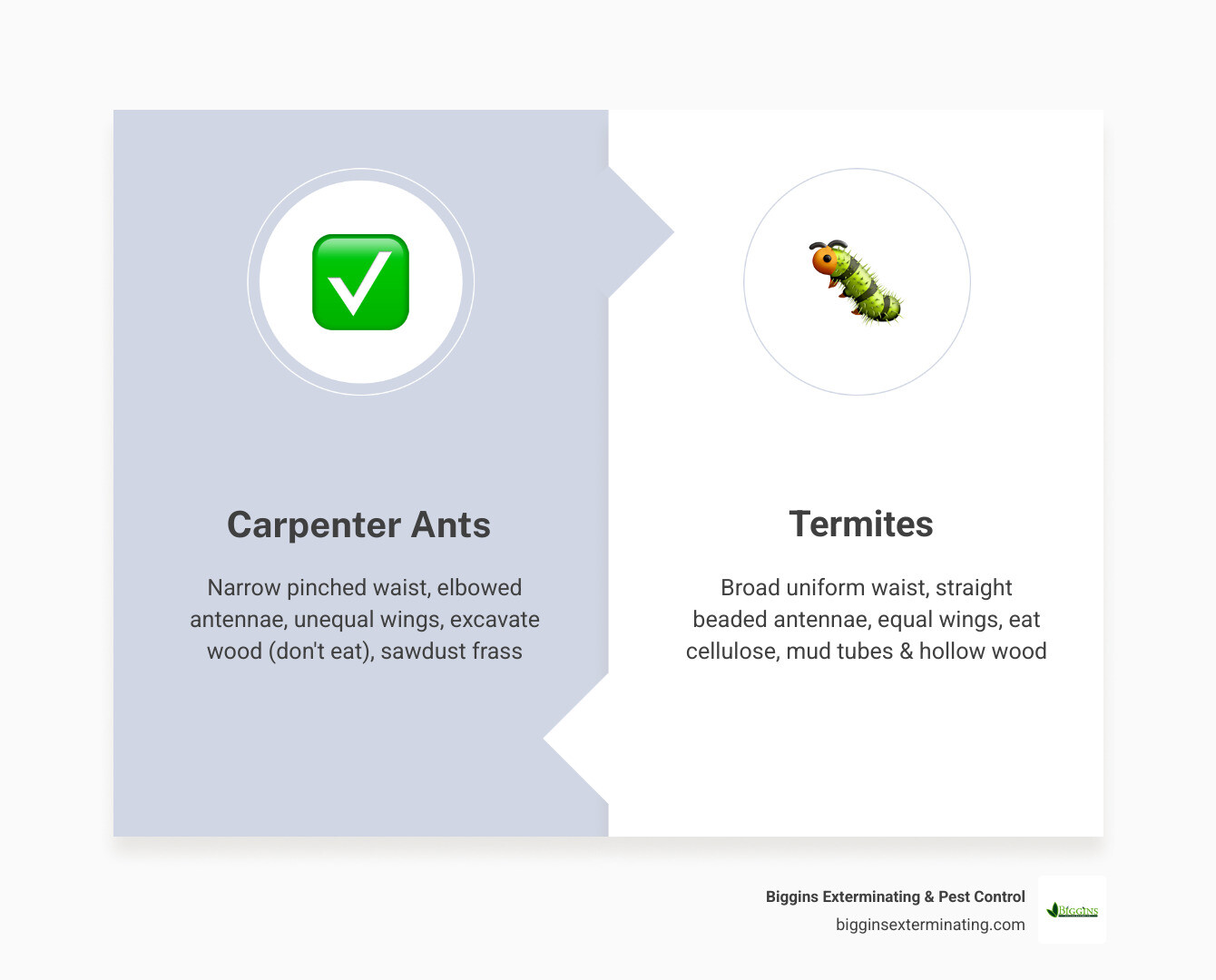
Here’s a quick way to tell them apart:
| Feature | Carpenter Ants | Termites |
|---|---|---|
| Waist | Narrow, pinched | Broad, uniform |
| Antennae | Elbowed (bent) | Straight, beaded |
| Wings (swarmers) | Front wings larger than back | All wings equal length |
| Wood behavior | Excavate for nesting | Eat the wood |
| Main evidence | Sawdust-like frass + insect parts | Mud tubes, hollow wood |
| Damage timeline | Several years | As little as 6 months |
They look similar. They both damage wood. But they are very different problems — and the wrong treatment is a waste of time and money while the damage keeps spreading.
That’s exactly why identification matters so much.
I’m Stephen Biggins, owner of Biggins Exterminating Co., and over more than four decades of pest control work in Massachusetts, I’ve inspected countless homes where carpenter ants vs termites were misidentified — costing homeowners far more than necessary. In this guide, I’ll walk you through exactly how to tell these two pests apart so you know what you’re dealing with before it gets worse.
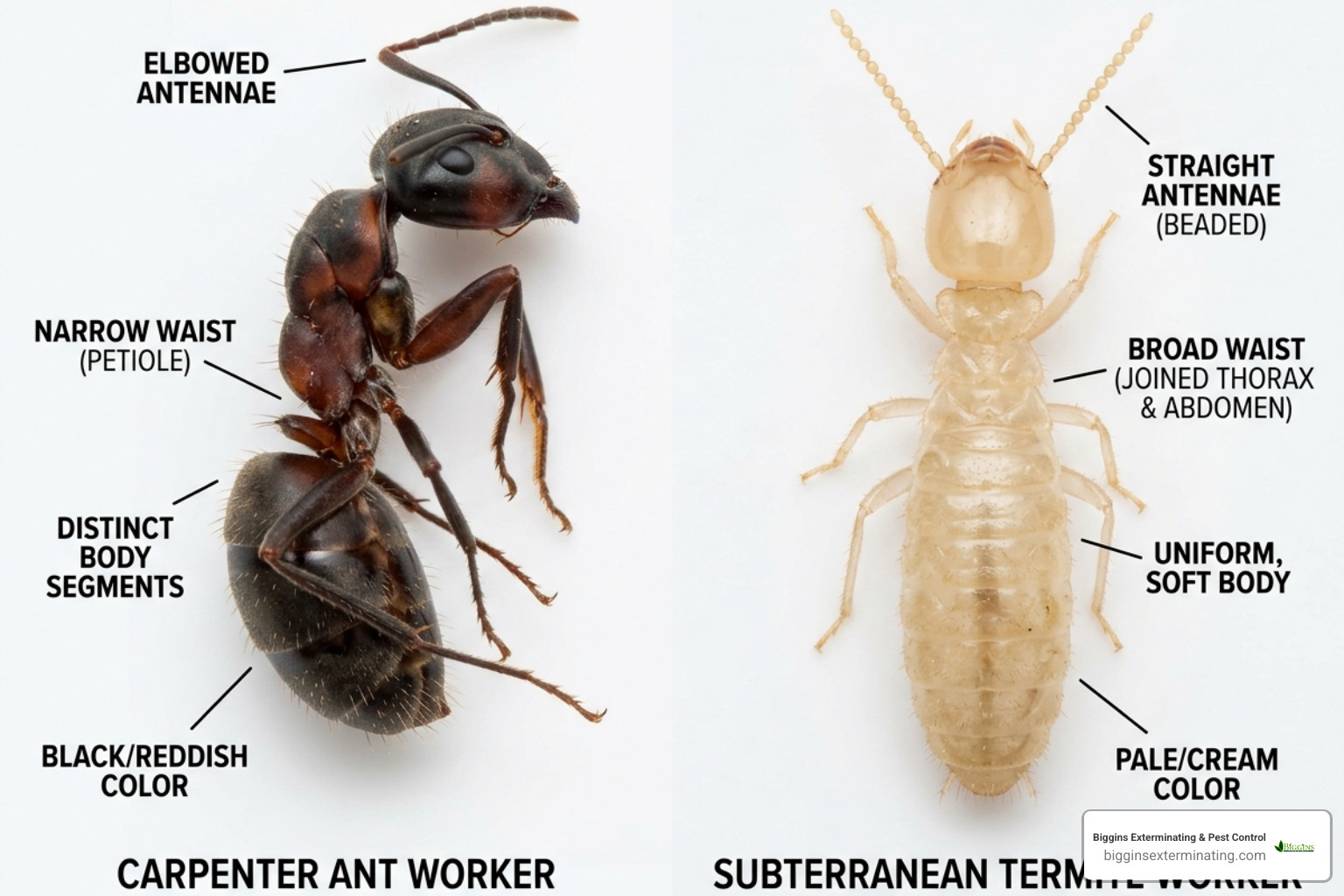
When you are staring at a tiny insect on your windowsill in Wilmington or Lexington, it can be hard to tell exactly what you are looking at. However, if you look closely at their anatomy, the differences between carpenter ants vs termites become very clear.
Ants have a very distinct “wasp-like” appearance. They possess three clear body segments with a narrow, pinched waist. In contrast, termites have a much more uniform, “cigar-shaped” body. Their waist is broad and thick, making them look like a single continuous segment to the naked eye. Some experts even describe a termite worker as looking like a “grain of rice with legs.”
Another major giveaway is the antennae. Carpenter ants have “elbowed” antennae, meaning they have a distinct bend or joint. Termite antennae are straight and look like they are made of tiny, round beads stacked on top of each other. For more on these physical traits, you can refer to this guide on how to tell the difference.
Finally, consider the color and size. Carpenter ants in Massachusetts are typically large (1/4 to 1/2 inch) and dark black or reddish-black. Termite workers are usually smaller (1/4 inch) and pale, almost translucent or creamy-white, because they spend their lives hidden away from the light.
For more detailed help on spotting these physical traits, check out our guide on How To Distinguish Carpenter Ants From Termites Identifying The Menace In Your Home.
Identifying Swarmers in April 2026
As of April 2026, we are right in the middle of “swarming season” here in Middlesex County. Swarmers are the reproductive members of the colony that fly out to start new nests. This is often the only time homeowners actually see termites, as the workers stay underground.
You can tell them apart by their wings. Termite swarmers have four wings of equal length that are much longer than their bodies. These wings are often smoky or milky in color and are very fragile; you will often find piles of discarded wings near windowsills or doors. Carpenter ant swarmers also have four wings, but the front pair is significantly larger than the hind pair. Furthermore, ant wings are usually more transparent with a reddish-brown tint, and ants don’t shed them as quickly as termites do.
If you see wings but no bugs, it’s a strong sign of a termite issue. You can learn more about winged ants in our article Do Carpenter Ants Have Wings.
Diet and Damage: Do Carpenter Ants Eat Wood?
This is perhaps the biggest biological difference: termites eat wood, while carpenter ants simply live in it. Termites possess special protozoa in their gut that allow them to digest cellulose, the primary component of wood. They are essentially “nature’s recyclers,” but they don’t distinguish between a fallen log in a Woburn forest and the floor joists in your home.
Carpenter ants, on the other hand, do not eat wood. They are predators and scavengers that eat other insects and “honeydew” from aphids. They use their powerful mandibles to chew through wood purely to create galleries for their nests.
| Damage Feature | Carpenter Ants | Termites |
|---|---|---|
| Gallery Texture | Smooth, “sanded” look | Rough, ragged, “dirty” |
| Debris | Piles of sawdust (frass) | Mud-caked walls, no sawdust |
| Wood Preference | Moist, decaying wood | Solid wood (subterranean) |
| Consumption | Excavation only | Consumes cellulose |
Because they have different goals, the damage looks different. Carpenter ant galleries are clean and smooth, almost as if a carpenter used a piece of sandpaper on them. Termite galleries are messy; they are often caked with mud and soil to keep the humidity levels high for the colony. For more on identifying these patterns, see our page on Signs Of Termite Damage.
Structural Impact and Timeline
In the battle of carpenter ants vs termites, termites are the undisputed heavyweights of destruction. Because a mature subterranean termite colony can contain anywhere from 300,000 to over 5 million workers eating 24/7, they can cause significant structural compromise in as little as 6 months to 2 years.
Carpenter ants move much more slowly. It usually takes a mature colony 3 to 6 years to cause serious structural damage. However, because they prefer moist wood, their presence often indicates a secondary problem like a roof leak or plumbing issue. If left untreated for years, they can eventually hollow out multiple 2×4 studs. If you suspect a nest is hidden in your walls, we have tips on how to Find Carpenter Ant Nest.
Signs of Infestation: Frass, Mud Tubes, and Sounds
Since these pests stay hidden, you have to look for the evidence they leave behind. For termites, the “smoking gun” is the mud tube. Subterranean termites need moisture to survive, so they build pencil-width tubes made of mud and saliva to travel from the soil to the wood of your home. You’ll often find these on foundation walls, in crawl spaces, or along floor joists. Check out our detailed look at Termite Mud Tunnels for visual examples.
Carpenter ants don’t build mud tubes. Instead, they leave “frass.” Because they don’t eat the wood they excavate, they have to kick it out of the nest. This creates small piles of sawdust-like material that often contains bits of dead insects and insulation.

Distinguishing Debris
If you find a pile of debris, look closely.
- Carpenter Ant Frass: Looks like pencil shavings or sawdust. It is fibrous and loose.
- Drywood Termite Droppings (Frass): These are tiny, hard, six-sided pellets that look like grains of salt or pepper. (Note: These are less common in our specific Massachusetts service area than subterranean termites).
- Subterranean Termites: Usually leave no “frass” because they pack their waste into their muddy tunnels.
You might also hear them. Carpenter ants are surprisingly noisy. In a quiet house at night, a large infestation can produce a faint rustling or “crinkling” sound inside the walls, similar to someone quietly crumpling a paper bag. You can find more about indoor signs at Carpenter Ant Infestation In House.
Professional Treatment and Prevention Strategies
The treatment for carpenter ants vs termites is completely different. Treating for the wrong one is a common DIY mistake that wastes hundreds of dollars.
For termites, the goal is to create a barrier between the soil and the home. This usually involves liquid soil treatments or the installation of a baiting system like Sentricon. For carpenter ants, the key is finding and eliminating the “parent nest,” which is often located outdoors in a tree stump or woodpile, and then treating the “satellite nests” inside the house with specialized baits or dusts.
Prevention is your best defense. Here are the steps we recommend for homeowners in Wilmington, Billerica, and surrounding towns:
- Moisture Control: Fix leaky pipes and ensure gutters are clear. Both pests are drawn to moisture.
- Wood-to-Soil Contact: Ensure there is at least a 6-inch gap between the soil and any wood siding or trim.
- Firewood Storage: Keep firewood at least 20 feet away from your foundation and elevated off the ground.
- Landscaping: Trim tree branches so they don’t touch your roof or siding. These act as “highways” for carpenter ants.
For a deeper dive into protecting your property, read our Carpenter Ant Prevention Ultimate Guide and our tips on Termite Prevention.
Seasonal Protection in Massachusetts
In our part of Massachusetts, April and May are the “danger months.” The combination of spring rains and warming soil triggers swarms across Middlesex County. Whether you are in Andover or North Reading, you should be inspecting your foundation and windowsills at least once a month during the spring.
If you live in a heavily wooded area like parts of Tewksbury or Bedford, you are at a higher risk for carpenter ants. If you have an older home with a damp basement in Burlington or Woburn, subterranean termites are a more likely threat. For a complete look at local termite behavior, see our Subterranean Termite Ultimate Guide.
Frequently Asked Questions about Carpenter Ants vs Termites
Which pest causes more structural damage: carpenter ants vs termites?
Termites cause significantly more damage. Nationally, termites cause over $5 billion in property damage every year. Because they actually eat the wood and live in massive colonies (sometimes millions of individuals), they can ruin the structural integrity of a home much faster than carpenter ants. While carpenter ants still cause millions in damages, they are generally considered “secondary” wood destroyers compared to termites.
Can a home have an infestation of both carpenter ants vs termites at once?
Yes, and it happens more often than you might think. Both pests are attracted to the same conditions: moisture and wood. In some cases, carpenter ants have even been known to move into a home to feed on a pre-existing termite colony! If you suspect both, you need a professional inspection to develop two separate treatment plans. You can find more clues on identifying these issues at How Do You Know If You Have Termites.
What are the average repair costs for wood-destroying organisms?
Based on publicly available internet data, repair costs vary wildly depending on how long the infestation went unnoticed.
- Carpenter Ants: Minor repairs might range from $250 to $1,500, but if they have been hollowing out floor joists for five years, costs can reach into the thousands.
- Termites: The average termite repair cost is often cited around $3,000, but for major structural beam replacements, homeowners have seen bills ranging from $1,000 to over $9,000.
Note: These are average costs based on general internet data and do not reflect Biggins Exterminating’s actual service pricing.
Conclusion
Identifying the difference between carpenter ants vs termites is the first step in saving your home from expensive structural damage. Whether you are seeing “sawdust” in your Wilmington kitchen or mud tubes in your Lexington basement, time is of the essence.
At Biggins Exterminating & Pest Control, we have been protecting Massachusetts families for over 40 years. We are a local, family-owned and operated company that believes in high-quality service without the need for high-pressure contracts. From Andover to Woburn, we provide reliable warranties and ensure that the job is done right the first time.
If you are worried about wood-destroying pests in your home, don’t wait for the damage to get worse. Contact Biggins Exterminating today for a professional inspection and peace of mind.
