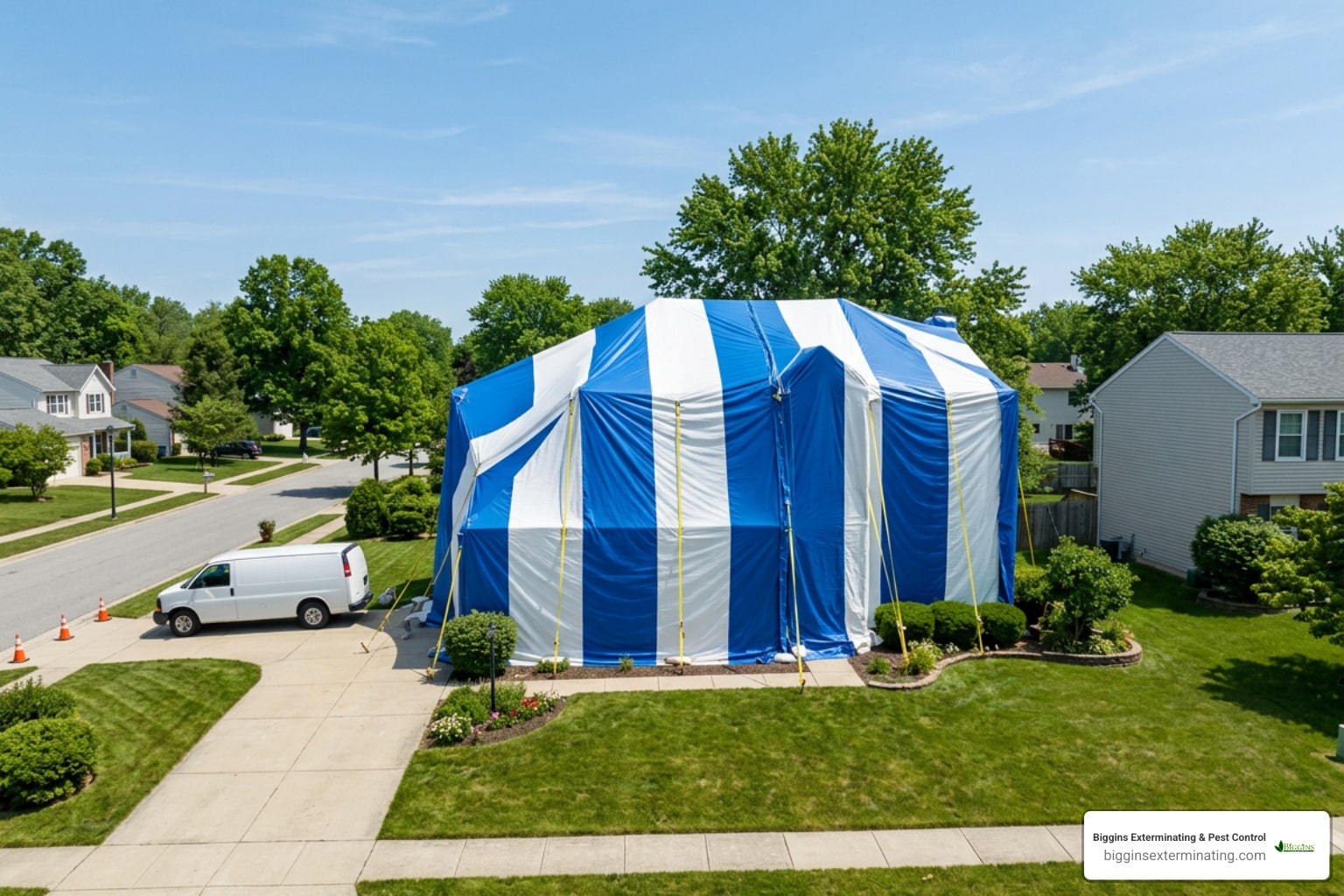
What Does It Cost to Tent a House for Termites?
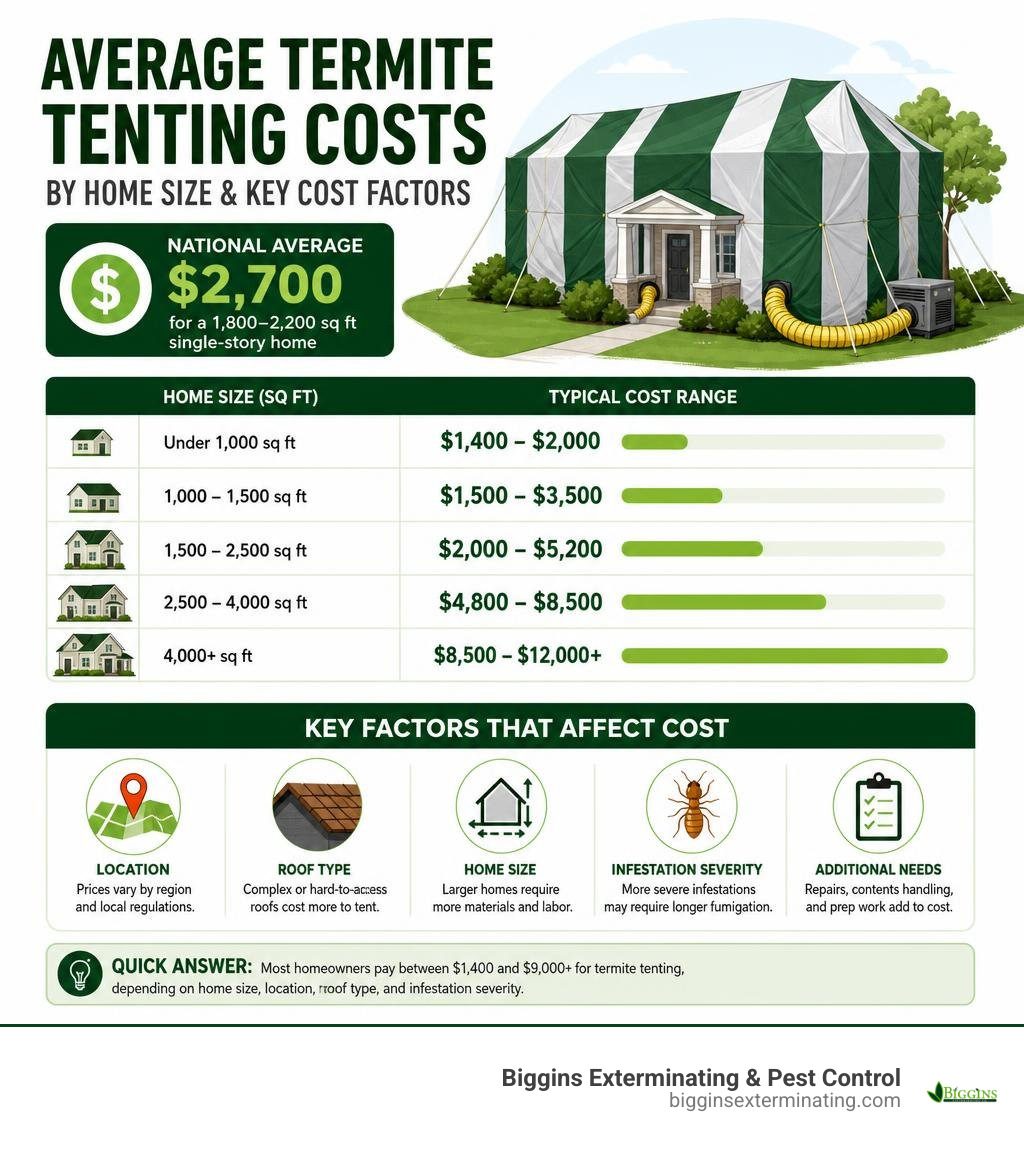
The average cost to tent a house for termites falls around $2,700 for most single-family homes, but the full range is wide:
| Home Size | Typical Cost Range |
|---|---|
| Under 1,000 sq ft | $1,400 – $2,000 |
| 1,000 – 1,500 sq ft | $1,500 – $3,500 |
| 1,500 – 2,500 sq ft | $2,000 – $5,200 |
| 2,500 – 4,000 sq ft | $4,800 – $8,500 |
| 4,000+ sq ft | $8,500 – $12,000+ |
Quick answer: Most homeowners pay between $1,400 and $9,000+ for termite tenting, depending on home size, location, roof type, and infestation severity. The national average sits near $2,700 for a 1,800–2,200 sq ft single-story home.
Note: All prices above reflect average costs based on publicly available internet data and do not represent Biggins Exterminating’s actual pricing.
That sinking feeling when a pest inspector points to tiny mud tubes or sawdust-like droppings in your walls is hard to forget. For homeowners facing a drywood termite infestation, whole-structure fumigation — commonly called tenting — is often the most effective solution. But before you call a contractor, it pays to understand exactly what drives the cost and what surprises to expect on the bill.
One important note for Massachusetts homeowners: tenting is actually rare in New England. Drywood termites — the species that require full-home fumigation — are not common here. The primary threat in towns like Wilmington, Andover, and Woburn is the subterranean termite, which lives in soil and is treated very differently. We’ll cover that in detail below.
I’m Stephen Biggins, owner of Biggins Exterminating Co., a family-owned pest control company serving Wilmington, MA and surrounding communities since 1982. With over four decades of hands-on experience helping Massachusetts homeowners navigate termite threats, I can tell you that understanding the average cost to tent a house for termites — and whether tenting is even necessary for your situation — can save you thousands of dollars. Let’s walk through everything you need to know.
Terms related to average cost to tent a house for termites:
The Average Cost to Tent a House for Termites
When you start researching the financial impact of whole-home fumigation, you will quickly notice that quotes vary wildly. According to national market data compiled in How Much Does Termite Tenting Cost? [2026 Data], the standard investment for a complete structural treatment runs in a very broad range.
Because we want to help you make sense of these figures, we always look at the broader picture. If you are trying to estimate your potential out-of-pocket expenses, you can review our general breakdown of localized treatments on our Termite Treatment Cost page. That structural tenting represents the “nuclear option” of pest control—meaning it is designed for severe, widespread infestations that cannot be resolved with targeted localized applications.
National Average Cost to Tent a House for Termites in 2026
As we move through 2026, the national average cost to tent a house for termites hovers right around $2,700, with most standard treatments falling between $2,000 and $5,000. However, depending on the complexity of your home and regional labor rates, the total cost can easily stretch from $1,400 to a high-end price of $9,000+.
This wide pricing range is heavily influenced by the physical volume of the building and the regulatory standards of different states. According to the House Tenting Cost in 2026: Fumigation Price Guide, the base cost of the fumigant itself, combined with the specialized labor required to safely seal and monitor a structure, sets a high entry price for any professional tenting project.
How Home Size Affects the Average Cost to Tent a House for Termites
Many homeowners assume that pest control companies calculate tenting prices solely by floor-plan square footage. In reality, chemical fumigation relies on cubic volume (the total three-dimensional space enclosed by your walls and roof).
Fumigators use a mathematical calculation known as the “concentration-time product” to determine exactly how many pounds of gas—typically sulfuryl fluoride—are required to saturate the home’s wooden framing and eliminate the colony. If you have vaulted ceilings, an open two-story foyer, or a steep roofline, your home has a much higher cubic volume than a flat-ceiling ranch of the exact same square footage. Consequently, it will require more gas and cost more to treat.
For a general comparison of how floor space translates to average costs, consider this structural size breakdown:
| Home Size (Square Footage) | Cubic Volume Estimate | Average Cost Range (National Internet Data) |
|---|---|---|
| 1,000 sq ft | ~8,000 – 10,000 cu ft | $1,400 – $2,000 |
| 1,500 sq ft | ~12,000 – 15,000 cu ft | $1,500 – $3,500 |
| 2,000 sq ft | ~16,000 – 20,000 cu ft | $2,000 – $5,200 |
| 3,000 sq ft | ~24,000 – 30,000 cu ft | $4,800 – $8,500 |
| 4,000+ sq ft | ~32,000+ cu ft | $8,500 – $12,000+ |
As detailed in the Fumigation Cost: 2026 Tenting Prices by Home Size, multi-story homes or structures with complex footprints require significantly more preparation, larger tarps, and specialized rigging, which naturally pushes the price toward the higher end of the spectrum.
Key Factors That Drive Fumigation Pricing
Beyond simple measurements, a handful of critical variables will determine where your written estimate lands. Understanding these factors helps you communicate more effectively with pest control professionals and avoid unexpected surcharges.

Structural Complexity and Roof Type
The design of your roof plays a massive role in the labor required to tent your home. In the pest control industry, there is a well-known phenomenon called the “tile roof tax.” If your home features concrete, clay barrel, or Spanish tiles, the technicians cannot simply drag heavy tarps across them without risking widespread breakage. To prevent this, the crew must use a specialized “strip and replace” method or install foam-padded support systems, adding an extra $800 to $1,500 to the bill.
Other structural elements that drive up the price include:
- Multi-story designs: Homes with two or three stories require elaborate rigging and carry a 10% to 20% labor surcharge.
- Crawl spaces and basements: If your home has a dirt crawl space or an unfinished basement, the team must spend extra time sealing the foundation to ensure the gas does not escape into the surrounding soil.
- Attached decks and porches: These structures must either be entirely enclosed within the tent or carefully isolated, which increases the total tarp square footage.
Regional Pricing: Florida vs. California
Geography dramatically impacts the price of structural fumigation. Florida and California account for roughly 80% of all residential tenting in the United States because their warm, coastal climates are highly hospitable to drywood termites.
- Florida: Tenting costs here are relatively competitive due to the sheer volume of providers. Prices typically range from $1,000 to $3,000 (or $1.00 to $2.00 per square foot), as highlighted in the Cost To Tent a House for Termites in Florida guide.
- California: Due to strict environmental regulations, rigorous licensing requirements under the California Department of Pesticide Regulation (CDPR), and higher local labor rates, homeowners in California often pay between $1,800 and $3,500+ for the exact same size home.
Because drywood termites are concentrated in these southern and coastal regions (often referred to as the “drywood termite belt”), local economies of scale keep these services readily available. In northern regions, the lack of local demand means tenting is a specialized service with premium pricing.
Hidden and Additional Costs of Termite Tenting
When budgeting for whole-home fumigation, the number on the pest control contract is only part of the story. Homeowners often overlook the secondary expenses required to prepare the home and relocate the household.
According to the comprehensive breakdown in Termite Tenting Cost 2026: Real Prices by House Size + Hidden Fees, failing to budget for these hidden fees can lead to significant financial stress.
Relocation and Preparation Expenses
Because structural fumigation involves pumping a highly toxic gas (sulfuryl fluoride) into the home, every living thing—including humans, pets, and houseplants—must vacate the property. The typical exposure and aeration process takes 48 to 72 hours.
Homeowners must budget for:
- Lodging: Hotel stays for 2 to 3 nights typically range from $240 to $600+.
- Pet Boarding: Kenneling dogs, cats, or relocating exotic pets can add $100 to $300 to your relocation budget.
- Food Preservation: Any food, medicine, or pet food that is not factory-sealed in metal or glass must either be removed from the home or double-bagged in specialized, heavy-duty polymer bags called Nylofume bags.
- Utility Coordination: You must coordinate with your local gas utility to shut off the gas line before the tent goes up and schedule a technician to turn it back on and relight your pilot lights afterward.
Post-Treatment Repairs and Drywall Patching
Fumigation is incredibly effective at killing the termites currently living inside your walls, but it does absolutely nothing to repair the structural wood damage they left behind.
Once the tent comes down, you may discover that load-bearing studs, floor joists, or drywall have been severely compromised. We recommend checking our guide on the Signs of Termite Damage to recognize what needs attention.
Replacing structural wood elements can cost anywhere from $600 to over $6,000 depending on the severity. Additionally, accessing damaged wall framing often requires cutting away drywall. For a realistic look at restoration costs, the Drywall Repair Cost 2026: $75-$800 by Damage Size guide indicates that patching and painting even minor wall damage can run between $75 and $800 per area.
Consumer tip: Many national pest control chains bundle subcontracted carpentry work into their chemical quotes and apply a 400% to 600% markup. To save money, we always recommend getting separate itemized quotes from independent, licensed general contractors for any structural repairs.
Tenting vs. Non-Tenting Alternatives for New England Homeowners
Now let’s bring the conversation back home to Massachusetts. If you live in Wilmington, Andover, Woburn, or any of our neighboring towns, we have some very good news for you: you will almost certainly never need to tent your house.

Why Tenting Is Rare in Massachusetts
The reason tenting is incredibly rare in New England comes down to biology and our local climate. The drywood termites that nest deep within attic rafters and require whole-structure gas fumigation simply cannot survive our freezing winters.
Instead, our local nemesis is the Eastern subterranean termite. Unlike drywood termites, subterranean termites do not live inside your wooden framing. They live deep underground in the moisture-rich soil around and beneath your foundation. They only travel up into your house through mud tubes to gather food (wood) before returning to their underground colony.
If you suspect you have activity, you can read our guide on How to Tell if You Have Termites to spot the differences. Because these pests live in the dirt, putting a giant striped tent over your roof and pumping gas inside will not solve the problem. The gas cannot penetrate the soil, meaning the main colony underground would remain completely unharmed.
If you live in North Andover, we highly recommend reading about our localized approach on our Termite Control North Andover page, or scheduling a professional assessment through our Termite Inspection Services. We even offer a Free Termite Inspection to give you complete peace of mind without any upfront cost.
Soil Barriers and Baiting Systems
Because subterranean termites require an earth-to-wood connection, we treat them from the ground up using localized, highly targeted methods rather than whole-home tenting.
The two most effective professional alternatives include:
- Liquid Soil Barriers: We dig a shallow trench around the exterior foundation of your home and apply a liquid termiticide (such as Termidor). When termites pass through this treated zone, they carry the active ingredient back to the nest, effectively eliminating the entire colony. You can read all about this in our Subterranean Termite Ultimate Guide and explore how we install a protective Termite Barrier Treatment.
- In-Ground Baiting Systems: We install discreet bait stations around the perimeter of your yard. The termites feed on the highly attractive bait, which contains a slow-acting insect growth regulator, and share it with the rest of the colony, leading to total colony elimination.
These methods are highly effective, require zero preparation on your part, do not require you to leave your home, and typically cost significantly less than structural tenting.
Frequently Asked Questions About Termite Tenting
To help you feel completely confident in your pest control decisions, we have compiled answers to the most common questions homeowners ask about the tenting process.
Is termite tenting covered by homeowners insurance?
In almost all cases, no. Homeowners insurance policies explicitly exclude termite damage and eradication treatments from their coverage. Insurance companies view termite activity as a preventable maintenance issue rather than a sudden, accidental loss (like a fire or storm damage). Because termites eat wood slowly over several years, the responsibility for regular inspections and preventative care falls entirely on the property owner.
How long does the termite tenting process take?
The entire process generally takes between 48 and 72 hours.
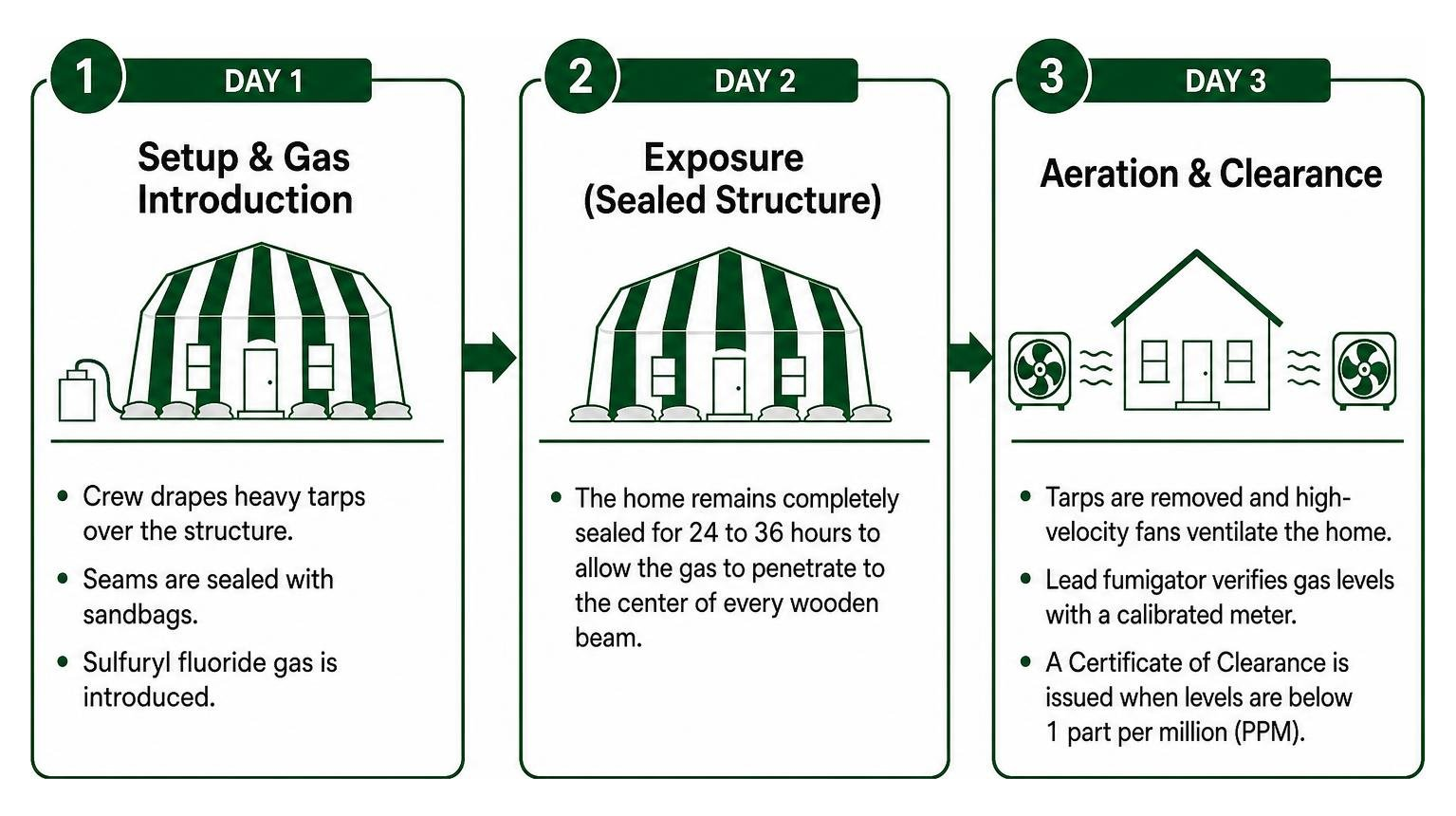
- Day 1 (Setup & Gas Introduction): The crew drapes heavy tarps over the structure, seals the seams with sandbags, and introduces the sulfuryl fluoride gas.
- Day 2 (Exposure): The home remains completely sealed for 24 to 36 hours to allow the gas to penetrate to the center of every wooden beam.
- Day 3 (Aeration & Clearance): The tarps are removed, and high-velocity fans ventilate the home. The lead fumigator uses a highly calibrated gas-detection meter (such as a Fumiscope) to verify that the interior gas levels have dropped below the EPA safety threshold of 1 part per million (PPM) before issuing a written Certificate of Clearance.
What preparation is required before a home is tented?
Preparing for a tenting treatment requires careful attention to safety protocols:
- Remove or double-bag food: All unsealed food, pantry items, medicines, and pet foods must be sealed in Nylofume bags or removed.
- Relocate living things: All people, pets (including fish in aquariums), and houseplants must be completely out of the house.
- Trim landscaping: Shrubs, branches, and mulch must be cleared back at least 18 inches from the foundation to allow the tarps to seal flat against the ground.
- Shut off the gas: The main gas line must be closed by the utility company before the treatment begins.
Conclusion
Discovering termites in your home can feel incredibly overwhelming, but you do not have to navigate the process alone. While the average cost to tent a house for termites is a major factor for homeowners in the southern “drywood belt,” remember that New England’s subterranean termites are treated with far less invasive, more affordable soil barriers and baiting systems.
At Biggins Exterminating Co., we have spent the last 44 years protecting homes in Wilmington, Woburn, Andover, Bedford, Billerica, Burlington, Lexington, North Reading, and Tewksbury. As a local, family-owned and operated company, we pride ourselves on delivering honest, high-quality Termite Pest Control without requiring long-term contracts.
Whether you need a quick inspection or want to learn How to Prevent Termites from targeting your foundation, our experienced team is here to help. Reach out to us today, and let us protect your home’s structural integrity with the care and professionalism your family deserves!