What Does Getting Rid of Termites Actually Cost?
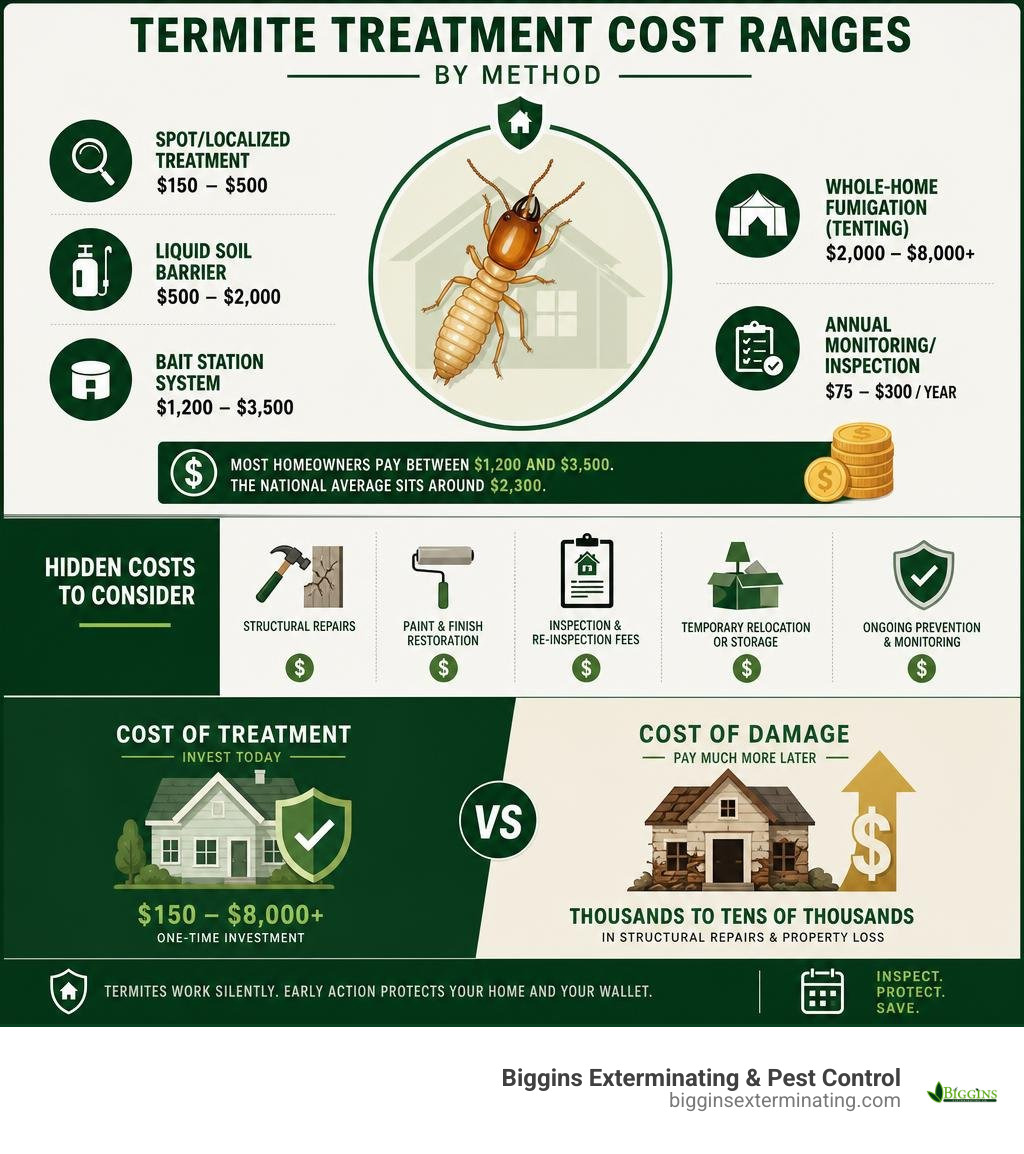
Getting rid of termites cost ranges widely depending on your home’s size, the severity of the infestation, and the treatment method used. Here’s a quick snapshot so you can orient yourself fast:
| Treatment Method | Typical Cost Range |
|---|---|
| Spot/localized treatment | $150 – $500 |
| Liquid soil barrier | $500 – $2,000 |
| Bait station system | $1,200 – $3,500 |
| Whole-home fumigation (tenting) | $2,000 – $8,000+ |
| Annual monitoring/inspection | $75 – $300/year |
The short answer: Most homeowners pay between $1,200 and $3,500 for professional termite treatment. The national average sits around $2,300, but costs can run much higher for large homes or severe infestations.
These are average costs based on publicly available internet data and do not reflect the actual pricing of any specific company. Your actual quote will depend on your home and situation.
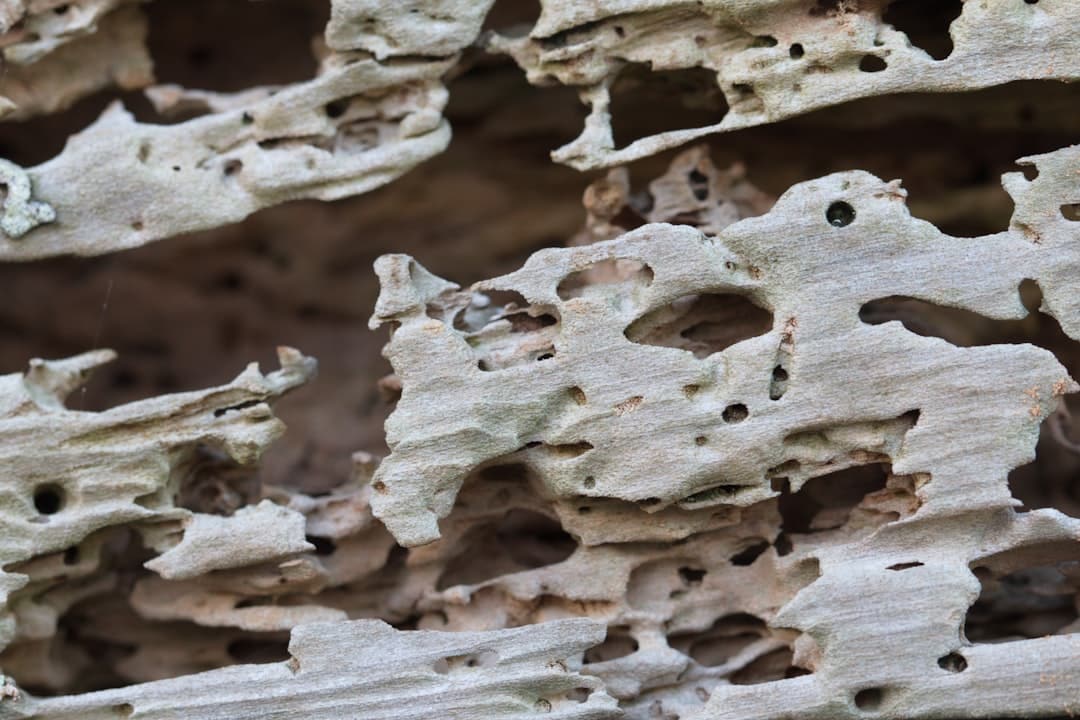
Here’s the harder truth: termites cause an estimated $5 billion in property damage across the United States every year. By the time most homeowners notice the problem, a colony has often been quietly active for three to five years. That tiny scratch in your baseboard or a faint hollow sound when you knock on a wall could already represent thousands of dollars in structural damage — with more on the way.
What makes this especially frustrating is that standard homeowners insurance does not cover termite damage. It’s classified as a preventable maintenance issue, which means you’re paying out of pocket — for both the treatment and the repairs.
I’m Stephen Biggins, owner of Biggins Exterminating Co., a family-owned Massachusetts pest control company that has been helping homeowners understand and manage the real cost of getting rid of termites since 1982. In this guide, I’ll walk you through everything you need to know — from treatment options and pricing factors to the industry traps that cause homeowners to overpay.
Understanding the National and Regional Getting Rid of Termites Cost
When you start researching how much you will spend to protect your home, you will see a massive spread in pricing. It is helpful to look at both national benchmarks and what we actually see in our corner of New England.
According to national industry audits, the average single-treatment cost across the United States is around $575, with most homeowners paying between $225 on the very low end for a minor spot treatment to $2,500 for standard barrier work. However, when looking at comprehensive, whole-home eradication plans, the national average rises to approximately $2,300, with severe cases easily climbing higher.
Here in Massachusetts, the climate and historical home construction play a huge role in pricing. New England homes are often older, featuring stone foundations, crawlspaces, and dirt cellars that are highly attractive to wood-destroying organisms. Because of these structural complexities, regional pricing tends to run slightly higher than the national average.
For example, publicly available internet data shows that the average cost of termite treatment in Massachusetts is around $748 for standard pest services, but a full-scale professional eradication plan for an active infestation typically ranges from $500 to over $3,500. In severe cases involving older, historic framing or large properties, the high end can easily reach $5,000 or more—which is more than three times the basic average.
Disclaimer: Please note that these figures are averages compiled from publicly available 2026 internet data across various consumer pricing platforms. They do not represent the actual pricing structure of Biggins Exterminating. Every home is unique, and on-site evaluations are required to determine exact costs.
To get a better sense of how these numbers break down across different methods and regions, you can check out the Termite Treatment Cost: 2026 Prices by Type guide. For a look at how professional plans protect your budget over time, read our breakdown on the Termite Treatment Cost page.
Key Factors That Influence Termite Treatment Pricing
No two homes are built exactly alike, and termites do not discriminate. When a professional technician evaluates your property, they look at several distinct variables to calculate your quote.

- Foundation Type: Houses built on concrete slabs require different treatment methods than those with full basements or crawlspaces. Slabs often require “slab drilling”—where the technician must drill precise holes through the concrete to inject liquid termiticide into the soil underneath. Crawlspaces and stone foundations require meticulous trenching and chemical application, which can increase labor costs.
- Severity of the Infestation: A localized colony that has just begun nesting in a single basement sill plate is significantly cheaper to treat than a widespread infestation that has traveled up into the first-floor joists and attic rafters.
- Construction Layout: Complex architectural layouts, multiple floor levels, attached porches, and concrete patios directly adjacent to the foundation add labor hours. If a technician has to navigate obstacles to create a continuous barrier, the price will reflect that extra time.
- Geographic Location: Local labor rates, regional pest pressure, and municipal environmental regulations all play a role. In high-pressure termite zones, treatment protocols must be exceptionally robust.
How Home Size Impacts the Getting Rid of Termites Cost
The size of your home is one of the most direct mathematical drivers of your final invoice. Most professional liquid barrier treatments are priced per linear foot (the perimeter of your foundation), while baiting systems and some fumigation methods are calculated by square footage.
According to industry data on Termite Treatment Cost | Termite Extermination Cost | Fixr.com, liquid barrier treatments typically run between $3 and $16 per linear foot. Let’s look at how this plays out for different home sizes:
- Small Homes (under 1,500 sq. ft.): These homes typically have a foundation perimeter of 120 to 150 linear feet. A standard liquid barrier treatment might range from $450 to $1,800, depending on soil conditions and foundation type.
- Medium Homes (1,500 – 2,500 sq. ft.): With a perimeter of 150 to 220 linear feet, these properties usually see pricing averages between $1,500 and $3,000.
- Large Homes (over 2,500 sq. ft.): Large footprints or multi-wing estates can easily exceed 250 linear feet. Complex structures with expansive foundations often see treatment costs scaling from $3,000 to $8,000+.
How Termite Species Affect the Getting Rid of Termites Cost
The type of termite chewing on your home dictates the entire treatment strategy. In our service areas—including Woburn, Billerica, and Andover—the primary culprit is the Eastern Subterranean Termite.
- Subterranean Termites: These pests live in the soil and build mud tubes to travel into your home’s wooden framing. Because they must return to the dirt for moisture, they are treated by establishing a continuous chemical barrier in the soil around your foundation or by installing bait stations. This is highly effective and avoids the need for structural tenting. You can learn more about how we handle these specific pests on our Subterranean Termite Control page.
- Drywood Termites: Common in coastal southern states and California, drywood termites live entirely inside the wood they consume and do not need contact with the soil. Because of this, they often require whole-home structural fumigation (tenting). Note: Because drywood termites are not native to Massachusetts, local homeowners rarely have to worry about the high costs associated with structural gas tenting.
- Dampwood Termites: These termites target wood with exceptionally high moisture content, often associated with leaks or wood-to-soil contact. Eradication is typically highly localized and paired with moisture remediation, making it more affordable if caught early.
- Formosan Termites: A hyper-aggressive species of subterranean termite found in the southern US. They form massive colonies and eat wood at alarming speeds. Treating them requires aggressive, high-volume soil barriers and baiting, which pushes costs to the higher end of the spectrum.
Primary Termite Treatment Methods and Their Average Costs
To make an informed decision, you need to understand the science and the pricing behind the primary treatment methods used by professionals today.
Liquid Soil Barriers
This is the traditional “gold standard” for subterranean termite control. The process involves digging a shallow trench in the soil around the entire perimeter of your foundation. If there are concrete walkways, patios, or driveways flush against the house, the technician must drill small holes through the concrete every 12 inches to reach the soil beneath.
A high-quality, non-repellent liquid termiticide (such as Termidor) is then pumped into the trench and drilled holes. Because the chemical is undetectable to termites, they walk through it, carry it back to the colony, and spread it to their peers through a “transfer effect.”
- Average Cost: $500 to $2,500+ depending on linear footage and concrete drilling requirements.
- Lifespan: A professionally applied liquid barrier can protect your home for 5 to 10 years.
- Key Benefit: It provides an immediate, continuous shield around your home. If you want to dive deeper into long-term eradication, check out our guide on How to Get Rid of Termites Permanently.
Baiting Systems and Monitoring Plans
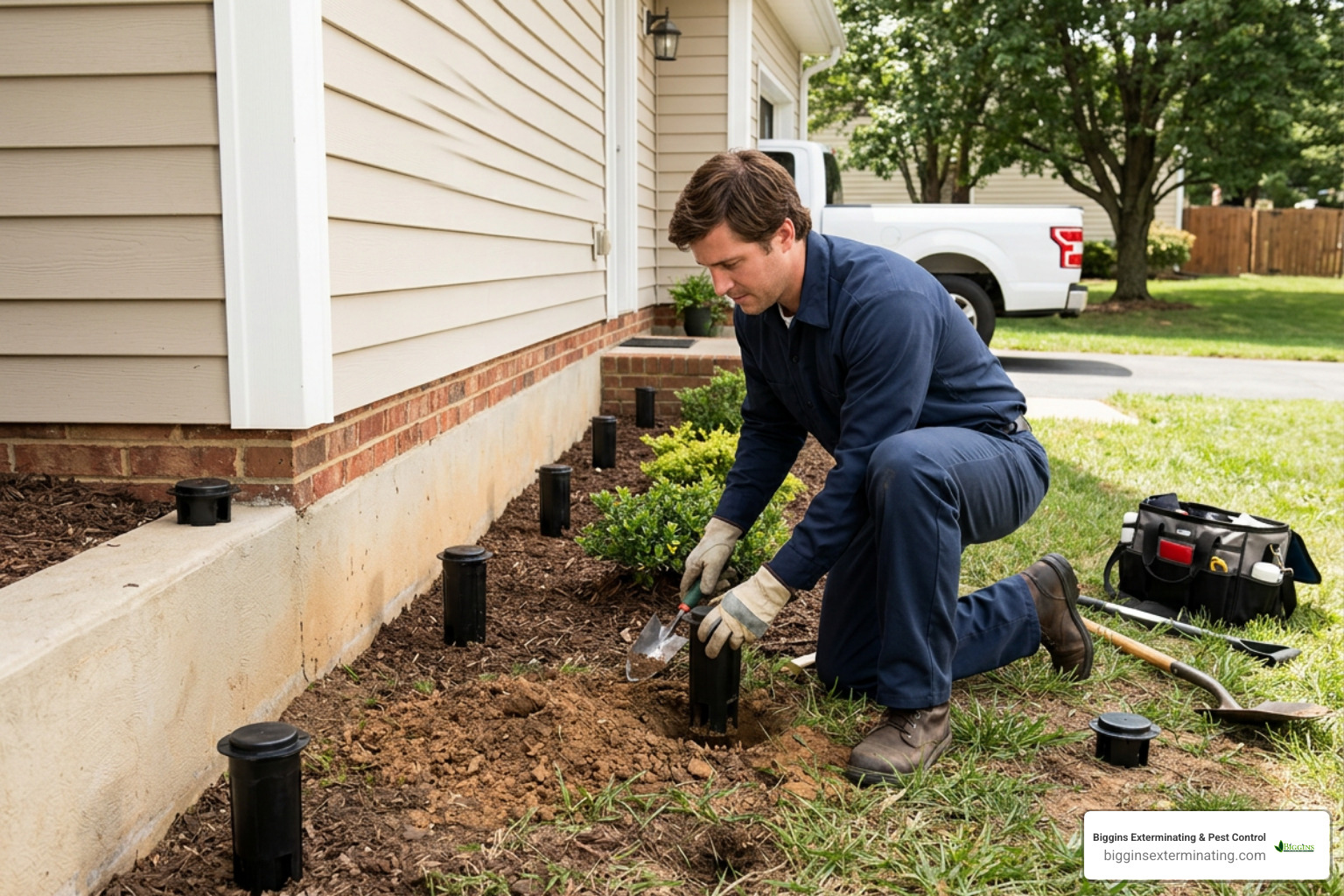
Baiting systems take a different approach. Instead of treating the soil continuously, plastic bait stations are installed flush with the ground every 15 to 20 feet around your home’s perimeter. These stations initially contain wood or cellulose monitoring cartridges.
Once termite activity is detected in a station, the monitoring material is swapped for a slow-acting active ingredient that disrupts the termites’ molting process. The worker termites feed on the bait, return to the underground colony, and feed it to the rest of the nest, eventually causing complete colony collapse.
- Average Cost: $1,200 to $3,500 for the initial installation, plus $300 to $500 annually for monitoring and maintenance.
- Lifespan: Ongoing as long as the system is maintained and inspected.
- Key Benefit: Highly targeted, uses minimal chemicals in the soil, and provides year-round monitoring.
Whole-Home Fumigation and Tenting
Fumigation is the ultimate “reset button” for drywood termite infestations. The entire structure is sealed inside a multi-colored vinyl tent, and a gas fumigant (usually sulfuryl fluoride) is released inside. The gas penetrates deep into every wall void, structural beam, and piece of furniture, completely eliminating all active termites.
- Average Cost: $2,000 to $8,000+ depending on the volume (cubic footage) of the home.
- Hidden Costs: Homeowners must completely vacate the property for 2 to 3 days, which means factoring in hotel stays, boarding pets, and discarding or sealing food.
- New England Context: Because subterranean termites are our primary threat in Massachusetts, tenting is almost never required here. If a local company tries to sell you on tenting for a standard subterranean infestation, seek a second opinion.
Hidden Fees, Warranties, and Common Industry Traps to Avoid
The pest control industry, like any other home service, has its share of pricing traps. Knowing what to look out for can save you thousands of dollars in unnecessary expenses.
The Wood Repair Markup Trap
When termites have been chewing on joists or sill plates, structural wood repairs are often necessary. Many national pest control chains will offer to bundle these carpentry repairs directly into their treatment contract.
Be careful. Pest control companies are experts at eliminating bugs, but they are rarely licensed, cost-efficient structural carpenters. Bundling wood repairs often results in a 400% to 600% markup on the actual carpentry labor. You are almost always better off hiring an independent, licensed local general contractor to handle the structural repairs after the pest control team has verified that the active infestation is completely dead.
Understanding Termite Bonds and Warranties
A termite bond is a formal contract between a homeowner and a pest control company. It typically includes an initial treatment, annual inspections, and a warranty. Warranties generally fall into two categories:
- Retreatment-Only Warranties: If termites return, the company will re-treat the affected area at no additional charge.
- Damage-Repair Warranties: The company agrees to pay for structural repairs and retreatment if termites return and cause new damage. These are more expensive but offer maximum peace of mind.
Always read the fine print. Watch out for “live termite” loopholes, where a company won’t honor the warranty unless you can prove there are active, live termites inside the home at the exact moment of inspection. To ensure you are getting an honest assessment of your home’s health, consider scheduling professional Termite Inspection Services with a trusted local provider.
Frequently Asked Questions About Termite Treatment Costs
Does homeowners insurance cover termite damage and treatment?
No. Standard homeowners insurance policies explicitly exclude termite damage and treatment from their coverage. Insurance companies view termite prevention as a basic home maintenance responsibility, much like fixing a leaky roof or painting your siding. If you neglect these tasks and termites move in, you will be paying for both the treatment and any structural wood replacement entirely out of pocket.
What are the early signs of termites that can save me money?
Catching termites early is the single best way to keep your getting rid of termites cost as low as possible. If you catch them when they are localized to a small area, you can often avoid expensive, large-scale barrier treatments. Keep an eye out for these warning signs:
- Mud Tubes: Pencil-thin tubes made of dirt and wood particles running along your foundation walls, floor joists, or sill plates.
- Discarded Wings: Small, translucent, equal-sized wings left behind on windowsills or near entryways after a spring swarm.
- Hollow-Sounding Wood: Wood that sounds thin or hollow when tapped with a screwdriver handle.
- Frass: Tiny, wood-colored, pellet-like droppings pushed out of small holes in drywood termite infested wood.
- Bubbling Paint: Moisture trapped beneath paint can cause it to bubble or peel, which often mimics water damage.
For a deeper dive into what to look for, read our guides on the Signs of Termites and How to Tell If You Have Termites.
How often should I get a professional termite inspection?
We highly recommend scheduling a professional termite inspection at least once a year. Because termites work silently inside wall voids and beneath subfloors, they can do massive damage before showing any visible signs on the surface. An annual inspection by an experienced technician is a small investment that can save you tens of thousands of dollars down the road.
If you are buying or selling a home, or if you simply want peace of mind, you can take advantage of a Free Termite Inspection to catch potential issues before they grow into budget-busting structural emergencies.
Conclusion
At the end of the day, protecting your home from termites shouldn’t feel like a high-pressure sales game. While the average getting rid of termites cost can seem daunting, understanding your options, recognizing the signs early, and choosing a trustworthy partner makes all the difference.
At Biggins Exterminating Co., we’ve spent more than 40 years keeping homes safe across Eastern Massachusetts. As a local, family-owned business based in Wilmington, MA, we don’t believe in locking our neighbors into rigid, high-priced corporate subscription contracts. Instead, we focus on providing honest, high-quality, contract-free pest and rodent control services backed by reliable warranties and a genuine commitment to customer satisfaction.
Whether you’re located in Andover, Bedford, Billerica, Burlington, Lexington, North Reading, Tewksbury, Woburn, or right here in Wilmington, we’re here to help you protect your biggest investment without breaking the bank.
Ready to secure your home against wood-destroying pests? Contact us today at Biggins Exterminating Termite & Pest Control to discuss your options and schedule your inspection.