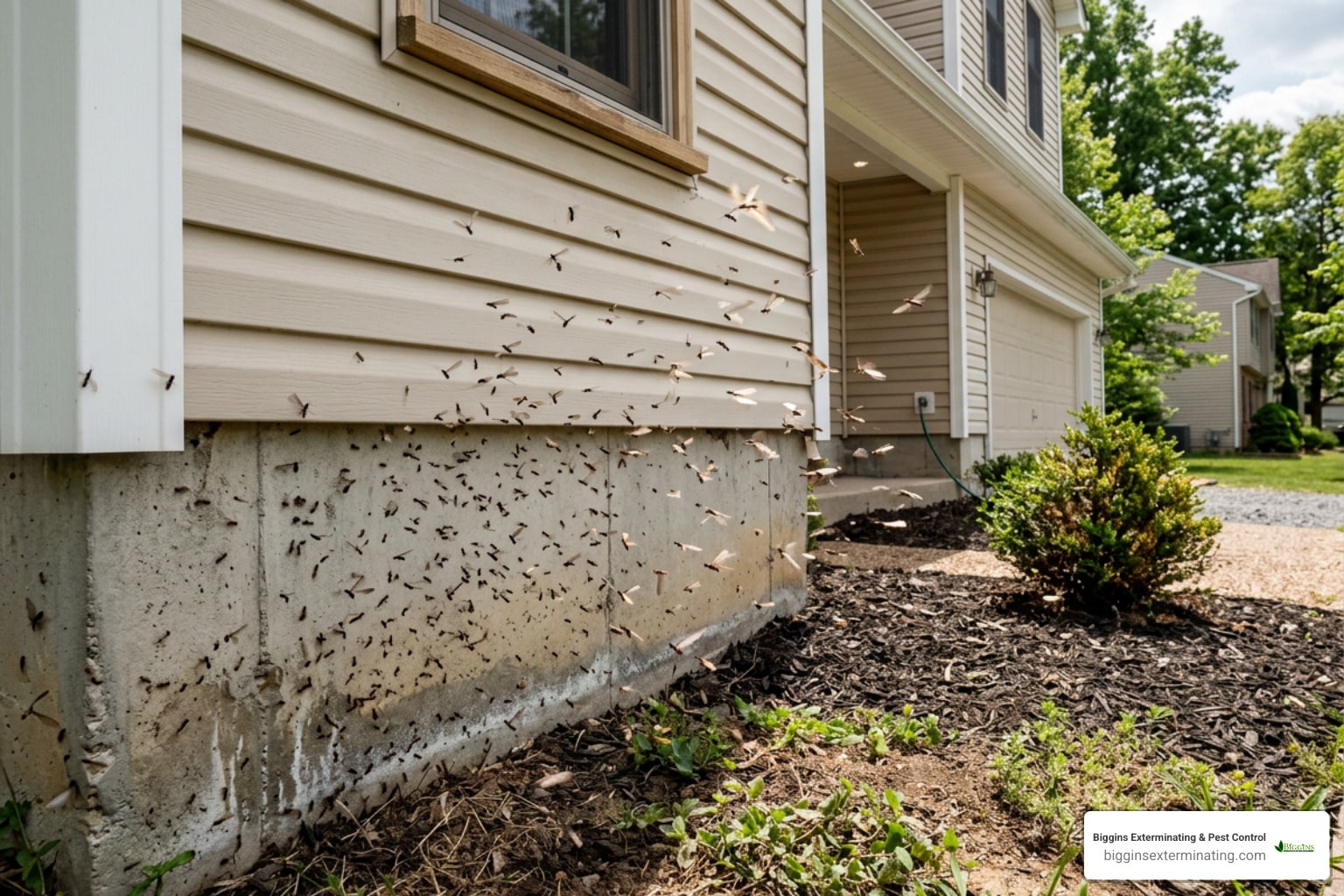
Flying Termites Outside Your House? Here’s What It Means
Seeing flying termites outside of house foundations, windows, or doorways is alarming — but before you panic, here’s the short answer:
Flying termites outside usually mean one of these things:
- A mature termite colony is established nearby (in your yard, a neighbor’s yard, or a tree stump)
- Termites are swarming to find mates and start new colonies — a normal seasonal behavior
- Your home may be at risk, but outdoor swarmers alone don’t confirm an active infestation inside
- If swarmers are appearing indoors or near your foundation, that’s a more serious warning sign
The most important thing to do right now: Don’t spray them. Take photos, collect a sample if you can, and call a pest control professional for an inspection.
Termite swarm season in Massachusetts typically runs from April through June, peaking in warm, humid conditions after spring rain. It’s one of the most common calls we get from homeowners in towns like Wilmington, Lexington, and Andover — and it’s almost always a sign worth taking seriously.
Flying termites (also called alates or swarmers) are the reproductive members of a termite colony. They don’t eat wood themselves, but the colony they come from — or the one they’re trying to start — absolutely will.
I’m Stephen Biggins, owner of Biggins Exterminating Co., a family-owned pest control company serving Wilmington, MA and surrounding communities since 1982, and in over four decades of dealing with flying termites outside of house foundations across New England, I’ve seen how a swarm that looks minor can signal a much bigger problem hidden in the structure. Read on — this guide will walk you through exactly what you’re dealing with and what to do next.
Key flying termites outside of house vocabulary:
What Are Termite Swarmers and Why Do They Appear?

To understand why you are seeing these winged pests, we have to look at the life cycle of a termite colony. Termite colonies are highly organized social structures divided into different castes: workers, soldiers, and reproductives.
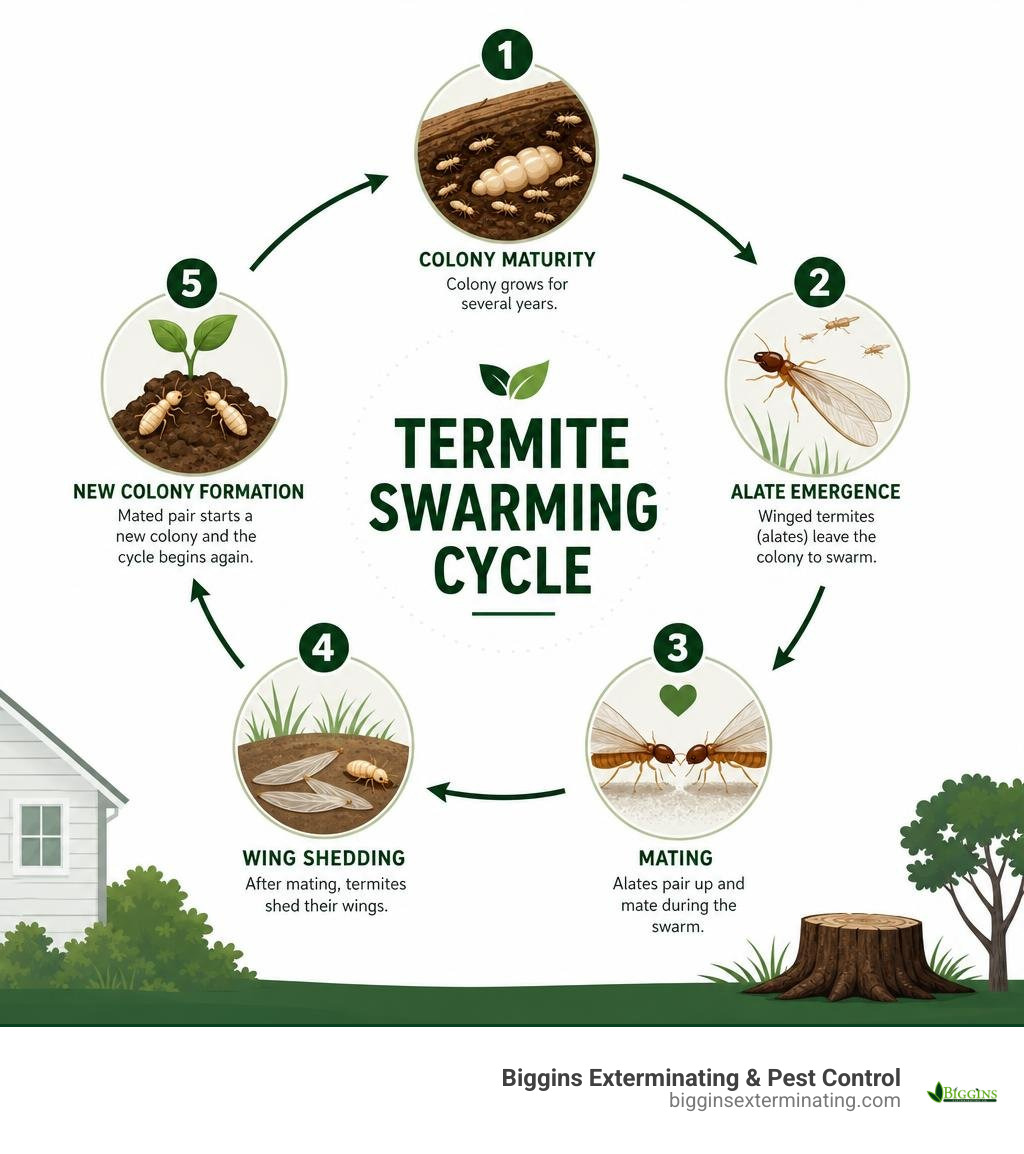
The winged termites you see flying around are the “alates,” also known as swarmers. These are the future kings and queens of the termite world. Their sole purpose in life is to leave their parent colony, find a mate, shed their wings, and start a brand-new colony in a suitable location.
A termite colony does not produce these winged reproductives right away. In fact, termite colonies take about three to six years to mature to the point when the colony produces alates. This means that if you see a massive swarm of flying termites, it is coming from a highly mature, well-established underground colony that has been thriving nearby for several years.
Learn more about termite biology to understand how these pests function and organize their colonies before they take flight.
Why You See Flying Termites Outside of House Foundations
In Massachusetts, we primarily deal with Eastern subterranean termites. Unlike drywood termites, subterranean termites live deep in the soil where they can maintain the high moisture levels they need to survive.
Because they live underground, they must build mud shelter tubes to travel from the soil to their food sources (like the wood in your home) without drying out. When a colony matures and is ready to release its swarmers, the workers build special launch portals—often called “swarm castles”—near the surface of the soil, in old tree stumps, or close to foundations where there is direct soil-to-wood contact.
If you see flying termites outside of house structures, it is because they have emerged from these underground nests. Our New New England climate, characterized by damp soil and abundant historic wood structures, provides the perfect breeding ground for these subterranean pests.
To learn more about how these underground invaders operate, take a look at our detailed guide on Subterranean Termites.
Environmental Triggers for Termite Swarms
Termites do not just fly away on a whim. Their departure is highly coordinated and triggered by specific environmental factors.
In our local service areas, from Woburn to Billerica, termite swarms are triggered by:
- Warm Temperatures: Usually when the outdoor temperature rises consistently above 70°F.
- High Humidity: Moist air prevents the delicate alates from drying out during their brief flight.
- Spring Rain: Swarms almost always occur on warm, sunny days immediately following a spring rainstorm.
Unlike other nocturnal pests, Eastern subterranean termites are daytime swarmers. They typically emerge during the morning or early afternoon, taking advantage of the bright spring sunlight to find their mates.
Flying Termites vs. Flying Ants: How to Tell the Difference
One of the most common mistakes homeowners make is confusing flying termites with flying ants. Because both species swarm at similar times of the year, it is easy to misidentify them. However, treating for ants when you actually have termites can lead to thousands of dollars in undetected structural damage.
Here is a simple breakdown to help you tell them apart:
| Physical Trait | Flying Termite (Alate) | Flying Ant |
|---|---|---|
| Antennae Shape | Straight and bead-like | Bent or “elbowed” |
| Waist Structure | Broad, thick, and straight waist | Narrow, pinched “wasp-like” waist |
| Wing Size & Shape | Two pairs of wings of equal length and width | Two pairs of wings; front wings are much larger than hind wings |
| Wing Shedding | Sheds wings very easily after a short flight | Retains wings much longer |
| Body Texture | Soft, uniform, dark brown to black body | Hard, segmented, shiny body |
If you are still unsure which insect is currently swarming near your patio or foundation, don’t guess. Take a look at our resource on How to Tell if You Have Termites for clear identification tips.
What It Means to See Flying Termites Outside of House Structures

Seeing a cloud of insects hovering near your garden beds or foundation can be incredibly unsettling. But what does it actually mean for the safety of your home?
First, it is important to understand the sheer scale of a swarm. A swarm of flying termites heading towards your house has the potential to land 50,000 termites at one time. However, nature is tough on these little invaders. Out of those thousands of swarmers, only about 10 percent will successfully find a mate, shed their wings, and survive long enough to start a new colony. The rest will quickly dry out, get eaten by birds or spiders, or fail to find soil.
While only a small fraction survive, seeing them outside is a clear warning sign. It proves that there is an active, mature, and healthy colony within a half-mile radius of your property. Because subterranean termites are subterranean, that colony could easily be feeding on your home’s sill plates or floor joists without you ever realizing it.
If you spot these winged insects or find piles of delicate, papery wings left behind on your porch, it is time to check for other Signs of Termites around your property.
Do Flying Termites Cause Direct Damage?
Here is a bit of good news: the flying termites themselves do not cause any direct damage to your home. They do not have the strong, wood-chewing mouthparts that the worker termites possess. Their only job is to fly, mate, and reproduce.
However, do not let this put you at ease. The presence of swarmers means that a massive army of worker termites is nearby. While the swarmers are busy flying, the workers are silently chewing through cellulose materials. Eastern subterranean termites are responsible for the vast majority of termite-related structural damage in the U.S., causing billions of dollars in losses each year.
To understand what these workers can do to wood, sheetrock, and framing, read our article on the Signs of Termite Damage.
Indoor vs. Outdoor Swarms
Where you see the swarmers makes a massive difference in how quickly you need to act:
- Outdoor Swarms: Seeing flying termites outside of house perimeters—such as in a woodpile, an old stump, or near garden mulch—is a warning. It means termites are in the neighborhood, and you should schedule a preventive inspection to ensure they haven’t found a way into your foundation.
- Indoor Swarms: If you see flying termites inside your home, emerging from baseboards, walls, or window casings, you have an active, ongoing infestation. This means the colony is already nesting inside or directly beneath your structure, and they are using your home’s warmth to launch their swarm.
You can Read about flying termite risks to understand how outdoor swarms transition into indoor structural threats if left unmanaged.
Immediate Steps to Take When You Spot a Swarm
If you step outside and find a termite swarm in progress near your home, do not panic. Take these immediate, practical steps:
- Do NOT Spray Them with Aerosol Insecticides: It is tempting to grab a can of bug spray and blast the swarm. Don’t do it. Spraying only kills the visible swarmers, which are going to die shortly anyway. Worse, chemical sprays can cause the remaining colony to retreat deeper into the structure or split into multiple sub-colonies, making professional treatment much harder.
- Collect a Specimen: Gently sweep up a few of the dead swarmers or collect some of their discarded wings. Place them in a sealed plastic baggie or a small jar. Having a physical specimen makes it incredibly easy for us to confirm the exact species when we arrive.
- Take Photos and Videos: Grab your phone and take clear, close-up photos of the insects, where they are emerging from, and any piles of discarded wings.
- Vacuum Them Up: If any swarmers have managed to slip inside through an open window or door, simply vacuum them up and empty the canister or bag into an outdoor trash bin.
- Turn Off Outdoor Lights: If the swarm occurs late in the afternoon or early evening, turn off your porch lights and draw your indoor blinds. Swarmers are highly attracted to light sources and will migrate toward them.
Long-Term Prevention and Professional Treatment Options
Protecting your home from subterranean termites is all about breaking their access to moisture and food. Because these pests require constant moisture to survive, reducing dampness around your foundation is your best line of defense.
To keep your home safe year-round, check out our comprehensive guide on Termite Prevention.
How to Prevent Flying Termites Outside of House Perimeters
To make your property as unattractive to termites as possible, implement these maintenance habits:
- Maintain a Wood-to-Soil Clearance: Ensure there is at least a 6-inch (ideally 18-inch) gap between the soil and any wooden parts of your home, such as siding, deck posts, or door frames.
- Manage Mulch Smartly: Keep mulch at least 6 to 12 inches away from your foundation. Never let mulch pile up against your siding, as it retains moisture and provides a perfect highway for termites.
- Slope Your Landscaping: Ensure the ground slopes away from your foundation so rainwater drains away instead of pooling near your basement walls.
- Clean and Repair Gutters: Clogged gutters can cause water to overflow and saturate the soil next to your foundation, creating a high-moisture zone that subterranean termites love.
- Seal Foundation Cracks: Use concrete caulk to seal any cracks or gaps in your foundation, around utility pipes, and near basement windows.
- Remove Cellulose Debris: Get rid of old tree stumps, buried construction materials, and cardboard boxes in your yard. Store firewood at least 20 feet away from your home and keep it elevated off the ground.
For a deeper look at local risks, read our guide on The Dangers of Termites and How to Prevent Them in Massachusetts.
Understanding Termite Treatment Costs
When homeowners realize they have a termite issue, the very first question they ask is: How much is this going to cost?
Based on publicly available internet data, the average cost for professional termite treatment nationally ranges from $500 to $3,000. Please keep in mind that these are average national costs based on public data and do not represent Biggins Exterminating’s actual pricing. The final cost of any termite treatment depends heavily on the size of your home, the severity of the infestation, and the specific treatment method required (such as liquid soil barriers or baiting systems).
To learn more about how professional treatments are priced and what factors influence the final estimate, review our resource on Termite Treatment Cost.
Frequently Asked Questions About Flying Termites
Are flying termites attracted to lights?
Yes. Flying termites exhibit a behavior called phototaxis, meaning they are naturally drawn to light sources. During or immediately after a swarm, you will often find them clustering around porch lights, street lamps, downlights, and even television screens or brightly lit windows. Turning off your outdoor lights during swarm season (May and June) is an easy way to prevent them from gathering near your doorways.
Do flying termites bite humans or pets?
No. Flying termites do not bite, sting, or carry diseases. They are completely harmless to humans and pets. Their only focus is finding a mate and locating a patch of damp soil to start a new colony.
How far do flying termites travel from their nest?
Not very far. Termites are notoriously poor flyers. On average, they fly no more than a half-mile radius from their parent colony, and often much less. They rely heavily on wind currents to carry them. If you see a swarm of flying termites outside of house structures on your street, the source nest is almost certainly on your property or a direct neighbor’s property.
Conclusion
Seeing flying termites outside of house foundations can be stressful, but with the right steps, you can protect your home before any serious damage occurs. Swarmers are nature’s warning system — they are telling you that a mature colony is nearby, giving you the chance to act before they find a way inside.
At Biggins Exterminating & Pest Control, we have been protecting homes across Middlesex County for over 40 years. As a local, family-owned and operated pest control company based in Wilmington, MA, we pride ourselves on delivering reliable, high-quality service without forcing our customers into long-term contracts. Whether you live in Lexington, Tewksbury, Andover, Woburn, Bedford, Billerica, Burlington, or North Reading, we are here to help.
If you have spotted flying termites or discarded wings around your property, don’t wait for the damage to start. Contact us today to schedule your Free Termite Inspection and learn more about our professional Termite Pest Control services. We will help you keep your home solid, safe, and completely termite-free!