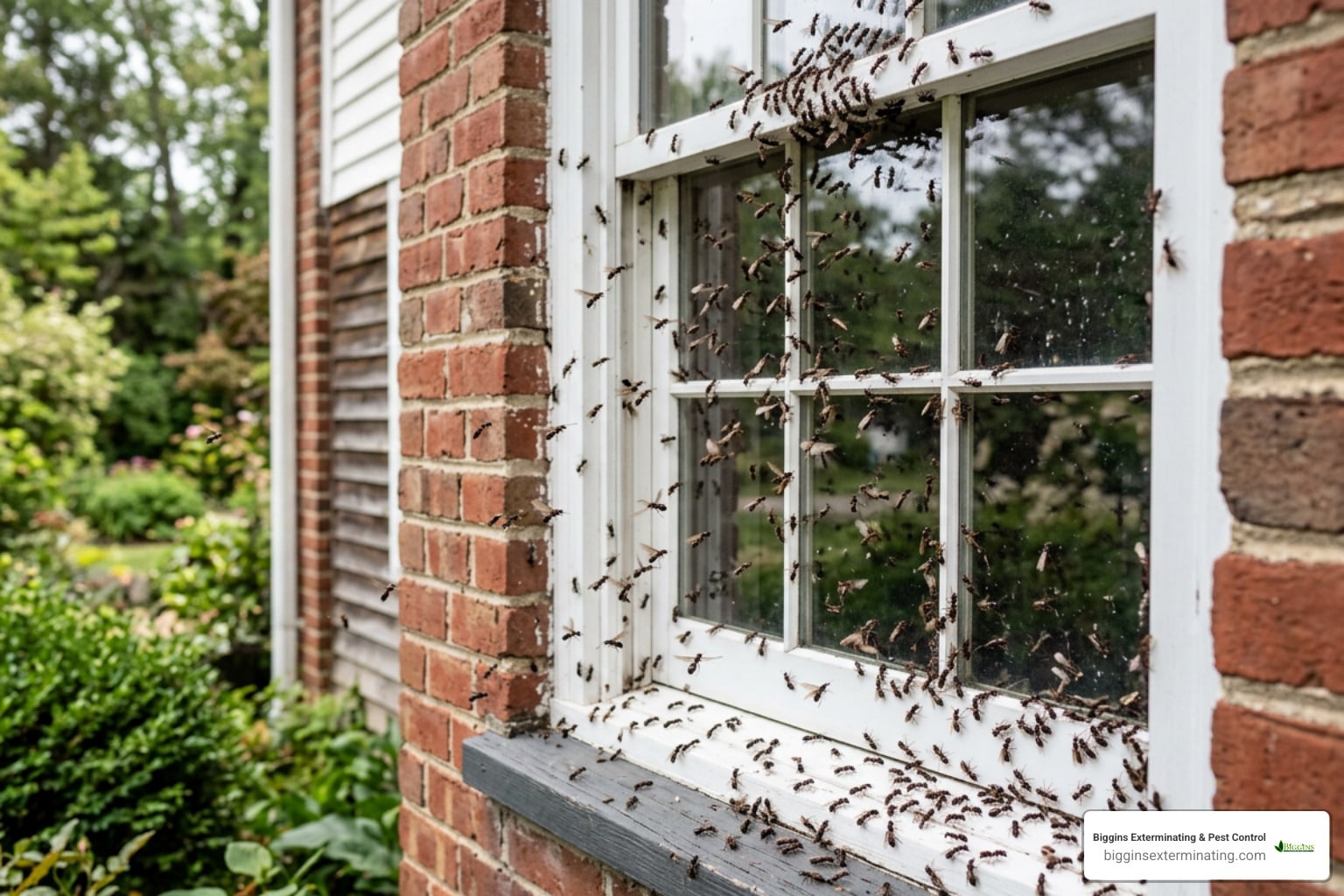
What Flying Carpenter Ants in Your Home Are Really Telling You
Flying carpenter ant control starts with understanding one key fact: winged carpenter ants aren’t a random nuisance — they’re a warning signal.
Here’s a quick summary of what to do if you’re seeing flying carpenter ants right now:
- Don’t just swat them — their presence means a mature colony is nearby
- Look for sawdust piles and moisture damage near windows, walls, and wood beams
- Avoid repellent sprays — they scatter the colony and make it harder to eliminate
- Inspect at dusk when carpenter ants are most active, and trace trails back to the nest
- Call a professional if you find swarmers indoors in spring or early summer — this almost always means a nest is already established in or near your home
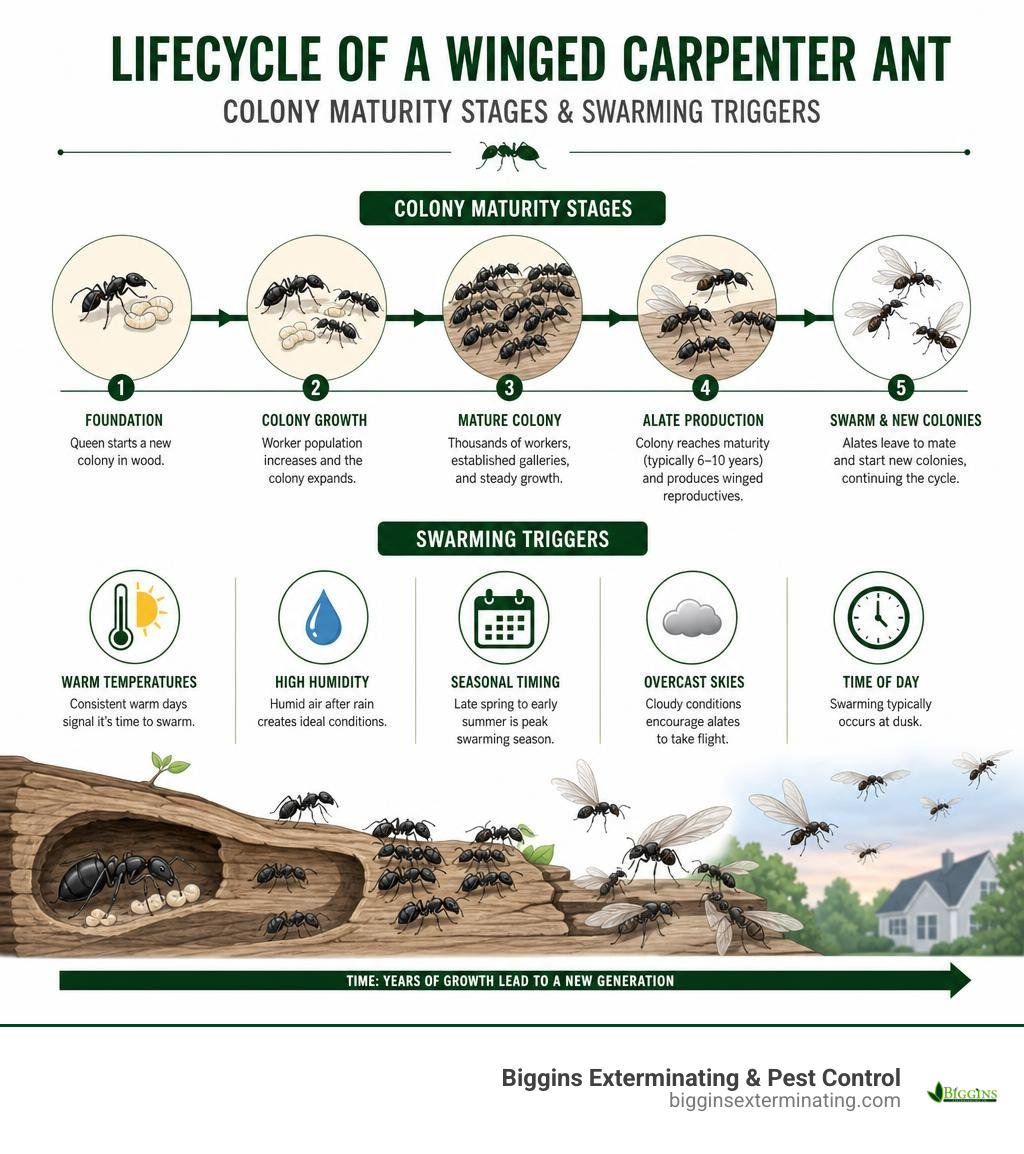
Those winged ants you’re seeing — called alates — are the reproductive members of a mature carpenter ant colony. They swarm to mate and start new colonies. A colony doesn’t produce them until it’s 6 to 10 years old and has grown beyond 2,000 workers. Seeing them inside your home in June 2026 is a strong sign that a colony is already nesting in or very close to your structure, likely in moisture-damaged wood.
This is especially common in Massachusetts during late spring and early summer, when warm, humid days trigger nuptial flights across the Wilmington area and surrounding towns.
I’m Stephen Biggins, owner of Biggins Exterminating Co., a family-owned pest control company serving Massachusetts for over 40 years — and flying carpenter ant control is one of the most common calls we get every spring. I’ll walk you through exactly what these ants mean, how to find the source, and when it’s time to call in a professional.
Glossary for flying carpenter ant control:
What Are Flying Carpenter Ants and Why Do They Swarm?
To understand how to handle these pests, we first need to look at who they are. Not all carpenter ants have wings. In fact, the vast majority of the ants in a colony are wingless female workers who spend their nights foraging for food and excavating wood.
The ones with wings are the elite class: the reproductives, or “alates.”
A colony doesn’t just start producing these winged flyers on a whim. According to scientific research on carpenter ant biology, a colony must reach maturity before it can support a reproductive caste. This process typically takes between 6 to 10 years, when the colony’s population exceeds 2,000 to 10,000 workers.
When conditions are just right — usually on a warm, humid day in spring or early summer, often right after a heavy rain — the colony releases these winged warriors. This event is called a “nuptial flight.” The sole purpose of these ants is to take to the air, mate, and then find a new piece of damp, decaying wood to start a brand-new colony.
Many homeowners ask us: Do Carpenter Ants Have Wings all year round? The answer is no. They only grow wings for this brief mating season. Once the female mates, she sheds her wings to establish her new nest as the queen, while the males die shortly after completing their flight.
If you see these winged ants outdoors in towns like Andover, MA, or Billerica, MA, they might just be passing through from a nearby tree stump. But if you see hundreds of them suddenly emerging inside your living room or bathroom, it’s a clear warning that there is a mature, long-established parent colony or major satellite nest living inside your home’s walls.
Flying Ants vs. Termites: How to Tell the Difference
One of the most stressful moments for any homeowner in Woburn, MA, or Lexington, MA, is seeing a swarm of winged insects inside the house. The immediate panic is almost always: “Do I have termites, or do I have flying ants?”
While both can cause structural damage to your home, termites pose a much faster, more severe threat to the structural integrity of your property. Fortunately, you don’t need a PhD in entomology to tell them apart. You just need to look closely at three key physical features: their antennae, their waist, and their wings.
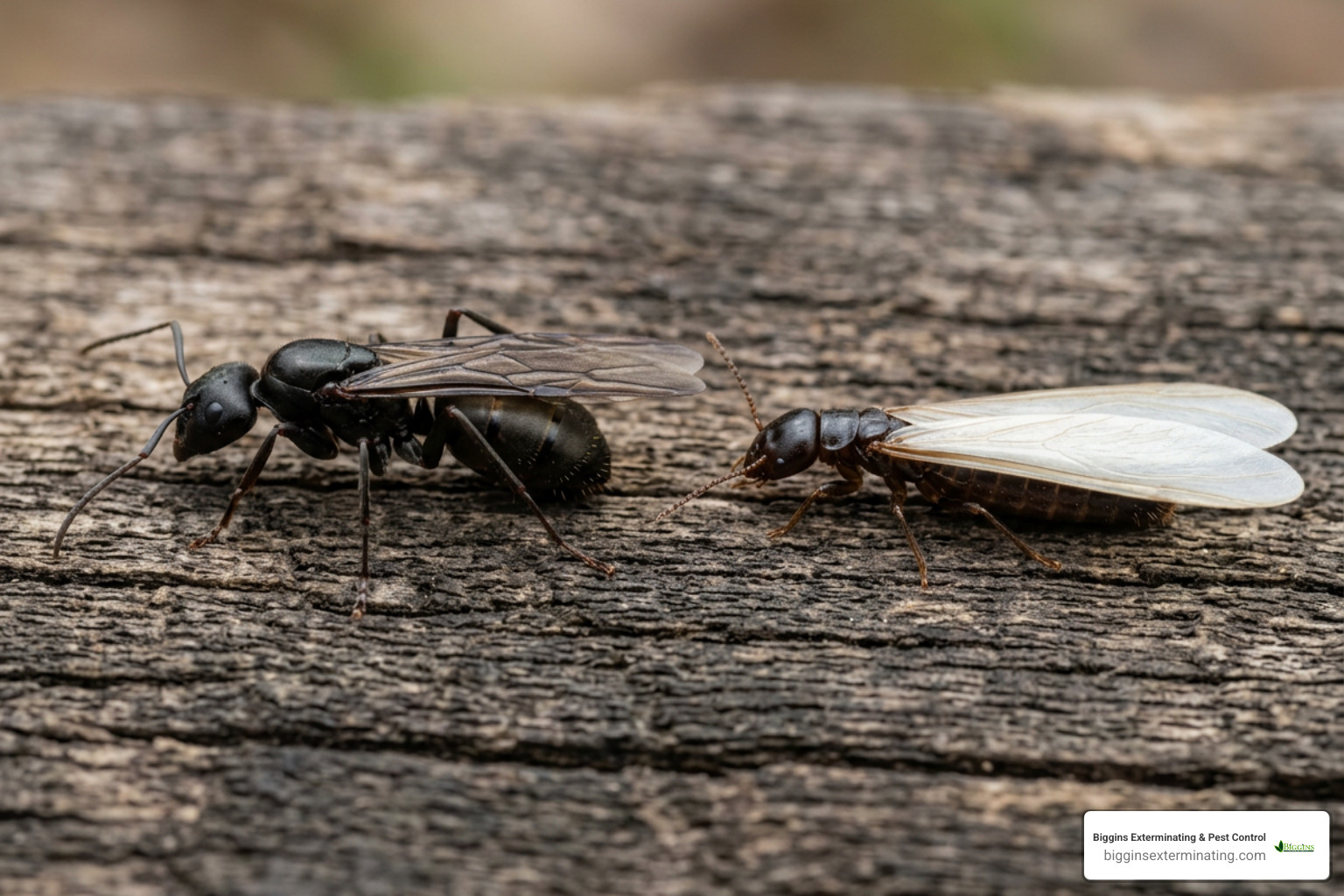
Here are the details on how they differ:
- Antennae: Carpenter ants have “elbowed” or bent antennae. Termite antennae are completely straight and look like tiny strings of beads.
- Waist: Ants have a very distinct, pinched “wasp waist” (a narrow petiolar node between the thorax and abdomen). Termites have a broad, thick waist, making their bodies look like one continuous tube.
- Wings: Both pests have two pairs of wings. However, a flying ant’s front wings are significantly larger than its hind wings. A termite’s wings are all exactly the same size and length, and they are much longer than their bodies. Termite wings are also incredibly fragile and drop off easily, often leaving piles of discarded wings on window sills.
To make this even easier to visualize, we’ve broken down these physical differences in the table below:
| Feature | Flying Carpenter Ant | Flying Termite (Swarmer) |
|---|---|---|
| Antennae | Elbowed (bent at an angle) | Straight (like a string of beads) |
| Waist | Pinched, narrow “wasp” waist | Broad, thick waist |
| Wings | Unequal length (front wings are larger) | Equal length (all four wings are identical) |
| Body Color | Usually dark black, dark brown, or reddish | Dark brown to black |
| Diet | Sugar, proteins, and honeydew (does not eat wood) | Cellulose (actually eats and digests wood) |
For a more detailed breakdown of these differences, check out our guide on the 5 Key Differences Carpenter Ants vs Termites.
Why You Need Professional Flying Carpenter Ant Control
It is tempting to think that a quick vacuum job or a can of store-bought bug spray is all you need for flying carpenter ant control. But treating only the winged ants you see is like trying to put out a house fire by blowing out a candle.
Winged ants represent less than 5% of the actual colony population. The real threat lies deep inside your walls, where the wingless workers are constantly chewing through your home’s structural wood to build their nesting galleries.
Unlike termites, carpenter ants do not eat wood. Instead, they act like tiny, relentless woodworkers, chewing out smooth, clean tunnels to create space for their growing families. They prefer damp, water-damaged wood because it is softer and easier to excavate. Over time, this excavation can severely weaken the wooden studs, roof rafters, and floor joists of your home, leading to costly structural repairs.
When you see a swarm, you are looking at the overflow of a massive network. Carpenter ant colonies are highly organized and often consist of a “parent colony” (usually located outdoors in a damp tree stump, log, or woodpile) and several “satellite nests” (often located indoors near moisture sources like leaky pipes, window frames, or roof valleys).
If you want to protect your home, you must eliminate the entire network — especially the queen in the parent nest. To understand how these networks function, read more about what a Carpenter Ant Infestation in House looks like.
The Limitations of DIY Flying Carpenter Ant Control
We understand the urge to handle pest problems yourself. However, when it comes to winged carpenter ants, DIY methods almost always fall short. Here is why:
- Vacuuming is only a temporary fix: Sucking up the flying ants with a vacuum cleaner gets them out of your sight, but it does absolutely nothing to stop the thousands of workers still nesting inside your walls.
- Repellent sprays make the problem worse: Standard over-the-counter chemical sprays are “repellents.” When you spray them, the ants detect the chemical and scatter. This often causes the colony to split up and relocate to other areas of your home, a process known as “budding.”
- Standard baits often fail: Carpenter ants have incredibly varied and complex diets that change depending on the season. A bait they love in April might be completely ignored in June. If you don’t use professional-grade, non-repellent baits, the ants will simply walk right past them. For more details on this, you can read How to Get Rid of Flying Carpenter Ants? to see how complex their feeding habits really are.
When to Call an Expert for Flying Carpenter Ant Control
If you live in Wilmington, MA, or surrounding towns like Tewksbury or North Reading, and you see winged carpenter ants inside your home, it is time to call in the experts.
Professional pest control technicians have the training, experience, and specialized equipment needed to locate the hidden parent colony and satellite nests. At Biggins Exterminating, we use professional-grade, non-repellent liquid treatments and insecticidal dusts. Because these treatments are undetectable to the ants, the workers walk through them and carry the active ingredients back to the heart of the nest, eliminating the queen and the entire colony permanently.
Locating the Source: Finding the Parent and Satellite Nests
The hardest part of flying carpenter ant control is finding where they are hiding. Because carpenter ants are primarily nocturnal, they do most of their work while you are asleep.
However, they do leave behind clues. If you suspect an infestation, look for these common signs:
- Sawdust piles (Frass): Unlike termites, who leave behind mud tubes, carpenter ants leave behind “frass.” This looks like small piles of coarse sawdust, but if you look closely, it also contains tiny fragments of dead insects and dirt that the ants have swept out of their clean nests.
- Rustling noises: If you tap on a wall void where a nest is located, you can sometimes hear a faint, dry rustling sound. This is the sound of thousands of tiny ant legs scurrying around in panic.
- Moisture leaks: Carpenter ants are obsessed with moisture. Check around window frames, roof eaves, under sinks, and behind bathtubs. Any wood that has been softened by a slow plumbing leak or rainwater is a prime target for a satellite nest.

To get a complete step-by-step guide on how we track down these pests, take a look at our resource on how to Find Carpenter Ant Nest.
Preventing Future Winged Carpenter Ant Swarms
Once we help you clear out an active infestation, the next step is making sure they never come back. Prevention is all about eliminating the food, water, and wood that attract them in the first place.
Here are the most effective steps you can take to protect your home:
- Control the Moisture: Since carpenter ants need wet wood to establish nests easily, fix any plumbing leaks immediately. Ensure your gutters are clean and draining water away from your foundation, and keep your attic and crawl spaces well-ventilated.
- Seal Entry Points: Use silicone caulk to seal cracks in your foundation, gaps around utility lines, and spaces around window and door frames.
- Trim Your Trees: Carpenter ants love to use overhanging tree branches as highway systems to crawl onto your roof. Trim all bushes and tree branches so they are at least two feet away from your home.
- Store Firewood Properly: Keep firewood piles stacked off the ground and at least 20 feet away from your home. Never bring firewood indoors until you are ready to throw it directly onto the fire.
For a complete blueprint on keeping your home safe year-round, read our Carpenter Ant Prevention Ultimate Guide.
Frequently Asked Questions about Winged Ants
Do flying carpenter ants bite humans?
Yes, carpenter ants can bite if they feel threatened. Because they are the largest pest ants in the United States, their mandibles are strong enough to pinch human skin and cause a mild, sharp pain.
However, they do not have a stinger, and they are not venomous. When they bite, they may spray a small amount of formic acid into the pinch, which can cause a mild, temporary burning sensation.
To learn more about what to do if you get nipped, check out our guide: Do Carpenter Ants Bite.
What does seeing flying ants inside in June 2026 mean?
If you are seeing winged ants inside your home in June 2026, it is a strong indicator of an active, mature indoor nest.
Because nuptial flights require specific outdoor weather conditions, ants nesting outdoors will swarm outside. If they are swarming inside your hallways or kitchen, it means they emerged directly from a nest hidden within your walls, attic, or crawl space and got trapped indoors while trying to fly away.
How much does professional carpenter ant extermination cost?
The cost of professional carpenter ant control varies widely based on the size of your home, the severity of the infestation, and how many satellite nests need to be treated.
Based on publicly available internet data, the average cost for professional treatment ranges from $150 to $1,800 or more. A simple exterior preventative barrier on a small home sits at the lower end of that range, while extensive structural treatments that require drilling into wall voids and treating multiple satellite nests in a large home make up the higher end.
At Biggins Exterminating, we believe in complete transparency. We provide thorough, contract-free inspections to give you an accurate, honest quote tailored specifically to your home.
Conclusion
Finding flying carpenter ants in your home can be incredibly stressful, but you don’t have to fight this battle alone.
At Biggins Exterminating & Pest Control, we are a local, family-owned and operated company based right here in Wilmington, MA. For over 40 years, we have helped our neighbors in Andover, Bedford, Billerica, Burlington, Lexington, North Reading, Tewksbury, Wilmington, and Woburn reclaim their homes from pests.
We don’t believe in forcing our customers into long-term, expensive contracts. Instead, we rely on our high-quality service, reliable warranties, and guaranteed customer satisfaction to keep your home pest-free.
If you’re ready to evict these winged invaders for good, explore More info about professional carpenter ant services and give us a call today!