
Why Bedford Homeowners Need Professional Rodent Solutions
Rodent removal Bedford MA requires professional expertise to protect your home from damage and health risks. If you’re dealing with unwanted rodents, here’s what you need to know:
Quick Action Steps:
- Identify the problem – Look for droppings, gnaw marks, and scratching sounds
- Contact professionals – Licensed technicians inspect and assess the infestation
- Remove active rodents – Through humane trapping and exclusion methods
- Seal entry points – Prevent future invasions with steel mesh and caulking
- Clean and sanitize – Remove contaminated materials and odors
- Schedule follow-ups – Ensure long-term protection with monitoring visits
Bedford’s wooded landscape and seasonal temperature changes make local homes particularly vulnerable to rodent invasions. Mice and rats seek shelter indoors during cold months, entering through gaps as small as a quarter inch. These pests multiply rapidly—a single female mouse can produce up to 60 offspring per year.
The stakes are high. Rodents chew through electrical wiring (creating fire hazards), contaminate food with disease-carrying droppings, and cause expensive structural damage. Their presence also attracts secondary pests like fleas and ticks into your living space.
Professional removal goes beyond setting a few traps. It involves thorough inspection, species identification, strategic trapping, complete exclusion work, and follow-up maintenance to keep your home rodent-free year-round.
I’m Stephen Biggins, and I’ve spent decades helping Bedford families reclaim their homes from rodent infestations through rodent removal Bedford MA services. At Biggins Exterminating, our family-owned approach combines 40+ years of local expertise with proven methods that protect both your property and your peace of mind.
Rodent removal Bedford MA word guide:
Identifying Common Rodents in Bedford, MA Homes
Bedford is a beautiful town, but its proximity to conservation land and wooded areas means we share our environment with a variety of clever critters. When the Massachusetts winter hits, these animals don’t just “go away”—they look for the same things we do: warmth, food, and a dry place to sleep. Unfortunately, your attic or crawlspace often fits the bill perfectly.

House Mice
The most common intruder we see in Bedford is the House Mouse. These small, grayish-brown rodents are incredibly agile. They can squeeze through a hole the size of a dime. Because they are curious by nature, they tend to explore every nook and cranny of your kitchen, often nesting near heat sources like the back of a refrigerator or inside oven insulation.
Deer Mice
Often found in more rural or heavily wooded parts of Bedford, Deer Mice have distinct white underbellies and large ears. While they look “cuter” than house mice, they are significant carriers of Hantavirus. They are known for “caching” or hiding large amounts of seeds and nuts in wall voids or boots left in the garage.
Norway Rats
Also known as brown rats or sewer rats, these are the heavyweights of the rodent world in Massachusetts. They are excellent diggers and often burrow underneath foundations or concrete slabs. If you see large holes in the soil near your home’s perimeter, you might be dealing with a Norway rat.
Roof Rats
While less common than Norway rats, Roof Rats are expert climbers. They prefer the upper levels of a home, such as the attic or the space above a drop ceiling. They are sleek, dark, and use overhanging tree limbs as highways to reach your roofline.
Gray Squirrels
While many people think of squirrels as “outdoor” animals, they are members of the rodent family and frequently cause havoc in Bedford attics. They are most active during the day, so if you hear scurrying or “rolling” sounds (like acorns being moved) during the morning hours, it’s likely a squirrel rather than a nocturnal mouse or rat.
Comparing Mice and Rats
It is important to know which guest you are hosting, as the strategies for removal differ significantly.
| Feature | House Mouse | Norway Rat |
|---|---|---|
| Size | 2.5–3.5 inches (body) | 7–10 inches (body) |
| Tail | Long, thin, slightly hairy | Thick, scaly, shorter than body |
| Droppings | Small, pointed (like grains of rice) | Large, capsule-shaped (blunt ends) |
| Behavior | Curious and social | Wary and cautious (Neophobic) |
| Entry Point | Dime-sized hole | Quarter-sized hole |
Signs of an Infestation
You don’t always have to see a rodent to know you have a problem. In fact, because they are mostly nocturnal, you usually won’t see them until the population has grown quite large. Keep an eye (and ear) out for these tell-tale signs:
- Droppings: This is usually the first sign. Fresh droppings are dark and moist, while older ones are gray and crumble when touched.
- Gnaw Marks: Rodents have teeth that never stop growing, so they must chew constantly. Look for teeth marks on food packaging, wooden baseboards, or plastic pipes.
- Scratching Noises: If you hear thumping or scurrying in the walls or ceiling at night, it’s a major red flag.
- Nesting Materials: Finding shredded paper, fabric, or dried plant matter in corners or drawers indicates a nest is nearby.
- Greasy Rub Marks: Rats and mice have oily fur. As they run along walls, they leave dark, greasy “smudge” marks on the baseboards.
If you’ve noticed any of these signs, it’s time to look into rodent control services to prevent a small problem from becoming a full-blown infestation.
The Importance of Professional Rodent Removal Bedford MA
Many homeowners try the “DIY” route first, buying a few wooden snap traps at the local hardware store. While this might catch one or two “scouts,” it rarely solves the underlying issue. Professional rodent removal Bedford MA is essential because rodents are biologically programmed to survive and thrive in human environments.
Property Damage and Fire Hazards
The damage rodents cause is more than just cosmetic. Their constant need to gnaw can lead to devastating consequences:
- Electrical Fires: It is estimated that a significant percentage of “undetermined” house fires are actually caused by rodents chewing through the insulation on electrical wires.
- Structural Integrity: Rats can chew through wood, plastic, and even soft metals like lead and aluminum. This can weaken support beams and damage expensive PVC plumbing.
- Insulation Destruction: Rodents love to nest in fiberglass or cellulose insulation. Once they move in, they soil the material with urine and feces, destroying its R-value and creating a foul odor that permeates the home.
For a deeper dive into why you shouldn’t wait, check out the top 5 dangers of rodents in and around your home or business.
Health Risks and Property Damage
The biological hazards rodents bring into a Bedford home are significant. They are vectors for various diseases and parasites:
- Salmonella: Spread through contact with rodent droppings or urine, particularly in kitchen areas.
- Hantavirus: Primarily spread by Deer Mice; this can be contracted by breathing in dust contaminated with rodent waste.
- Leptospirosis: A bacterial disease that can be transmitted through contact with water or soil contaminated by rodent urine.
- Rabies: While rare in small rodents, larger wildlife like raccoons or bats (which often follow similar entry paths) are known carriers of rabies.
- Parasites: Rodents act as transport for fleas, ticks, and mites. Even if you don’t have pets, a rodent infestation can lead to a secondary flea or tick problem in your carpets and upholstery.
Effective Methods for Rodent Removal Bedford MA
We don’t believe in “one-size-fits-all” solutions. Our approach to rodent removal Bedford MA involves a combination of high-tech tools and old-fashioned detective work.
- Humane Trapping: We use strategically placed traps that are designed to be effective while minimizing unnecessary suffering.
- Exclusion Techniques: This is the most important step. We identify every possible entry point—from gaps in the foundation to holes in the roofline—and seal them using “rodent-proof” materials like steel mesh and professional-grade caulking.
- Baiting Systems: In some cases, exterior baiting stations are used to reduce the local rodent population before they ever have a chance to enter your home.
- Integrated Pest Management (IPM): This is a holistic approach that focuses on sanitation, habitat modification, and long-term prevention rather than just relying on chemicals.
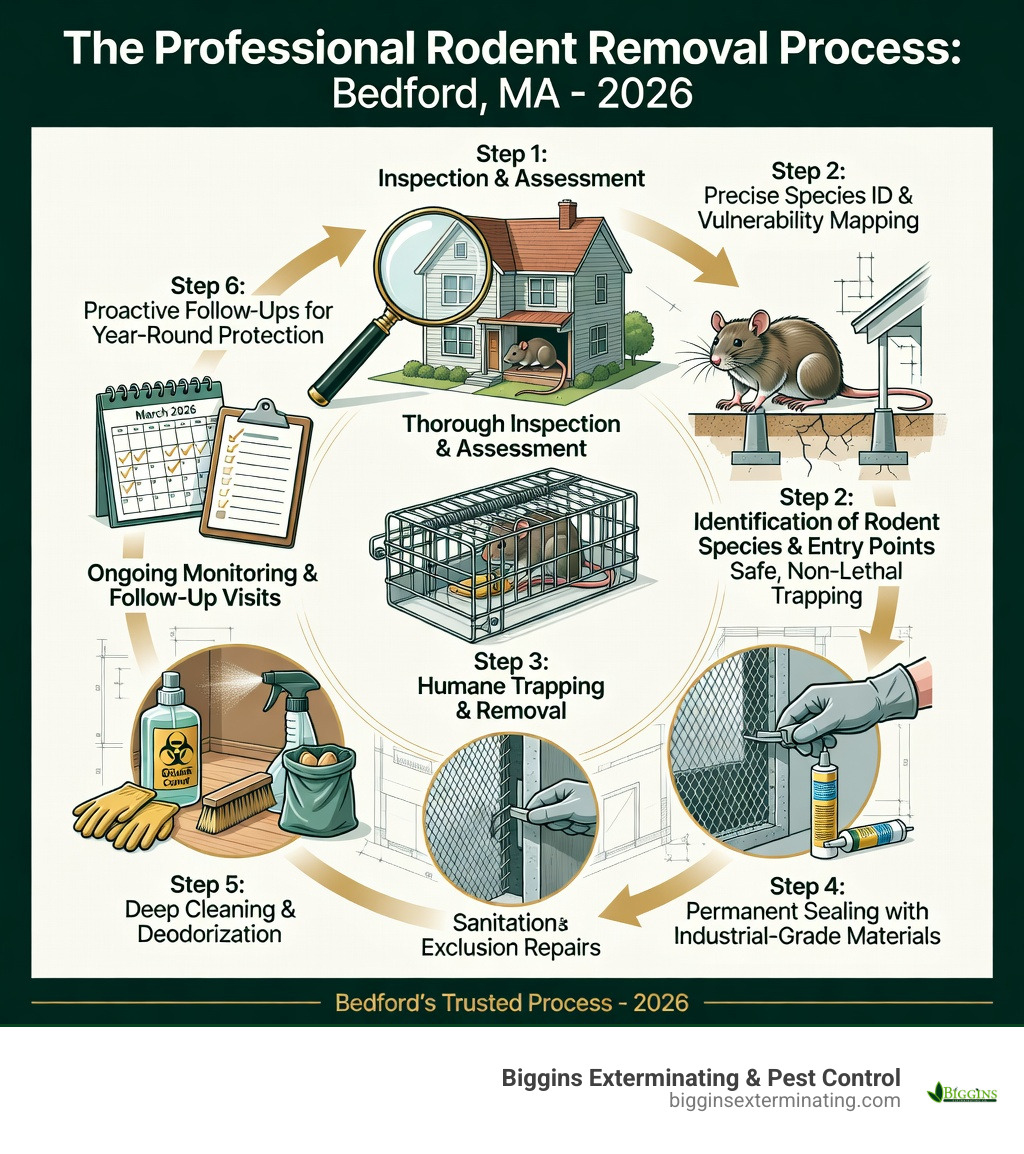
The Professional Removal Process: From Inspection to Follow-Up
When you call us for rodent removal Bedford MA, we follow a rigorous process to ensure the job is done right the first time. We aren’t just here to set traps; we’re here to provide a permanent solution.
1. Interior Inspection
Our technicians perform a “white glove” inspection of your home’s interior. We look behind appliances, inside pantries, and deep into the corners of your basement or crawlspace. We are looking for “hot spots”—areas where rodents are actively feeding or nesting.
2. Exterior Assessment
Rodents don’t just appear out of thin air; they come from outside. We walk the entire perimeter of your property, checking for gaps in the siding, holes around utility pipes, and branches that are touching the roof. This exterior assessment is the foundation of our exclusion plan.
3. Entry Point Identification
Once we find the holes, we mark them for repair. A mouse can enter through a gap the size of a pencil’s diameter. We pay special attention to the “sill plate” (where the house meets the foundation) and the “corner posts” of your siding, which are common highways for mice.
4. Customized Treatment Plans
Every home in Bedford is different. Based on our findings, we create a plan that might involve trapping, baiting, or a combination of both. We also provide you with a list of “homework” items, such as moving woodpiles away from the house or securing bird feeders.
5. Monitoring and Follow-Up
We don’t just walk away once the traps are set. We return for follow-up visits to check progress, remove any captured rodents, and ensure that our exclusion repairs are holding up. This monitoring phase is crucial for confirming that the “resident” population has been completely eliminated.
Long-Term Prevention and Damage Remediation
Removing the rodents is only half the battle. To truly protect your home, you must address the mess they left behind and ensure they can’t get back in.
Sanitization and Odor Control
Rodent waste contains pheromones that actually attract other rodents. If you don’t clean up the mess properly, you are essentially leaving a “vacancy” sign out for the next family of mice. We use professional-grade sanitizers to neutralize odors and kill bacteria left in nesting areas.
Attic Cleanup and Insulation Replacement
In cases of severe infestation, the insulation in your attic may be so contaminated that it needs to be removed and replaced. This not only removes the health hazard but also restores your home’s energy efficiency. We can guide you through the process of identifying when a full “attic restoration” is necessary.
For more tips on keeping your property secure, read our guide on how to identify and prevent rodent infestations in Massachusetts.
The Cost of Rodent Removal Bedford MA
We believe in transparency. While every situation is unique, we want to provide you with a general idea of what to expect. Please note that these are average costs based on publicly available internet data and do not reflect Biggins Exterminating’s actual pricing.
The cost of rodent removal Bedford MA can range widely depending on the size of the home, the severity of the infestation, and the amount of structural repair needed.
- Minor Issue: A few traps and basic sealing might range from $150 to $450.
- Average Infestation: Comprehensive trapping and full exclusion for a standard Bedford home typically ranges from $500 to $1,500.
- Major Restoration: If the rodents have caused extensive damage to insulation or require significant structural repairs, costs can exceed $4,500 or more.
For a more detailed breakdown, see our Rodent Treatment Cost Guide 2025.
Frequently Asked Questions
Why do rodents enter Bedford homes in the winter?
It’s all about survival. As the temperature drops in Massachusetts, the natural food sources for rodents—like seeds, berries, and insects—become scarce. At the same time, their metabolic needs increase to stay warm. Your home provides a steady temperature and easy access to crumbs, pet food, and pantry staples. To a mouse, your basement is a five-star hotel.
Can I remove rodents on my own?
While you can certainly buy traps, DIY rodent control is often a game of “Whack-A-Mole.” You might catch the mice that are brave enough to come out in the open, but you won’t reach the nests hidden deep within your walls. Furthermore, handling rodent waste without proper PPE can expose you to serious health hazards. Professionals have the training and equipment to handle infestations safely and thoroughly.
How long does the removal process take?
A typical rodent removal Bedford MA project takes about two to four weeks. The first week focuses on trapping the active population. The second week usually involves completing the exclusion repairs. We then monitor the property for another week or two to ensure no new activity is detected. If the infestation is severe or the property is very large, it may take longer to ensure total elimination.
Conclusion
At Biggins Exterminating & Pest Control, we understand that a rodent problem is more than just a nuisance—it’s a threat to your family’s comfort and safety. As a family-owned and operated company with over 40 years of experience, we take pride in serving our neighbors in Bedford, Wilmington, and the surrounding areas.
We don’t believe in locking you into long-term contracts. Instead, we rely on high-quality service, iron-clad warranties, and a commitment to customer satisfaction to earn your trust. Whether you’re dealing with a single mouse or a major rat problem, we have the expertise to handle it quickly and discreetly.
If you suspect you have a rodent problem, don’t wait for the damage to get worse. Contact the Pest Control Company Near Bedford MA that your neighbors have trusted for four decades. Let us help you say goodbye to rodents for good.
