
Why Mice Are Moving In This Fall
Mice extermination cost typically ranges from $150 to over $1,200 for professional services, depending on the severity of your infestation, property size, and the methods required.
Quick Cost Overview:
| Service Type | Average Cost Range* |
|---|---|
| Initial Inspection | $50 – $150 |
| One-Time Extermination | $250 – $780 |
| Per-Visit Charge | $90 – $150 |
| Severe Infestations | $400 – $1,200+ |
| Annual Prevention Plans | $100 – $250 (initial), $50 – $150 (follow-ups) |
*These are national averages based on internet data, not Biggins Exterminating quotes.
As temperatures drop this fall, mice are actively seeking shelter, food, and warmth inside Massachusetts homes. This seasonal migration happens when outdoor temperatures fall below 50°F, driving rodents indoors through openings as small as a dime.
The problem is more than just annoying sounds. Mice carry over 35 diseases, contaminate food, and cause property damage by chewing through wiring and insulation. A single female mouse can produce up to 120 babies in a year, quickly turning a small issue into a major infestation.
Understanding the cost of mice extermination helps you budget and recognize when DIY solutions are failing, allowing the problem to worsen.
I’m Stephen Biggins, owner of Biggins Exterminating Co. Since 1982, our family business has helped Massachusetts homeowners make informed decisions to protect their families and properties from pests.
Mice extermination cost terms to remember:
The Complete Breakdown of Your Mice Extermination Cost
When you call a pest control company about mice extermination cost, you’re hoping for a simple number. The truth is, every home situation is unique.

Based on national data, most homeowners pay between $175 and $1,200 for professional mouse removal. Some companies charge per visit, with online data showing rates between $90 and $150 per trip, while others bundle services into packages.
These figures represent national averages from internet research, not specific quotes from Biggins Exterminating. We share this to help you understand industry pricing. For a broader look at pest control pricing, see our guide on Pest Control Services Cost.
Key Factors That Determine the Price
Here’s what drives the final cost:
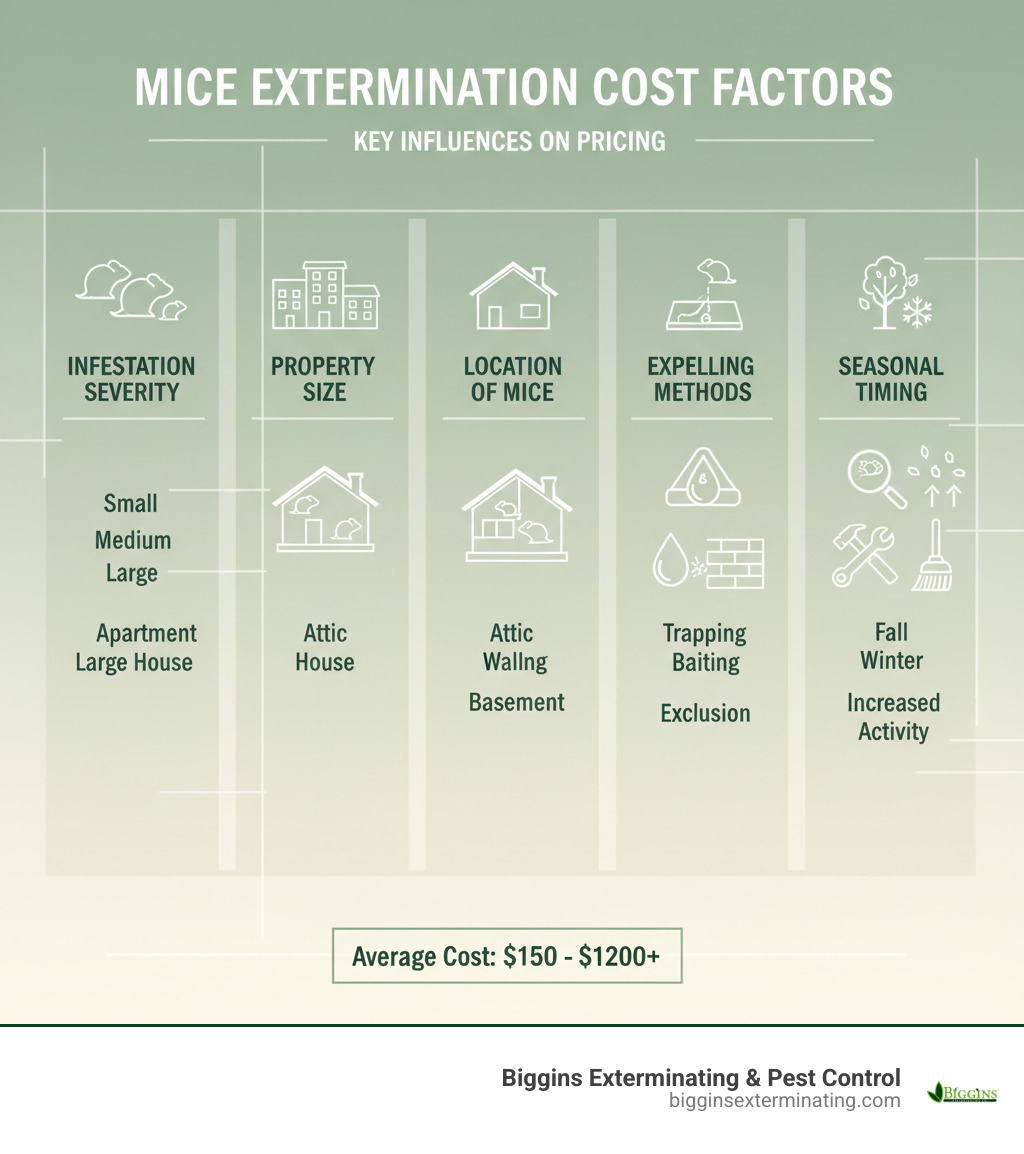
Infestation severity is the biggest factor. A few droppings behind a stove is different from an active nest in your attic. Internet data suggests small infestations might run $100-$500, while severe cases can exceed $1,000 due to the time, materials, and visits needed.
Property size matters. A studio apartment has fewer entry points than a three-story colonial with a basement and attic. Online sources indicate apartments might start around $200, while larger homes can begin at $500 and climb from there.
Where the mice are living impacts difficulty and cost. Mice in a basement are more accessible than those inside walls or deep in attic insulation, which may require specialized equipment. Attics are a popular spot in the fall as mice seek warmth.
Geographic location affects pricing due to local living costs and regulations. Our experience in Massachusetts helps us work efficiently because we know local mouse behavior, especially their fall migration indoors. For local insights, see our guide on How to Identify and Prevent Rodent Infestations in Massachusetts.
The mouse species (e.g., house mice, deer mice) can also influence the strategy, as different species have different habits.
Extermination Methods and Their Impact on Cost
The mice extermination cost varies based on the required approach:
Trapping is effective for small, accessible infestations. The cost reflects the time for setup, monitoring, and removal. Live trapping may require more visits but is a preferred humane option for many.
Baiting is used for larger populations or hard-to-reach areas. We use tamper-resistant bait stations to protect children and pets. The cost includes materials and expert placement.
Exclusion work is crucial for long-term results. We find and seal every potential entry point—gaps around pipes, cracks in foundations, and spaces under doors. This is vital in the fall to prevent new mice from entering. While it adds to the upfront cost, exclusion is the only way to stop the cycle.
We prioritize humane and environmentally responsible options, focusing on live trapping and thorough exclusion to minimize chemical use.
Integrated Pest Management (IPM) is the gold standard, combining inspection, exclusion, and targeted treatment to address root causes. Learn more from Integrated Pest Management (IPM) resources.
Method complexity can vary. Some situations require combining trapping, baiting, and exclusion. Extreme cases might require fumigation, a rare and expensive option that online sources indicate can cost $2,000 to $6,000 for a typical home.
Uncovering Additional Fees and Service Options
Transparency is key. Beyond basic extermination, other costs might apply:
Initial inspection fees are typically $50 to $150 according to internet data, though many companies (including us) offer free inspections with an estimate.
Emergency service fees of $100 to $200 (based on online averages) may apply for immediate help outside business hours.
Damage repair costs can be significant. Chewed wires are a fire hazard, and contaminated insulation may need replacement, potentially running $500 to $1,000 or more according to internet sources.
Deep cleaning and sanitization is needed to remove disease-carrying waste. Professional sanitization typically costs $200 to $400 based on online data.
Guarantees and warranties provide peace of mind. Reputable companies stand by their work, often including free follow-up visits if mice return.
Follow-up visits are usually part of a comprehensive plan. Annual prevention plans offer ongoing protection, with internet sources showing initial visits around $100-$250 and maintenance visits at $50-$150 each. Regular Rodent Control Services prevent small problems from becoming expensive emergencies.
DIY vs. Professional Extermination: A Cost-Benefit Analysis
It’s tempting to handle a mouse problem yourself. DIY seems cheaper and faster, but the initial price tag rarely tells the whole story when it comes to mice extermination cost.
| Feature | DIY Mouse Extermination | Professional Mouse Extermination |
|---|---|---|
| Initial Cost | Low (cost of traps/bait) | Moderate to High (service fees) |
| Effectiveness | Limited, often incomplete, temporary relief | High, comprehensive, long-term solutions |
| Time Invested | High (research, setup, monitoring, disposal) | Low (exterminator handles everything) |
| Safety | Risks of improper pesticide use, handling dead rodents | Safe, trained professionals, pet/child-friendly options |
| Guaranteed? | No | Often includes warranties/guarantees |
| Re-infestation | High likelihood due to incomplete exclusion | Low likelihood with proper exclusion and follow-up |
| Damage Repair | Still your responsibility, potential for more damage | Exterminator can identify damage, offer solutions/referrals |
| Peace of Mind | Often stressful, lingering doubt | High, problem solved by experts |
The True Cost of DIY Mouse Control
Hardware stores offer many mouse control products. Snap traps run about $1 to $30 a pack, live traps cost $5 to $30, and bait stations range from $7 to $35. Electronic traps can cost $30 to $75, while peppermint oil repellents are $5 to $20 per bottle. (These are average costs based on internet data.)
A quick note: we strongly discourage glue traps as they are inhumane.
On paper, DIY looks like a bargain. However, catching one mouse doesn’t solve the problem. That mouse likely has a mate and offspring, and while you’re dealing with one, others are causing damage.
Incomplete removal is the biggest hidden cost of DIY. Unless you find and seal every entry point (as small as a dime), new mice will keep arriving. It’s like bailing water from a boat without plugging the leak.
Then there’s the time investment and safety concerns. Homeowners can accidentally poison pets or expose themselves to diseases like hantavirus and salmonella when handling rodents.
Meanwhile, the mice continue to chew, contaminate, and reproduce. The money saved on professional service could turn into thousands in electrical repairs. This fall, as mice move indoors more aggressively, DIY methods become even less effective. For a detailed look at tackling mice on your own, check our guide on How to Get Rid of House Mice.
When to Call a Professional Exterminator
Some situations are clearly beyond DIY. Call a professional if you see these signs:
- Droppings scattered throughout multiple rooms: This indicates an infestation, not just a few mice.
- Gnaw marks on electrical wires: This is a serious fire hazard. Rodents are responsible for an estimated 20-25% of unexplained house fires.
- Strong, musty odors: A persistent ammonia-like smell indicates urine accumulation in walls or insulation, which poses a health risk.
- Scratching or rustling sounds in walls or ceilings: Nighttime activity means mice are established in your home.
- DIY methods have failed: If you’ve been trying for weeks without success, it’s time for professional help. The mice are winning, and the problem is getting worse.
Sometimes, it’s simply about peace of mind. If you’re asking, “Should I Call an Exterminator If I See a Mouse?“—especially in the fall when one mouse signals more to come—the answer is usually yes. Professional intervention prevents small problems from becoming expensive disasters.
Is Professional Mouse Extermination Worth the Investment?
When weighing the mice extermination cost, it’s easy to focus on the quote. But professional mouse control is an investment in your home’s safety, your family’s health, and your peace of mind. The long-term savings from preventing damage and health risks far outweigh the initial cost.

The High Price of Inaction: Property Damage and Health Risks
Delaying action against mice leads to escalating problems:
- Structural damage: Mice constantly gnaw on wood, pipes, drywall, and personal belongings, shredding items for nesting material.
- Chewed electrical wires: This is a life-threatening fire hazard. Rodents are linked to an estimated 20-25% of unexplained house fires.
- Damaged insulation: Mice tear apart insulation for nests and contaminate it with waste, reducing its effectiveness and increasing your energy bills. Replacing it can be costly, with internet data showing crawl space cleanup alone running $1,500 to $4,000.
- Contaminated food: Anything mice touch in your pantry or on counters is compromised and must be thrown out.
- Disease transmission: The CDC links rodents to over 35 diseases, including Hantavirus and Salmonellosis, spread through contact with mice or their waste. See the CDC’s information on rodent-borne diseases for more.
- Allergies and asthma: Mouse dander and waste can trigger allergic reactions and worsen asthma, especially in children.
The potential costs of these issues can easily run into the thousands, making the professional mice extermination cost a wise investment. Learn more in our article on the Dangers of Rodents in Your Home.
The Value of Expertise and Guaranteed Results
Here’s what you’re paying for with a professional service:
Professional knowledge means we understand mouse behavior and how to find entry points others miss. This expertise leads to effective, long-term solutions. We don’t just set traps; we inspect, eradicate, and perform exclusion work to seal entry points permanently.
Safety for pets and children is our priority. We use products responsibly and place treatments strategically to minimize risk to your family.
The time savings are significant. We handle the dirty work so you can focus on your life, not on battling rodents.
Most importantly, you get the peace of mind that comes with guaranteed results. As a family-owned business with over 40 years of experience, we stand behind our work with warranties. If mice return during the warranty period, so do we—at no extra charge. You can trust our Local Pest Control Experts to deliver a lasting solution.
Frequently Asked Questions about Mice Extermination Cost
After four decades in this business, I’ve heard every question about mice extermination cost. Here are the most common ones.
What is the average mice extermination cost for a one-time service?
Based on internet sources, a one-time, full-service treatment typically ranges from $250 to $780. This usually includes an inspection, treatment (traps or bait stations), and a few follow-up visits to ensure the mice are gone.
However, costs vary. A small infestation in a small home will cost less than a severe problem in a large house with mice in the attic, walls, and basement. Complex situations can exceed $1,000. That’s why we provide a detailed, customized quote. At Biggins Exterminating, we aim to be an Affordable Exterminator without compromising quality.
How do follow-up visits and annual plans affect the mice extermination cost?
Follow-up visits are often essential and may be included in a one-time service package. If extra visits are needed, per-visit charges might apply, which online sources indicate are typically $50 to $150 each.
Annual pest control plans offer long-term prevention. These plans usually start with a comprehensive initial visit (internet data suggests $100 to $250), followed by regular maintenance treatments ($50 to $150 each, based on national averages). An annual plan costs less over time than dealing with repeated infestations and provides year-round peace of mind.
Does homeowners insurance cover mouse extermination?
Unfortunately, the answer is usually no. Most insurance policies view pest control, including the mice extermination cost, as preventable maintenance that is the homeowner’s responsibility.
However, your policy might cover damage caused by the rodents. For example, if mice chew wires and cause a fire, the fire damage may be covered, but the extermination cost would not be. Coverage for things like contaminated food or destroyed insulation varies widely.
My advice is to read your policy carefully or call your insurance agent to clarify what is and isn’t covered regarding rodent damage.
Conclusion: Secure Your Home with a Clear Price and Lasting Solution
As the leaves fall and winter’s chill settles over Massachusetts, mice are looking for exactly what you are — a warm, comfortable place to wait out the cold months. Understanding mice extermination cost puts you in control of the situation, helping you make informed decisions about protecting your home and family without worrying about surprise fees or incomplete solutions.
Throughout this guide, we’ve explored the key factors that influence pricing: the severity of your infestation, the size of your property, where the mice have nested, and the treatment methods required. We’ve also looked at those additional costs that can catch homeowners off guard — inspection fees, damage repair, sanitization, and emergency services. Knowledge of these factors helps you budget appropriately and recognize when you’re getting a fair, comprehensive quote.
The choice between DIY and professional extermination often comes down to more than just initial cost. While a few traps from the hardware store might seem economical, the hidden expenses of incomplete removal, recurring infestations, ongoing damage, and health risks frequently make professional service the smarter investment. You’re not just paying for traps and bait — you’re paying for expertise, guaranteed results, and the peace of mind that comes from knowing the job is done right.
At Biggins Exterminating & Pest Control, we’ve been helping families in the Wilmington, MA area protect their homes for over 40 years. As a family-owned business, we understand the importance of transparency, reliability, and standing behind our work. We proudly serve homeowners in Wilmington, Andover, Bedford, Billerica, Burlington, Lexington, North Reading, Tewksbury, and Woburn with no-contract services and solid warranties.
Don’t let mice turn your home into their winter retreat. For a reliable quote and lasting solution custom to your specific situation, contact our local mouse exterminators today. We’ll assess your situation honestly, explain your options clearly, and help you reclaim your home before the mice settle in for the season.