Understanding the Cicada Killer Challenge
When those massive wasps start hovering around your yard during summer barbecues, panic often follows. As a homeowner, figuring out how to get rid of cicada killers becomes a top priority, even though these insects aren’t quite the villains they appear to be.
I’ve seen countless worried faces over my 40+ years helping Massachusetts families deal with these impressive insects. These wasps might look intimidating at 1.5-2 inches long, but their behavior tells a different story than their appearance suggests.
The challenge with cicada killers is balancing their beneficial role (each female removes dozens of cicadas from your property) against the unsightly soil mounds and intimidation factor they bring. Their preference for sunny, sparse lawns with nearby trees makes many suburban yards perfect real estate for these diggers.
| Quick Solutions for Cicada Killer Control |
|---|
| 1. Apply insecticidal dust directly into nest entrances at dusk or night |
| 2. Pour boiling water into burrows to eliminate adults and larvae |
| 3. Flood burrows with 1:1 ammonia-water solution at night |
| 4. Maintain lawn at 3-4 inches high with weekly deep watering |
| 5. Apply diatomaceous earth around nest entrances for a natural solution |
What makes these wasps particularly challenging is their nesting behavior. Unlike social wasps that build paper nests, cicada killers are solitary diggers, creating extensive underground tunnels in well-drained soil. Each female excavates her own burrow, pushing up distinctive U-shaped soil mounds that can damage turf and create tripping hazards.
While female cicada killers do possess stingers, they’re surprisingly docile toward humans. Unless you directly handle them or step barefoot on one, stings are remarkably rare. The males, though they might dive-bomb you intimidatingly, can’t sting at all—nature’s version of all bark, no bite.
I’m Stephen Biggins, owner of Biggins Exterminating Co., and I’ve spent decades developing effective, environmentally responsible approaches to how to get rid of cicada killers. My experience has taught me that successful control requires understanding their lifecycle and habits, not just reaching for the strongest chemicals available.
Before we dive into detailed solutions, it’s worth noting that cicada killers are active primarily in July through September. This timing coincides with adult cicada emergence—their preferred prey. Understanding this seasonal pattern helps target control efforts when they’ll be most effective.
The good news? With the right approach, you can reclaim your yard from these impressive but unwelcome guests. Whether you prefer natural deterrents or need faster chemical solutions, we’ve got you covered with proven strategies that work.
Related content about how to get rid of cicada killers:
– cicada killer repellent
– cicada wasp nest
Cicada Killer 101: Identification & Biology
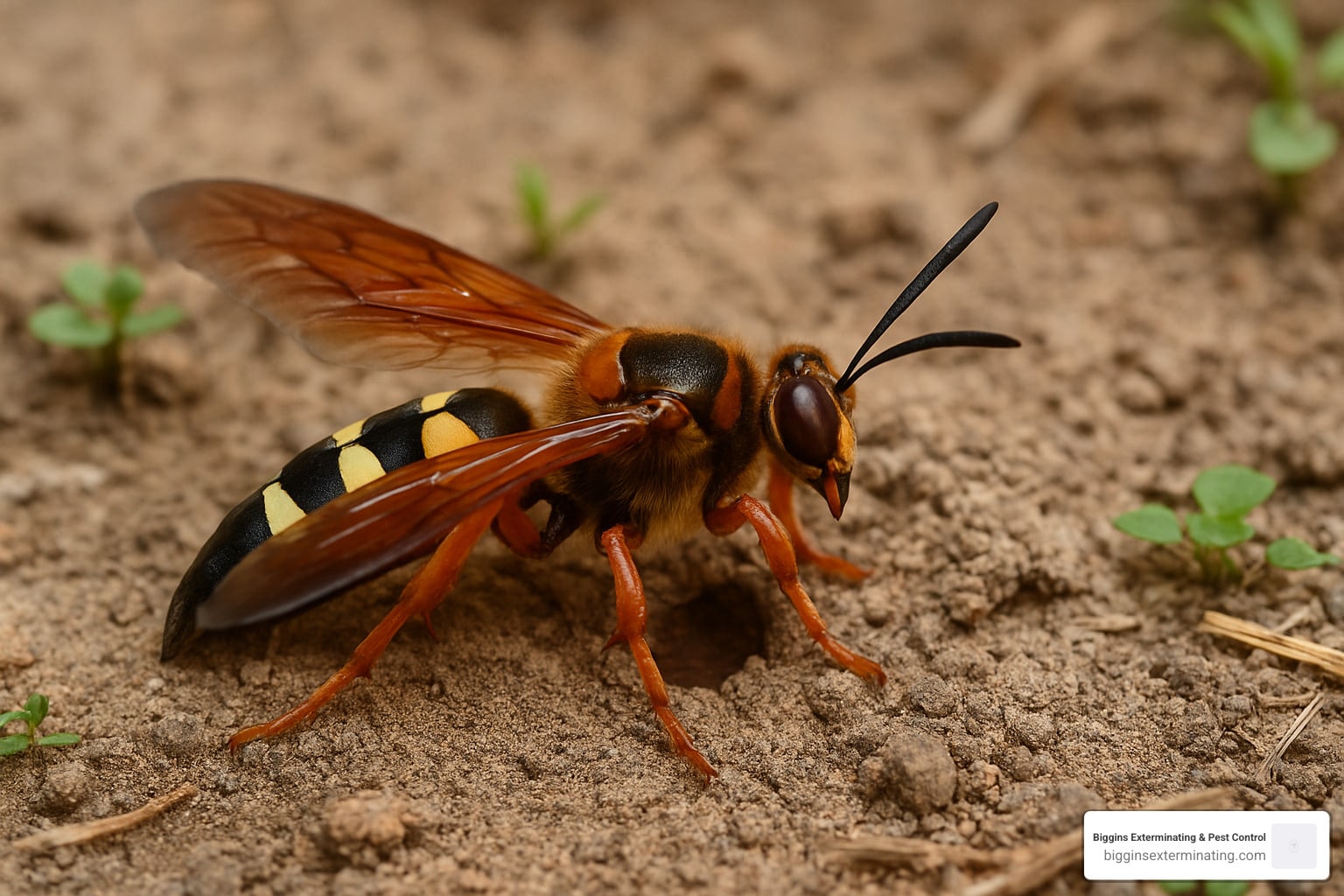
Want to know what’s buzzing around your yard? Before you can tackle those intimidating wasps, you need to know your enemy. Cicada killers (Sphecius speciosus) are nature’s own cicada control specialists, with some distinctive features that make them easy to spot.
These impressive insects are hard to miss with their thumb-sized bodies stretching 1.5 to 2 inches long. Look for their rusty-red head and thorax paired with amber-colored wings that catch the sunlight. Their black abdomen sports bright yellow bands that serve as nature’s warning coloration.
“We often get calls from homeowners describing them as ‘the biggest yellow jacket I’ve ever seen in my life!'” says our senior technician at Biggins Exterminating. “That size alone is usually enough to identify them.”
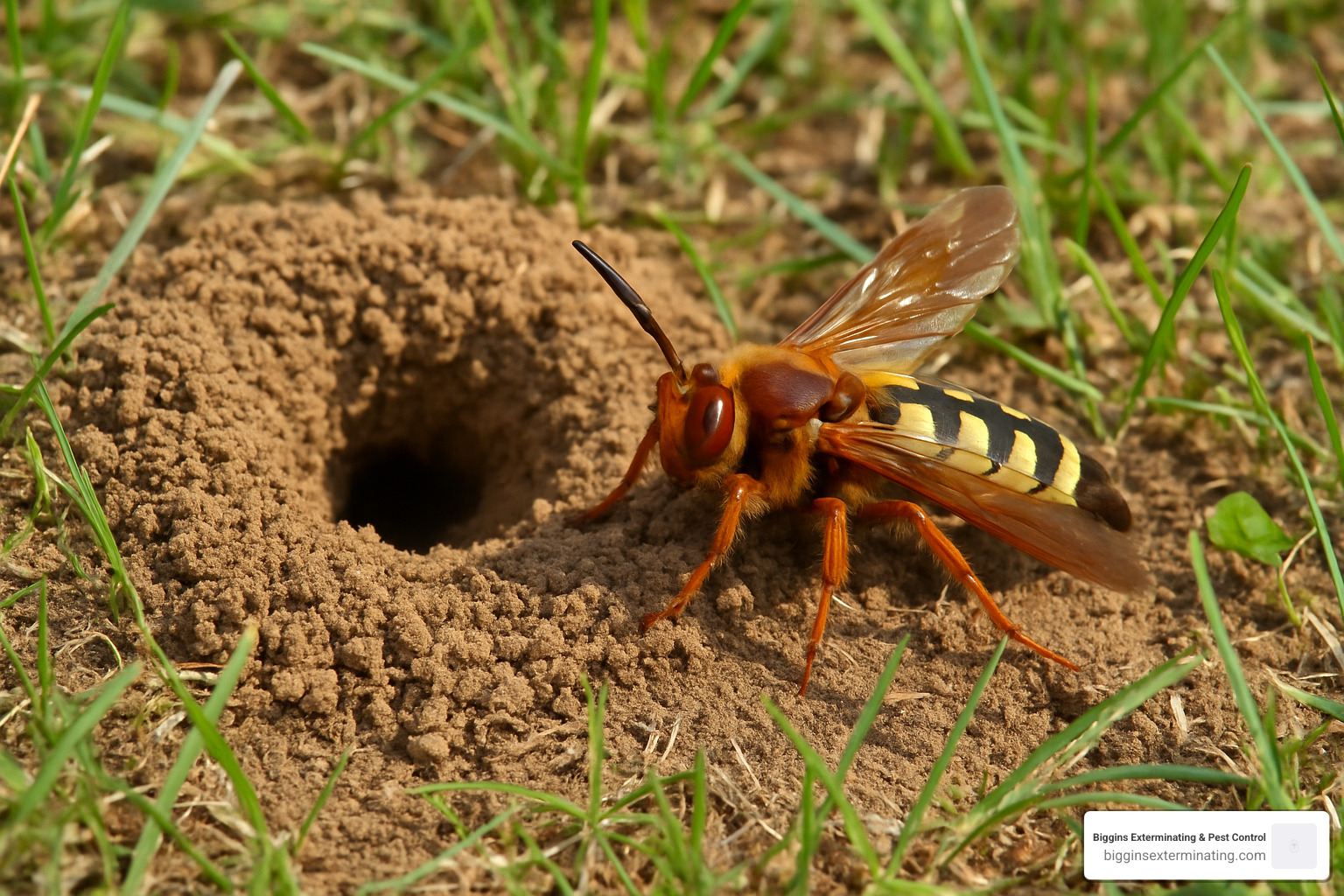
Unlike social wasps that build paper condominiums in trees, cicada killers are solitary ground-dwellers. Each female is her own contractor, digging an impressive underground tunnel system with a distinctive U-shaped collar of loose soil around the entrance. These aren’t simple holes – they’re engineering marvels extending 30-70 inches horizontally and plunging 12-15 inches below your lawn’s surface.
Inside these subterranean nurseries, female wasps create about 15 egg-shaped side chambers. Each chamber becomes a fully-stocked pantry containing 1-3 paralyzed cicadas and a single egg. Talk about meal prep! This ensures the developing larva has plenty to eat after hatching.
The good news? There’s only one generation of cicada killers each year. After a brief mid-summer romance, males die within a couple of weeks. Females live slightly longer (about 4 weeks) to complete their nest provisioning before they too pass on. The eggs they’ve laid develop into larvae, overwinter snugly in silken cocoons, and emerge as adults when summer returns.
For more scientific details on these fascinating insects, check out research on cicada-killer ecology from entomologists who study them professionally.
Look-Alikes You Might Mistake Them For
“Is that a murder hornet?!” We hear this question a lot, but rest easy – it’s probably not. Cicada killers are commonly confused with several other large wasps and bees:
European Hornets are slightly smaller (1-1.5 inches) with brown and yellow striped bodies rather than black and yellow. They build paper nests in trees or structures and defend their colonies much more aggressively than solitary cicada killers.
The infamous Asian Giant Hornets (incorrectly nicknamed “murder hornets”) aren’t established in Massachusetts or most of the US. They build aerial paper nests, not ground burrows, and have distinctive orange heads. As one expert from Purdue University puts it, they’re more like yellowjackets on steroids than cicada killers.
Carpenter Bees match cicada killers in size but sport shiny, hairless abdomens. They hover steadily in place (often near wooden structures) and drill perfectly circular holes in wood, not soil.
The easiest way to identify cicada killers? Check where they’re nesting (always in the ground) and watch their flight pattern. Cicada killers typically fly in low, searching patterns over lawns and rarely hover in one spot for long.
Life-Cycle Timing That Affects Control
Timing is everything when it comes to how to get rid of cicada killers. Their life cycle follows a predictable pattern:
Their eggs hatch quickly, just 2-4 days after being laid. The hungry larvae then feast on paralyzed cicadas for about 10-14 days before spinning silken cocoons to overwinter underground. When soil temperatures warm in July, adults emerge ready to start the cycle again. Their activity period typically runs through late August or early September.
“Temperature is the key trigger for cicada killer emergence,” explains our entomologist. “They typically appear about two weeks after the first cicadas start singing in your area.”
This predictable timing creates specific windows for effective control:
– Early Spring: Treat soil before adults emerge
– July-August: Target active adults and newly created burrows
– September: Seal abandoned burrows to prevent reuse next season
Understanding these biological basics helps you identify the right approach and timing for your cicada killer control plan. In the coming sections, we’ll explore exactly how dangerous these wasps really are and the most effective ways to reclaim your yard.
Are Cicada Killers Dangerous? Separating Myth from Reality
Those massive wasps buzzing around your yard look terrifying, but are they actually dangerous? Let’s put your mind at ease with some facts about these impressive insects.
Despite their intimidating size and behavior, cicada killers pose minimal danger to humans and pets. The males might seem aggressive as they dive-bomb anything that moves in their territory, but here’s the surprising truth: they can’t sting at all! That’s right—male cicada killers completely lack stingers, making their intimidation tactics all show and no substance.
Female cicada killers do have stingers, but they’re remarkably reluctant to use them. Unlike yellow jackets or hornets that aggressively defend their nests, a female cicada killer will only sting if physically grabbed or stepped on. Even then, their venom is quite mild compared to other stinging insects.
“In my 40 years of pest control work, I’ve only seen a handful of people actually stung by cicada killers,” says Stephen Biggins, owner of Biggins Exterminating. “They’re much more focused on hunting cicadas than bothering humans.”
When pets encounter cicada killers, it usually results in what we call a “single learning experience.” Dogs or cats that try to catch a female wasp typically get stung once and then wisely avoid them forever after. The sting causes momentary pain for most pets, though allergic reactions are possible but rare.
The real “danger” of cicada killers is largely psychological—their huge size (up to 2 inches!) and loud buzzing trigger our instinctive fear responses even though they’re unlikely to cause harm. Many homeowners describe them as “absolutely terrifying” despite their generally peaceful nature.
As Oklahoma State University Entomology notes: “In spite of its formidable size and burrowing habit, this wasp is unusually docile and harmless. Although capable of inflicting a painful sting, the female cicada killer wasp is usually difficult to provoke.”
Property damage from cicada killers is generally cosmetic rather than structural. Their tunnels create unsightly soil mounds and occasionally undermine small structures like pavers or pool decks. However, they don’t cause structural damage to buildings like termites or carpenter ants might.
Kids, Pets & Pools: Special Safety Notes
Cicada killers often choose to nest in exactly the wrong places from a human perspective—areas where children play or pets roam.
Playgrounds and sandboxes are particularly attractive to these wasps because they offer the loose, well-drained soil that’s perfect for digging. If you have cicada killers in your children’s play areas, consider covering sandboxes when not in use and treating the area early in the morning or after dark when children aren’t present.
Pool areas frequently become cicada killer hotspots. The wasps love nesting in the concrete joints around pools, and their soil mounds can create slip hazards on pool decks. Additionally, females may become trapped in pool water, creating a potential sting risk if someone tries to “rescue” the struggling wasp.
For pet safety, we recommend keeping animals indoors during peak wasp activity (10 AM – 4 PM) if you have a significant cicada killer population. If your pet is stung, especially in the mouth or throat, monitor carefully for swelling and seek veterinary care immediately if you notice any breathing difficulties.
“We once had a client whose Yorkie was stung after trying to catch a cicada killer,” recalls our senior technician. “The poor pup’s face swelled up quite a bit, but she recovered quickly with a vet’s help—and never chased another wasp again!”
If you have cicada killers in sensitive areas like these, professional help might be your best option. With decades of experience in the Wilmington area, we know how to safely address these situations while keeping your family and pets protected.
When it comes to how to get rid of cicada killers in these high-risk areas, targeted approaches that minimize chemical exposure are usually best—which we’ll cover in detail in the treatment sections ahead.
Recognizing an Infestation Before It Grows
That first cicada killer hole in your yard is like finding one ant at your picnic—there’s probably more coming. Catching these wasps early can save you a lot of headaches later on.
When I’m inspecting yards in Wilmington, here’s what I tell homeowners to watch for:
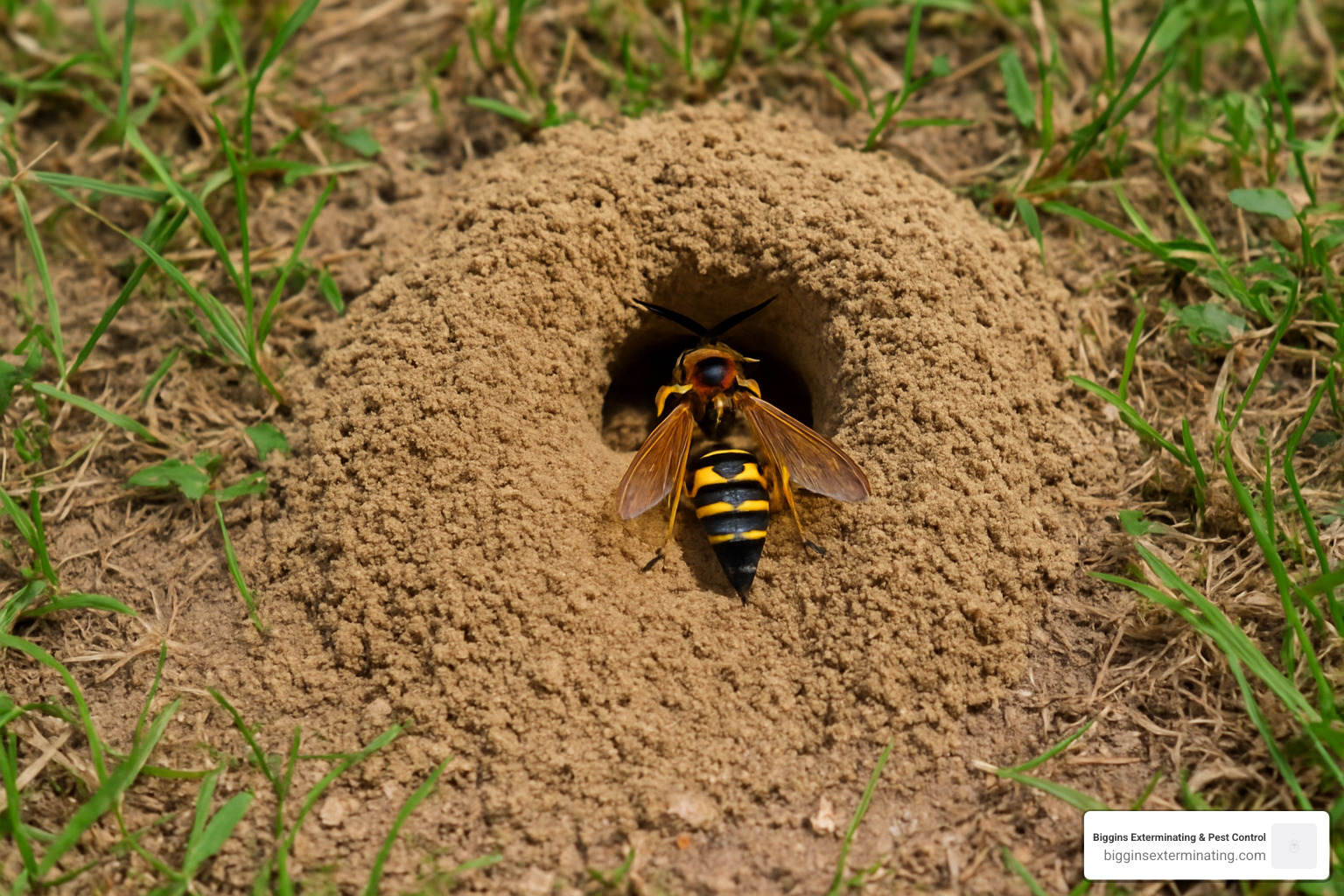
Those distinctive soil mounds are your first clue—little piles of dirt with a U-shaped collar around a hole about the width of your finger (½ inch). Think of them as tiny volcano-shaped doorbells announcing “wasp lives here!” These mounds pop up in sunny spots where the soil drains well.
You might also notice mushy turf in parts of your lawn. When you step on these spots, they feel spongy because the ground beneath is honeycombed with tunnels. This underground network can be surprisingly extensive—one female may dig several burrows, each running 30-70 inches long!
Keep an eye out for the wasps themselves, flying low over your lawn or, more tellingly, carrying paralyzed cicadas. These cicada carcasses might also turn up near burrow entrances—macabre little trophies of the wasps’ hunting success.
“What starts as one or two holes can quickly multiply,” I often warn customers during inspections. “In severe cases, we’ve seen yards with over 100 individual burrows.”
July and August mark peak activity when the adults are busy mating and stocking those underground nurseries. The population can seem to explode overnight if conditions are right.
Quick Inspection Checklist
Want to know how bad your cicada killer situation really is? Try this simple approach:
During daylight hours, take a slow walk around your property, focusing on the sunny, sparsely vegetated areas these wasps prefer. Check along fence lines, garden edges, and especially around concrete structures like your pool deck or patio—cicada killers love these warm spots.
For a more accurate count, head out at sunset when the wasps return to their burrows for the night. This dusk headcount gives you a better idea of your actual population. I recommend marking each burrow with a small flag or stick so you don’t lose track when it’s time for treatment.
It also helps to create a simple mapping strategy—just sketch your yard on paper and mark where you’ve found burrows. Look for patterns or clusters that might need extra attention. This map becomes especially valuable if you decide to call in professional help.
Don’t forget to chat with your neighbors if you’re seeing activity near your property lines. Cicada killers don’t respect boundaries, and a coordinated approach works much better than isolated treatments. At Biggins Exterminating, we’ve seen many cases where treating just one yard in a neighborhood results in temporary relief at best—those wasps simply relocate next door and return the following season.
Early detection truly is your best defense against a full-blown cicada killer invasion. Spotting those first few burrows means you can take action before your yard becomes the neighborhood wasp resort.
How to Get Rid of Cicada Killers (Core DIY & Pro Methods)
Now that you understand what you’re dealing with, let’s roll up our sleeves and tackle how to get rid of cicada killers effectively. Whether you’re a DIY enthusiast or thinking about calling in the pros, I’ve got you covered.
Getting control of these intimidating wasps follows a straightforward path. First, assess your yard and count those burrows (those little dirt volcanoes are a dead giveaway). Then choose your approach—chemical, natural, or a combination—and gather everything you’ll need. The magic happens at dusk or nighttime when the wasps are home, so timing your attack is crucial. After treatment, keep an eye on things for a couple of days and retreat any stubborn holdouts.
“Most homeowners are surprised by how quickly they can get results when they target the right spots at the right time,” says our senior technician at Biggins.
For a successful mission, you’ll need a few basics: a good flashlight (red filters are best since they won’t alert the wasps), some garden markers to flag the burrows, protective clothing, and your chosen treatment products. Don’t forget appropriate application tools like a duster or sprayer.
Cost-wise, DIY treatments typically run between $20-$200 depending on your yard size and how extensive the problem is. If you’d rather leave it to professionals, expect to pay anywhere from $150-$600+ for comprehensive treatment. The higher end reflects larger properties or severe infestations requiring multiple visits.
Note: These price ranges are based on internet data and not actual costs for Biggins Exterminating services.
Remember to always read product labels carefully—they’re not just suggestions, they’re federal requirements designed to keep you, your family, and the environment safe.
Non-Chemical & Organic Options to Start With — how to get rid of cicada killers without toxins
If you’re hesitant about using chemicals around your home, several natural approaches can help you get rid of cicada killers effectively:
The simplest method? A garden hose. Thoroughly flooding each burrow collapses the tunnels and can drown larvae. For best results, make this a daily ritual for about a week. It’s gentle but persistent—just like my grandmother’s approach to most problems in life!
For something stronger, a 1:1 mixture of household ammonia and water poured into burrows at night (about 2-3 cups per hole) creates an environment wasps simply can’t tolerate. Just keep kids and pets away from treated areas for 24 hours afterward.
Boiling water is another powerful option. Two gallons poured directly into each burrow after sunset delivers immediate results, killing adults and larvae while destroying the tunnel structure. Just be extremely careful—second-degree burns aren’t worth a wasp-free yard.
Diatomaceous earth sprinkled around and inside burrow entrances works more gradually but effectively. This natural powder damages the wasps’ exoskeletons when they crawl through it. White vinegar creates similarly inhospitable conditions when poured into burrows, turning their cozy homes into muddy messes they’d rather abandon.
For a gentler approach, peppermint oil (about 20 drops per quart of water) sprayed around your yard perimeter creates a scent barrier many wasps avoid. Think of it as an invisible fence that needs refreshing every few days, especially after rain.
One of our Wilmington customers shared her success story: “I tried the boiling water method on five burrows in my backyard. I marked each hole with a plastic knife during the day, then came back after dark with my kettle. By the third night, all activity had stopped, and I haven’t seen them return to those spots.”
Targeted Insecticidal Dusts & Sprays — how to get rid of cicada killers fast
When natural methods aren’t cutting it or you need faster results, insecticidal products offer proven effectiveness:
Dust treatments are the gold standard for cicada killer control. Products containing carbaryl (Sevin) or Drione dust work exceptionally well when puffed directly into burrow entrances at dusk. Just 2-3 puffs per hole creates a lethal barrier that kills wasps entering or exiting. A single 6 oz jar can treat over 100 nests, making this an economical solution.
Here’s a pro tip from our field technicians: Create your own precision applicator by cutting the tip off the dust bottle and attaching a 6-8″ vinyl hose. This lets you deliver the dust deep into the burrow without getting down on your hands and knees.
Liquid sprays containing pyrethroids (like cypermethrin or bifenthrin) offer quick knockdown power. Using a sprayer with a pinstream nozzle, target the burrow entrance and surrounding soil. These work fast but typically don’t last as long as dusts.
For prevention, granular treatments spread across your entire yard create an inhospitable environment for nesting. Water them in thoroughly after application. These work best applied in early spring before adults emerge and provide season-long protection.
| Treatment Type | Speed | Residual | Cost Range | Best For |
|---|---|---|---|---|
| Dust | Fast (1-2 days) | 2-4 weeks | $15-$40 | Direct nest treatment |
| Liquid | Medium (2-3 days) | 1-2 weeks | $20-$50 | Visible burrows |
| Granular | Slow (7-14 days) | 2-3 months | $30-$75 | Prevention |
Always dress for the occasion—long sleeves, pants, gloves, and eye protection are must-haves when applying insecticides. And be prepared to follow up—check treated burrows after 48 hours and retreat any that still show activity.
Treating Sensitive Areas: Playgrounds, Sand Traps & Pool Decks
When cicada killers set up shop in areas where children play or near water features, special care is needed:
For playgrounds and sandboxes, timing is everything. Use only products specifically labeled safe for play areas, and apply when children won’t be present for at least 24 hours. Botanical insecticides derived from plant oils are often good choices here. Covering treated sand with a tarp after application adds an extra layer of protection.
Around pool areas, avoid products that might wash into the water. Dust formulations that adhere to surfaces are preferable to liquids that can run off. Focus on treating the concrete joints and cracks where nests are typically located, then follow up with a gentle rinse-down after the product has dried completely.
For pet areas, look for products with “pet-safe” on the label and keep your furry friends away until everything is completely dry. Temporary fencing can be helpful to restrict access during and after treatment.
“When dealing with sensitive areas like these,” explains our senior technician, “timing is everything. We typically schedule treatments for Sunday evenings when facilities like public playgrounds will have minimal use for the next 24 hours.”
When & How to Seal Burrows After Treatment
The final step in how to get rid of cicada killers is proper burrow sealing to prevent reinfestation:
After confirming no activity for at least three days, it’s time to reclaim your yard. Fill each burrow completely with fresh topsoil, tamping it down firmly to eliminate air pockets. In lawn areas, take the opportunity to reseed bare spots—dense turf is naturally resistant to future nesting.
Don’t skip the important step of removing that distinctive U-shaped soil collar around the entrance. “I always tell customers to rake away that collar of soil around the hole,” says one of our Biggins technicians. “It’s like taking down a billboard that says ‘Great place to nest!'”
For areas particularly prone to reinfestation, consider placing landscape fabric under mulch or gravel. This physical barrier makes it nearly impossible for returning wasps to dig through, forcing them to look elsewhere for nesting sites.
With these approaches, you’ll not only eliminate your current cicada killer problem but also make your yard less inviting for future generations of these impressive but unwelcome insects.
Long-Term Prevention: Keeping Next Year’s Wasps Away
Once you’ve dealt with your immediate cicada killer problem, it’s time to think about prevention. Creating an environment that’s less appealing to these wasps can save you from facing the same battle next summer.
Healthy soil creates an unwelcoming environment for cicada killers. Get your soil tested and apply the recommended fertilizers to promote dense root growth that naturally deters digging. If you have sandy soil (a cicada killer favorite), adding organic matter improves its structure and makes it less appealing for their burrows.
Your mowing habits make a huge difference too. Keep your grass at 3-4 inches tall throughout the summer months. This height creates shade at the soil level, which cicada killers hate, since they prefer hot, sunny spots for digging. As an added bonus, taller grass develops deeper roots, creating firmer soil that’s harder for wasps to excavate.
“The number one mistake I see homeowners make is cutting their grass too short,” explains our lawn specialist at Biggins. “That crew-cut look might be tidy, but it’s basically rolling out the welcome mat for cicada killers.”
Smart watering practices complement your mowing strategy. Water deeply but infrequently – about one inch per week is ideal. This encourages grass to develop deeper root systems while maintaining soil firmness. Consistently moist (but not soggy) soil is much more difficult for wasps to dig through than dry, crumbly dirt.
Any bare patches in your yard are prime real estate for cicada killers, so address them promptly:
– Reseed thin areas of lawn as soon as you notice them
– Add a thick 3-inch layer of mulch to garden beds
– Consider groundcover plants in hard-to-grow areas where grass struggles
For those who’ve battled cicada killers before, early prevention is key. Apply granular insecticides in late April or early May before wasps emerge. Focus especially on areas where you’ve seen nests in previous years. This proactive approach can stop the cycle before it begins.
Since cicada killers need cicadas to feed their young, managing cicada populations can indirectly control these wasps. Strategic pruning of trees that harbor cicadas can reduce their numbers. In years with large cicada emergences, you might consider treating trees specifically for cicadas.
One North Reading customer shared their success: “After two summers of fighting these wasps, we followed your advice about lawn care. We raised our mower height, watered deeply once a week, and applied the granules in spring. This is the first summer in three years we haven’t seen a single cicada killer!”
Natural Predators & Eco-Friendly Deterrents
Mother Nature offers her own cicada killer control mechanisms that you can encourage in your yard.
Birds are excellent allies in your fight against wasps. Installing birdhouses to attract insect-eating species like swallows and martins creates a natural control system. Keep bird baths filled to make your yard more attractive to these feathered friends who will happily snack on adult wasps.
Certain insects prey on cicada killers too. Robber flies are natural predators that can help keep populations in check. To support these beneficial insects, avoid using broad-spectrum insecticides that kill indiscriminately. Instead, plant diverse flowers that attract a healthy mix of beneficial insects.
Even some mammals can help. Skunks and other small mammals will dig up cicada killer larvae as a tasty treat. While they might cause some minor lawn damage in the process, they can be effective controllers in remote areas of your property where a little digging won’t matter.
Creating a diverse landscape with various native plant species establishes a more balanced ecosystem that naturally limits pest outbreaks. When no single species dominates, you’re less likely to see explosion in wasp populations.
“We’ve noticed properties with diverse landscaping and bird habitats tend to have fewer recurring cicada killer problems,” notes our wildlife specialist. “It’s about creating balance in your yard’s ecosystem.”
For evening protection, consider installing bat houses to attract these nocturnal insect predators. A single bat can consume thousands of flying insects each night, and they’re most active during evening hours when cicada killers return to their nests.
By combining these prevention strategies, you can make your yard significantly less attractive to cicada killers while creating a healthier ecosystem overall. The best part? Most of these approaches improve your landscape’s health and appearance while naturally discouraging these intimidating wasps.
DIY vs. Professional Help: Deciding When to Call In Backup
There comes a point when battling cicada killers where you might need to wave the white flag and call in reinforcements. While I’ve helped many homeowners tackle these wasps themselves, certain situations definitely warrant professional intervention.
When should you put down the spray bottle and pick up the phone? Consider calling Biggins Exterminating when:
You’re facing a large-scale invasion with more than 10 active burrows scattered across your property. These extensive infestations often have hidden nests that DIYers miss.
“Last summer, a Burlington homeowner called us after counting 8 burrows,” shares our lead technician. “By the time we arrived, we finded 27 active nests, including several hidden along their foundation that they hadn’t noticed.”
If you’ve become an unwilling host for annual reunions where cicada killers return year after year despite your best efforts, professionals can break this cycle with more comprehensive treatments.
The stakes rise considerably when someone in your household has insect sting allergies. While cicada killers rarely sting, that “rarely” becomes meaningless when anaphylaxis is a possibility.
Commercial properties or public spaces present liability concerns that make professional management the prudent choice. Imagine cicada killers appearing at your daycare’s playground or your restaurant’s patio!
Sometimes it simply comes down to comfort level with insecticides or having nests in tricky locations like under concrete slabs or within retaining walls.
Professional services from Biggins Exterminating bring several advantages to the table. We offer proper identification (ensuring you’re not treating harmless lookalikes), access to commercial-grade products, and refined application techniques developed over four decades of service.
Most professional cicada killer treatments range from $150-$600+, with factors like property size, infestation severity, and location affecting the final cost. While this represents an upfront investment, it often saves money by preventing property damage and eliminating the need for repeated DIY attempts.
Note: These price ranges are based on internet data and not actual costs for Biggins Exterminating services.
“What separates a professional job from DIY is thoroughness,” explains our service manager. “We don’t just treat the obvious nests—we find and treat all of them, including those in hard-to-spot locations.”
What a Licensed Tech Will Do Differently
When you welcome a Biggins Exterminating technician to your property, you’re getting more than someone with a sprayer and a uniform. Our approach to how to get rid of cicada killers has been refined through thousands of successful treatments.
We start with a comprehensive inspection that goes far beyond spotting visible burrows. Our techs assess your entire property, identifying conditions that attract these wasps and documenting every nest location. We often find burrows homeowners have missed—like those hidden beneath ornamental grasses or alongside foundations.
Our treatment methods leverage professional products that homeowners can’t access. We use non-repellent formulations that wasps can’t detect, allowing them to unwittingly transfer the treatment throughout the nest system. This approach is particularly effective for eliminating entire populations rather than just treating visible entrances.
“I had a customer in Lexington who tried three different store-bought products before calling us,” recalls our senior technician. “Within one visit, we eliminated all activity using our targeted application methods and professional-grade materials.”
We employ digital mapping technology to mark treatment areas precisely. This creates a historical record of infestation patterns on your property, allowing us to provide property-specific recommendations and anticipate future problem areas before they develop.
Perhaps most valuable is our structured follow-up protocol. We don’t just treat and leave—we schedule return visits to assess effectiveness, retreat any persistent activity, and provide seasonal preventive applications to break the yearly cycle.
All our services come with solid guarantees and warranties that protect your investment. If cicada killer activity persists after our treatment, we return at no additional cost until the problem is resolved.
With over 40 years serving communities like Wilmington, Bedford, Lexington, and surrounding areas, our experienced technicians understand the unique challenges of New England pest control. We’ve seen how cicada killers behave in our specific climate and soil conditions, knowledge that translates into more effective solutions for your property.
Interested in learning more about our Bee and Wasp Removal services or our approach to High Quality Hornet and Wasp Removal? We’re just a phone call away.
Frequently Asked Questions about How to Get Rid of Cicada Killers
Do cicada killers really help control cicadas, and should I leave them alone?
Cicada killers are nature’s own pest control specialists when it comes to cicadas. A colony of about 100 female wasps can remove an impressive 16,000+ cicadas from your neighborhood in a single season. That’s a lot of protection for your trees and shrubs that might otherwise suffer damage from these noisy insects.
But should you live and let live? Well, it depends on your specific situation.
Consider your tolerance level based on how many nests you’re dealing with, their location on your property, whether you have curious children or pets, and honestly, your personal comfort with these large buzzing visitors.
“I had three nests way back in my yard near the compost pile,” shares one of our Bedford customers. “Since they weren’t bothering anyone, I decided to let them be. They actually reduced the cicada noise considerably that summer!”
If you’ve got just a handful of nests in a low-traffic area of your yard, coexistence is definitely worth considering. Many environmental experts and entomologists believe their ecological benefits outweigh the nuisance factor. Think of them as free, natural cicada control working on your behalf.
Will chemical treatments harm pollinators like bees and butterflies?
Good news – the targeted treatment methods we recommend are specifically designed to minimize impact on beneficial insects. Unlike broadcast spraying that covers large areas, our approach focuses insecticides precisely where needed – directly into burrow entrances.
To keep your garden’s pollinators safe while tackling cicada killers, we suggest these pollinator-friendly practices:
Apply treatments in the evening when bees and butterflies have returned to their homes for the night. Never spray flowering plants that attract pollinators. Use dust formulations inside burrows rather than surface sprays whenever possible. And always consider non-chemical alternatives first before reaching for insecticides.
“We’re beekeepers as well as pest control professionals,” explains our senior technician. “So we understand the critical importance of protecting pollinators while still solving pest problems effectively.”
At Biggins Exterminating, our 40 years of experience has taught us that responsible pest management means protecting both your property and the environment. We take that dual responsibility seriously with every treatment.
How long until I see zero activity after treating the nests?
Patience is key when dealing with cicada killers, as different treatment methods work at different speeds:
Dust applications typically show dramatic results quickly, usually eliminating activity within 1-2 days. The dust creates an effective barrier that wasps can’t avoid as they enter or exit.
Liquid treatments take slightly longer, with most activity stopping after 2-3 days as the product needs time to fully contact all wasps.
Natural methods like boiling water or ammonia solutions may require 3-5 days with repeated applications to achieve complete control.
Granular treatments are the slowest but most preventative option, taking 7-14 days to fully eliminate activity as they work through the soil.
One thing to remember is that complete elimination often requires treating new burrows as they appear. Adult wasps continue emerging from pupation throughout their July-September active season.
“After the first treatment, we saw maybe 80% reduction in activity,” a Woburn homeowner told us. “It took a second round a week later to get the stragglers. By the third week, we had zero wasps.”
This is why monitoring and follow-up are essential parts of our professional treatment plans. We don’t just treat and leave – we make sure the problem is actually solved.
Conclusion
Taking control of cicada killers is absolutely possible with the right approach and a bit of persistence. Throughout this guide, we’ve walked through everything from identifying these intimidating wasps to implementing effective control strategies that really work for Massachusetts homeowners.
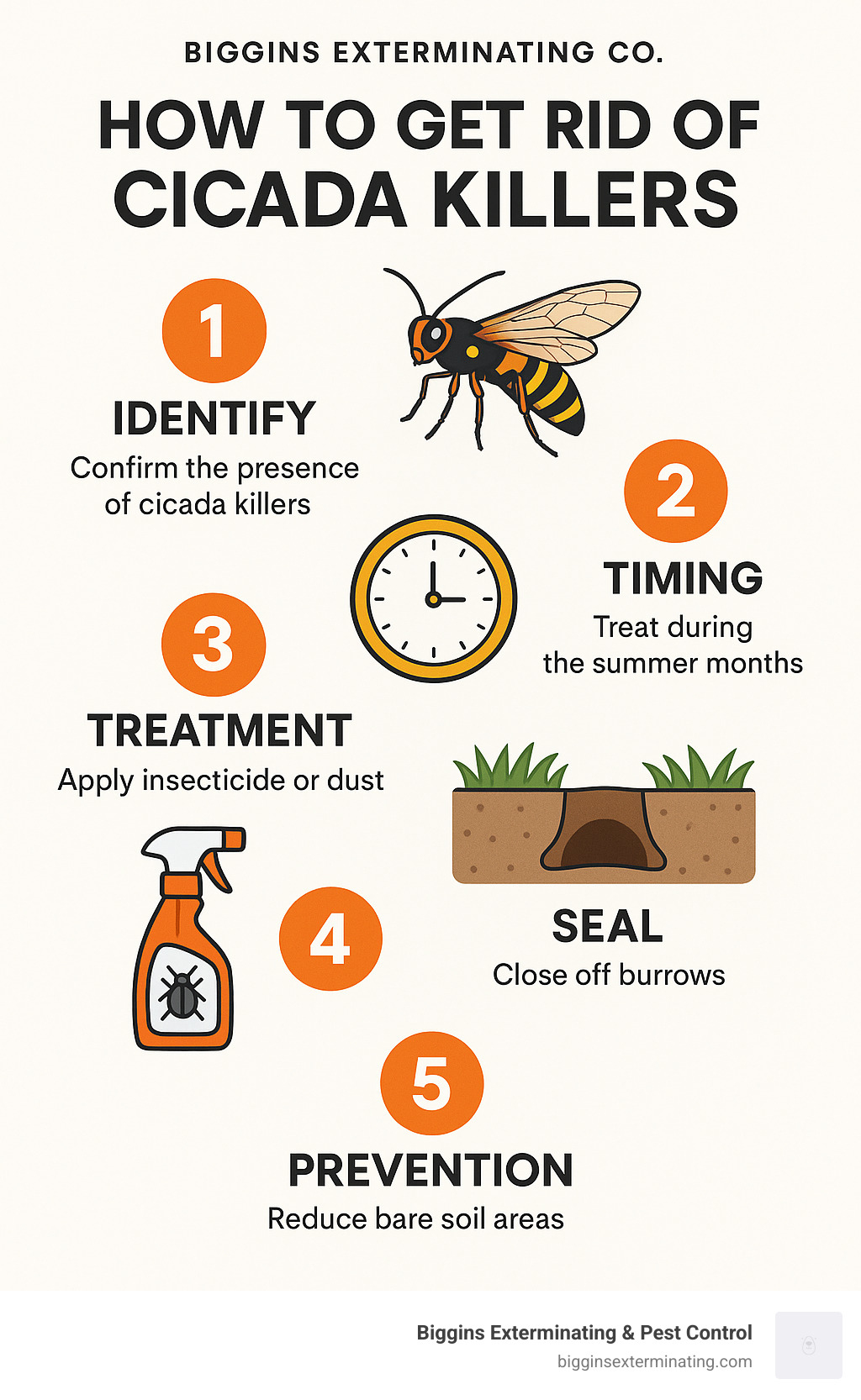
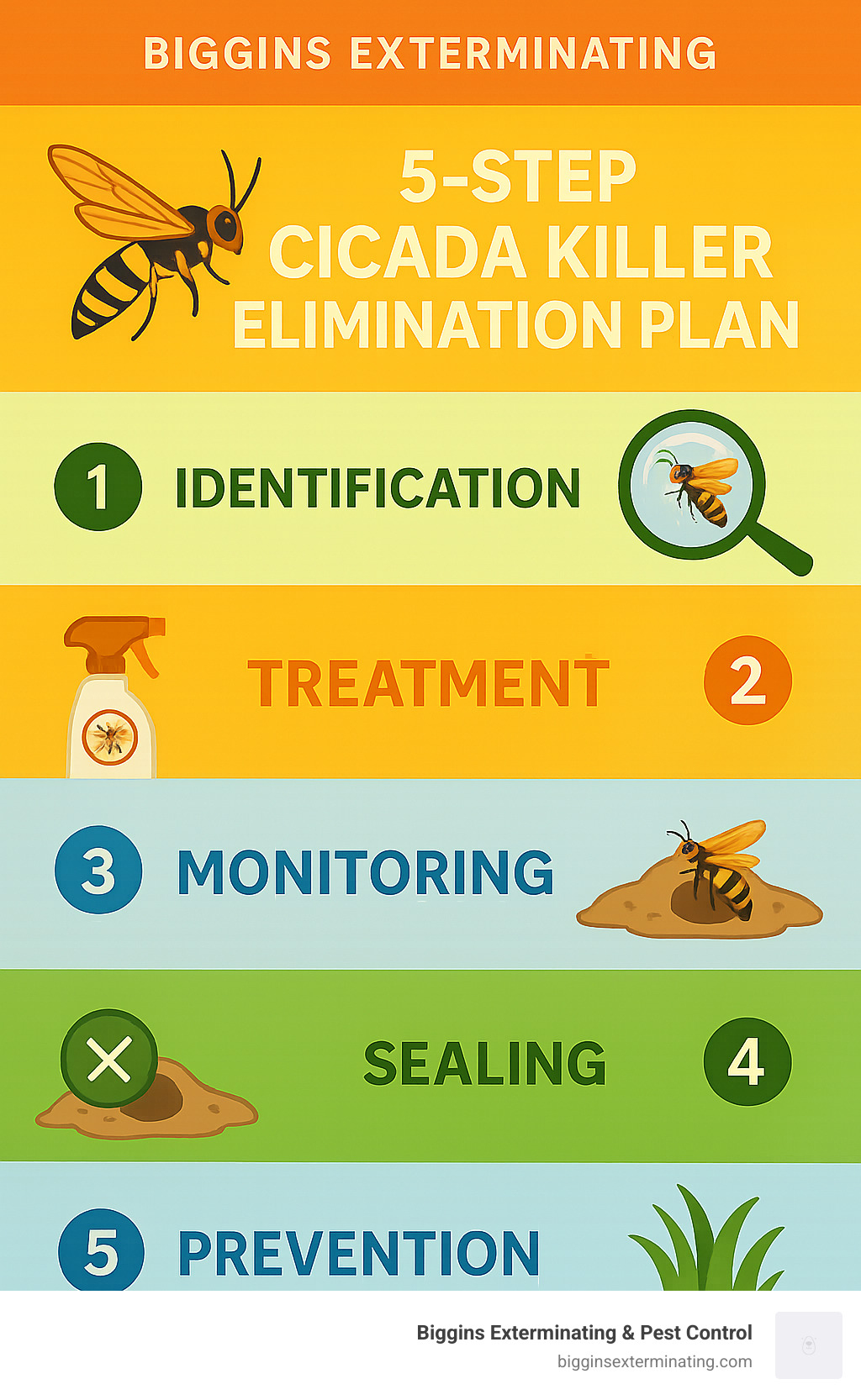
Success comes down to five key steps that make all the difference:
First, proper identification ensures you’re not wasting time and resources on the wrong insect. Those distinctive yellow bands on a black abdomen and that impressive 2-inch size are your confirmation.
Second, timing your treatments when wasps are actually in their burrows (typically dusk and nighttime) dramatically improves your success rate. This simple adjustment can mean the difference between frustration and victory.
Third, targeted applications directly into burrow entrances protect beneficial insects while effectively eliminating the cicada killers. This precision approach is both more environmentally responsible and more effective than random spraying.
Fourth, consistent follow-up ensures complete elimination. Even the best initial treatment might miss a few wasps, so checking back after 48 hours makes all the difference.
Finally, implementing prevention strategies like maintaining thicker lawns and eliminating bare soil areas will keep your yard cicada-killer free for seasons to come.
At Biggins Exterminating & Pest Control, we’ve spent over four decades helping families just like yours solve pest problems throughout Wilmington and surrounding Massachusetts communities. As a family-owned business, we understand the importance of feeling comfortable in your own backyard – without worrying about intimidating wasps disrupting your summer gatherings.
We take genuine pride in offering straightforward solutions without pushing unnecessary long-term contracts. Our approach is simple: solve your pest problem effectively, stand behind our work with solid warranties, and earn your trust through reliable results.
If cicada killers have taken up residence in your yard in Wilmington, Andover, Bedford, Billerica, Burlington, Lexington, North Reading, Tewksbury, or Woburn, we’re just a phone call away. Our experienced local technicians will assess your specific situation and develop a customized treatment plan that addresses your concerns while respecting your environmental preferences.
For more information about our cicada killer pest control services or to schedule a no-obligation consultation, reach out to the Biggins family today. Let our experience and local knowledge help you reclaim your outdoor spaces from these impressive but unwelcome guests.