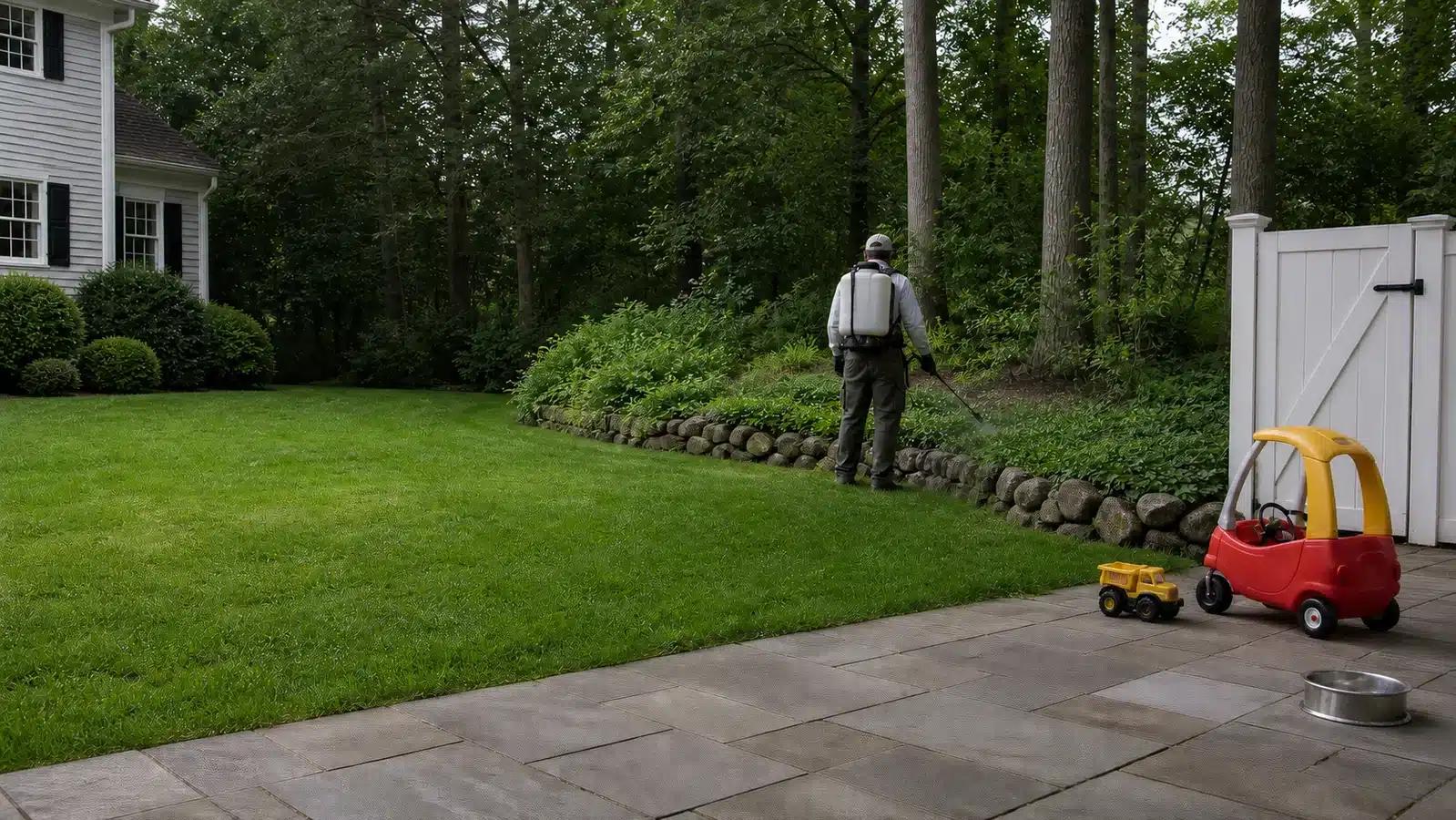
Short answer: how long to stay off grass after tick treatment depends on the exact product label, the applicator’s written instructions, and whether the treated surface has reached the required condition—often a specified interval, complete drying, or both. Do not substitute a familiar number from a previous visit. Before anyone steps onto the lawn, confirm the instructions for this application.
If you are still deciding when to schedule service, start with our guide to when to treat a yard for ticks in Massachusetts. This article focuses on the next question: how to make a safe reentry decision after the work is done.
Use four checks before returning to the lawn
A reliable decision uses all four checks below. A green check on only one item—such as “the grass looks dry”—is not enough if the label or technician gave a longer interval.
- Confirm the treatment was completed. Ask which areas were treated and whether any sections of the property have different instructions.
- Read the written reentry direction. Use the service note or exact product label, not a general rule remembered from another product.
- Check the surface condition. If the direction requires drying, look at the treated vegetation and ground in both sun and shade. Damp leaf litter, low spots, and dense groundcover can remain wet after open turf dries.
- Account for what happened after application. Rain, irrigation, heavy dew, or an interrupted application can change what you need to ask. Contact the provider instead of guessing whether the waiting period should restart.
The National Pesticide Information Center’s exposure guidance advises keeping people and pets away for the label-specified interval or until the pesticide has dried, whichever is longer. It also notes that granules may have different watering and drying directions. That is why one universal wait time cannot safely cover every tick treatment.
Why “dry” can take different amounts of time in Massachusetts yards
Drying is a condition, not a promise that every yard will be ready at the same clock time. In Wilmington and nearby eastern Massachusetts communities, an open sunny lawn may dry before shaded vegetation along a stone wall, fence, woodland edge, or mature foundation planting. Late-summer humidity, morning dew, and leaf litter can also leave small treated zones damp after the main lawn appears ready.
If the provider’s direction uses “until dry,” inspect the slowest-drying treated area—not just the middle of the lawn. If the label specifies a longer interval, wait for that interval even when the turf appears dry sooner.
A reentry checklist for children and pets
Children and animals spend more time close to grass and may pick up toys, sticks, or other objects from treated areas. Before they return:
- Move pet bowls, toys, leashes, children’s toys, blankets, and portable play equipment away before application, or follow the technician’s direction for items that could not be moved.
- Keep doors and gates secured so children and pets cannot enter early.
- Confirm the entire area they will use—including shaded edges and pet runs—meets the label and provider requirements.
- Do not let pets eat treated grass, lick damp vegetation, or retrieve toys from a restricted area.
- Ask the provider what to do if someone entered early or if a pet contacted a wet surface.
For pet-specific precautions, the NPIC guide to pets and pesticide use recommends removing bowls, toys, and bedding before treatment and keeping pets away for the label’s time or until the pesticide has dried, whichever is longer. The exact label remains the controlling instruction.
What if it rains after the tick treatment?
Do not assume that any rain ruins an application or that any amount of drying makes rain irrelevant. Product formulations and label directions differ. Record roughly when the application ended and when rain or irrigation began, then ask the provider whether the treatment needs more drying time, an inspection, or a follow-up. Avoid adding another pesticide on your own.
Should you mow before or after treatment?
Ask about mowing when the appointment is scheduled. Mowing immediately after an application may remove treated vegetation or create contact with areas that are still restricted. If the lawn needs mowing, the provider can tell you whether to do it beforehand and how long to wait afterward based on the treatment used.
Longer-term yard maintenance and reentry serve different purposes. The CDC’s Lyme disease prevention guidance recommends reducing tick-friendly habitat such as leaf litter and brush around homes. Those landscape steps can support a broader tick-management plan, but they do not replace the reentry instructions for a fresh application.
Questions to ask before the technician leaves
- Which exact parts of the property were treated?
- What is the reentry instruction for adults, children, and pets?
- Does the direction require a clock interval, complete drying, watering, or more than one condition?
- What should we do if rain or irrigation starts sooner than expected?
- When can mowing, leaf cleanup, and normal play resume?
- Who should we contact if a person or pet enters the area early?
Make the decision from this treatment, not a generic timetable
The safest answer is specific: use the written directions for the product and property treated that day, wait for every required condition, and contact the applicator when weather or access creates doubt. If you are planning tick service in the Wilmington area, contact Biggins Exterminating and ask for the preparation and reentry instructions before the appointment.