
Understanding the Silent Wood Destroyers
You might not hear them working, but carpenter ants are busy turning your home’s wooden structures into their personal condominiums. Carpenter ant service is specifically designed to tackle these silent destroyers before they compromise your home’s structural integrity.
When you’re facing these unwelcome tenants, here’s what our specialized treatment approach includes:
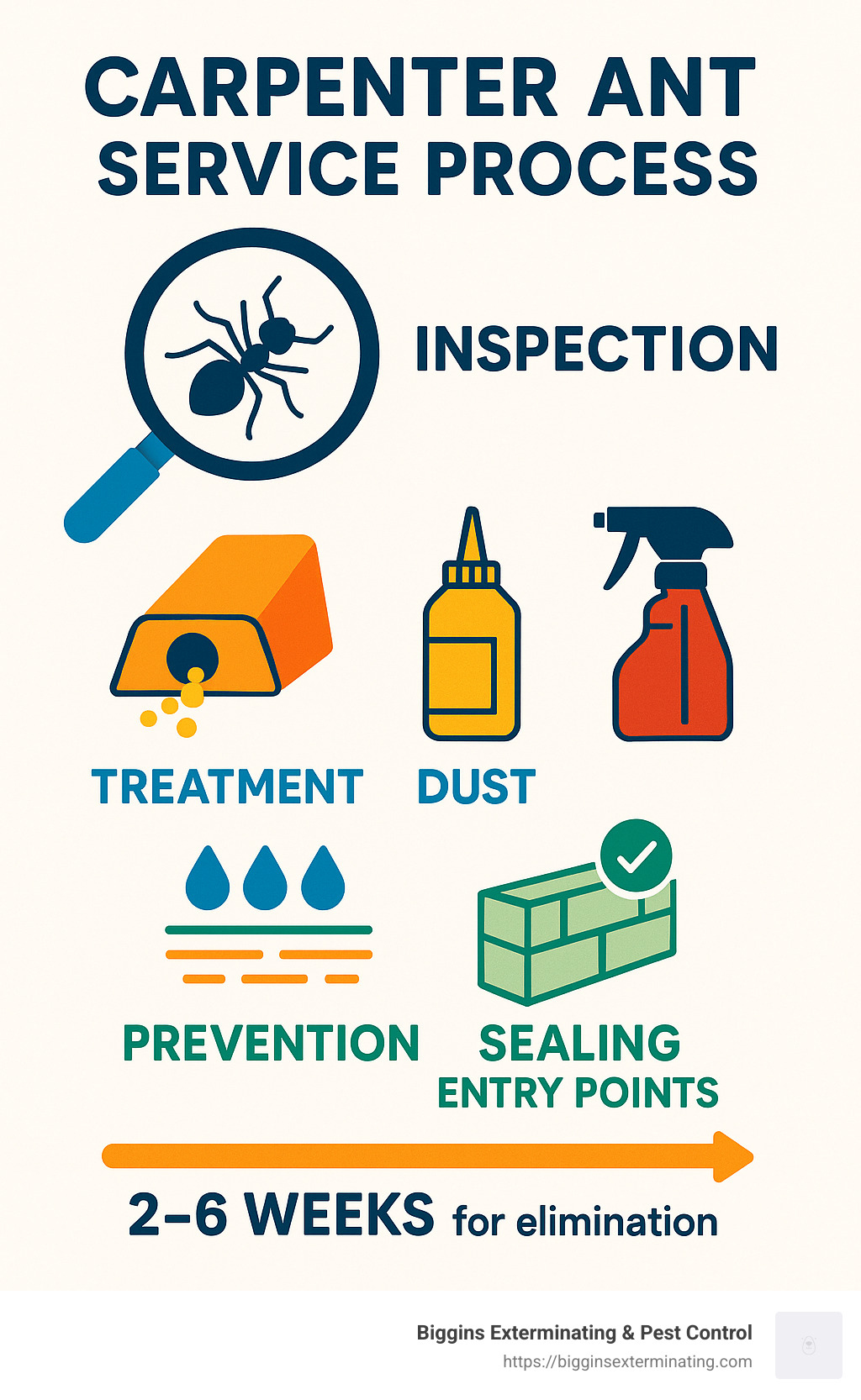
Quick Guide to Carpenter Ant Services:
* Inspection: Professional identification of parent and satellite colonies
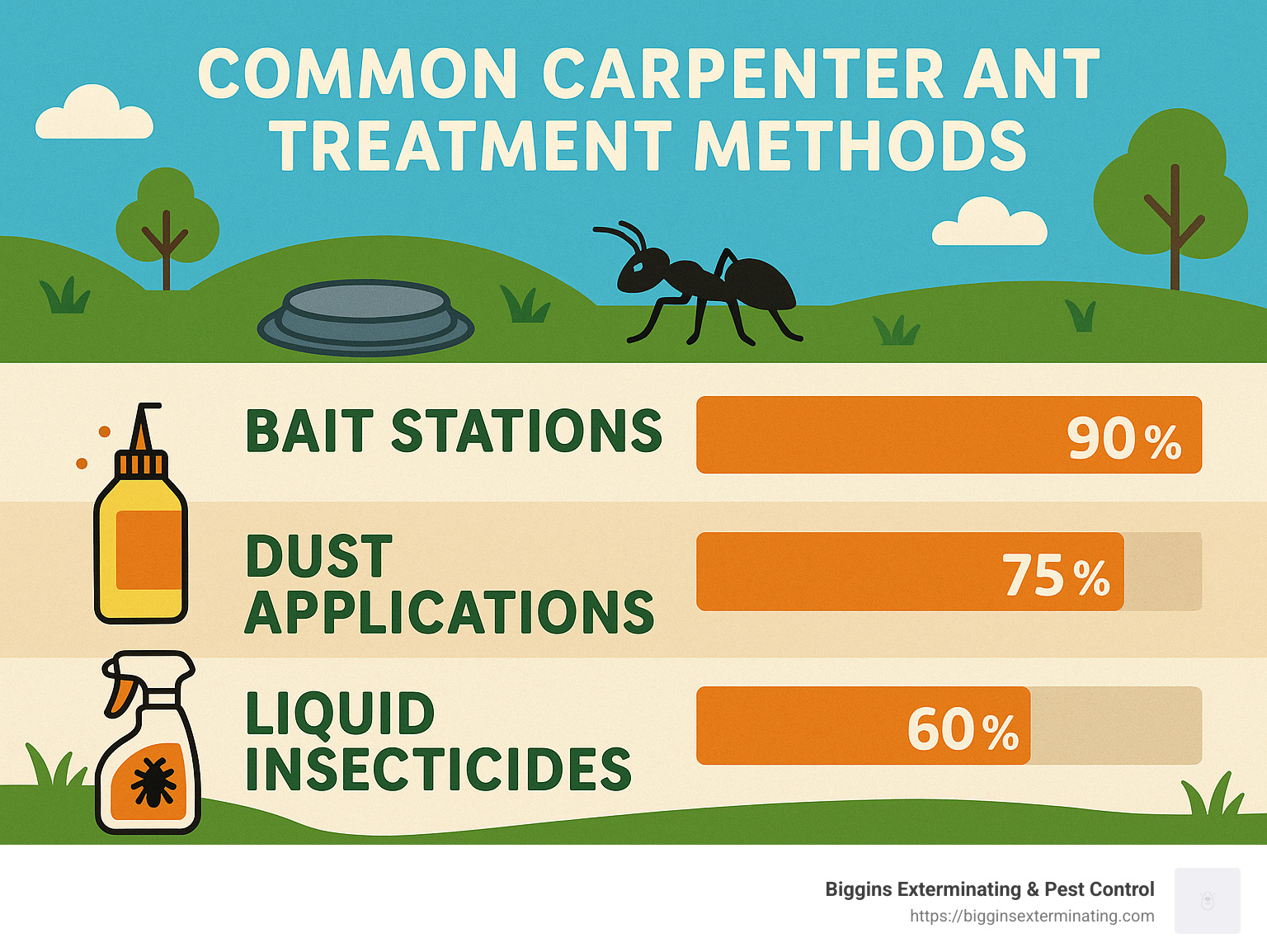
* Treatment: Targeted applications using baits, dusts, and non-repellent sprays
* Prevention: Moisture control and sealing entry points
* Timeline: Complete elimination typically takes 2-6 weeks
* Cost Range: $300-$1,200+ depending on infestation severity and home size
These industrious insects rank among North America’s most destructive wood-damaging pests, particularly thriving in our moisture-rich New England climate. Unlike termites that actually eat wood, carpenter ants are more like tiny carpenters—they excavate galleries through wooden structures, leaving behind distinctive sawdust-like debris called “frass” as evidence of their handiwork.
What makes carpenter ants particularly sneaky is their colony structure. A mature colony can house over 50,000 individuals and remain hidden for 8-10 years while silently weakening your home’s framework. They’re nocturnal, so you’ll rarely catch them in the act during daylight hours.
Even more challenging is their dual-colony strategy. The main parent colony typically establishes itself in outdoor trees or stumps, while satellite colonies set up shop inside your walls, attics, or crawlspaces. Since about 80% of carpenter ants never venture outside their nest, complete elimination requires finding and treating every colony location—not just the ones you can see.
“Carpenter ants are recognized as the number one wood destroying pest in New England and cause more damage to structures than termites,” according to industry research. Their ability to establish multiple interconnected nests spanning several yards makes professional intervention not just helpful, but essential.
I’m Stephen Biggins, owner of Biggins Exterminating Co., and for over four decades, I’ve been providing specialized carpenter ant service throughout Massachusetts. Our approach combines targeted, minimally-invasive techniques that protect your family while ensuring complete colony elimination—not just temporary relief.
Glossary for carpenter ant service:
– Carpenter Ant Pest Control
– carpenter ant infestation in house
– pest control for carpenter ants
Carpenter Ant 101: Biology, Identification & Termite Confusion
When it comes to wood-destroying pests, carpenter ants are among the most fascinating – and troublesome. These industrious insects (genus Camponotus) aren’t just ordinary ants that happen to live in wood; they’re complex social creatures with behaviors that make them particularly challenging to eliminate without proper carpenter ant service.
Carpenter ants operate with military precision through a sophisticated caste system. The queen can live an astonishing 20-25 years, continuously producing generations of workers that range from ¼ to ⅝ inch in size. These workers aren’t all created equal – there are larger “majors” that defend the colony and smaller “minors” that handle day-to-day tasks. The entire life cycle from egg to adult takes just 6-12 weeks, allowing colonies to grow rapidly.
“What makes carpenter ants so resilient is their distributed colony structure,” explains our lead technician at Biggins Exterminating. “They establish a parent colony, usually outdoors in a tree stump or rotting wood, then create satellite colonies that might be hiding inside your home’s walls, attic, or crawlspace. Even if you eliminate one nest, the others can continue thriving.”
This two-pronged approach to colony building is why professional carpenter ant service is often necessary – you need to locate and treat both the parent and satellite colonies for complete elimination.
Spot-the-Ant Checklist
Correctly identifying carpenter ants is crucial before treatment begins. Unlike their smaller household cousins, carpenter ants make quite an impression with their size and distinctive features:
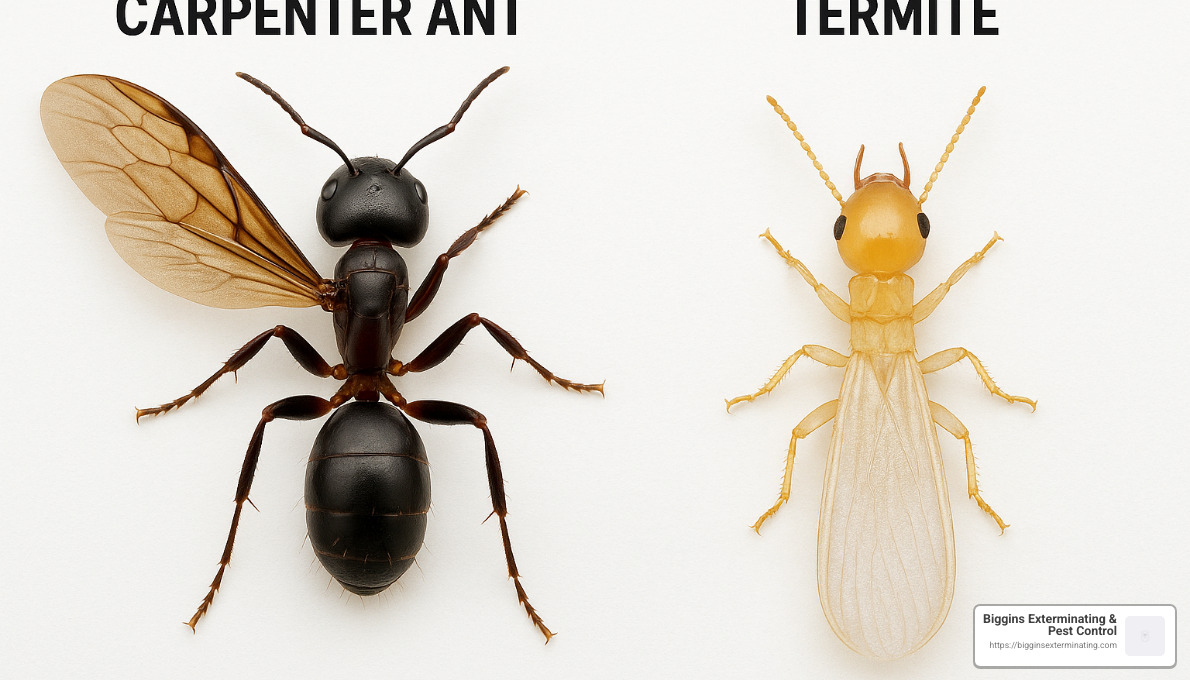
Look for ants with a distinctly heart-shaped head and elbowed antennae. While most carpenter ants are black, some species show reddish or yellowish coloration. Their clearly pinched waist is a key identifier – one you’ll need when differentiating them from termites.
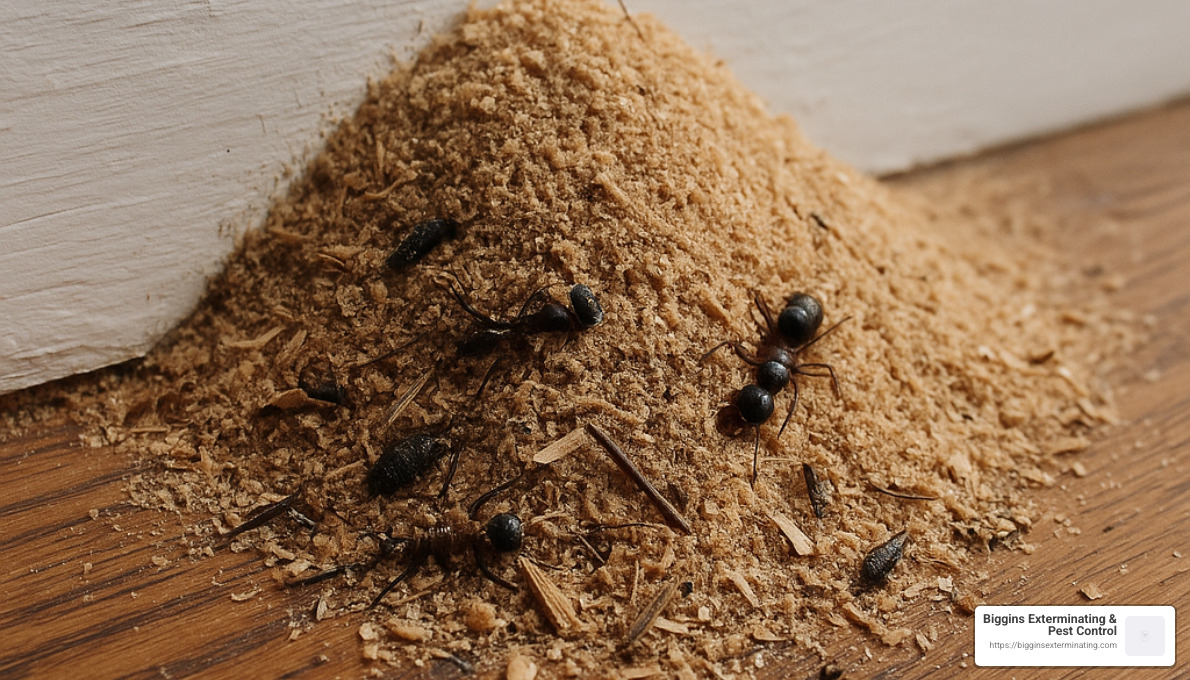
One of the most obvious signs of carpenter ant activity is frass – a sawdust-like material they push out of their galleries as they carve through wood. Unlike termites that actually eat wood, carpenter ants simply excavate it to create living spaces, leaving behind this distinctive debris.
If you’re up late at night (when these nocturnal creatures are most active), you might even hear them working. Place your ear against a suspected wall, and you might detect a faint rustling sound, similar to crinkling cellophane – that’s the sound of thousands of tiny carpenters at work!
Carpenter Ants vs Termites
“At least once a week, we get calls from Wilmington homeowners who are convinced they have termites, when what they’re actually seeing are carpenter ants,” says our senior technician. This confusion is understandable but can lead to inappropriate treatments that waste time and money.
Here’s how to tell these wood-destroying pests apart:
| Feature | Carpenter Ants | Termites |
|---|---|---|
| Antennae | Elbowed (bent) | Straight, bead-like |
| Waist | Pinched, narrow | Broad, no distinct waist |
| Wings | Front wings longer than back wings | Equal-length wings |
| Color | Usually black or red-black | Creamy white to light brown |
| Wood damage | Clean, smooth galleries with frass pushed out | Rough galleries with mud and soil |
| Diet | Don’t eat wood, just excavate it | Consume wood as food |
| Activity | Visible foraging, especially at night | Rarely seen, remain hidden |
| Treatment | Targeted nest elimination | Soil treatments and baiting systems |
The difference in feeding habits is particularly important. Carpenter ants don’t actually eat wood – they just carve through it, leaving behind those telltale piles of frass that resemble sawdust. Termites, on the other hand, actually consume the wood, which is why you won’t find frass piles with termite infestations.
This distinction matters because it affects treatment approaches. Effective carpenter ant service requires locating and treating nests directly, while termite control often involves creating chemical barriers in the soil or installing bait stations.
For more detailed information about these and other wood-destroying insects, you might find this Scientific research on wood-destroying insects helpful in understanding the threats to your home.
At Biggins Exterminating, we’ve been identifying and eliminating carpenter ants in Massachusetts homes for over 40 years. Our technicians are experts at spotting the subtle differences between wood-destroying pests and creating targeted treatment plans for each specific situation.
Infestation Warning Signs & Structural Damage
Have you ever been jolted awake by strange noises in your walls at night? That unsettling sound might be more than just your house settling—it could be carpenter ants hard at work destroying your home. These nocturnal insects typically operate under cover of darkness, which explains why many homeowners don’t find infestations until significant damage has already occurred.
The sneaky nature of carpenter ants makes early detection crucial. When I visit homes in Wilmington and surrounding towns, I often find homeowners shocked at how long these pests have been silently damaging their property.
“Last summer, I inspected a home in Lexington where the family had been hearing odd rustling sounds in their walls for months,” I tell clients. “They thought it was just normal house noises. By the time they called us, carpenter ants had severely damaged several floor joists, requiring expensive structural repairs that their insurance wouldn’t cover.”
Those rustling sounds are one of several warning signs to watch for. You might also notice small piles of sawdust-like material (called frass) near baseboards or window frames. This debris isn’t just wood shavings—it’s actually a mixture of wood particles and insect parts that ants push out as they excavate their nesting galleries. Finding these telltale frass piles is often the first concrete evidence homeowners find.
Another common indicator is hollow-sounding wood when tapped with a screwdriver handle. Healthy wood sounds solid, while infested wood has a distinctive empty sound due to the extensive tunneling inside. You might also spot winged carpenter ants indoors, especially during spring and summer months—a sure sign of a mature colony that’s ready to expand.
The structural damage from carpenter ants differs from termite damage in important ways. While termites consume wood evenly, carpenter ants create smooth, sandpaper-like galleries that follow the grain of the wood. Over time, this excavation can seriously compromise:
- Window and door frames, which often develop noticeable gaps
- Structural beams and floor joists supporting your home
- Roof supports that maintain your home’s structural integrity
- Flooring and subflooring throughout living spaces
- Deck supports and railings that may suddenly feel unstable
What makes carpenter ant damage particularly troublesome is how long it can remain hidden. Industry research shows that colonies can thrive undetected in homes for 8-10 years while causing progressive damage. A mature colony can house over 50,000 ants, all working continuously to expand their territory within your walls.
Most concerning for homeowners is the financial impact. I always make sure to tell my clients that most homeowner’s insurance policies specifically exclude damage caused by insects, leaving you fully responsible for what can become very expensive repairs.
Common Nesting Hot Spots
Carpenter ants aren’t random in choosing where to establish their colonies. They have clear preferences for wood that is or has been damp, soft, or decaying. Understanding these hot spots can help you identify potential problem areas before they become major headaches.
Inside your home, these pests gravitate toward areas with moisture issues. Bathrooms with leaky fixtures, kitchen sink cabinets, and walls containing plumbing are prime real estate for carpenter ants. They’re also fond of window frames (especially older wooden ones), door frames and thresholds exposed to the elements, and wall voids near roof leaks.
Don’t forget to check your attic, particularly around roof penetrations where water might seep in during heavy rain. Crawlspaces with high humidity and wooden support beams in basements also rank high on the carpenter ant wish list. Even hollow wooden doors can become carpenter ant condominiums if conditions are right.
Outdoors, the list of potential trouble spots grows even longer. Dead trees and stumps within 100 yards of your home can serve as launching pads for invasions. Woodpiles stacked against your house provide both shelter and easy access to your home’s interior. Wooden fence posts, landscape timbers, decks, and steps all offer attractive nesting options.
“During a recent carpenter ant service call in Burlington,” I often share with clients, “we finded a parent colony in a rotting tree stump about 50 feet from the house, with multiple satellite colonies in the home’s crawlspace and attic. This network of interconnected nests made DIY treatment impossible, as store-bought products couldn’t reach all colony locations.”
This complex colony structure—with parent nests outdoors and satellite nests indoors—is why professional carpenter ant service is typically necessary for complete elimination. The parent colony might be in that old tree stump, while satellite colonies are spreading throughout your home’s structural elements.
The presence of carpenter ant frass is perhaps the most reliable indicator of an active infestation. Unlike termite frass, which looks like tiny pellets, carpenter ant frass resembles fine sawdust often mixed with insect parts. Finding these small piles near wooden structures should prompt an immediate call for professional carpenter ant service before the damage worsens.
Carpenter Ant Service: Professional Control Process & Methods
When it comes to carpenter ant service, there’s a world of difference between professional treatment and DIY attempts. At Biggins Exterminating, we’ve spent over four decades perfecting our approach to ensure we not only eliminate the ants you see but completely eradicate the colonies hiding within your walls.
Professional carpenter ant service isn’t about randomly spraying chemicals around your home. It’s a methodical, science-based process that targets the root of your problem while minimizing chemical exposure to your family and pets.
“Most homeowners are shocked when we show them where their carpenter ant colonies actually live,” says Tom, our senior technician. “The ants you see in your kitchen are just the tip of the iceberg – it’s the thousands hiding in your walls that cause the real damage.”
Our comprehensive approach follows a carefully developed protocol that addresses the full scope of the infestation:
- Detailed inspection to locate all colonies (not just the visible ones)
- Customized treatment plan based on your specific situation
- Targeted application using the right tools and products
- Structural recommendations to prevent future problems
- Follow-up monitoring to ensure complete elimination
Carpenter Ant Service – Inspection Phase
The inspection is truly where professional carpenter ant service shines. Our technicians arrive equipped with specialized tools that help locate even the most hidden carpenter ant nests.
We start by mapping ant trails throughout your property. Since carpenter ants follow scent trails that can extend several hundred feet, tracking their movement patterns often leads us directly to their nests. These inspections sometimes happen after dark, when carpenter ants are most active.
“Water and carpenter ants go hand in hand,” explains our lead inspector. “That’s why we bring professional-grade moisture meters to every inspection.” These sophisticated tools help us identify damp areas in walls, ceilings, and wood structures – prime real estate for carpenter ant colonies.
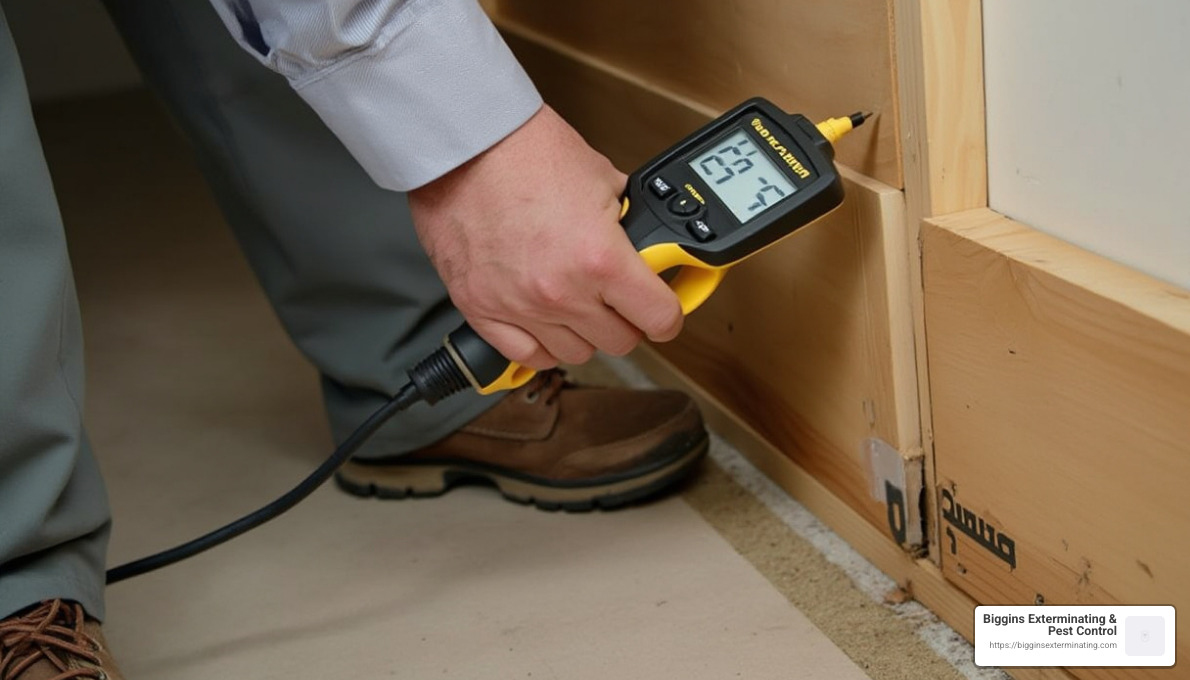
For particularly challenging cases, we might employ thermal imaging cameras to detect the subtle temperature differences that indicate ant galleries within walls. We’ll also tap on suspicious areas, listening for the hollow sound of damaged wood or the faint rustling of ants inside.
During a recent home inspection in Lexington, our technician finded a complex network of carpenter ant nests. “The homeowner had been treating the kitchen for months with store-bought sprays,” recounts our technician. “But our inspection revealed the parent colony was actually in a rotting maple tree 60 feet from the house, with satellite colonies in the bathroom wall and attic. No wonder the DIY approach wasn’t working!”
For a closer look at our thorough inspection process, visit our Carpenter Ants Exterminator page.
Carpenter Ant Service – Targeted Treatment
Once we’ve mapped your carpenter ant infestation, we implement a multi-faceted treatment approach custom to your specific situation. There’s no one-size-fits-all solution when it comes to effective carpenter ant service.
For nests hidden in walls, we use specialized drill-and-inject techniques that allow us to deliver treatments directly into carpenter ant galleries without damaging your home. Our micro-injector equipment can flush ants from their hiding spots and treat areas that would otherwise be inaccessible without opening walls.
Non-repellent liquid applications form a key part of our strategy. Unlike older pesticides that ants can detect and avoid, these advanced formulations are undetectable to carpenter ants. The insects walk through treated areas, pick up the product, and unwittingly carry it back to the colony – affecting ants that never leave the nest, including the queen.
We strategically place gel baits along active trails where foraging ants will find them and bring them back to feed the colony. These slow-acting products ensure the bait is widely distributed throughout the nest before taking effect.
“What makes professional carpenter ant service different is precision,” says our treatment specialist. “We’re not just spraying baseboards. We’re placing materials exactly where carpenter ants live and travel, which means we can use far less product while getting much better results.”
For homes with children, pets, or environmental concerns, we offer reduced-risk options that maintain effectiveness while minimizing exposure. Our technicians are thoroughly trained in applying products in a manner that poses minimal risk to your family and the environment.
Learn more about our targeted treatment approaches on our Carpenter Ant Pest Control page.
Carpenter Ant Service – Verification & Warranty
The final phase of our carpenter ant service is all about ensuring your problem is completely resolved and stays that way.
After treatment, we conduct thorough follow-up inspections to verify that all colonies have been eliminated. We’ll check all previously identified nesting sites and monitor for any signs of continued activity.
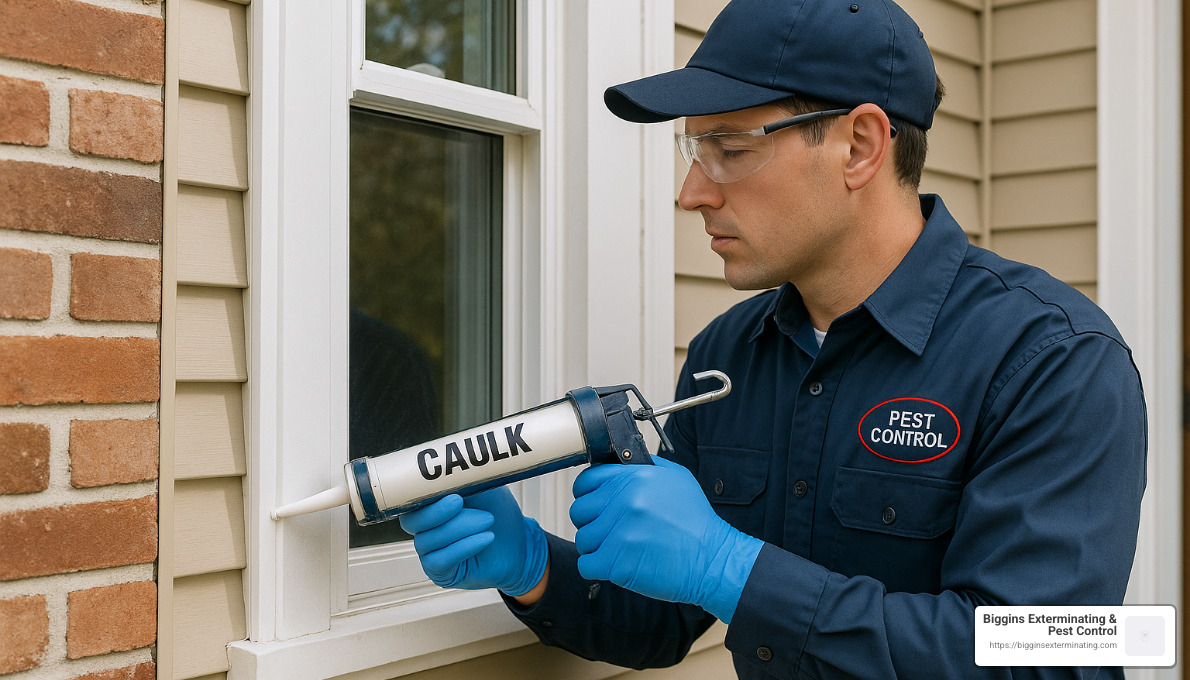
We don’t just treat the ants – we help prevent future problems by identifying and sealing potential entry points. Our technicians can spot the tiny cracks and gaps that carpenter ants use to access your home, often recommending simple repairs that will keep them out for good.
Moisture issues are the number one attractant for carpenter ants, so we provide detailed recommendations for addressing any water problems that might be making your home attractive to these pests. Sometimes, a simple fix like repairing a leaky pipe or improving ventilation in a crawlspace can make all the difference.
After each service, you’ll receive a written report documenting our findings, treatments applied, and recommendations for preventing future problems. This documentation is valuable not only for your records but sometimes for insurance purposes as well.
“The best part of what we do is the peace of mind we provide,” says our customer service representative. “Our warranties mean that if you see any carpenter ant activity after our treatment, we’ll return at no additional charge to take care of it.”
Unlike many pest control companies that require ongoing service contracts, Biggins Exterminating offers one-time carpenter ant service with solid warranties. You get the protection you need without being locked into unnecessary long-term commitments.
Costs, Safety & Eco-Friendly Options (Plus FAQs)
When homeowners consider professional carpenter ant service, three questions usually come to mind: “How much will it cost?”, “Is it safe for my family?” and “What are my options?” Let’s break these down in simple terms.
The price tag for professional carpenter ant treatment varies widely across the United States. Based on industry data (not Biggins Exterminating pricing), you can expect to pay anywhere from $300 for a straightforward treatment to $1,200+ for tackling severe infestations requiring multiple visits.
Several factors play into this price range:
“The size of your infestation makes a huge difference,” explains our senior technician. “A small satellite colony might be relatively simple to address, while a property with multiple established colonies throughout the structure requires significantly more time and materials.”
Your home’s size matters too – larger homes simply require more inspection time and treatment materials. The approach needed (targeted nest treatment versus whole-house treatment), accessibility issues (like hard-to-reach crawlspaces), and warranty length all influence the final cost.
At Biggins, we believe in transparency. We provide clear pricing after a thorough inspection – no surprises, no hidden fees, and no pressure to sign ongoing contracts. We’re in the business of solving your carpenter ant problem, not locking you into unnecessary services.
Are Treatments Safe for Kids & Pets?
As a family-owned business, we understand your safety concerns. Modern carpenter ant service has come a long way from the days of heavy-handed chemical applications.
“Random application of material is always avoided,” our lead technician emphasizes. “We place treatments precisely where carpenter ants travel and nest, not throughout your entire home.”
Today’s professional products target insects while posing minimal risk to mammals when properly applied. Once dried, these materials bond to surfaces and don’t readily transfer to skin or paws. All products we use are EPA-approved and applied according to label instructions by our licensed professionals.
For areas that might require extra caution, we provide clear guidance on when it’s safe to re-enter. As one customer in Reading told us, “I was nervous about having treatments with my new baby, but they explained everything so clearly and were so careful about where they applied products that my worries disappeared.”
Eco-Conscious Choices
Many of our customers care deeply about environmental impact, and we’re right there with you. Our green carpenter ant service options include:
Botanical-based products derived from plant oils and extracts provide effective control with minimal environmental impact. These work particularly well for maintenance treatments once the main infestation is addressed.
We also offer reduced-risk materials that meet the EPA’s stringent environmental and safety criteria. Our targeted baiting approach uses minimal amounts of material placed in contained stations that ants carry back to the colony – the insect equivalent of “taking the medicine to the patient” rather than treating your entire home.
“Our HomeCare Green program focuses on minimizing pesticide usage,” shares our environmental specialist. “We believe effective pest control and environmental responsibility work hand in hand.”
The cornerstone of our eco-friendly approach is Integrated Pest Management (IPM) – combining multiple strategies to achieve control with minimal environmental impact. This often starts with addressing moisture issues and sealing entry points before considering chemical treatments.
DIY vs Pro — Which Is Cheaper?
I’ll be straight with you – those store-bought sprays might seem like a bargain at $20-$100, compared to professional carpenter ant service at $300-$900+. But here’s what typically happens:
“I wasted nearly $300 on different sprays and baits over six months before finally calling Biggins,” a Wilmington customer recently told us. “Wish I’d just started with the pros – would have saved money and a lot of frustration.”
The DIY approach often means multiple applications over weeks or months, with a low to moderate success rate because these products treat symptoms, not the source. Most importantly, DIY treatments come with zero warranty protection.
By contrast, professional service typically requires just 1-3 visits, offers a high success rate by identifying and treating all colonies, and includes warranty coverage. The health and safety risks are also minimized with trained application.
Store products rarely reach parent colonies or nests inside walls. Many DIY treatments actually repel ants, causing them to relocate within your home rather than eliminating them. Without proper inspection tools, finding all nest locations is nearly impossible, and most DIY products lack residual protection against re-infestation.
When you factor in these realities, professional carpenter ant service often proves more economical in the long run than repeated DIY attempts.
Quick-Fire FAQs About Carpenter Ant Service
1. How long does elimination take?
Complete elimination typically takes 2-6 weeks, depending on colony size and number. You’ll notice results within days, but complete colony elimination takes time as treatments need to reach all ants, including the queen who may be hiding deep in the nest.
2. Will ants return after treatment?
Without addressing underlying issues like moisture problems and entry points, carpenter ants may return. That’s why our carpenter ant service includes recommendations for preventing re-infestation, and our warranties provide protection if ants do return.
“We had carpenter ants return the following spring after treatment elsewhere,” shared a Bedford homeowner. “Biggins not only retreated at no charge under warranty but helped us identify and fix the moisture issue that was attracting them.”
3. Do carpenter ants bite?
Yes, they can bite if threatened, using their mandibles to pinch skin and sometimes spraying formic acid into the wound, causing a mild burning sensation. However, bites are rare and typically only occur when ants are directly handled or their nest is disturbed. These aren’t aggressive insects looking to attack humans – they’re just trying to build their homes (unfortunately inside yours).
4. How far do carpenter ants forage from their nest?
These industrious insects can travel up to 300 feet from their nest, following established scent trails to food sources. This extensive range explains why the parent colony may be located quite far from where you’re spotting ants in your home – perhaps in that old tree stump at the edge of your property.
5. Is it necessary to treat the entire house?
Not always. Professional carpenter ant service targets specific nesting sites and travel routes rather than treating the entire structure. This targeted approach is more effective and reduces unnecessary pesticide use – better for your family and the environment.
6. How can I tell if carpenter ants have damaged my home’s structure?
Listen for hollow-sounding wood when tapped, look for visible galleries in exposed wood, notice sagging floors or ceilings, check if doors and windows stick unexpectedly, and watch for wood shavings (frass). A professional inspection can properly assess the extent of damage and give you peace of mind.
Prevention & Conclusion
Preventing carpenter ant infestations is far easier and less costly than dealing with established colonies. After helping Massachusetts homeowners for decades, I’ve seen how simple preventive measures can save thousands in repair costs.
Moisture control is your first line of defense against carpenter ants. These pests are drawn to damp wood like moths to a flame. Fix leaky pipes and roof areas promptly, ensure proper ventilation in enclosed spaces like attics and crawlspaces, and direct water away from your foundation with proper grading and gutters. In particularly damp areas, a dehumidifier can make a world of difference.
“I had a customer in Woburn who installed a simple $200 dehumidifier in their crawlspace,” shares our prevention specialist. “That single step prevented a likely carpenter ant infestation that would have cost thousands to treat and repair.”
Your landscaping choices matter too. Keep tree branches trimmed at least 6 feet away from your roof – carpenter ants use these as highways into your home. Remove dead stumps and trees near your property, as these often serve as parent colony locations. When storing firewood, keep it liftd and away from your house. I always recommend maintaining a vegetation-free zone of about 12-18 inches around your foundation.
Regular home maintenance pays dividends in carpenter ant prevention. Seal cracks around windows, doors, and utility entrances – even a gap the width of a credit card is enough for carpenter ants to enter. Replace water-damaged wood promptly, as this is prime real estate for carpenter ant colonies. Don’t forget about proper ventilation and repairing damaged screens and weather stripping.
Perhaps the most overlooked prevention strategy is regular inspection. Take time each season to check for signs of carpenter ant activity, especially in areas prone to moisture. Many homeowners I work with in Burlington and Bedford have added carpenter ant inspection to their spring cleaning routines, checking window frames, door jambs, and basement sills for signs of trouble.
“An ounce of prevention is worth a pound of cure, especially with carpenter ants,” I often tell my customers. “Most of the severe infestations we treat could have been prevented with basic moisture control and home maintenance.”
For homes in high-risk areas or those with previous infestations, our preventive carpenter ant service programs include regular inspections and perimeter treatments to keep your home protected year-round.
Conclusion
Carpenter ants represent a serious threat to your home’s structural integrity, particularly in the moisture-prone New England climate. Their complex colony structure, nocturnal habits, and ability to establish multiple nests make them challenging to eliminate without professional intervention.
Professional carpenter ant service provides comprehensive solutions that address both active infestations and the conditions that attract these destructive pests. At Biggins Exterminating & Pest Control, our 40+ years of experience in Wilmington and surrounding Massachusetts communities has taught us that effective carpenter ant control requires a systematic approach:
- Thorough inspection to locate all colonies
- Targeted treatments that reach the queen and all nest locations
- Addressing moisture issues and entry points
- Follow-up verification to ensure complete elimination
Unlike many pest control companies that require ongoing contracts, we offer one-time carpenter ant service with warranties, giving you peace of mind without long-term commitments. Our family-owned business understands the importance of protecting your family and home with safe, effective methods.
“Carpenter ants are the number one wood-destroying pest in New England,” I remind homeowners during inspections. “Don’t wait until significant damage has occurred to address an infestation.”
If you’re seeing large black ants in your home, hearing rustling in your walls, or noticing small piles of sawdust-like material, contact Biggins Exterminating today for a professional inspection and customized treatment plan. Our service areas include Andover, Bedford, Billerica, Burlington, Lexington, North Reading, Tewksbury, Wilmington, and Woburn.
Learn more about our carpenter ant programs or call us today to schedule your inspection. When it comes to carpenter ants, early intervention saves both your home and your wallet.
