
The Buzzing Menace Behind Your Walls
Spring brings many welcome changes—warmer weather, blooming flowers, and longer days. But for many homeowners, it also brings the unwelcome return of carpenter bees under siding. These industrious insects can turn a peaceful afternoon on your deck into a nerve-wracking experience as they hover and buzz around your home’s exterior.
If you’ve spotted these wood-boring bees around your property, here’s what you need to know to take action quickly:
Quick Guide: Carpenter Bees Under Siding
1. Identification: Look for perfectly round ½-inch holes, sawdust piles, and shiny black bees
2. Immediate Action: Apply insecticidal dust into holes at dusk when bees are inside
3. Repair: Fill treated holes with wood putty after 24-48 hours
4. Prevention: Paint exposed wood and seal gaps in siding
Unlike their cousins the termites, carpenter bees aren’t interested in eating your home—they’re just looking for a cozy place to raise their families. These solitary bees have a particular fondness for soft, unpainted woods like pine, cedar, and redwood. This preference makes the wooden structures hiding behind vinyl siding particularly appealing real estate for them.
Female carpenter bees are remarkable excavators. They can drill through wood with surprising efficiency, creating galleries up to 6 inches long in just one week. While a single tunnel might seem harmless, the real problem develops over time. As generations of bees reuse and extend existing nests, these tunnels can expand into elaborate networks stretching up to 10 feet long—turning your home’s wooden framework into a bee apartment complex.
What many homeowners don’t realize is that carpenter bees under siding have an uncanny ability to smell decaying wood even through vinyl cladding. They’re experts at finding tiny gaps, seams, and imperfections that give them access to the wooden buffet hiding beneath your home’s exterior shell.
In my 40+ years helping homeowners with pest problems at Biggins Exterminating, I’ve seen countless cases where people mistake these wood-boring insects for harmless bumblebees. The confusion usually clears up when they find the perfectly round entry holes (about the size of your pinky finger) and small piles of sawdust that signal a carpenter bee infestation.
Meet the Culprit: Carpenter Bees vs. Other Bees
When homeowners call us at Biggins Exterminating about “bees in their siding,” the first step is always proper identification. Those buzzing visitors could be several different species, but if they’re drilling perfect holes in your home, we’re likely dealing with carpenter bees (Xylocopa species).
“They don’t chew into vinyl,” our senior technician often explains to worried callers. “There must be exposed wood somewhere if it’s carpenter bees under siding.”
Anatomy & Behavior Basics
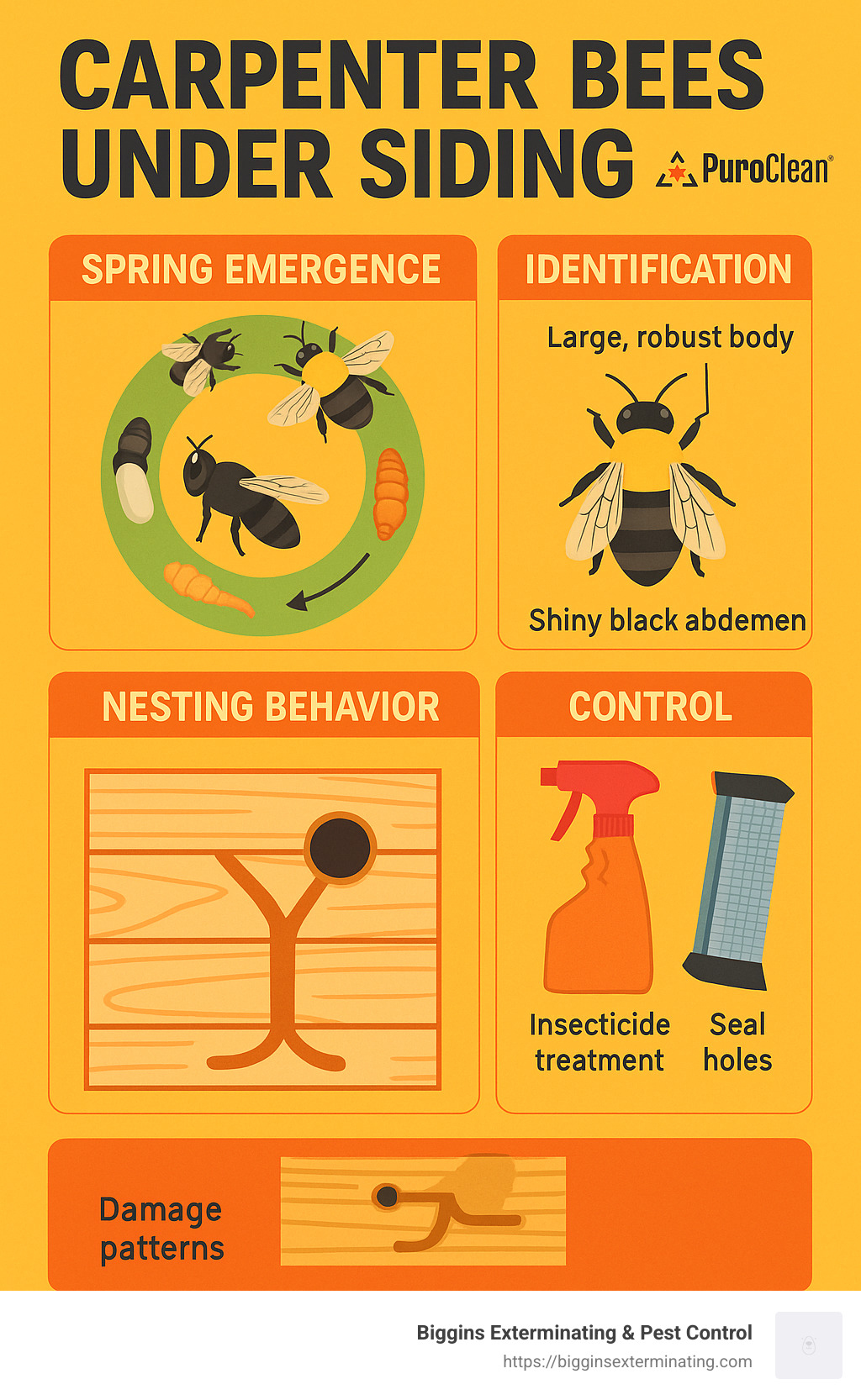
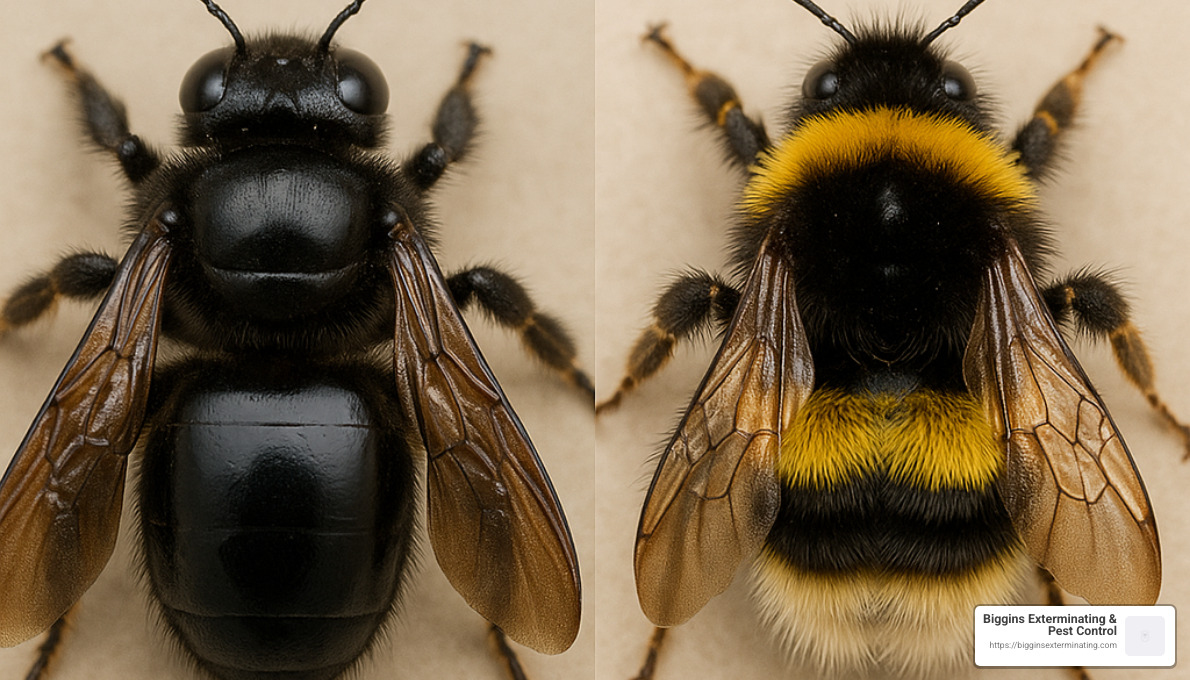
The telltale sign of carpenter bees is their shiny, hairless black abdomen that looks almost polished in the sunlight. Unlike their social cousins, these independent contractors prefer the solitary life, working alone to create their wooden nurseries. They’re substantial insects, measuring about ¾ to 1 inch long, without the pollen baskets other bees use to transport flower pollen.
Female carpenter bees are the true woodworkers of the insect world. Armed with powerful mandibles, they carve perfectly round half-inch tunnels into wood. After drilling about an inch deep, they make a clever 90-degree turn and tunnel along the grain for another 4-6 inches, creating galleries where they’ll lay their eggs.
The males, while intimidating with their territorial hovering and aggressive buzzing, are all buzz and no bite—they literally cannot sting! They’ll dart at anything that moves near their nests—including you and your family—but it’s just for show. Females do have stingers but rarely use them unless you handle them directly. As one customer told us after watching a male bee dive-bomb him repeatedly, “I felt silly when I learned he couldn’t hurt me after all that running!”
Bumblebees, Honeybees & Carpenter Bees—Spot the Difference
“I thought I had bumblebees until I noticed the perfect little holes appearing along my deck and sawdust piling up below,” a Lexington homeowner recently told us. “That’s when I realized I needed help.”
This confusion is incredibly common among Massachusetts homeowners. Here’s how to tell these bees apart:
Bumblebees are the teddy bears of the bee world, with completely fuzzy bodies—including their abdomens. They’re social creatures that nest in the ground or in abandoned rodent burrows, not in your woodwork. Their hairy abdomen is the quickest way to distinguish them from carpenter bees.
Honeybees are smaller, more slender, and highly social, living in large colonies with complex social structures. They build wax combs to raise their young and store honey, not wooden tunnels. They’re rarely found drilling into homes.
Carpenter bees are the woodworkers, with their distinctive shiny, hairless black abdomens. They work alone or in small family groups, methodically drilling into wood to create their nests. Unlike other bees, they don’t collect pollen in special baskets on their legs, though they’re still valuable pollinators for your garden.
Despite their destructive habits, carpenter bees actually provide important ecological benefits. They’re excellent pollinators, especially for certain plants with deep flowers that other bees can’t access. Some carpenter bee species even perform “buzz pollination,” vibrating their bodies to shake loose pollen from flowers—a technique that makes them particularly valuable for crops like tomatoes and blueberries.
So while you may not want them tunneling into your home’s wooden structures, these industrious insects do play a beneficial role in our ecosystem—just preferably not under your siding!
Why Carpenter Bees Under Siding Happens
Carpenter bees aren’t randomly selecting your home for their woodworking projects. These savvy insects are drawn to specific conditions that make your siding an irresistible real estate opportunity.
How Carpenter Bees Under Siding Find Entry Points
These determined insects have an uncanny ability to find the weaknesses in your home’s protective shell. They’re like nature’s home inspectors, finding flaws you never knew existed.
Soffit seams and joints create perfect entry highways for carpenter bees. Where two boards meet, even the tiniest gap becomes an invitation. One Wilmington homeowner was shocked when we showed her how bees were accessing her attic through a barely visible gap in her soffit.
J-channel voids around vinyl siding are particularly problematic. These U-shaped pieces designed to hold siding panels create small spaces where carpenter bees can access the wooden structure behind.
“They found a space barely wider than a credit card,” reported one North Reading customer after finding carpenter bees were accessing the wood behind his vinyl siding through a tiny gap where the J-channel met the corner post.
Rain-screen gaps intended for moisture control ironically create perfect bee highways. These small ventilation spaces between siding and sheathing allow bees to travel freely behind your siding once they find an entry point.
Fascia board connections at roof edges often have small gaps where carpenter bees can squeeze through. These areas are doubly attractive because they’re usually made of softer woods that are easier to tunnel into.
Loose or warped siding panels create spaces large enough for carpenter bees to slip behind. Once there, they can access all the tasty wooden structural elements hidden from view.
Favorite Materials for Carpenter Bees Under Siding
Not all woods appeal equally to the discerning carpenter bee. These insects show strong preferences for certain materials, with softwoods topping their wish list.
Pine ranks as their absolute favorite. Its soft, straight grain makes for easy tunneling and comfortable nesting. Many homes have pine fascia boards, soffits, or structural elements that become prime targets.
Cedar, despite its natural oils that theoretically repel insects, becomes vulnerable once weathered. After a few seasons exposed to the elements, those protective oils diminish, leaving the wood susceptible to bee excavation.
Redwood makes another appealing option, particularly when it’s been weathered. Like cedar, aging reduces its natural insect resistance.
Untreated lumber of almost any variety provides an easy target. Without chemical preservatives, these woods offer no defense against determined carpenter bees.
“Carpenter bees are like real estate agents,” jokes one of our Woburn technicians. “They’re all about location, location, location—preferably in soft, unpainted wood with morning sun exposure.”
What’s fascinating is their selective behavior. They typically ignore pressure-treated lumber and hardwoods like oak, which explains why they might bypass your treated deck posts but happily drill into the untreated fascia boards tucked under your gutters.
Wind-driven dust accumulating in corners and seams can actually help carpenter bees locate potential nesting sites. This dust carries the scent of wood, which attracts females searching for nesting locations. Once they find rotting or water-damaged wood, they’re even more likely to move in, as deteriorating wood is easier to excavate.
Red Flags: Spotting an Infestation Early
Early detection can save you thousands in repairs when it comes to carpenter bees under siding. These industrious insects leave behind several unmistakable calling cards that alert observant homeowners to their presence.
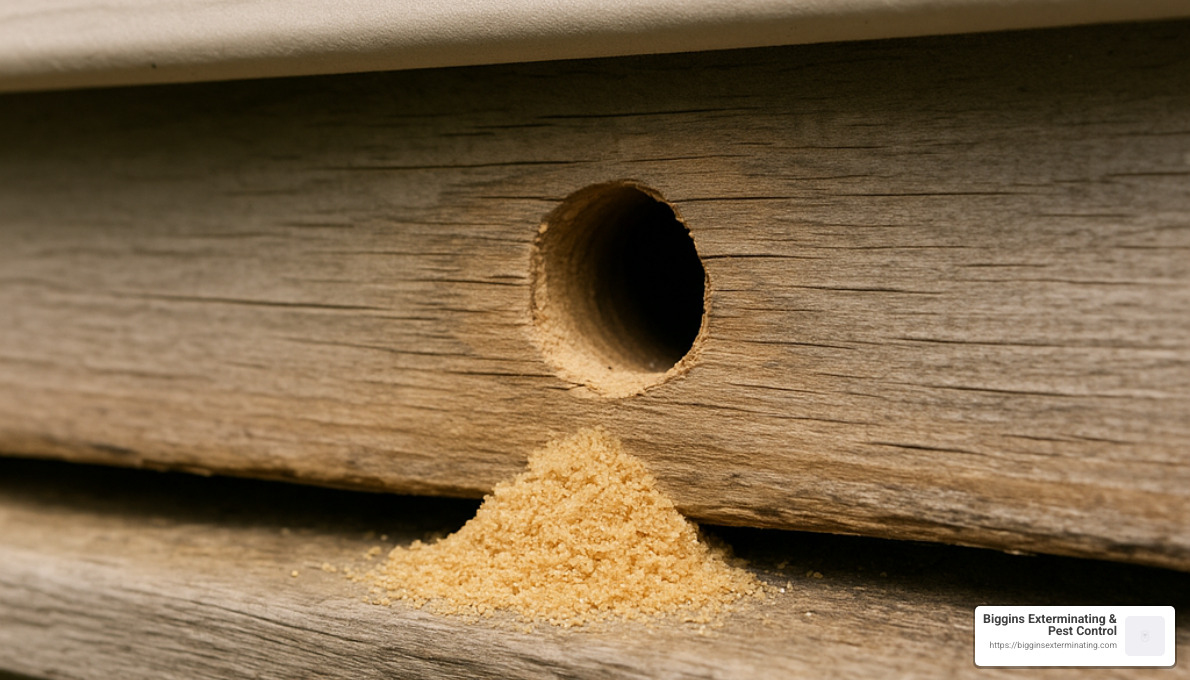
Spring is prime time for carpenter bee activity, as overwintered adults emerge hungry and ready to establish new nests. Keep your eyes peeled for perfectly round drill holes about ½-inch in diameter that look almost machine-made. These aren’t random damage—they’re precisely engineered entryways to the bees’ nurseries.
“The holes are so perfect they look like someone took a drill to my house,” remarked one Andover homeowner who called us last April. “I thought it was neighborhood vandalism until I saw the bees!”
Another telltale sign is the presence of sawdust piles (what entomologists call “frass”) collecting beneath entry points. This fresh wood debris resembles pencil shavings and indicates active drilling. One Burlington customer shared her findy: “I noticed what looked like pencil shavings on my windowsill. When I looked up, I could see a perfect little hole in the trim above. That’s when I knew I had carpenter bees.”
Pay attention to fan-shaped stains around entry holes—these discolorations come from the oils in bee bodies rubbing against the wood as they enter and exit repeatedly. Your ears can help too; many homeowners report buzzing or scraping sounds coming from inside walls, especially noticeable during quiet evenings when the bees are most active.
The presence of hovering bees near your home’s exterior is another red flag. Male carpenter bees act as sentries, aggressively patrolling near nest entrances on sunny days. While they can’t sting, their intimidating behavior—darting at anything that moves—is unmistakable.
Perhaps the most destructive warning sign is fresh woodpecker damage near your siding. These birds have remarkable hearing and can detect bee larvae inside wood. They’ll happily tear into your siding to feast on the developing bees, creating even more extensive damage in the process.
“We had no idea we had carpenter bees until a woodpecker started hammering away at our fascia board,” a Winchester customer told us. “By the time we investigated, we had two problems to solve instead of one.”
Don’t wait until the damage is extensive. If you spot any of these warning signs, it’s time to take action before these wood-boring bees turn your siding into their multi-generational apartment complex.
Damage & Risks: What Happens If You Ignore Them
Those tiny holes might seem harmless at first, but ignoring carpenter bees under siding can lead to bigger headaches down the road.
“Unlike termites, bees and wasps do not cause structural damage,” notes building scientist Martin Holladay. But he quickly adds, “When she’s about an inch into the wood, she makes a right turn and excavates with the grain for maybe six inches more.”
This is where the trouble begins. What starts as a single tunnel can transform into something much more concerning over time.
Female carpenter bees create these galleries to lay their eggs, but their offspring often return to the same spot year after year. Rather than starting from scratch, they’ll extend existing tunnels, gradually creating an expanding network of chambers. After several seasons, what began as a single hole can become a honeycomb-like maze throughout your wooden structures.
Water intrusion is perhaps the most serious consequence of these tunnels. Each hole creates a perfect entry point for moisture, which can seep into your walls and cause rot and mold to develop. This is especially problematic during our rainy Massachusetts springs and humid summers.
Then there’s the woodpecker problem. These birds have incredible hearing and can detect bee larvae inside the wood. They’ll happily hammer away at your siding to reach this protein-rich snack, creating even larger holes and more extensive damage in the process.
A Tewksbury homeowner shared his costly lesson with us: “I ignored a few holes for several seasons. When we finally removed the affected siding, we found a honeycomb of tunnels throughout the fascia board. What started as a minor issue became a major repair.”
Once carpenter bees abandon their tunnels, other pests often move in. Ants, wasps, and various insects are quick to claim these ready-made homes, potentially creating new pest management challenges.
In rare but particularly problematic cases, honeybees might even take over abandoned carpenter bee tunnels, bringing with them the potential for honey accumulation inside your walls—a sticky situation indeed!
While a single bee won’t bring your house down, the combined effect of multiple generations can be significant. According to scientific research on carpenter bee tunneling, extensive gallery networks can eventually compromise wooden structures if left unchecked for multiple seasons.
And let’s not forget about the sting risk. While male carpenter bees can’t sting (despite their intimidating hovering), females can and will if they feel threatened. For those with bee allergies, this presents a serious health concern that shouldn’t be ignored.
The good news? All these risks can be avoided with timely intervention—which we’ll cover in the next section.
Step-By-Step Removal: DIY and Professional Options
When those telltale perfect holes appear and you’ve confirmed you have carpenter bees under siding, it’s time to take action. The good news? You’ve got options ranging from weekend warrior approaches to calling in the cavalry.
DIY Blueprint for Eviction
If you’re comfortable on a ladder and enjoy home improvement projects, tackling carpenter bees yourself can be satisfying and cost-effective.
Start by marking all entry holes during daylight hours when bees are buzzing about. You’ll need a few supplies: insecticidal dust specifically labeled for carpenter bees, a hand duster with an extension tube, protective gear (including safety goggles – those eyes are important!), and wood putty for repairs.
The magic happens at dusk when most bees have returned to their nests for the night. That’s your moment to strike.
“I always tell homeowners to wait until the sun starts setting,” shares our senior technician. “The bees are home for dinner, and you’ll get maximum impact from your treatment.”
Apply 3-5 puffs of insecticidal dust directly into each hole, making sure to get good coverage inside the tunnel. This is crucial – don’t skimp here! Then exercise patience. Leave the holes open for 24-48 hours so bees returning to the nest contact the insecticide.
Only after this waiting period should you seal the holes with wood putty or caulk. Finish by painting or sealing the repaired areas to prevent future nesting – unpainted wood is basically a “Vacancy” sign for next year’s bees.
One creative Bedford homeowner shared his technique: “I vacuum them out with my shop vac early in the morning, then plug the holes with putty. Works like a charm for the spots I can reach!”
For the environmentally conscious, some homeowners report temporary success with citrus oil sprays (bees apparently dislike the scent), almond oil near entry points, or even creating vibrations with wind chimes nearby. Just know these gentler methods typically offer short-lived relief rather than permanent solutions.
Calling in the Pros for Carpenter Bees Under Siding
When those pesky bees have established multiple entry points, created tunnels deep under siding, or built nests in hard-to-reach areas, professional help makes sense.
At Biggins Exterminating & Pest Control, we bring specialized equipment and expertise to the carpenter bee battle. Our approach goes beyond what most homeowners can achieve on their own.
We start with a comprehensive inspection to identify all entry points—including the sneaky ones you might miss. Our technicians then apply professional-grade insecticidal dusts that penetrate deep into galleries where DIY treatments might not reach.
“After two failed DIY attempts, I called Biggins,” a relieved Billerica customer told us. “Their technician found three additional entry points I’d completely missed and treated the entire problem in one visit.”
For bees that have made their way into wall voids behind siding, we perform specialized void treatments that target these hidden areas. We’ll also provide recommendations for sealing entry points after treatment to prevent future invasions.
Professional carpenter bee treatments typically cost between $75 and $450+ based on internet data (not actual Biggins pricing), with factors like infestation severity, home size, and accessibility affecting the final cost. While DIY might seem cheaper initially, most homeowners find professional treatment cost-effective when considering the potential damage from persistent infestations.
When you factor in the peace of mind that comes from knowing the job was done right, professional treatment often proves its value quickly. Plus, you get to stay safely on the ground while we handle those precarious ladder maneuvers!
Seal & Heal: Repairing and Replacing Damaged Siding
After you’ve successfully evicted your buzzing invaders, it’s time to roll up your sleeves and fix what they’ve left behind. The damage from carpenter bees under siding ranges from a few neat holes to extensive honeycomb-like tunneling—and your repair strategy should match the severity.
| Damage Level | Repair Method | Materials Needed | Skill Level |
|---|---|---|---|
| Few isolated holes | Spot repair | Wood filler, caulk, paint | Beginner |
| Multiple holes, minor damage | Board replacement | Matching siding, nails, paint | Intermediate |
| Extensive tunneling, rot | Section replacement | Multiple boards, flashing, paint | Advanced |
| Structural compromise | Professional repair | Varies based on damage | Professional |
For those lucky enough to catch the problem early, minor repairs are usually straightforward. “Most homeowners can handle patching a few holes,” says our senior technician at Biggins. “It’s when those holes connect to form internal highways that things get complicated.”
When tackling wood siding with just a few bee holes, start by thoroughly cleaning out each hole. If the surrounding wood feels soft or spongy, apply a wood hardener first—this helps restore strength before filling. Next, pack the holes with a high-quality exterior wood filler, allowing it to dry completely before sanding it smooth. Finish with primer and paint that matches your existing siding to create a seamless repair that also protects against future invasions.
Vinyl siding presents a different challenge. Since carpenter bees don’t actually chew through vinyl (they just find gaps to access the wood behind it), your repair might involve removing a section of siding to address the wooden structure underneath. Vinyl’s modular design makes this easier than you might think—panels are designed to unclip and be replaced.
“I was surprised how easy it was to pop out the damaged section,” shared one Winchester homeowner. “The tricky part was treating all the tunnels hidden behind it.”
When replacing damaged wood behind vinyl siding, consider adding insect screening at transition points and seams. This extra barrier helps keep determined bees from finding their way back in through tiny gaps.
For homes with repeated infestations or extensive damage, it might be time to consider upgrading materials during your next renovation. Fiber cement siding has become increasingly popular among homeowners tired of battling wood-destroying pests. While more expensive initially, its resistance to carpenter bees, termites, and even woodpeckers makes it a cost-effective long-term solution.
One Andover customer finded the true extent of damage only during repairs: “What looked like three small holes from the outside turned into a shocking network when we removed the boards. We ended up replacing the entire fascia along that side of the house.”
Carpenter bee damage often extends farther than what’s visible from the surface. When you find one damaged area, it’s worth checking adjacent boards for early signs of infestation. Being thorough now can prevent more extensive repairs later.
For structural damage or repairs beyond your comfort level, don’t hesitate to call in professionals. The cost of proper repairs is almost always less than dealing with the compounding problems of water intrusion and continued pest activity that come from postponing necessary work.
Prevention Playbook: Keeping Carpenter Bees Out for Good
The best way to deal with carpenter bees under siding is to prevent them from nesting in the first place. Here’s our comprehensive prevention strategy:
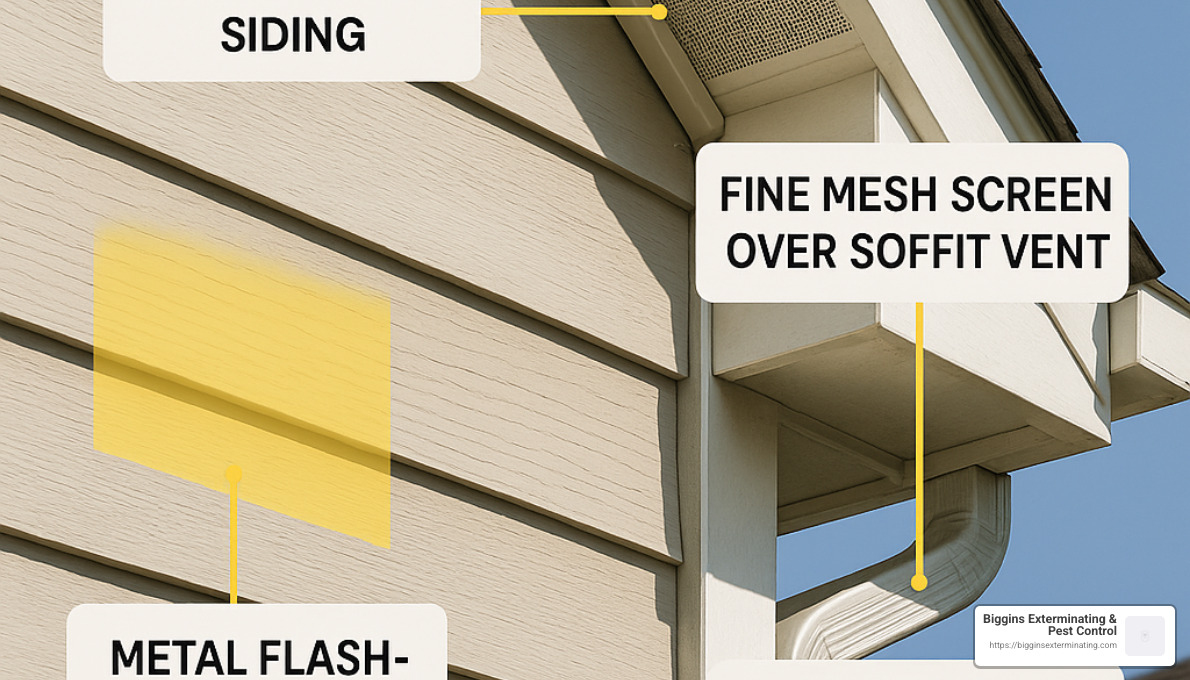
After 40 years of battling these persistent pollinators, we’ve learned that an ounce of prevention truly is worth a pound of cure. Our most successful customers follow a multi-layered approach that turns their homes into “no vacancy” zones for carpenter bees.
Physical Barriers
The single most effective deterrent against carpenter bees under siding is simply paint. These wood-boring insects strongly prefer bare, untreated wood and will typically bypass painted surfaces. “It’s like magic,” says one of our technicians. “I’ve watched carpenter bees inspect a freshly painted fascia board and literally fly away to find easier pickings.”
For extra protection, install fine mesh screens at soffit vents and behind decorative trim where bees might find access. Metal flashing at material transitions creates another effective physical barrier. One Winchester customer told us, “After installing aluminum flashing where our fascia meets the roof edge, we haven’t had a single new carpenter bee hole in three years.”
Don’t forget to fill existing holes—even old, abandoned ones. These ready-made tunnels are like “For Rent” signs to new carpenter bees looking for a home. For persistent problem areas, consider applying perforated metal or plastic mesh behind siding venting to block access while maintaining proper airflow.
Chemical Deterrents
For those seeking additional protection, several chemical options can complement physical barriers. Paint additives like NBS (No Bugs Allowed) transform ordinary exterior paint into a carpenter bee deterrent. When repainting, simply mix it into your chosen color for added protection.
Residual insecticide sprays applied to potential nesting sites before bee season can create an invisible barrier. For a more natural approach, citrus oil treatments work as effective repellents—carpenter bees strongly dislike the smell of citrus. One Tewksbury homeowner shared, “I spray diluted orange oil on my deck posts every spring, and it’s been surprisingly effective at keeping them away.”
Habitat Modifications
Sometimes the smartest strategy is redirection rather than repulsion. While it might seem counterintuitive, creating alternative housing for native bees can actually reduce carpenter bee damage. Bee hotels placed at the far edge of your property give these important pollinators somewhere to nest besides your home.
Consider planting natural repellents like mint and citronella near vulnerable areas of your home. These aromatic plants create an invisible barrier that many bees prefer to avoid. At the same time, be mindful that certain flowering plants placed directly adjacent to your home might initially attract bees to your property.
Maintenance Schedule
Consistency is key to long-term carpenter bee prevention. Develop a seasonal maintenance routine that includes:
Early spring inspection before bee activity begins is crucial. Walk your property looking for potential entry points and address them before the bees emerge. A post-treatment follow-up ensures all holes remain sealed throughout the active season. Finally, fall preparation gives you a chance to seal any new holes before bees settle in for overwintering.
“The most important thing is consistency,” explains our senior technician. “A single unpainted board can attract carpenter bees to your property, even if the rest of your home is well-protected.”
One Lexington customer shared her success story: “After three years of fighting carpenter bees, we followed Biggins’ recommendation to paint all exposed wood and install mesh behind our decorative trim. This is the first spring in years we haven’t seen a single carpenter bee!”
For more information about effective prevention and treatment options, visit our Bee and Wasp Removal page. According to scientific research on bee nesting, understanding their natural behaviors is key to disrupting their nesting cycles effectively.
Frequently Asked Questions about Carpenter Bees Under Siding
Do carpenter bees eat wood or just drill it?
Despite their name, carpenter bees aren’t actually eating your home for lunch. Unlike termites that consume wood, carpenter bees are simply master excavators, drilling tunnels solely for nesting purposes. They use their powerful mandibles to create galleries where they’ll raise their young and store pollen provisions.
“That’s why you’ll see those neat little piles of sawdust under active nests,” explains our senior technician. “What you’re looking at is literally bee sawdust—they’re drilling and tossing out the wood chips as they go.” This frass, as it’s technically called, is actually one of the best early warning signs of carpenter bees under siding.
Will they sting me if I get close to their holes?
Good news for nervous homeowners: those intimidating bees hovering aggressively near your eaves are almost certainly males, and male carpenter bees cannot sting—at all. Their dive-bombing behavior might look frightening, but it’s just territorial display with no actual threat behind it.
Female carpenter bees (the ones doing all the actual drilling) do have stingers but rarely use them unless directly handled or threatened. As one of our technicians likes to put it, “They’re too busy with their woodworking projects to bother with stinging.” Many of our customers report living with carpenter bees for years without ever receiving a sting.
When is the best time of year to treat carpenter bees under siding?
Timing is everything when dealing with carpenter bees under siding. The optimal treatment window is early spring (typically April-May in Massachusetts) when bees first emerge from overwintering but before they’ve laid new eggs. This prevents the next generation from establishing.
A second effective treatment period comes in late fall before bees settle in for winter. Many homeowners miss this opportunity, but it can be highly effective at breaking the cycle.
“If you’re seeing bees flying around your eaves after new siding has been installed,” notes our pest control specialist, “they may be emerging from overwintered nests that were inadvertently covered by the new siding. In these cases, we need to treat the voids behind the siding, which requires specialized equipment.”
Can carpenter bees damage vinyl siding?
Here’s an interesting fact that surprises many homeowners: carpenter bees don’t actually chew through vinyl siding itself. They’re specifically searching for wood, not plastic. However, they’re remarkably clever at finding seams, gaps, and transitions where they can access wooden structural elements behind the vinyl.
They’re particularly drawn to wooden trim adjacent to vinyl siding or the wooden fascia boards that might be partially covered by vinyl. As one pest control forum expert noted, “They don’t chew into vinyl; there must be exposed wood somewhere if it’s carpenter bees.”
How do I know if carpenter bees have gotten behind my siding?
You might not see the actual holes if carpenter bees have found their way behind your siding, but there are several telltale indicators to watch for:
Bees flying in and out from under siding edges or J-channels is the most obvious sign. You might also notice sawdust accumulating on window sills or at the base of walls, sometimes quite a distance from the actual entry point. Look for staining or discoloration on siding, particularly in a fan pattern where bees have been regularly entering and exiting.
Many homeowners report hearing buzzing or scraping sounds within their walls, especially in the quiet evening hours. And if you notice woodpeckers suddenly fascinated with specific areas of your siding, they might be hunting for carpenter bee larvae inside.
Will caulking holes keep carpenter bees away?
Caulking existing holes is definitely part of the solution, but timing matters tremendously. Always treat active nests before sealing holes; otherwise, trapped bees may drill new exit holes, potentially straight into your living space!
Also, most caulks begin to fail within 3-8 years, especially in our harsh Massachusetts weather cycles, so regular inspection and maintenance are necessary. For truly effective long-term protection, caulking should be just one part of a comprehensive approach that includes painting exposed wood and applying preventative treatments.
“The most successful approach we’ve seen,” shares one of our Biggins technicians, “is treating the active holes, waiting 48 hours, then sealing with wood putty followed by a good exterior paint. We haven’t had a callback yet when homeowners follow all these steps.”
Conclusion
Living with carpenter bees under siding can feel like hosting unwelcome roommates who are constantly renovating your walls. While these industrious insects rarely cause immediate structural issues, their persistent drilling creates pathways for moisture, leading to wood rot and cosmetic damage that compounds over time.
The good news? With the right approach, you can send these buzzing carpenters packing while protecting your home’s integrity and appearance.
At Biggins Exterminating & Pest Control, we’ve spent more than 40 years helping Massachusetts homeowners tackle carpenter bee problems. Our family-owned business understands the unique challenges these wood-boring insects present to New England homes – from weathered cedar trim to the spaces behind vinyl siding where wooden treasures await findy by determined bees.
“Most homeowners don’t realize there’s a problem until they see the perfectly round holes or notice sawdust collecting on their windowsills,” shares one of our experienced technicians. “By then, the bees have already established themselves.”
Carpenter bees actually play an important role in our ecosystem as pollinators. They’re just looking for a place to raise their families – preferably not in your home’s structural woodwork! With proper prevention strategies, you can redirect these beneficial insects to more appropriate accommodations.
Our approach combines immediate relief with long-term protection. We don’t just treat the symptoms; we help you address the underlying conditions that make your home attractive to carpenter bees in the first place. And unlike many pest control companies, we don’t lock you into long-term contracts. We focus on solving your immediate problem with results we stand behind.
If you’re noticing the telltale signs of carpenter bees under siding around your Wilmington, Andover, Bedford, Billerica, Burlington, Lexington, North Reading, Tewksbury, or Woburn home, we invite you to contact us for a free inspection. Our friendly technicians will assess the situation, explain your options, and help you develop a plan that fits your needs and budget.
Don’t wait until spring brings a fresh generation of wood-boring bees to your doorstep. With early intervention and the right prevention strategy, you can protect your home while encouraging these industrious insects to take their carpentry skills elsewhere.
After all, your home should be a sanctuary for your family – not a honeycomb of bee tunnels hidden behind your siding. Let’s work together to keep it that way.
