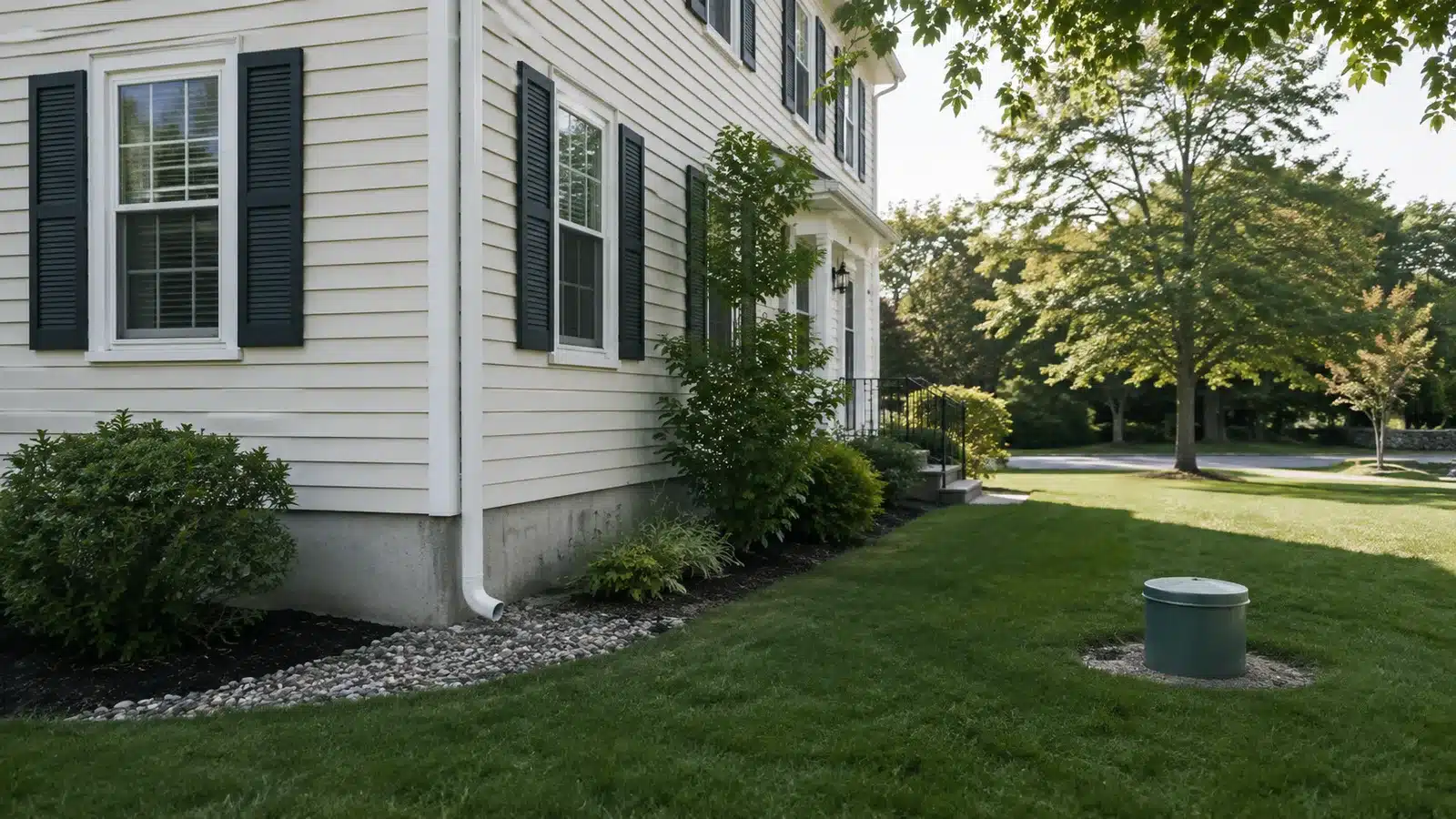
Termite treatment near a private well may be possible, but the treatment plan must account for the exact location and construction of the water system. A well, cistern, foundation drain, or nearby drainage outlet can change which methods and application details are appropriate. The safest first step is to map those features and disclose them before a proposal is finalized.
This is not a situation where a universal distance or one preferred product answers every property. The actual pesticide label, Massachusetts requirements, building details, and the pest professional’s inspection control the plan.
Map the water and drainage features before the estimate
Do a short property walk before the termite company arrives. Mark each known feature on a simple sketch or on a printed satellite image. Include features even when they are old or no longer used.
| Property feature | What to show the inspector | Why it matters |
|---|---|---|
| Wellhead or cistern | Location, whether it is active, and any access cover inside or outside the structure | Labels may limit or add instructions for soil treatment near water sources |
| Water-supply route | Where the line enters the foundation, if known | The visible wellhead may not reveal the full path between the well and house |
| Foundation or French drain | Known drain path and where it discharges | A hidden drain can carry runoff away from the treatment area |
| Crawlspace, slab, or basement | Construction type, additions, utility penetrations, and inaccessible areas | Construction changes how termite evidence and possible entry paths are inspected |
| Recent excavation or waterproofing | Where soil was removed, replaced, or disturbed | Soil work can affect an existing termite barrier or service agreement |
NC State Extension specifically advises homeowners to tell the pest company about wells, cisterns, drains, and unusual conditions before termite work begins. Foundation drains may be hard to see during a routine inspection, so do not assume the technician will discover every buried feature without your input.
Ask for the actual label, not only a safety sheet
Ask the provider for the exact product name and a copy of the label for any proposed pesticide. A Safety Data Sheet describes hazards and handling, but it is not the application instruction document. The label states where and how a registered product may be used.
The U.S. Environmental Protection Agency’s termite guidance explains that registered termiticides must be used according to label directions. EPA also warns that an improperly performed soil barrier treatment can contaminate a home or a drinking-water well. In most cases, EPA says termiticide application is work for a trained pest-management professional.
A clear proposal should answer:
- What termite evidence was found, and where?
- What treatment or monitoring method is proposed?
- How do the well, supply line, cistern, drain, or nearby surface water affect that plan?
- Which label directions or restrictions apply to this property?
- What areas will be treated, excluded, or monitored?
- What follow-up inspections are included, and what property changes must be reported?
Do not assume an unused well is irrelevant
A disconnected or non-drinking well can still connect to groundwater. NC State notes that simply stopping use or disconnecting a pipe is not the same as legally abandoning a well. Tell the inspector about any suspected old well, buried cover, or unexplained pipe near the foundation. If the well’s status is uncertain, the appropriate local or state authority—not a guess—should determine what documentation or closure is required.
Liquid treatments and baits require a property-specific choice
EPA lists liquid soil-applied termiticides and termite baits among approved treatment types. A private well does not automatically mean that one category is always right. Construction, termite activity, access, product labeling, water features, and the service company’s capabilities all affect feasibility.
NC State describes baiting as an important alternative to consider for houses with wells or foundation drains, while also noting that either approach may require additional work. The practical homeowner question is therefore not “Which method is universally safest?” but “Why does this method fit this inspected property, and how does it comply with the label?”
Coordinate drainage and excavation work
Tell the termite provider before waterproofing a foundation, installing a French drain, adding an irrigation line, rebuilding a porch, or excavating beside the house. NC State explains that disturbing soil next to the foundation can remove a chemical barrier and may affect a termite-protection agreement. Drain outlets also matter because they may empty into a yard, ditch, pond, or other sensitive area.
If another contractor is involved, keep the site sketch and treatment diagram together. Ask both companies to identify the order of operations in writing so new construction or drainage work does not undo termite protection.
A pre-service checklist for Massachusetts homeowners
- Locate the active and inactive well or cistern components you know about.
- Mark foundation drains, sump discharge, drainage outlets, ponds, and ditches.
- Gather well records, property plans, prior termite paperwork, and recent construction notes.
- Photograph mud tubes, damaged wood, or swarmers without removing the evidence.
- Request the proposed product label and written treatment diagram.
- Confirm how the plan changes around water and drainage features.
- Keep the final diagram for future landscaping, waterproofing, and excavation projects.
If you need an inspection, Biggins Exterminating offers termite pest control for Wilmington-area properties. Mention the private well, cistern, or foundation drain when booking so those features are part of the inspection conversation from the start.
Source note: Water-source and foundation-drain planning is grounded in NC State Extension’s guidance for houses with wells, cisterns, or foundation drains, reviewed April 8, 2022, and EPA’s current consumer termite guidance. Product labels and applicable local requirements remain controlling.