Why Understanding Pest Control Costs is Crucial for Every Homeowner
Pest control services cost can vary dramatically depending on your specific needs, but understanding the pricing landscape helps you budget effectively and avoid surprises. Whether you’re dealing with an active infestation or planning preventive treatments, knowing what to expect financially puts you in control.
Quick Cost Overview:
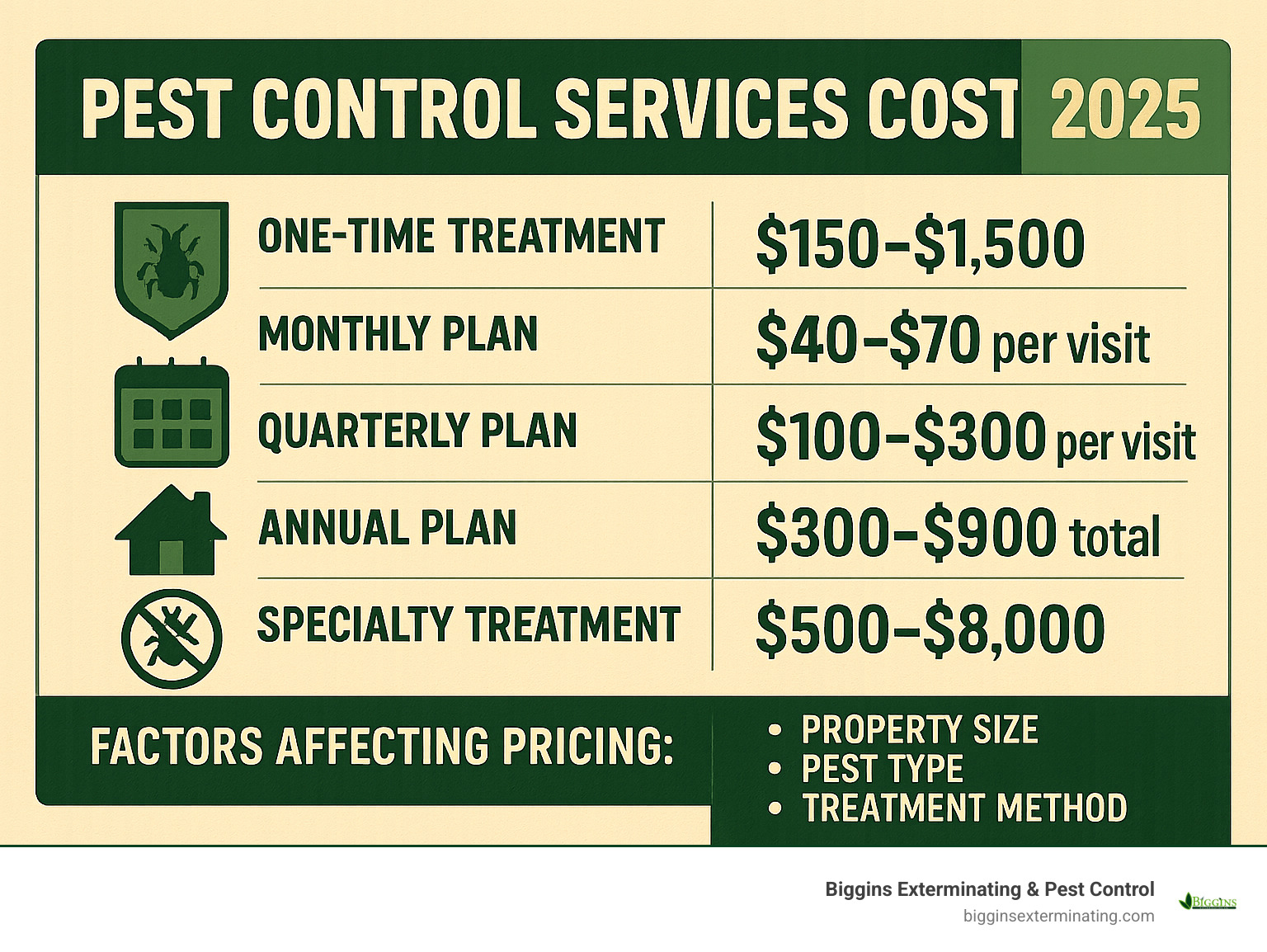
- One-time treatments: $300-$500 average (can range $150-$1,500+)
- Monthly plans: $40-$70 per visit
- Quarterly plans: $100-$300 per visit
- Annual plans: $300-$900 total
- Specialty treatments: $500-$8,000+ (termites, bed bugs, fumigation)
Note: These are average costs based on internet data and not actual costs for Biggins Exterminating services.
The reality is that pest control pricing isn’t one-size-fits-all. A simple ant treatment might cost $150, while whole-house termite fumigation can exceed $8,000. Your location, property size, pest type, and treatment method all play major roles in the final price.
Understanding these costs upfront helps you:
- Budget for both emergency treatments and preventive care
- Compare service providers effectively
- Choose between one-time fixes and ongoing protection plans
- Avoid hidden fees and unexpected charges
As Stephen Biggins, owner of Biggins Exterminating Co. since 1982, I’ve helped thousands of Massachusetts families steer pest control services cost decisions without the pressure of long-term contracts. My experience shows that transparent pricing and honest advice save homeowners both money and stress in the long run.
Pest control services cost vocab to learn:
How Much Does Pest Control Really Cost in 2024–2025?
Let’s cut through the confusion and talk real numbers. Pest control services cost has been climbing steadily, but the ranges are still pretty predictable if you know what to look for.
Right now, most homeowners are paying $300-$500 for one-time treatments when they call in a professional. That’s your bread-and-butter service call – nothing too fancy, just good solid pest control. Follow-up visits typically run $40-$70 each, which makes sense since the heavy lifting is already done.
Now, if you’re dealing with something serious like termites or bed bugs, buckle up. Full-house fumigation runs $2,000-$8,000 depending on your home’s size. That’s roughly $1-$4 per square foot, and yes, it’s a big investment. But consider the alternative – termites can literally eat your house.
These are average costs based on internet data and not actual costs for Biggins Exterminating services.
Looking ahead to 2025, we’re expecting costs to bump up about 3-5% annually. It’s not just inflation – stricter environmental rules mean better (and pricier) products, plus more folks are asking for eco-friendly options.
Initial vs. Follow-Up Visits
Here’s something that trips up a lot of homeowners: that first visit costs more, and there’s a good reason why. Initial treatments typically run $125-$450 because your technician is doing detective work.
They’re crawling around your property, identifying where pests are getting in, figuring out what’s attracting them, and developing a game plan that actually works. That comprehensive inspection takes time, and time costs money.
Follow-up visits are different beasts entirely. They’re focused on monitoring what’s working, tweaking what isn’t, and keeping problems from coming back. Since the groundwork is already laid, these visits are typically 50-70% less expensive than that initial service call.
Annual Budget Snapshot
If you’re the type who likes to plan ahead, here’s what to budget for yearly pest control plans:
Most homeowners spend somewhere between $300-$900 annually on preventive pest control. Quarterly service – which is what most families choose – typically runs $400-$1,200 for the year. Monthly service bumps that up to $480-$840 annually, not counting your initial visit.
The math is pretty straightforward: preventive care costs way less than emergency treatments. A monthly plan might feel like a lot upfront, but it’s nothing compared to what you’d pay for a major infestation that got out of hand.
Pest Control Services Cost: One-Time vs. Monthly, Quarterly, Annual Plans

When it comes to pest control services cost, the frequency of service you choose makes a huge difference in both your budget and the level of protection you receive. Think of it like maintaining your car – you can wait for breakdowns and pay for expensive repairs, or invest in regular maintenance to prevent problems.
| Service Type | Cost Range* | Best For | Includes |
|---|---|---|---|
| One-time | $150-$500 | Emergency situations | Single treatment, limited warranty |
| Monthly | $40-$70/visit | High pest pressure areas | Regular monitoring, unlimited callbacks |
| Quarterly | $100-$300/visit | Standard prevention | Seasonal treatments, pest identification |
| Annual | $300-$900 total | Low pest pressure | Inspection, treatment, basic warranty |
These are average costs based on internet data and not actual costs for Biggins Exterminating services.
After four decades in the pest control business, I’ve learned that quarterly plans hit the sweet spot for most Massachusetts homeowners. They align with seasonal pest patterns, keep costs manageable, and provide consistent protection without feeling overwhelming.
At Biggins Exterminating, we believe in giving you the flexibility to choose what works best for your family. That’s why we offer no-contract service – you’re never stuck with a plan that doesn’t fit your needs or budget. Our Affordable Pest Control Services are designed to protect your home without breaking the bank.
One-Time Treatments & Emergency Calls
Sometimes life throws you a curveball, and you need immediate pest control help. One-time treatments are perfect when you find a wasp nest right before your daughter’s birthday party or when ants suddenly march across your kitchen counter in spring.
But here’s what I’ve learned from thousands of service calls: one-time treatments often turn into repeat visits. Industry data shows that about 70% of customers who start with emergency treatments end up needing follow-up service within three months. Why? Because that initial treatment handles the immediate problem but doesn’t address what attracted the pests in the first place.
Recurring Plans & Savings Math
Here’s where the numbers get interesting. Recurring plans aren’t just about convenience – they’re about smart financial planning and better pest control results.
When you commit to monthly or quarterly service, several things happen that benefit your wallet. First, the per-visit cost drops significantly – sometimes by 40-50% compared to one-time treatments. Second, most plans include unlimited callbacks during your service period, so if pests reappear between visits, you’re covered.
The real value comes from long-term ROI. Regular treatments prevent small problems from becoming expensive infestations. Think about it – would you rather pay $200 quarterly to keep termites away, or find $15,000 in structural damage two years from now?
Price Differences by Pest Type
Not all pests are created equal when it comes to pest control services cost. A simple ant problem might set you back $75, while a serious termite infestation could cost thousands to resolve properly. Understanding these price differences helps you budget appropriately and avoid sticker shock when you need professional help.
Common household pests like ants typically cost $75-$400 to treat, depending on the species and severity. Cockroaches run slightly higher at $100-$500 for most situations, though severe infestations in large buildings can reach $8,000. Spiders usually fall in the $200-$450 range, while silverfish treatments average $250-$350. Fleas, despite being tiny, can cost $75-$400 to eliminate completely due to their complex life cycle.
The challenging pests command higher prices for good reason. Bed bugs are notorious for their treatment costs, running $350-$1,200 per room or $1,000-$2,500 for whole-house treatments. Mice start around $150-$300 initially but often require ongoing monitoring. Rats are more expensive at $300-$800 because they need extensive exclusion work to prevent re-entry.
Stinging insects like wasps and hornets cost $100-$1,500 depending on nest location and size. A simple ground-level wasp nest might cost $150 to remove, while a massive hornet nest tucked under your roof eaves could run $800 or more. For detailed pricing on these dangerous pests, check out our guide on Average Cost to Remove Hornets Nest.
These are average costs based on internet data and not actual costs for Biggins Exterminating services.
Pest Control Services Cost for Wood-Destroyers
Termites earn the title of most expensive pest to eliminate, and for good reason. These silent destroyers can cause thousands of dollars in structural damage before you even know they’re there. The pest control services cost for termites reflects both the complexity of treatment and the long-term protection required.
Chemical barrier treatments typically run $1,350-$2,500 for average-sized homes. This involves treating the soil around your foundation and creating a protective barrier that lasts for years. Bait systems cost around $1,500 for installation and monitoring, using strategically placed stations to eliminate entire colonies.
Fumigation or tenting represents the most expensive option at $2,000-$8,000 for whole-house treatment. This involves sealing your entire home and filling it with gas to eliminate every termite inside. Heat treatment offers a chemical-free alternative at $1,200-$2,500 for localized infestations.
Pest Control Services Cost for Biting & Stinging Insects
Stinging insects demand immediate attention, especially if anyone in your family has allergies. The pest control services cost for these dangerous pests varies significantly based on species and nest accessibility.
Wasp removal typically costs $200-$600, with ground nests on the lower end and high, hard-to-reach nests commanding premium prices. Hornets are more aggressive and expensive to remove, running $300-$800 for large nests. Bee removal presents unique challenges, costing $100-$700 depending on whether they’re honeybees or aggressive species.
Mosquito control, while less expensive per treatment at $49-$200, provides crucial health protection. The West Nile & Zika insight from the CDC reminds us that these tiny pests carry serious diseases, making professional treatment a health investment as much as a comfort measure.
These are average costs based on internet data and not actual costs for Biggins Exterminating services.
What Drives the Price Tag? Key Cost Factors
Ever wonder why your neighbor paid $200 for ant control while you got quoted $500? Pest control services cost isn’t pulled from thin air – several key factors determine your final bill, and understanding them helps you budget smarter and avoid sticker shock.
Infestation severity tops the list of cost drivers. A few ants marching across your kitchen counter? That’s a quick fix. But when those ants have established highways through your walls and set up multiple colonies in your yard, you’re looking at a much bigger project. Severe infestations can cost three to five times more than light ones because they require more time, materials, and follow-up visits.
Property size matters too, but not always in the way you’d expect. Most pest control companies don’t measure your home with a tape measure – they use general size categories. A 1,200-square-foot ranch and a 1,500-square-foot colonial might fall into the same pricing tier. However, larger homes definitely cost more because they require more product, longer treatment times, and more thorough inspections.
Your home’s location affects pricing in multiple ways. Urban areas typically cost 10-20% more due to higher overhead costs, while rural properties might face travel charges. Here in Massachusetts, we’re fortunate to have competitive pricing compared to major metropolitan areas.
Treatment method creates the biggest price swings. Standard liquid spray treatments represent baseline pricing, while specialized approaches like heat treatment or fumigation can cost four to five times more. The complexity of the equipment, specialized training requirements, and time involved all factor into these premium prices.
Professional licensing and insurance add to costs but protect you as a customer. In Massachusetts, pest control operators must be licensed through the Texas Department of Agriculture certification guide equivalent – our state Department of Agricultural Resources. These credentials ensure your technician knows proper application techniques and safety protocols.
Property Size & Layout
Most pest control companies price homes in tiers rather than exact square footage measurements. Typical size categories start with homes under 1,500 square feet receiving base pricing. Properties between 1,500-2,500 square feet usually see a 10-15% premium, while homes over 3,500 square feet often require custom pricing.
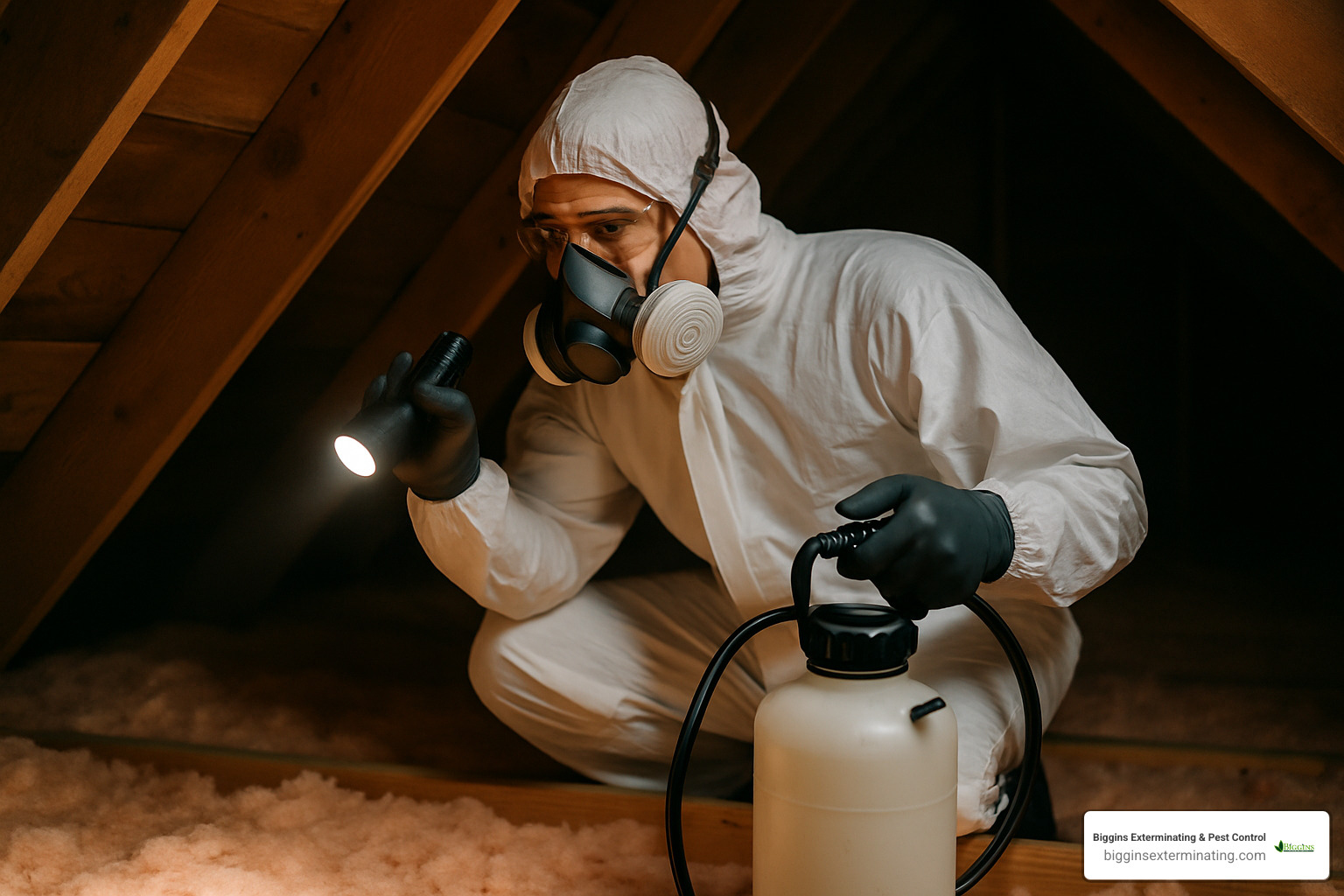
Multi-level homes face additional challenges that affect pricing. Attic treatments can add $50-$150 to your bill because they require special equipment and safety precautions. Crawlspace access adds $25-$100 depending on conditions.
Treatment Type & Materials
The treatment method you choose dramatically impacts your final cost. Liquid spray treatments represent the baseline – they’re effective, time-tested, and relatively quick to apply. Granular applications cost 10-20% more because they require specialized equipment and take longer to apply properly.
Heat treatments cost significantly more – often 200-400% of liquid treatments – because they require specialized equipment, longer treatment times, and careful monitoring. However, they’re chemical-free and can eliminate entire infestations in a single visit.
Eco-friendly treatments typically add 15-25% to your bill compared to conventional options. These products often cost more to manufacture and may require more frequent applications, but many families find the safety benefits worth the premium.
Hidden & Additional Fees
Nobody likes surprise charges, so let’s talk about potential extras that might appear on your bill. Travel charges of $25-$75 are common for rural locations or properties far from the service provider’s base. After-hours service typically costs 25-50% more because technicians earn overtime pay.
Emergency calls often include a $50-$150 surcharge because they disrupt scheduled routes and require immediate response. Exclusion work – sealing entry points to prevent future infestations – can add $200-$1,500 depending on the scope of work needed.
Regarding tipping etiquette, it’s not required but appreciated for exceptional service. A $10-$20 tip per technician for particularly difficult jobs or outstanding service is thoughtful but not expected for routine treatments.
For budget-conscious customers seeking effective rodent control, our Cheap Mouse Exterminator service focuses on cost-effective solutions without sacrificing quality or cutting corners on safety.
Residential vs. Commercial Pricing & Hidden Fees
When it comes to pest control services cost, protecting a home and safeguarding a business are two very different jobs.
Residential pricing remains straightforward. Around our Massachusetts service area, most houses pay $100–$300 per quarterly visit (average costs based on internet data and not actual costs for Biggins Exterminating services). Flat-rate plans make budgeting simple, and because Biggins never locks you into contracts, you can scale service up or down as needed.
Commercial pricing is driven by square footage and compliance paperwork. Businesses usually spend $0.05–$0.20 per square foot each month because every visit includes detailed logs for health inspectors. That means a 5,000-sq-ft office might see $250–$600 monthly, while a 20,000-sq-ft warehouse can exceed $1,000. Food-handling operations pay the most because a single pest sighting can shut them down.
We handle both home and business needs through our Best Rated Exterminator Near Me service.
Small-Business Packages
Most mom-and-pop shops budget $50–$200 per month for inspection, monitoring stations, and the service logbook local regulators require.
Large Facility Programs
Sites over 10,000 sq ft usually choose an integrated pest management (IPM) agreement. At $100–$500+ monthly (size and industry dependent), these programs bundle routine visits, written documentation, and 24/7 emergency help so managers avoid surprise invoices.
Eco-Friendly Options, DIY vs. Pros & Long-Term Savings
More families want greener solutions, and modern products finally deliver both safety and performance. Expect to pay 15–25 % more per visit—roughly $25–$75 extra—for botanical or reduced-risk materials (average costs based on internet data and not actual costs for Biggins Exterminating services). Chemical-free heat treatments remain premium because of the specialized equipment involved.
DIY vs. Professional—What Really Saves Money?
A $10 store-bought spray looks cheap until you add repeat purchases, weekends spent spraying, and the 55 % chance the pests return. Homeowners typically drop $20–$100 per attempt on supplies and invest several hours each trip.
Professional treatments cost more upfront but succeed roughly 85 % of the time and include warranties, professional-grade materials, and correct pest identification. Once you factor in time, re-infestation risk, and potential property damage, hiring a pro usually wins the long-game budget battle—and you get your Saturday back.
Frequently Asked Questions about Pest Control Services Cost
How often should pest control be scheduled for prevention?
Quarterly visits match Massachusetts’ seasonal pest cycles and work for most homes. Properties with heavy pressure may need monthly service, while very low-pressure homes can stretch to twice a year.
What certifications or licenses should a pest control company hold?
Ask to see state pesticide licenses plus proof of liability and workers’ compensation insurance. Optional credentials such as NPMA QualityPro show commitment to ongoing education and safety.
Is tipping technicians customary or expected?
Not required. If a tech provides exceptional service, a $10–$20 tip or a positive online review is always appreciated.
Conclusion
Making smart decisions about pest control services cost starts with understanding what you’re really paying for – not just the treatment itself, but the expertise, peace of mind, and long-term protection that comes with professional service.
After helping Massachusetts families with pest problems for over 40 years, I’ve learned that the lowest price rarely equals the best value. The homeowner who spends $50 on a DIY ant treatment only to call us three weeks later when the problem returns has actually spent more than someone who invested in proper professional treatment from the start.
The real value of professional pest control extends far beyond the initial treatment cost. You’re investing in accurate pest identification, proper treatment methods, ongoing monitoring, and the warranty protection that comes with experienced service. When you factor in the potential damage from unchecked termites, the health risks from disease-carrying pests, or simply the stress of dealing with unwanted invaders, professional pest control makes financial sense.
Budget-conscious homeowners often worry about ongoing costs, which is why we’ve never required contracts at Biggins Exterminating. You shouldn’t feel trapped by a service agreement when your pest pressure changes seasonally or your budget shifts. Our approach lets you adjust your protection level as needed while still maintaining the relationship with technicians who know your property.
Long-term protection costs less than emergency treatments. The homeowner paying $400 annually for quarterly service spends far less than someone dealing with a major infestation that requires $2,000 in specialized treatment. Prevention isn’t just about saving money – it’s about avoiding the disruption and stress that comes with serious pest problems.
For families working within tight budgets, our Affordable Pest Control Services focus on essential protection without unnecessary extras. Everyone deserves a pest-free home, and we work with customers to find solutions that fit their specific situation and budget.
The Biggins difference comes down to treating your home like our own. We’ve built our reputation on fair pricing, honest advice, and the flexibility to adjust your pest control program as your needs change. Whether you’re dealing with an emergency situation or planning preventive care, we’re here to help you make the right choice for your family and your budget.
Your home should be your sanctuary, not a place where you worry about unwanted pests. Professional pest control isn’t just about eliminating current problems – it’s about creating the peace of mind that comes from knowing your family is protected.