
Paper Wasps Are Active in Wilmington, MA Right Now — Here’s What to Do
Paper wasps removal in Wilmington, MA is something many homeowners need every spring and summer — and May 2026 is no exception. If you’ve spotted a small, open, umbrella-shaped nest hanging from your eave, porch ceiling, or shed, you likely have paper wasps. Here’s a quick answer to help you act fast:
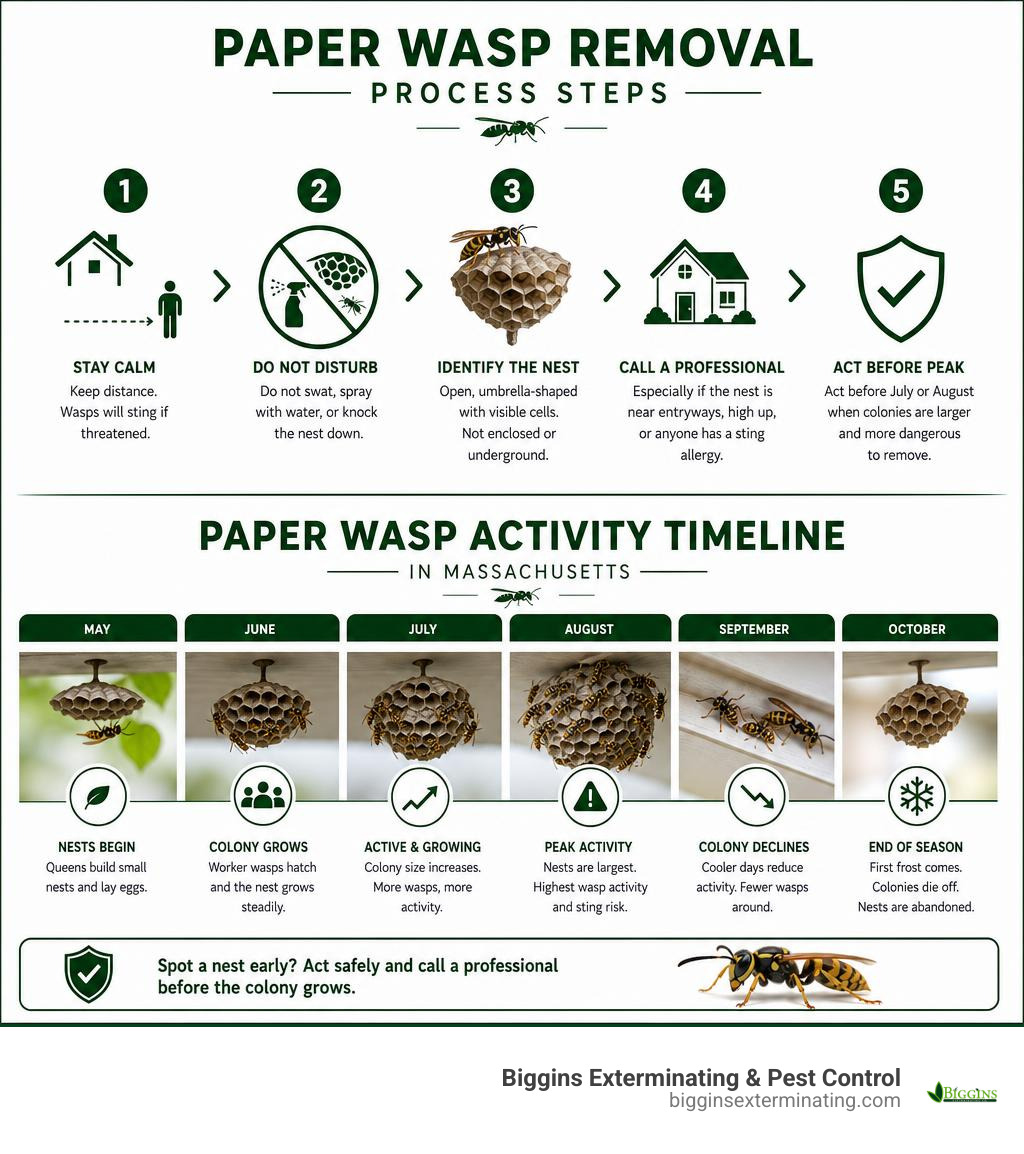
Quick Steps If You Find a Paper Wasp Nest:
- Stay calm and keep distance — paper wasps will sting if they feel threatened
- Do not swat, spray with water, or knock the nest down — this triggers an attack
- Identify the nest — paper wasp nests are open and umbrella-shaped with visible cells (not enclosed or underground)
- Call a licensed pest control professional — especially if the nest is near a doorway, high up, or your household includes anyone with a sting allergy
- Act before July or August — colonies grow through summer and become harder and riskier to remove at peak size
Paper wasps are active in Massachusetts from May through October, with colonies growing steadily through late summer. A nest that looks small today can double in size within weeks.
I’m Stephen Biggins, owner of Biggins Exterminating Co. — a local, family-owned pest control company serving Wilmington, MA and surrounding communities for over 40 years. I’ve handled hundreds of paper wasps removal in Wilmington, MA jobs across all property types, and in this guide I’ll walk you through everything you need to know to stay safe and solve the problem for good.
Paper wasps removal Wilmington MA terms you need:
Identifying Paper Wasps and Their Nests
Paper wasps are one of the most common stinging insects we deal with around Wilmington, Andover, Bedford, Billerica, Burlington, Lexington, North Reading, Tewksbury, and Woburn homes during the warm months.
They are not usually as aggressive as yellowjackets, but that does not mean they are harmless. A paper wasp nest near a door, deck, pool, shed, patio, mailbox, or business entrance can quickly become a safety problem.

Paper wasps get their name from the material they use to build nests. They scrape tiny fibers from wood, fences, deck boards, sheds, and plant stems, mix those fibers with saliva, and create a gray, papery nest. If you have untreated or weathered wood around your property, paper wasps may see it as a convenient building supply store. Unfortunately, they do not pay at checkout.
If you are unsure what type of wasp you are seeing, our wasp pest control service can help identify the species and the safest treatment approach.
Physical Characteristics of Paper Wasps
Paper wasps belong to the genus Polistes. Around Massachusetts homes, they are usually slender, long-legged wasps with narrow waists. They may be reddish-brown, dark brown, black, or yellow-marked depending on the species.
Some European paper wasps have noticeable orange antennae, which can help separate them from yellowjackets, whose antennae are typically black. Paper wasps also fly with their long legs dangling below the body, which gives them a slightly “lazy legs” look in flight.
Here is a simple comparison:
| Feature | Paper Wasps | Yellowjackets |
|---|---|---|
| Body shape | Slender with long legs | Stockier and more compact |
| Common colors | Brown, reddish-brown, black, yellow markings | Bright yellow and black |
| Antennae | Often orange or lighter colored in some species | Usually black |
| Nest style | Open, umbrella-shaped comb with visible cells | Enclosed paper nest or hidden ground/wall nest |
| Typical colony size | Often 15-30 wasps | Can reach 1,000-5,000 wasps |
| Aggression level | Defensive near nest, usually less aggressive | More aggressive, especially late summer |
| Common nest locations | Eaves, soffits, porch ceilings, railings, sheds | Ground holes, wall voids, attics, shrubs, enclosed spaces |
A paper wasp colony is usually smaller than a yellowjacket colony, but one nest can still create plenty of trouble if it is close to daily activity.
Paper Wasp Nests vs. Yellowjacket Nests
The nest is often the easiest way to tell what you have.
A paper wasp nest usually looks like a small upside-down umbrella. It is open on the bottom, and you can often see the individual hexagon-shaped cells. These nests are commonly attached by a short stalk to a protected surface.
Common paper wasp nest locations include:
- Under roof eaves
- Porch ceilings
- Deck joists and railings
- Shed rafters
- Garage door frames
- Attic vents
- Playsets
- Fences
- Outdoor furniture
- Light fixtures and utility boxes
A yellowjacket nest is different. Yellowjackets often nest underground in old rodent burrows, inside wall voids, under steps, or in enclosed cavities. Their nests are usually covered in a paper envelope, and you may only see wasps flying in and out of a small hole.
A bald-faced hornet nest is usually a larger, enclosed, football-shaped paper nest hanging from a tree, shrub, roofline, or structure.
For more help understanding different stinging insect nests, see our guide on wasp control and hornets nests.
The key point: do not assume every “wasp nest” is the same. Treatment depends on the insect, nest style, height, activity level, and location.
Professional paper wasps removal Wilmington MA
Professional paper wasps removal Wilmington MA service is about more than knocking down a nest. The goal is to identify the insect, reduce sting risk, treat the active colony, remove the nest when appropriate, and help prevent new nests from forming in the same area.
We recommend professional removal when:
- The nest is near a doorway, deck, patio, pool, walkway, or business entrance
- The nest is high on a roofline or eave
- The nest is inside a wall void, attic vent, soffit, or shed
- There are children, pets, elderly family members, or allergic individuals nearby
- You are not 100% sure whether it is a paper wasp, yellowjacket, hornet, or bee nest
- There are multiple nests on the property
- The wasps are entering the structure
Stinging insects cause thousands of emergency room visits each year in the United States. Wasp and hornet stings are also associated with roughly 60 deaths annually, often involving people with undiagnosed allergies. That is why we take these jobs seriously.
As a family-owned local company with over 40 years of experience, we have seen many “small nest” problems turn into very active situations once someone hits the nest with a broom, hose, or spray can. Please do not challenge a wasp colony to a duel. They have more wings than you do.
For high-risk nests, our professional wasp removal approach is the safer choice.
Safe Professional Elimination Methods
The exact method depends on the nest location and the level of activity. In general, professional paper wasp removal may include:
-
Inspection and identification
We first confirm whether the insects are paper wasps, yellowjackets, hornets, bees, or another stinging insect. This matters because the wrong treatment can make a situation worse. -
Risk assessment
We look at the nest height, access, nearby foot traffic, structural openings, and whether ladders or specialized equipment are needed. -
Protective equipment
Professionals use protective clothing, gloves, veils, and other safety equipment when needed. Paper wasps can sting repeatedly, so exposed skin is not your friend. -
Targeted treatment
Depending on the nest, treatment may involve professional-grade aerosol, liquid, or dust products applied directly to the nest or entry point. Treatments are chosen to target the colony while limiting unnecessary product use. -
Nest removal when safe and accessible
Once activity is controlled, the nest may be removed if it is accessible. Removing the nest can reduce confusion and discourage lingering wasps from returning to the exact structure. -
Follow-up recommendations
We look for conditions that attracted the wasps, such as exposed wood, open trash, food residue, gaps in trim, or sheltered nesting spots.
Some general industry resources on wasp control services also note that nest location and ladder access are important details to share when requesting removal. When you call us, telling us where the nest is and how high it is helps us prepare properly.
Eco-Friendly and Non-Chemical Options
Many Wilmington-area homeowners ask whether paper wasps can be handled without heavy chemical use. The answer is sometimes, but it depends on the nest.
Eco-conscious options may include:
- Removing inactive, abandoned nests during the off-season
- Sealing or painting exposed wood to reduce nesting appeal
- Exclusion work around soffits, gaps, vents, and trim
- Reducing food and water attractants
- Physical removal after the colony has been safely eliminated
- Using targeted applications instead of broad spraying
There are also natural methods people talk about online, such as soapy water. However, we do not recommend homeowners attempt close-range nest treatment, especially if the nest is active, elevated, or near a busy area. Even a small paper wasp nest can become dangerous if disturbed.
The best “green” strategy is often prevention: make your home less attractive before nests form. This reduces the need for treatment later.
For more information about stinging insect control in nearby Massachusetts communities, see our guide to wasp and hornet nest removal.
How to Prevent Paper Wasps from Nesting on Your Property
Prevention works best in early spring, when queens are scouting for nest sites. In Massachusetts, that usually means late April through June, with activity increasing through July and August.
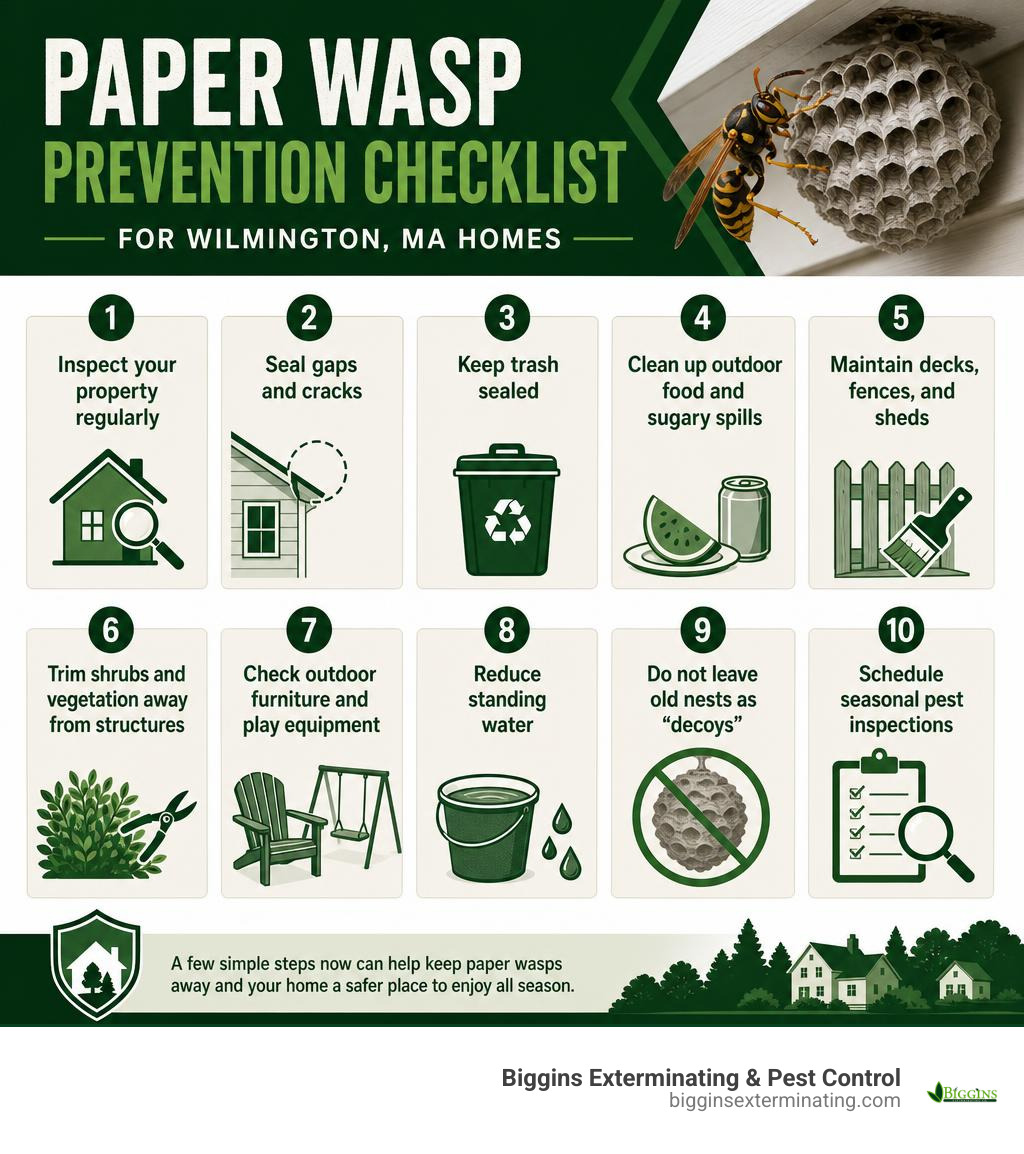
Here are practical steps Wilmington-area residents can take:
-
Inspect eaves, soffits, and porch ceilings weekly in spring
Early nests may be small, sometimes only the size of a golf ball. The earlier they are found, the easier they are to address professionally. -
Seal gaps and cracks
Repair openings around fascia boards, siding, window trim, utility penetrations, vents, and rooflines. Paper wasps like sheltered attachment points. -
Keep trash sealed
Use tight-fitting lids on outdoor trash and recycling bins. Rinse bottles, cans, and food containers before disposal. -
Clean up outdoor food and sugary spills
Wasps are attracted to fruit, soda, juice, beer, desserts, and food scraps. Outdoor dining is great; feeding wasps is less great. -
Maintain decks, fences, and sheds
Paper wasps collect wood fibers from weathered wood. Painting, staining, or sealing wood surfaces can make them less attractive. -
Trim shrubs and vegetation away from structures
Good airflow and visibility make it easier to spot nest-building early. -
Check outdoor furniture and play equipment
Paper wasps often nest under patio chairs, tables, umbrellas, grills, swing sets, and playhouses. -
Reduce standing water
Wasps need water. Empty buckets, toys, planters, and clogged gutters. -
Do not leave old nests as “decoys”
It is true that paper wasps generally do not reuse old nests the following year. But old nests do not reliably prevent new ones nearby. If a nest is inactive, removal and prevention work are better. -
Schedule seasonal pest inspections
A trained eye can catch activity before it becomes a major problem.
If you want help protecting your home beyond a single nest removal, our residential pest control in Wilmington MA service can help reduce seasonal pest pressure around your property.
Frequently Asked Questions About Wasp Control
Paper wasps create a lot of questions because they are visible, active during outdoor season, and often nest right where people walk, grill, garden, or relax.
For local service help, you can also visit our wasp treatment near me page.
What is the average cost of paper wasps removal Wilmington MA?
Average paper wasp removal costs vary based on nest height, location, activity level, number of nests, equipment needed, and whether follow-up work is required.
Based on publicly available internet data, professional wasp nest removal often ranges from about $150 to $750 or more, with complicated high-access or structural situations sometimes costing more. This is not Biggins Exterminating’s actual pricing. It is only a broad public-data estimate.
Factors that can affect cost include:
- Nest height
- Whether a ladder is needed
- Whether the nest is exposed or hidden
- Number of nests
- Species involved
- Urgency of service
- Whether exclusion or prevention work is needed
- Residential vs. commercial property
For nearby service information, see our guide to wasp nest removal in Burlington.
The best way to get an accurate answer is to call us with details. Helpful information includes:
- Where is the nest?
- How high is it?
- Is it open and umbrella-shaped or enclosed?
- Are wasps entering a wall, roofline, or ground hole?
- Is anyone in the home allergic?
- Is the nest near a door, deck, or walkway?
When is paper wasps removal Wilmington MA most urgent?
Paper wasp removal is most urgent when the nest is close to people, pets, customers, or building entrances.
In Wilmington and surrounding Massachusetts towns, paper wasps are most active from May through October, with peak nesting activity commonly in July and August. Colonies grow as summer progresses, so a small spring nest can become a larger late-summer problem.
Removal is especially urgent if:
- The nest is near a front door, back door, garage, deck, or patio
- Wasps are flying near children or pets
- The nest is on a business entrance or outdoor seating area
- Someone on the property has a known sting allergy
- Wasps are entering the home through a soffit, vent, or wall gap
- The nest is at face height or near outdoor work areas
- Landscaping, painting, roofing, or repairs will disturb the nest
Paper wasps are less aggressive than yellowjackets, but they will defend the nest if they feel threatened. Vibrations from doors, lawn equipment, ladders, hedge trimmers, or kids bouncing around on a deck can all trigger defensive behavior.
For more seasonal safety tips, see our wasp nest removal Bedford complete guide.
What should I do if a family member is allergic to wasp stings?
If anyone in your home has a known wasp, bee, hornet, or yellowjacket sting allergy, treat the nest as an immediate safety concern.
Do this:
- Keep the allergic person away from the area
- Do not attempt DIY removal
- Call a licensed pest control professional
- Make sure prescribed emergency medication, such as an epinephrine auto-injector, is available if recommended by a doctor
- Call 911 immediately if symptoms of anaphylaxis occur
Signs of a severe allergic reaction can include:
- Trouble breathing
- Swelling of the face, lips, tongue, or throat
- Dizziness or fainting
- Rapid heartbeat
- Hives beyond the sting area
- Nausea or vomiting
- Confusion or weakness
Most people experience pain, redness, and swelling after a sting, but allergic reactions can become life-threatening quickly. Wasp and hornet stings account for dozens of deaths per year in the United States, and many severe cases involve people who did not previously know they were allergic.
If your household includes someone with an allergy, do not wait for the nest to “settle down.” It will not become safer as the colony grows.
For help finding local service, visit our pest control company near Wilmington MA page.
Conclusion
Paper wasps are a normal part of warm-weather life in Wilmington, MA, but they do not belong above your front door, under your deck, inside your shed, or next to your business entrance.
The safest approach is simple:
- Identify the nest correctly
- Keep people and pets away
- Avoid hitting, spraying, flooding, or knocking it down
- Call a professional when the nest is active, elevated, or near people
- Prevent future nests with sealing, sanitation, wood maintenance, and seasonal inspections
At Biggins Exterminating & Pest Control, we are a local, family-owned and operated Massachusetts pest control company with over 40 years of trusted service. We proudly help homeowners and businesses in Wilmington, Andover, Bedford, Billerica, Burlington, Lexington, North Reading, Tewksbury, and Woburn handle seasonal pests safely and professionally.
We do not require long-term contracts for every situation, and we focus on reliable service, warranties where applicable, and customer satisfaction. If you need paper wasps removal in Wilmington MA, we are ready to help.
You can also learn more about regional stinging insect removal resources or visit our local pest control Wilmington MA page to schedule service with our team.
