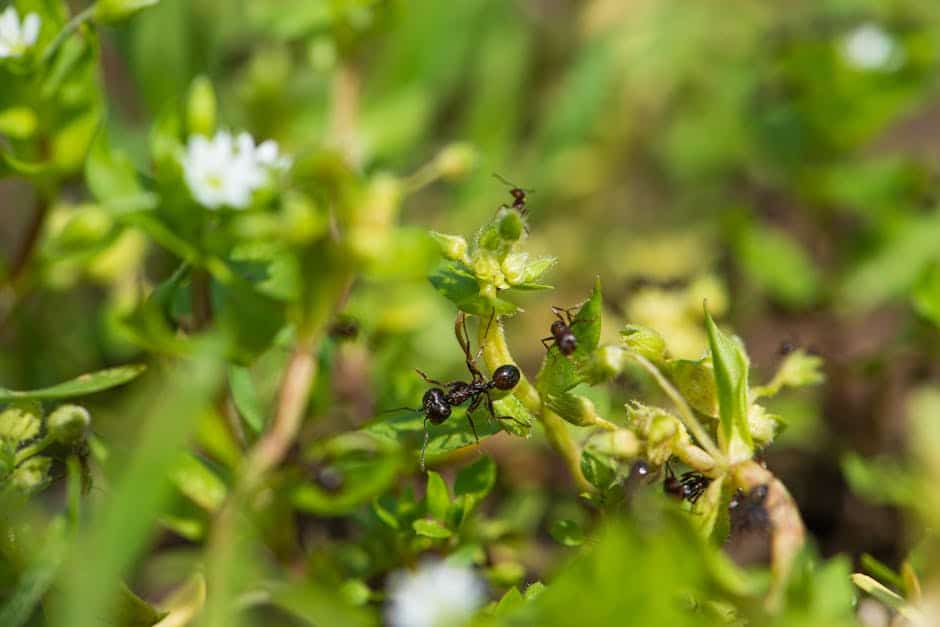
Say Goodbye to Unwanted Ants Naturally
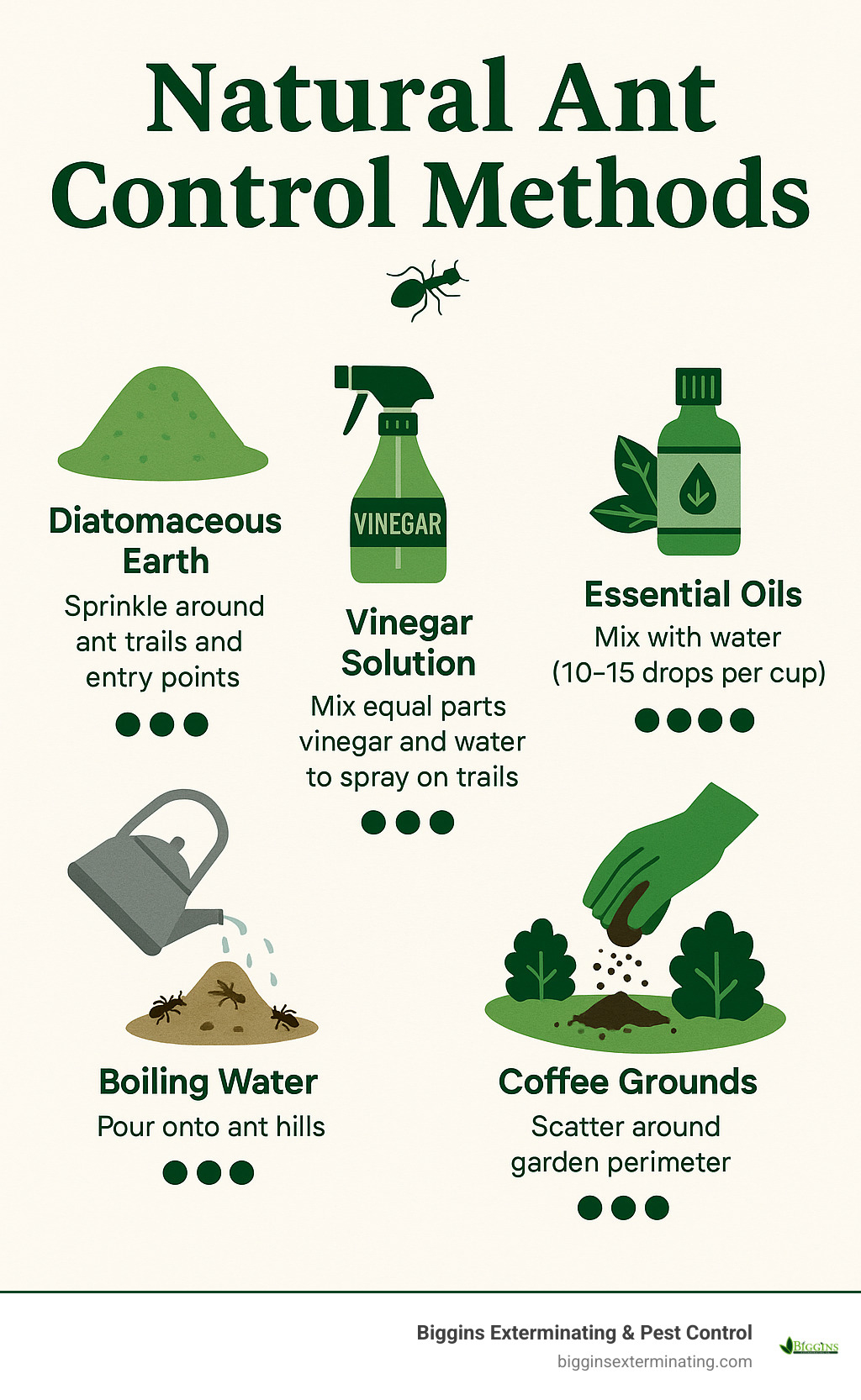
Looking for quick natural ant control outside solutions? Here’s what works best:
- Diatomaceous Earth – Sprinkle food-grade DE around ant trails and entry points
- Vinegar Solution – Mix equal parts vinegar and water to spray on trails
- Essential Oils – Peppermint, tea tree, or cinnamon oil mixed with water (10-15 drops per cup)
- Boiling Water – Pour directly into outdoor ant hills for immediate colony reduction
- Coffee Grounds – Scatter used grounds around garden beds and home perimeter
Finding natural ant control outside your home doesn’t have to mean harsh chemicals or complicated procedures. When those tiny invaders start marching across your patio, garden beds, or making their way toward your home, you have plenty of safe, effective options that won’t harm your family, pets, or the environment.
While ants play beneficial roles in our ecosystem – aerating soil, controlling other pests, and helping with decomposition – they can quickly become unwelcome guests when they invade our outdoor living spaces or form a pathway into our homes.
The good news? Your kitchen cupboards and garden shed likely already contain many of the ingredients needed to send ants packing naturally. From food-grade diatomaceous earth that dehydrates ants on contact to aromatic deterrents like peppermint oil that disrupt their scent trails, nature provides numerous solutions for keeping these persistent insects at bay.
I’m Stephen Biggins, owner of Biggins Exterminating Co., and I’ve spent over four decades helping homeowners implement effective natural ant control outside their properties before resorting to more intensive treatments. My approach always begins with the least invasive, most environmentally friendly methods that protect your family while respecting the delicate balance of your outdoor ecosystem.
Natural ant control outside vocab explained:
– Local pest control services
– House Ant Exterminator
– indoor ant control
Understanding Outdoor Ants: Friends or Foes?
Before declaring war on every ant you see, it’s important to understand that not all ants are created equal—and not all deserve immediate eviction from your property. In fact, many ant species provide valuable ecosystem services that benefit your yard and garden.
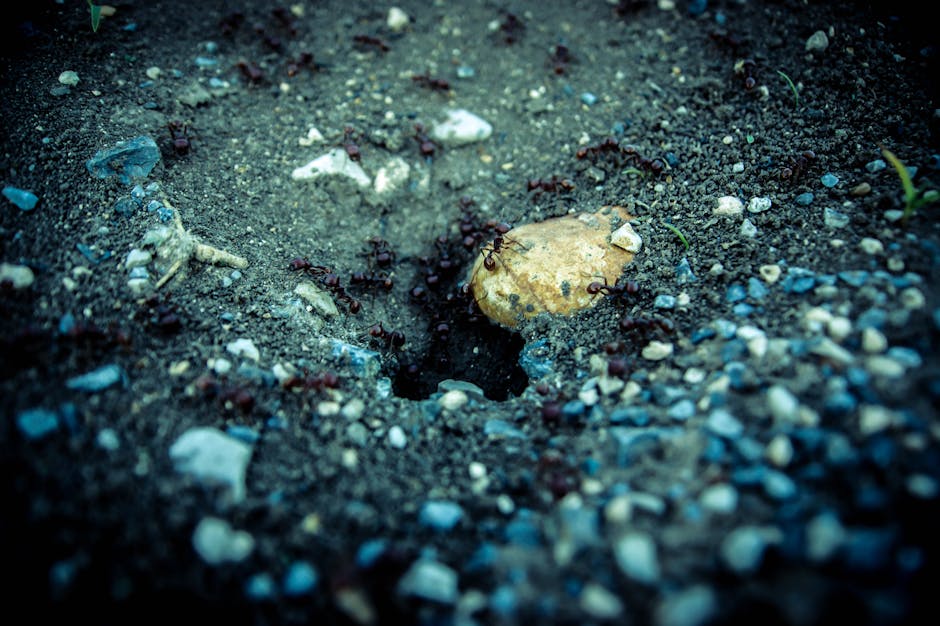
When we visit homes in Wilmington and surrounding Massachusetts communities, we often find homeowners surprised to learn that ants are actually nature’s tiny gardeners and cleanup crew. They’re busy behind the scenes, aerating soil as they tunnel, which improves drainage and creates space for healthy root growth. Many species also act as a natural pest control squad by preying on harmful insects, while others help break down organic matter – essentially providing free composting services!
Recent scientific research on ant benefits confirms what we’ve observed in the field: ants play crucial roles in maintaining healthy outdoor ecosystems. They establish intricate pheromone trails to efficiently gather food and communicate with their colony members, demonstrating remarkable organization that’s fascinating to observe (from a distance, of course).
However, certain situations definitely warrant intervention:
When those impressive ant hills start damaging your carefully maintained lawn, when they’re farming aphids that harm your prized roses, or when aggressive species pose risks to your children and pets – that’s when you’ll want to consider natural ant control outside your home. The same goes for when they begin scouting expeditions indoors or when carpenter ants take up residence near wooden structures.
The key to effective natural ant control outside is understanding which ants you’re dealing with and whether they’re actually causing problems or just going about their beneficial business.
Common Ant Species in Yards
In the Northeastern Massachusetts region, we commonly encounter these ant species in outdoor spaces:
Carpenter Ants – These large black or red-and-black ants (measuring 1/4 to 5/8 inch) don’t eat wood but excavate it for nesting, potentially causing structural damage. They’re often found around damp or decaying wood, making them a concern for homeowners.
Field Ants – Varying in color from reddish-brown to black, these ants build mounds in lawns and gardens. While they rarely enter homes, their nests can damage grass and garden beds, creating unsightly bumps throughout your yard.
Argentine Ants – These invasive ants form massive super-colonies with multiple queens, making them particularly difficult to control. They’re aggressive toward other ant species and can quickly dominate an area.
Odorous House Ants – When crushed, these small dark ants emit a distinctive rotten coconut smell. They’re particularly attracted to sweet foods and can move their nests quickly when disturbed, making them adaptable and persistent.
Fire Ants – Less common in Massachusetts but increasingly found in warmer years, these aggressive ants deliver painful stings and build distinctive dome-shaped mounds. They’re one species you’ll definitely want to address promptly, especially if you have children or pets.
Identifying which species you’re dealing with helps determine whether natural deterrents will be sufficient or if you need professional intervention.
Are Ants Always a Problem?
In our 40+ years of pest control experience across Wilmington, Andover, Bedford, and other Massachusetts communities, we’ve learned that ants often get a bad rap. Here’s the truth: many ant activities actually benefit your property.
Soil health gets a major boost from ant tunneling. As they dig their elaborate networks underground, they naturally aerate the soil, improve water penetration, and distribute nutrients throughout your garden beds. It’s like having thousands of tiny rototillers working for free!
Pest predation is another hidden benefit. Many ant species prey on termites, fleas, bed bugs, and other problematic insects. They’re nature’s cleanup crew, often eliminating pests before you even realize you have them.
When ants collect and store seeds, they’re helping with native plant propagation throughout your landscape. And their work breaking down organic matter speeds up the decomposition process, enriching your soil naturally.
So when should you actually intervene? Generally, it’s time to consider natural ant control outside when:
Carpenter ants are damaging wooden structures around your property
They’re creating unsightly mounds that ruin your lawn’s appearance
You notice them farming aphids on your favorite garden plants
They’re entering your home in search of food or shelter
Stinging species pose risks to family members, especially those with allergies
For most other situations, we recommend a live-and-let-live approach, focusing on natural ant control outside only where ants directly interfere with your enjoyment of outdoor spaces. After all, these industrious insects have been maintaining healthy ecosystems for millions of years – sometimes the best strategy is simply to let them do their job!
Natural Ant Control Outside: Quick-Reference Methods List
When those tiny invaders start marching across your yard, you don’t need to reach for harsh chemicals right away. Mother Nature provides plenty of effective solutions for natural ant control outside your home. After helping Massachusetts homeowners for over four decades, I’ve compiled this handy comparison of what really works.
Each method has its own strengths and situations where it shines brightest. Food-grade diatomaceous earth, for instance, has become one of our most recommended solutions for homeowners in Wilmington and Lexington. When applied during dry weather, it can reduce visible ant activity by up to 90% within just 48 hours! The microscopic sharp edges of DE dehydrate ants as they cross through it, yet it remains completely safe for humans and pets.
Vinegar and lemon juice solutions work brilliantly for immediate trail disruption. That bottle of white vinegar sitting in your pantry creates a powerful barrier that erases ant pheromone trails when mixed equally with water. While you’ll need to reapply after rain, it costs pennies per application and poses zero risk to curious pets or children playing nearby.
For those who prefer aromatic solutions, essential oils like peppermint, tea tree, and cinnamon not only repel ants effectively but leave your garden smelling wonderful. Just be cautious using these around fish ponds, as the concentrated oils can harm aquatic life.
Coffee grounds deserve special mention as they’re essentially free – just repurpose what you’d normally throw away! Scatter used grounds around garden beds and your home’s foundation for a natural barrier that most ants avoid. The caffeine and acidity create an environment ants simply don’t appreciate.
When you spot an active ant hill, sometimes the simplest solution works best: carefully pouring boiling water directly into the mound can eliminate a significant portion of the colony instantly. Just be mindful of nearby plants that might not appreciate the steam bath!
For longer-term colony reduction, cornmeal or borax-based baits work through a slower process where worker ants carry the substance back to feed the colony. While effective, borax solutions require careful placement away from pets and children due to their toxicity.
Pros & Cons of Natural vs Chemical Outdoors
At Biggins Exterminating, we always recommend starting with the least invasive methods before considering chemical treatments. Natural solutions offer impressive advantages: they’re non-toxic to humans and wildlife, safe around edible plants, and won’t harm beneficial pollinators like bees and butterflies. Many can be implemented immediately using items you already have at home, often at a fraction of the cost of commercial products.
The trade-offs? Natural remedies typically require more frequent application, especially after rain. They generally work more slowly than chemical alternatives and may not completely eliminate deeply established colonies. You’ll need to be more hands-on with application and monitoring.
Chemical solutions certainly have their place – they typically work faster, require less frequent application, and when professionally applied, come with service warranties. For severe infestations, they may be necessary to regain control of your outdoor spaces.
However, the downsides of chemical treatments include potential toxicity concerns for family members and pets, possible harm to beneficial insects, and environmental considerations like water runoff. Some ant species have even developed resistance to common pesticides over time.
For homeowners concerned about finding that perfect balance between effectiveness and environmental responsibility, our Green Pest Control approaches offer targeted solutions with minimal ecological impact. These methods use the most current science to control pests while respecting the natural balance of your outdoor spaces.
The best approach often combines several methods – perhaps using diatomaceous earth for perimeter protection while disrupting existing trails with vinegar solutions. With a bit of patience and consistency, these natural methods can help you reclaim your outdoor spaces while keeping your family safe and your conscience clear.
Deep Dive: Natural Remedies and How to Use Them Safely
Now let’s explore the most effective natural ant control outside methods in detail, with specific instructions for safe and effective application.
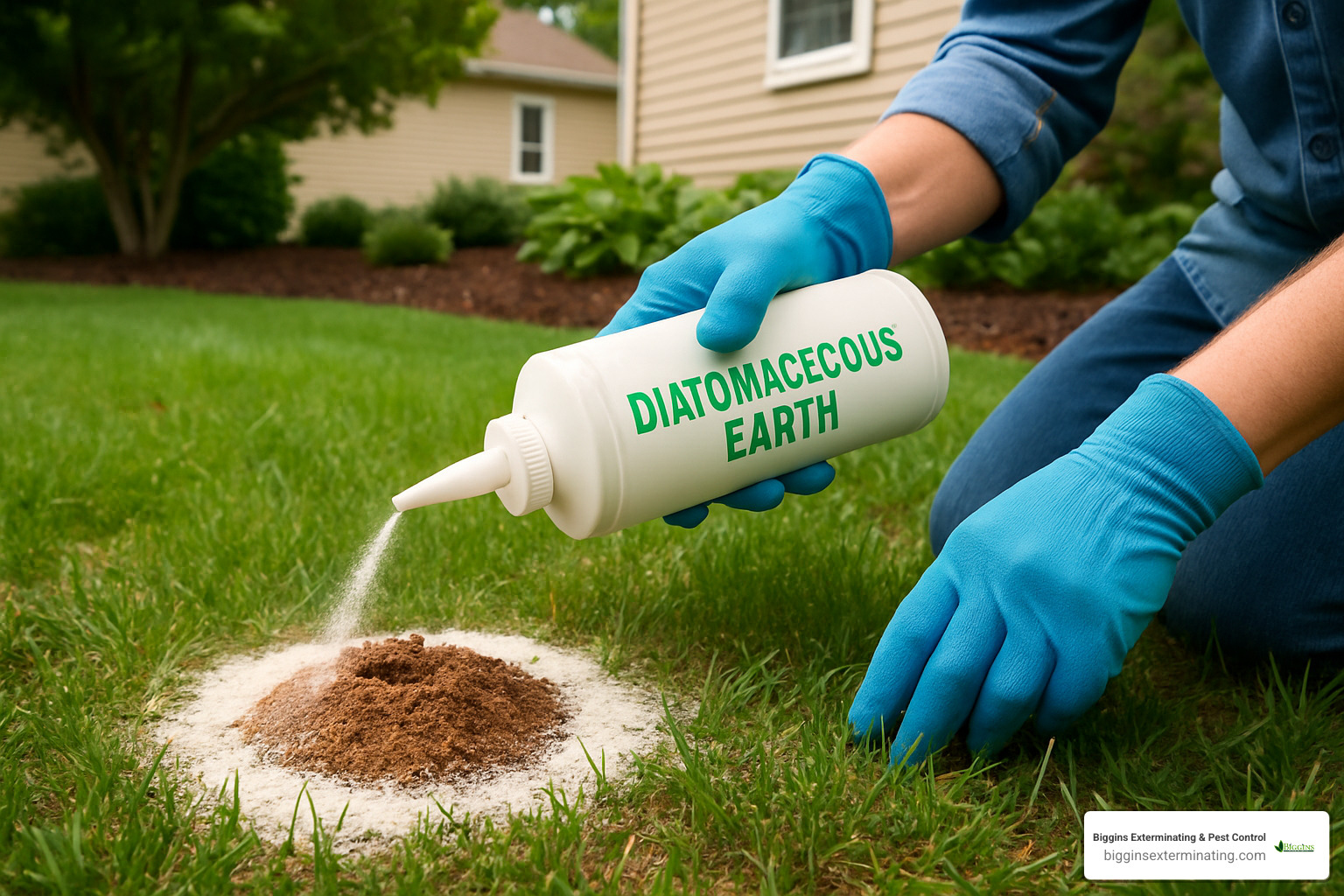
Using Diatomaceous Earth for Natural Ant Control Outside
Diatomaceous earth might sound fancy, but it’s actually one of nature’s simplest ant solutions. This fine powder is made from the fossilized remains of tiny aquatic organisms, and it works like microscopic razor blades against ants.
When ants walk through food-grade DE, the tiny sharp particles cut through their protective waxy coating, causing them to dehydrate. It’s purely physical, not chemical, which means ants can’t develop resistance to it – a major advantage over many commercial products.
For best results, only use food-grade DE (never the pool-grade variety, which contains harmful chemicals). Apply it when conditions are dry, creating a thin, continuous barrier around your home’s foundation, entry points, and visible ant trails. A layer about half an inch high and two inches wide works perfectly.
“Many of our customers in Wilmington are amazed at how quickly DE works,” says Stephen Biggins. “We typically see a 90% reduction in visible ant activity within just 48 hours when applied properly.”
While DE is completely non-toxic to humans and pets – it’s even used in some food products – do wear a simple dust mask during application to avoid lung irritation. After rain, you’ll need to reapply, as moisture renders it ineffective.
For a quality food-grade option, many of our customers have success with HARRIS Diatomaceous Earth, which comes with a convenient applicator.
Essential-Oil Sprays for Natural Ant Control Outside
If you’re looking for a pleasant-smelling solution to your ant problems, essential oils might be your new best friend. Not only do they smell wonderful to us, but many oils are absolutely repulsive to ants.
Peppermint oil disrupts ant trails and confuses workers with its strong scent. Tea tree oil acts as a natural insecticide, while cinnamon oil both repels and can be lethal to ants at higher concentrations. Lemon eucalyptus oil creates a powerful deterrent that most ants won’t cross.
Creating your own spray is simple: mix 10-15 drops of essential oil with a cup of water and a couple drops of liquid dish soap (which helps the oil and water mix properly). Shake well before each use, and spray directly on ant trails, entry points, and around your home’s perimeter.
“I always recommend focusing on doorways and windowsills,” notes Stephen. “These are the superhighways ants use to enter your home, and disrupting these paths can make a huge difference.”
For the science-minded, research has confirmed that a 1% peppermint oil solution acts as an effective repellent, while a 2% solution can actually kill ants on contact. Scientific research on cinnamon oil efficacy has shown particularly promising results.
While these oils are natural, they can be harmful to some pets, particularly cats and fish. Keep your sprays away from fish ponds and use caution in areas where your pets frequent.
Vinegar & Lemon Juice Trail Breakers
Ants are amazing navigators, but they rely heavily on chemical trails to find their way. This is where vinegar and lemon juice shine as natural ant control outside options – they’re like erasing the ant’s GPS system!
A simple 1:1 mixture of white vinegar and water in a spray bottle creates an effective trail disruptor. The acidic nature of vinegar completely obliterates the pheromone trails ants leave behind, causing confusion in their ranks. For a stronger solution, you can even use undiluted white vinegar, though I’d recommend testing it on surfaces first to avoid damage.
Lemon juice works similarly – mix one part lemon juice with three parts water and apply to entry points and active areas. The citrus scent is pleasant to us but completely disrupts ant communication. You can even repurpose your morning lemon wedges by drying the peels, grinding them up, and sprinkling the powder around entry points.
“Vinegar solutions are my go-to recommendation for customers in North Reading and Tewksbury who want an immediate, child-safe solution,” shares Stephen. “It’s something everyone already has in their pantry, and it works remarkably well when used consistently.”
Both solutions are completely safe around children, pets, and edible plants. Just be aware that vinegar can damage natural stone surfaces, and lemon juice might lighten fabrics, so apply with care on sensitive materials. For more information about vinegar as a natural remedy, check out this vinegar reference.
Baits: Borax, Baking Soda, Cornmeal
Sometimes the best natural ant control outside strategy is to let the ants do the work for you. Bait methods rely on worker ants carrying substances back to their colony, affecting the entire nest rather than just the scouts you see.
Borax-sugar bait is highly effective but requires careful placement. Mix one teaspoon of borax with two tablespoons of sugar and add just enough warm water to make a syrup. Soak cotton balls in this mixture and place them in shallow containers near ant trails, but well out of reach of curious pets and children. The sweet sugar attracts the ants, who then carry the borax back to the colony where it disrupts their digestive systems.
For households with pets or young children, baking soda offers a safer alternative. Mix equal parts baking soda and powdered sugar in shallow dishes near ant activity. The sugar attracts the ants while the baking soda reacts with acidic substances in their digestive system.
Cornmeal is perhaps the safest method of all. Simply sprinkle it around ant mounds and trails. Ants will carry it back to feed the colony, but they cannot actually digest it, eventually leading to starvation. While slower than other methods, it’s exceptionally safe around children, pets, and gardens.
“In our experience serving Massachusetts homes for over 40 years, bait methods typically take 1-2 weeks to show noticeable results,” explains Stephen. “But the patience pays off with more thorough colony elimination than contact killers can provide.”
For more scientific background on these approaches, you can review research on home remedies for pest control.
Physical & Thermal Tactics
Sometimes the most straightforward approaches to natural ant control outside deliver the most satisfying results, especially when dealing with visible ant mounds.
Boiling water is the ultimate eco-friendly ant mound treatment. Simply boil several gallons of water and carefully pour it directly onto ant hills. This thermal shock can eliminate up to 60% of a colony in one treatment. For even better results, add a cup of liquid dish soap per gallon – the soap breaks down the ants’ protective coating while the heat does the rest. Most mounds require 2-3 applications for complete elimination.
“Just be careful not to splash yourself or damage nearby plants,” cautions Stephen. “We’ve seen many DIY attempts go wrong when people get careless with boiling water.”
A gentler approach is the soap spray method. Mix 1-2 tablespoons of liquid dish soap with a quart of water and spray directly onto visible ants and trails. The soap breaks down their protective exoskeleton and essentially suffocates them, providing immediate results for surface ants.
Physical barriers offer yet another option. Ants won’t cross lines of certain materials, including chalk (which contains calcium carbonate that disrupts their scent trails), petroleum jelly (creates a sticky barrier they avoid), double-sided tape (forms an impassable sticky zone), or even baby powder (which works similarly to diatomaceous earth).
While these methods provide immediate satisfaction, they work best as part of a comprehensive approach. The boiling water might eliminate the visible portion of a colony, but combining it with preventative barriers helps ensure they don’t simply relocate nearby.
Prevention & Habitat Management: Keeping Ants Out of Home and Garden
The most effective natural ant control outside strategy is prevention. By making your outdoor environment less attractive to ants, you can significantly reduce the likelihood of problematic infestations.
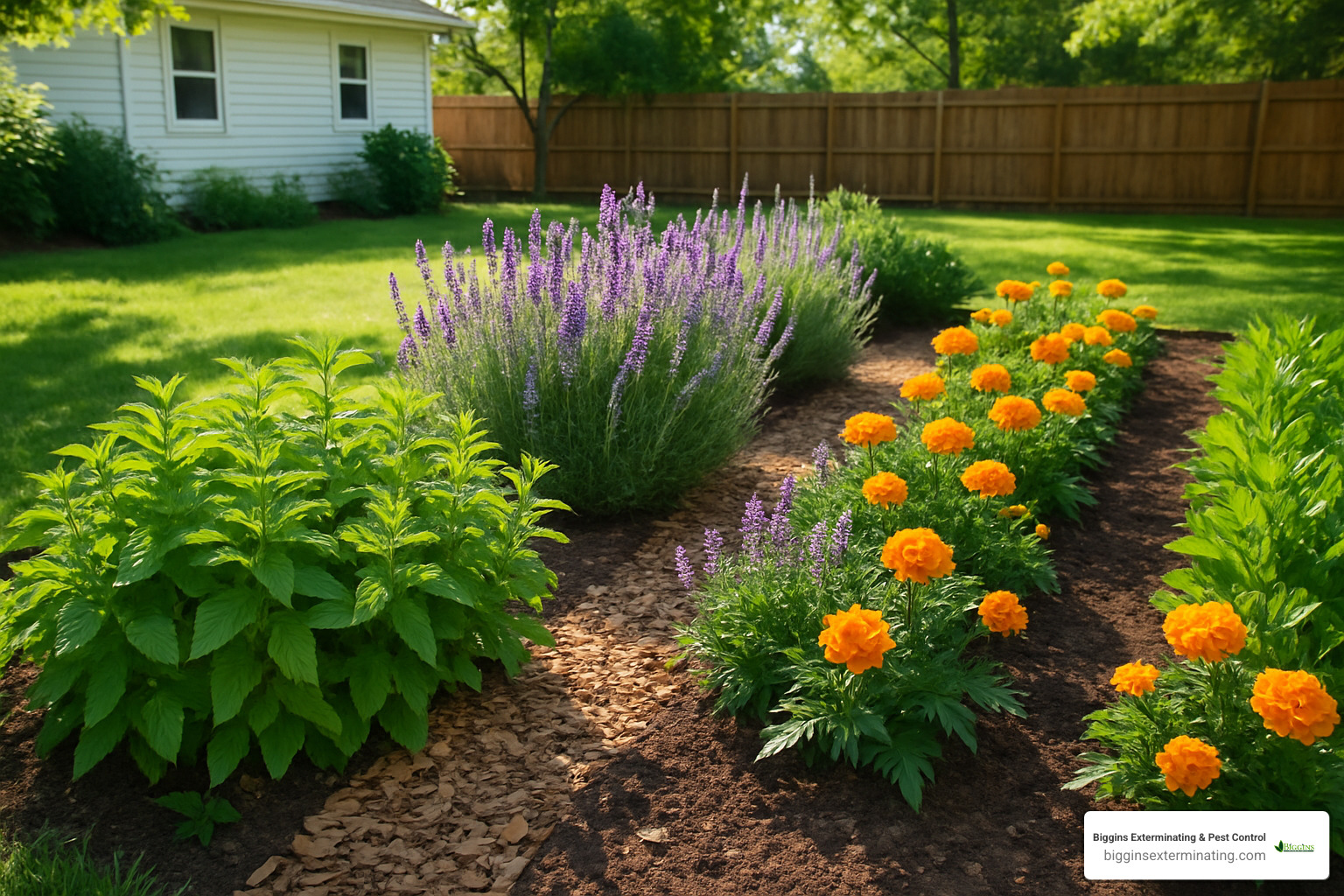
Living Barriers: Plants That Repel Ants
Nature has provided us with beautiful allies in our quest to manage ant populations. Certain plants contain natural compounds that make ants think twice before crossing their territory, creating living barriers that can reduce ant activity by up to 60% in treated areas.
Mint varieties like peppermint and spearmint are ant-repelling superstars. Their high menthol content creates an aromatic force field that ants simply can’t stand. I often recommend planting mint around patios and entry points, though I always warn my Wilmington clients to keep it in containers since it spreads aggressively.
Lavender does double duty in your garden – repelling ants with its intense fragrance while attracting beneficial pollinators with its beautiful purple blooms. As a bonus, it’s drought-tolerant and requires minimal maintenance, making it perfect for busy homeowners.
Tansy brings bright yellow flowers and powerful ant-repelling compounds to your landscape. While beautiful, I always caution pet owners that tansy can be toxic if Fido or Fluffy decides to make it a snack, so placement matters.
Wormwood offers silvery, textured foliage and contains compounds that ants actively avoid. It thrives in our Massachusetts climate, though I advise keeping it away from vegetable gardens as it can inhibit the growth of nearby plants.
Catnip contains nepetalactone, a natural compound that confuses and repels ants while attracting beneficial predatory insects. Just be prepared for neighborhood cats to show their appreciation for your pest control efforts!
Citronella grass creates a lemony scent barrier that disrupts ant navigation systems. This attractive ornamental grass pulls double duty by helping keep mosquitoes at bay during our humid Massachusetts summers.
For the most effective living barrier, I recommend creating a mixed perimeter using several of these plants around your home’s foundation, patios, and children’s play areas. The varied scents create a more comprehensive deterrent than relying on just one species.
If you have pets, it’s worth checking the ASPCA’s toxic plant database before adding new plants to your yard, particularly tansy and wormwood which can cause issues if ingested in large amounts.
Hardscape & Sanitation Tactics
Beyond planting, simple changes to your landscape can make a huge difference in ant populations. In my 40+ years helping Massachusetts homeowners, I’ve seen these hardscape modifications work wonders:
Creating a 12-inch gravel barrier around your home’s foundation not only looks attractive but creates terrain that ants find difficult and undesirable for nesting. Similarly, raised garden beds with cedar or redwood frames naturally deter ants while making gardening easier on your back – a win-win!
Water management is crucial for ant prevention. Fixing drainage issues eliminates the moisture that many ant species seek, while sealing cracks in your foundation and around windows removes their highways into your home. A tube of quality silicone caulk is one of the most cost-effective pest prevention investments you can make.
Regular landscape maintenance plays a vital role too. Keep shrubs and tree branches trimmed back from touching your home – these create bridges that ants use to bypass other barriers. When applying mulch, keep it at least 6 inches from your foundation and never pile it deeper than 2-3 inches, as excessive mulch creates perfect ant real estate.
Old tree stumps and rotting logs are ant magnets, so removing these from your property eliminates prime nesting sites. If you compost (which I encourage!), position bins away from your house and consider adding a protective ring of diatomaceous earth around them.
The cleanliness of your outdoor spaces matters tremendously. After hosting backyard barbecues at your Wilmington or Andover home, promptly clean outdoor eating areas to remove food residues that attract scouts. Store pet food in airtight containers rather than leaving it accessible, and keep trash cans tightly sealed to eliminate food sources.
If you enjoy wildlife, maintain bird feeders by regularly cleaning up spilled seed, which otherwise becomes an ant buffet. For those who heat with wood, stack firewood at least 20 feet from your home and lift it off the ground to discourage nesting.
These preventative measures create an environment that’s simply less hospitable to ants. By implementing even a few of these strategies, you’ll significantly reduce the likelihood of problematic infestations and minimize the need for more intensive control methods. At Biggins Exterminating & Pest Control, we’ve found that prevention truly is the most effective and environmentally friendly approach to natural ant control outside.
Monitoring, Ecosystem Balance & When to Call a Pro
Keeping tabs on your natural ant control outside efforts isn’t just about spraying and forgetting. Like tending a garden, it requires a watchful eye and occasional adjustments. Throughout our decades serving Massachusetts homes, we’ve found that the most successful ant management happens when homeowners stay engaged with the process.
After applying your chosen remedies, set aside time each week to check previously active areas. Has the ant traffic decreased? Are they creating new trails? This ongoing assessment helps you determine if your methods are working or if you need to try a different approach. Simple monitoring tools like sticky cards placed in strategic locations or even index cards with a dab of honey can help track ant activity patterns across your yard.
Weather impacts effectiveness—most natural remedies need reapplication after rain, and seasonal changes affect ant behavior dramatically. What worked perfectly in spring might need adjustment by midsummer.
Signs It’s Time for Professional Help
While I’m a firm believer in starting with natural solutions, I’ve also seen when it’s wisest to call in reinforcements. Here at Biggins, we encourage homeowners to try DIY methods first, but recognize certain situations where professional help becomes the most practical option.
Consider reaching out to professionals when you notice multiple large mounds spreading across your property, as this indicates extensive colony development that’s difficult to manage with home remedies alone. Carpenter ants deserve immediate attention when spotted near wooden structures, as their excavation activities can compromise structural integrity over time.
The presence of fire ants or other stinging species also warrants professional consideration, especially if family members have allergies or sensitivity to stings. And if you’ve diligently applied natural ant control outside methods for 2-3 weeks with minimal improvement, it might be time for a more targeted approach.
Persistent indoor invasions despite outdoor control efforts often signal hidden nests that professionals can more effectively locate and treat. And of course, any signs of structural damage should prompt an immediate professional assessment.
Professional ant control services typically range from $150-$500 for initial treatment across the industry, with costs varying based on property size, infestation severity, and ant species involved. At Biggins Exterminating, we’re transparent about costs and always begin with the least invasive methods that will effectively solve your specific ant problem.
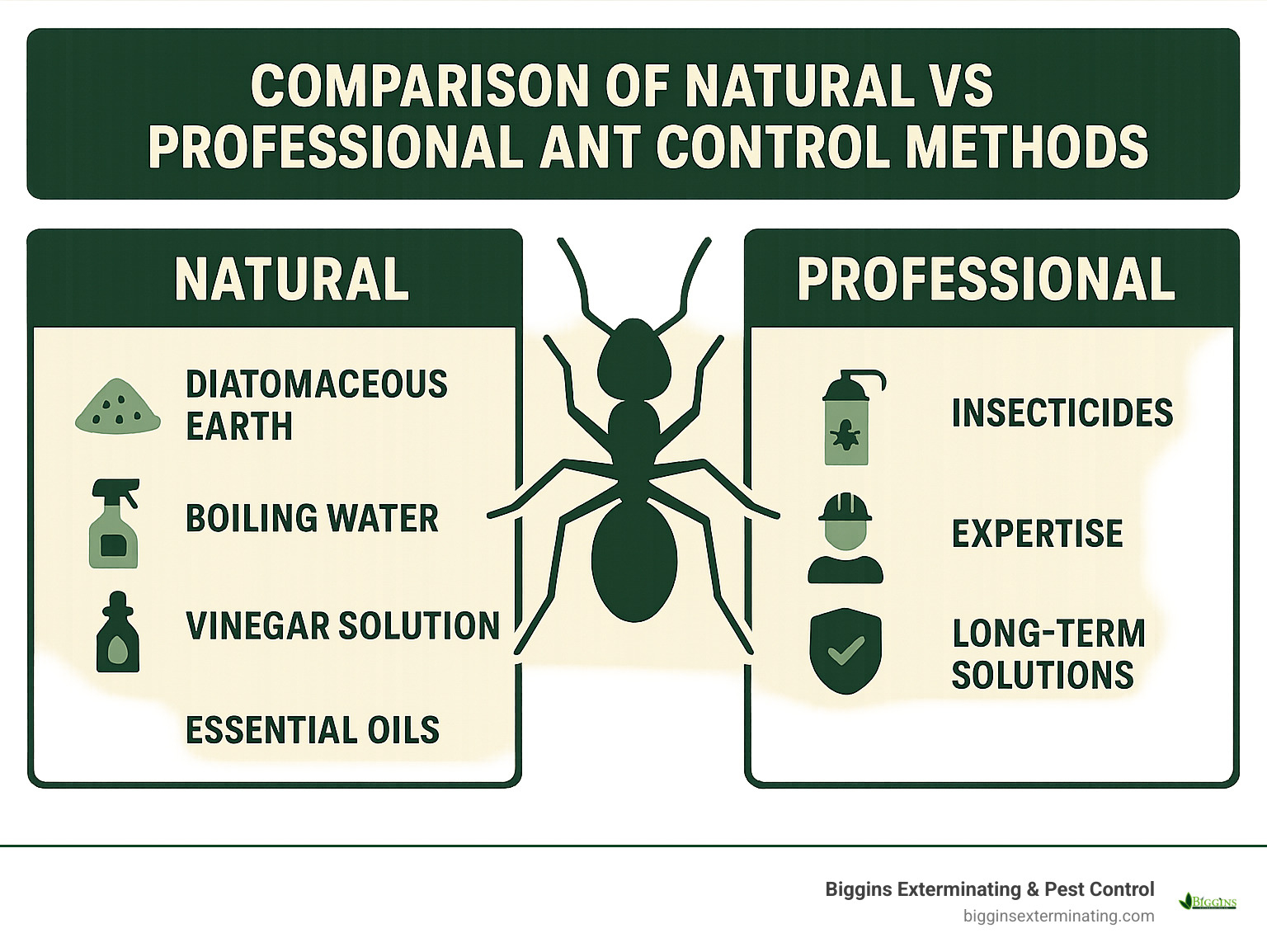
Balancing Control with Garden Health
The delicate dance of natural ant control outside isn’t just about eliminating ants—it’s about creating harmony in your outdoor space. The goal isn’t to create an ant-free zone (which would actually harm your garden’s health), but rather to manage ant populations in a way that prevents problems while preserving benefits.
Instead of treating your entire yard, focus on problem areas—particularly ant trails leading to your home and nests near foundations or outdoor living spaces. This targeted approach allows beneficial ant activity to continue in garden areas where they’re actually helping by aerating soil and controlling other pests.
Timing matters tremendously when applying treatments. Early morning or evening applications help protect pollinators like bees and butterflies that visit flowering plants during daylight hours. This simple adjustment—along with avoiding powder or spray applications directly on flowers—helps maintain the pollinator population your garden depends on.
The changing seasons offer natural opportunities to adjust your approach. In early spring, focus on prevention before colonies expand. Summer often requires more vigilant monitoring, especially during warm, dry periods when ants are most active. As fall approaches, you can typically reduce treatments as ant activity naturally decreases.
Through our 40+ years serving Wilmington, Woburn, Lexington, and surrounding Massachusetts communities, we’ve witnessed the most sustainable success stories come from homeowners who work with nature rather than against it. The healthiest yards maintain a balanced ecosystem where beneficial insects thrive while problematic ant behaviors are strategically discouraged.
When natural methods reach their limits, our Ant Control Exterminators services provide the next level of protection, always with an eye toward preserving the ecological balance that makes your outdoor space thrive.
Frequently Asked Questions about Outdoor Ant Control
What’s the fastest natural way to kill an ant colony outdoors?
When it comes to quick results, nothing beats the boiling water method for visible ant colonies. I’ve seen homeowners get dramatic results by pouring a mixture of boiling water with a cup of dish soap directly into ant hills. This simple approach can wipe out up to 60% of a colony in just one treatment! For complete elimination, you’ll likely need to repeat the process 2-3 times over several days.
The catch? This only works on nests you can actually see. For those sneaky hidden colonies, I typically recommend a two-pronged approach: create barriers with food-grade diatomaceous earth while simultaneously setting out borax-sugar baits. This combination delivers more comprehensive results, though you’ll need a bit more patience—expect to wait 1-2 weeks to see the full effect as the baits work their way through the colony.
How often should I reapply remedies after rain?
Rain is the nemesis of most natural ant control outside methods! After four decades in pest control across Massachusetts, I’ve learned that timing reapplications correctly makes all the difference.
With diatomaceous earth, you’ll need to reapply immediately after any rainfall or even heavy morning dew—once it gets wet, it loses its effectiveness completely. The same goes for powdered repellents like cinnamon or pepper, which simply wash away.
Essential oil sprays need refreshing every 2-3 days under normal conditions, but right after rain, you should reapply immediately. Similarly, vinegar or lemon sprays work best with daily application and definitely after precipitation.
For borax baits, prevention is better than reapplication—keep them covered or in protected locations to shield them from moisture. If they do get wet, replace them promptly. Used coffee grounds should be replenished weekly and after any significant rainfall.
The simple rule of thumb I share with our Wilmington and Andover customers: if you can see that your treatment has been washed away or diluted, it’s time to reapply.
Will natural ant control outside harm my vegetable garden?
Good news for gardeners! Most natural ant control outside methods can safely coexist with your tomatoes and cucumbers, though a few precautions will keep your harvest healthy.
Food-grade diatomaceous earth is completely garden-friendly—it’s so safe you could actually sprinkle it directly on plants to manage other pests. Many of our customers in Bedford and North Reading use it as their go-to garden protector.
While vinegar solutions won’t contaminate your vegetables, they can damage plant foliage due to their acidity. I always recommend keeping the spray directed at the soil and away from your plants’ leaves.
Essential oils require similar caution—they’re powerful natural compounds that can sometimes stress sensitive plants. It’s best to create a perimeter around your garden rather than applying them directly to areas where edibles grow.
For borax-based treatments, placement is key. Keep these baits well away from garden beds or use enclosed bait stations to prevent any soil contamination. Your plants won’t appreciate borax in their root zone!
Coffee grounds and cornmeal get the gold star for garden safety—they’re completely harmless and may even improve your soil structure as they break down. I’ve seen some impressive gardens in Tewksbury where coffee grounds pull double-duty as both ant deterrent and soil amendment.
Just remember that boiling water, while effective against ants, is indiscriminate and will damage plant roots and kill beneficial soil organisms. Save this method for driveways and other areas far from your precious vegetables.
For garden-specific protection, I often recommend creating a protective perimeter with diatomaceous earth, strategically placing coffee grounds, and planting natural repellent herbs like mint and marigolds around your garden’s edge. This three-part strategy has helped countless gardeners across Massachusetts enjoy both bountiful harvests and reduced ant activity.
Conclusion
Finding the right balance for natural ant control outside your home doesn’t have to be complicated. Throughout this guide, we’ve explored how to maintain a comfortable outdoor environment while respecting these industrious insects and the beneficial roles they play in our ecosystem.
As you tackle your ant challenges, keep these essential points in mind:
Not all ants are troublemakers—many are actually helping your garden thrive by aerating soil, controlling other pests, and breaking down organic matter. Take time to identify which species you’re dealing with before deciding if control measures are necessary. Often, the most effective approach starts with simple prevention and habitat modifications rather than immediate treatment.
When treatment is needed, target specific problem areas rather than broadcasting solutions across your entire property. This focused approach protects beneficial insects while addressing your ant concerns. Remember to monitor your results and be flexible—what works in spring might need adjustment as seasons change.
At Biggins Exterminating & Pest Control, we’ve spent over four decades helping Massachusetts families implement effective, environmentally responsible pest management. As a family-owned business serving Wilmington, Andover, Bedford, and surrounding communities, we understand the importance of keeping your outdoor spaces both enjoyable and safe—especially for homes with children, pets, and gardens.
If you’ve given natural methods a fair try without success, or if you’re facing more challenging situations with carpenter ants, fire ants, or other potentially destructive species, we’re here to help. Our eco-friendly solutions respect both your property and the environment, and our no-contract approach ensures you get exactly the service you need, backed by our satisfaction guarantee.
The beauty of natural ant control is that it allows you to maintain harmony in your outdoor space—deterring unwanted guests while preserving the delicate balance that keeps your garden healthy. With patience and consistent application of these natural methods, most homeowners can successfully manage outdoor ant populations without resorting to harsh chemicals.
For more information about our specialized ant control services or to schedule a consultation with our experienced team, visit our Ant Control Exterminators page. We’re committed to helping you maintain a comfortable, pest-free home using the safest, most effective methods available—because your family’s wellbeing is always our top priority.