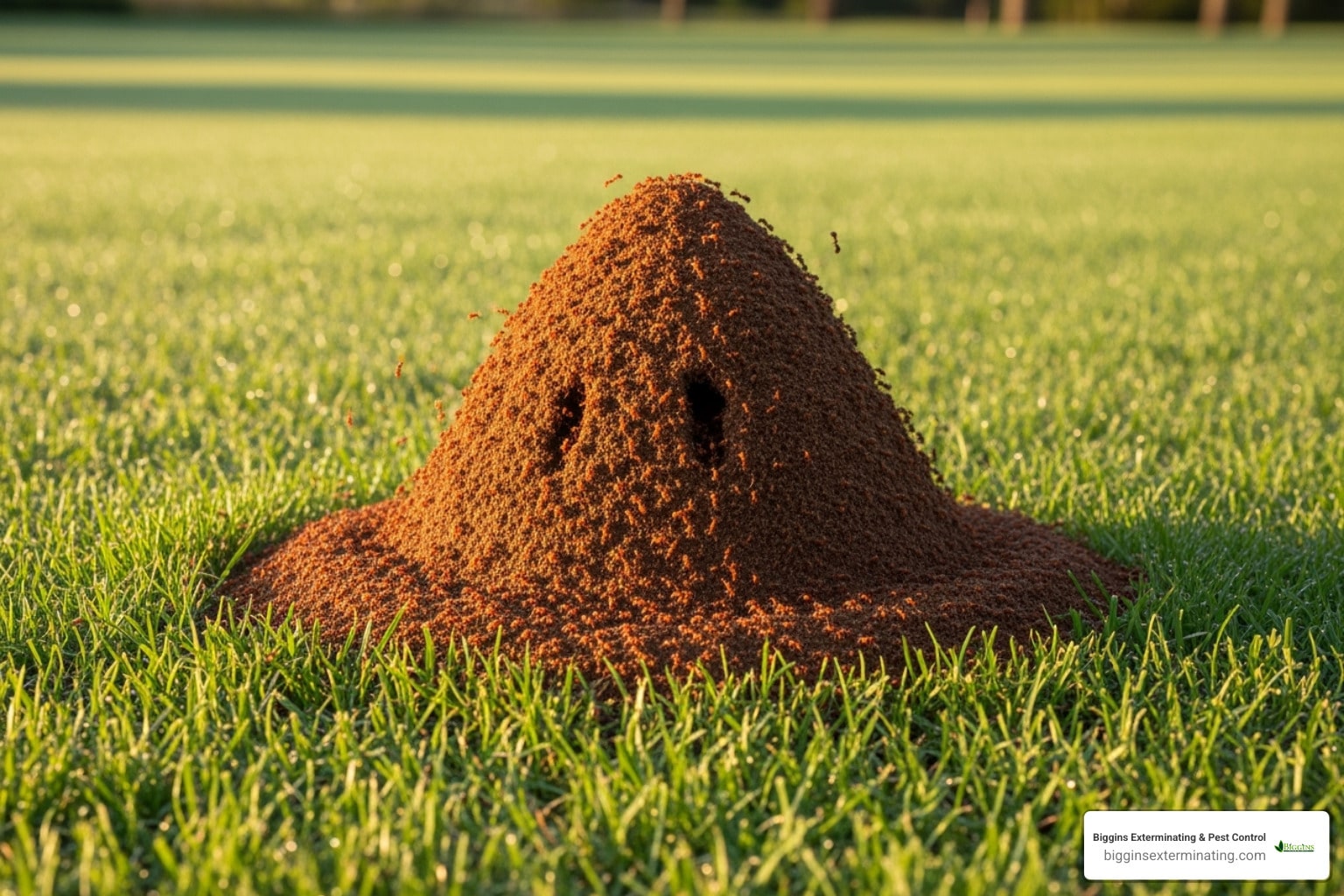
Understanding the Fire Ant Invasion
The most effective fire ant treatment combines slow-acting baits that target the queen with fast-acting contact killers for immediate mound control. Fire ants are aggressive invaders that deliver painful, burning stings, turning your yard into a dangerous minefield. Winning the battle requires more than just killing the workers you see on the surface.
Top Fire Ant Treatment Options:
- Two-Step Method – Broadcast bait (kills the entire colony) + spot-treat remaining mounds with a contact killer (works quickly).
- Fire Ant Baits – Products that eliminate the queen and colony over time.
- Contact Killers – Liquid drenches or granular treatments for fast mound elimination.
- Professional Treatment – Guaranteed results with proper application and follow-up.
The key is to eliminate the queen to destroy the entire colony. A single colony can house up to 500,000 ants, and without targeting the queen deep underground, new workers will keep emerging.
Most homeowners only treat visible mounds, but colonies can be working underground for months before you see their telltale dirt hills. I’m Stephen Biggins, and with over 40 years of pest control experience, I’ve learned that the most effective fire ant treatment always involves understanding the colony and using the right products to target both workers and the queen.
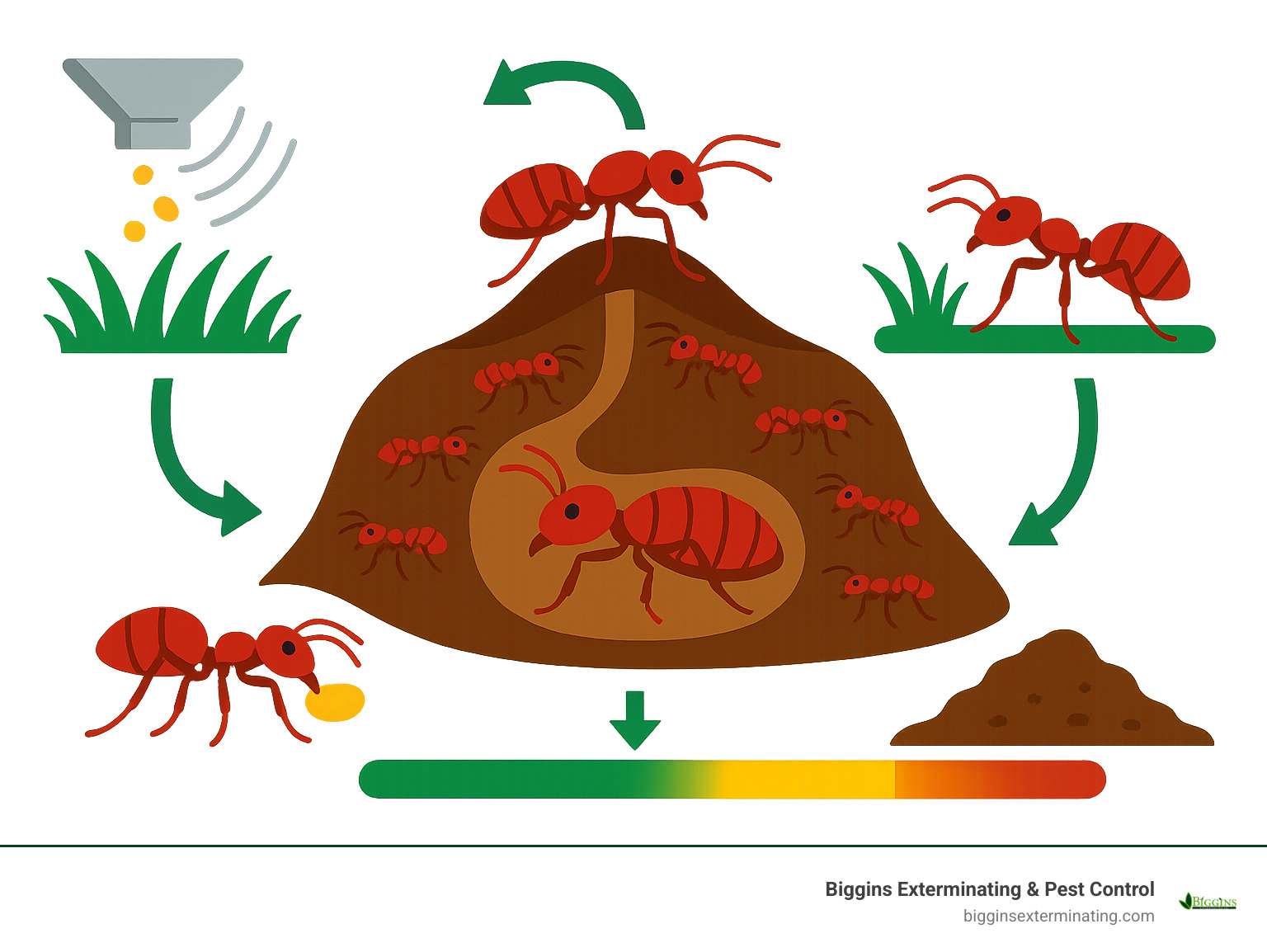
Most effective fire ant treatment word roundup:
The Heart of the Problem: Why You Must Target the Queen
A single fire ant mound is the tip of the iceberg. Beneath your lawn can be an underground city of up to 500,000 worker ants, all serving one boss: the queen. Understanding their social structure is crucial for finding the most effective fire ant treatment.
- Worker ants are the sterile females you see foraging for food and defending the colony. Killing them won’t solve the problem, as they are easily replaced.
- The brood consists of eggs, larvae, and pupae—the colony’s next generation, kept safe underground.
- The queen is the CEO of this empire. Her sole job is to lay up to 1,000 eggs per day. She can live for years, and without her, the colony collapses.
This is why simply spraying a mound often fails. You might kill surface workers, but the queen remains safe underground, producing replacements. Some species even have multi-queen colonies, which can expand and merge with neighbors, making them even harder to control.
The key to bait-based treatments lies in a unique feeding behavior. Adult fire ants can only consume liquids. Worker ants feed solid food to the larvae, who digest it and regurgitate it as a liquid that is shared throughout the colony—including with the queen. This is how slow-acting poison in baits reaches its target.
By the time you spot a mound, the colony is already well-established. The most effective fire ant treatment must target this hidden infrastructure. Kill the queen, and you’ve won the war.
For a deeper dive into fire ant social structure, you can learn more by understanding these pests. If you’re dealing with persistent ant problems, we offer more info about ant extermination services that target the source.
Chemical Warfare: Choosing Your Fire Ant Control Product
After four decades in pest control, I’ve seen homeowners waste money on treatments that don’t work. Success lies in understanding the two main categories of fire ant products: contact killers and baits. Think of them as a hammer and a precision screwdriver—the most effective fire ant treatment often uses both.
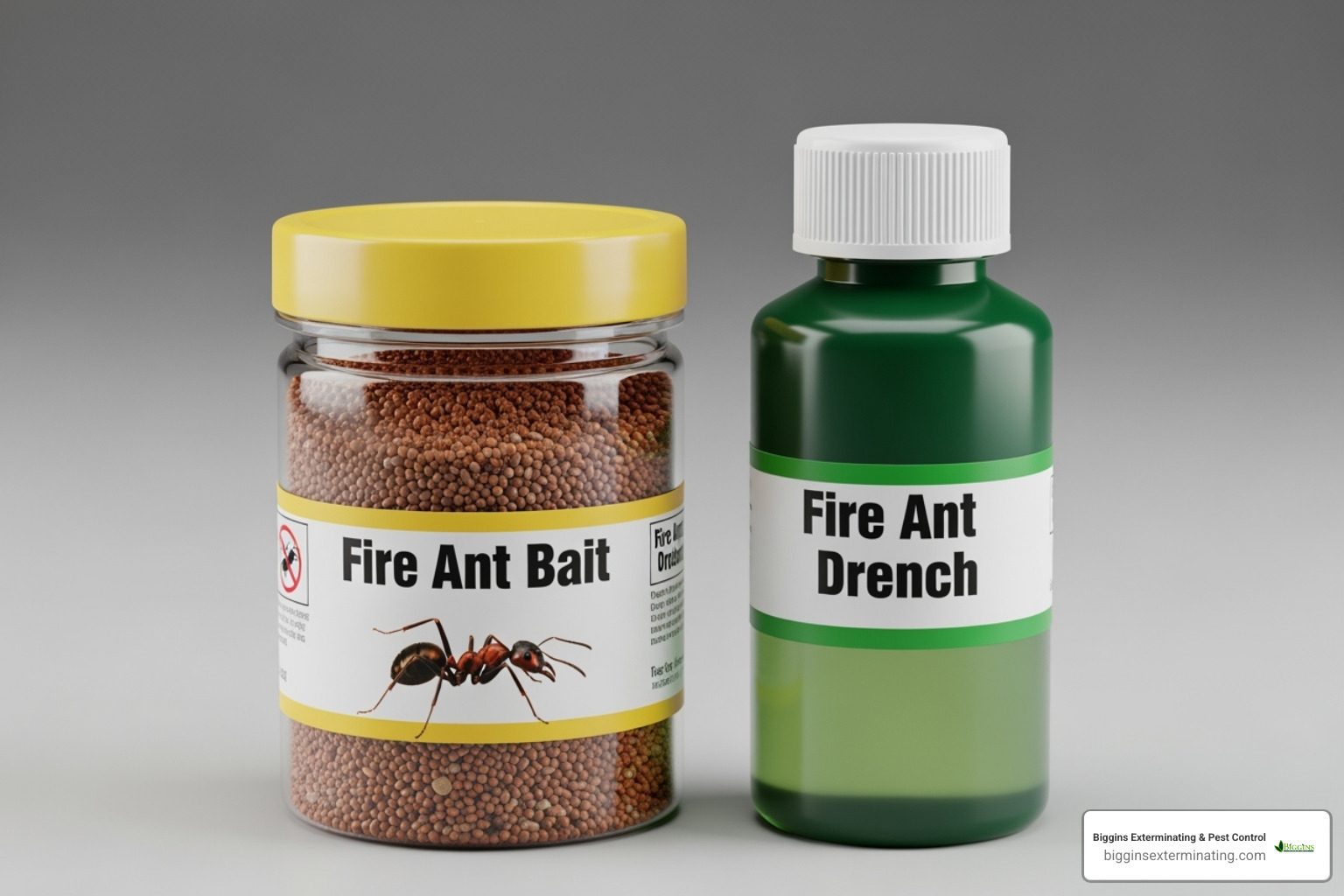
Here’s a breakdown of each approach:
| Feature | Contact Killers | Baits |
|---|---|---|
| Mechanism of Action | Kills ants on contact; some have residual effects. | Ants carry bait back to the colony, sharing it with the queen. |
| Speed of Results | Fast-acting; mound elimination in 15 minutes to 24 hours. | Slow-acting; takes 2 to 6 weeks for full colony control. |
| Duration | Varies from quick knockdown to months of control. | Long-lasting colony elimination once the queen is killed. |
| Best For | Quick elimination of visible mounds; immediate relief. | Long-term colony elimination; widespread infestations. |
| Application Method | Liquid drenches, dry mound treatments, broadcast sprays. | Granules sprinkled around mounds or broadcast over an area. |
Fire Ant Baits: The Slow and Steady Kill
Baits are the most effective fire ant treatment for long-term colony elimination. They are a Trojan horse strategy: worker ants carry poisoned granules back to the mound, thinking it’s food. The slow-acting poison doesn’t kill them immediately, allowing it to be shared throughout the colony and eventually reach the queen.
Common active ingredients include hydramethylnon, indoxacarb (the fastest-acting), and spinosad (a natural option). These can take anywhere from a few days to several weeks to achieve full colony control. Baits can be broadcast across your entire lawn for widespread issues or applied to individual mounds. The main drawback is the wait—it takes 2 to 6 weeks for maximum control, but the results are worth it. Remember not to water in baits, as moisture makes them ineffective.
For a deeper dive, check out more info on effective baits.
Contact Killers: For Fast, Targeted Results
When you need immediate results—like before a weekend barbecue—contact killers are your best friend. These products attack the ants’ nervous system on contact, causing rapid death. Common active ingredients include fast-acting pyrethroids and longer-lasting fipronil.
Application methods include liquid drenches poured directly into the mound, dry mound treatments sprinkled on top (usually watered in), and broadcast applications for wider coverage. While they provide immediate relief, they may not always reach the queen in a large colony, meaning the problem could return. For best results, never disturb the mound before treatment, as this can cause the workers to move the queen to safety.
For more insights into chemical solutions, explore more info about effective ant control.
The Two-Step Method: The Most Effective Fire Ant Treatment Strategy
Homeowners who use only one approach to fire ants often get frustrated. A contact spray might kill one mound, but another pops up. A bait application might leave you wondering if it’s working while ants continue to march.
That’s why the most effective fire ant treatment is the two-step method. It’s a strategic campaign, not a single battle.
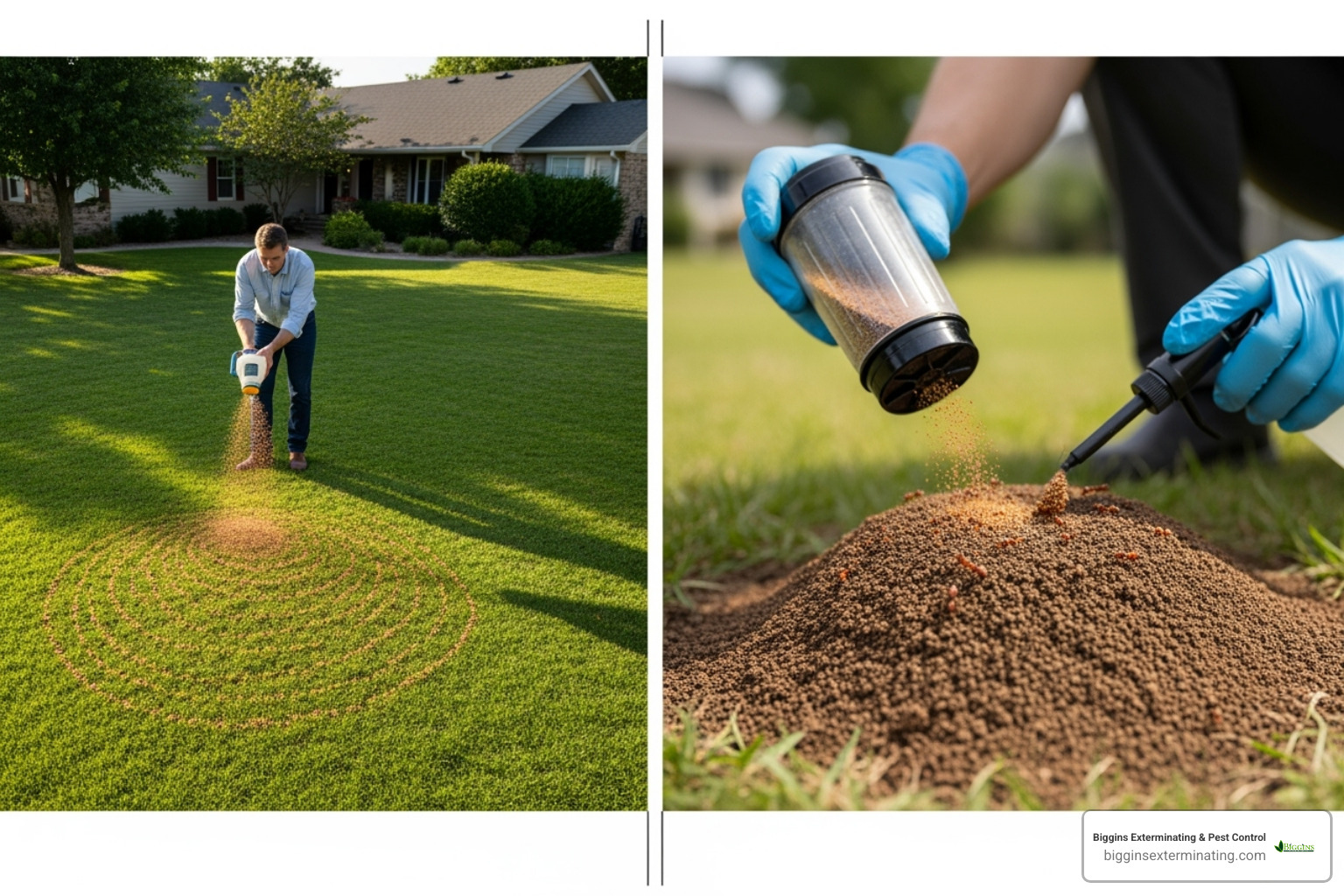
Step 1: Broadcast Bait Across Your Property. This targets all colonies, including hidden ones that haven’t yet formed visible mounds. Worker ants carry the bait back to their queen. This step does the heavy lifting but requires patience, taking 2 to 6 weeks for complete colony elimination.
Step 2: Spot-Treat Remaining Mounds. A week or so after applying bait, use a fast-acting contact killer on any remaining active mounds. These treatments provide immediate control, working in 15 minutes to 24 hours.
This most effective approach to fire ant treatment delivers several key benefits:
- Comprehensive Control: Addresses both visible and hidden mounds, reducing mound numbers by 80-90%.
- Immediate & Long-Term Results: You get the satisfaction of fast mound removal plus the lasting effect of total colony elimination.
- Reduced Pesticide Use: Spot-treating is more targeted and uses less product than drenching every potential mound site.
The two-step method transforms fire ant control from an endless game of whack-a-mole into a strategic victory.
Application, Safety, and Other Control Methods
Choosing the right product is only half the battle. The most effective fire ant treatment also requires correct application, a focus on safety, and knowing which methods to avoid.
Application tips for the most effective fire ant treatment
- Timing is everything. Apply treatments when ants are most active, typically in the morning or late afternoon when temperatures are between 70-90°F.
- Check the weather. Avoid applying products if heavy rain is forecast within 24-48 hours, as moisture can wash away contact killers and ruin baits.
- Read the label. This is your roadmap to success. It provides application rates, safety information, and whether to water the product in.
- Don’t disturb the mound. When applying bait, sprinkle it around the mound, not on top. Poking the mound can cause the queen to be moved to safety.
- Be responsible. Avoid applying products near waterways or on slopes where runoff can occur.
For a broader approach, you can explore more info about Integrated Pest Management.
Keeping Your Family and Pets Safe

When used correctly, fire ant treatments are safe. Always read the product label for re-entry times—how long people and pets must stay off the treated area. Keep children and pets indoors during application and store all pesticides securely in their original containers, away from food and pet supplies. For specific guidance, check out how to protect your family and pets from fire ants.
Physical, Biological, and Ineffective “Home Remedies”
While chemicals are often the most effective, it’s good to know about other methods.
- Physical Methods: Pouring scalding water on mounds or excavating them has a low success rate (20-60%), is labor-intensive, and risks aggressive swarms. It’s not practical for most infestations.
- Biological Controls: The use of phorid flies and pathogens are fascinating, large-scale solutions that work slowly over time to suppress fire ant populations. They are not a quick fix for a homeowner’s yard. For more, see the Sustainable Fire Ant Control research from UF/IFAS.
- Ineffective/Harmful Remedies: Do not use grits, club soda, or soap; they don’t work. Most importantly, never use gasoline, bleach, or ammonia. These are dangerous, environmentally destructive, and illegal for pest control. Diatomaceous earth is also largely ineffective outdoors against deep fire ant colonies.
For safer, natural approaches, we have resources on natural ant control outside.
Frequently Asked Questions about Fire Ant Treatments
After four decades of helping families in Massachusetts communities like Wilmington, Andover, and Lexington, I’ve heard every question imaginable. Here are the answers to the most common ones.
How long does it take to get rid of fire ants?
The timeline depends on the method:
- Contact killers offer the fastest results, eliminating a mound in as little as 15 minutes to 24 hours.
- Baits are slower, requiring 2 to 6 weeks for maximum colony control as the poison works its way to the queen.
- The two-step method provides both immediate relief from visible mounds and long-term elimination of the entire colony.
Can fire ants be permanently eliminated from my yard?
Permanent elimination is highly unlikely. Fire ants are resilient, and newly mated queens can fly in from neighboring properties to start new colonies. The goal isn’t total eradication but consistent, long-term management. Think of it like lawn care—regular treatments, such as annual or semi-annual broadcast bait applications, keep populations suppressed and your yard safe.
When should I call a professional for fire ant control?
While many homeowners can manage fire ants, calling a professional is the smartest move in certain situations. Consider professional help for:
- Large-scale infestations with dozens of mounds.
- Recurring problems where ants keep returning despite your DIY efforts.
- Safety concerns about handling and storing pesticides around your family and pets.
- Guaranteed results and the peace of mind that comes with a warranty and expert application.
At Biggins Exterminating & Pest Control, we assess your property, create the most effective fire ant treatment plan, and stand behind our work.
Reclaim Your Yard from Fire Ants for Good
Winning the war against fire ants is possible. The most effective fire ant treatment is a smart, consistent strategy, not a one-time fix. By using the two-step method—combining broadcast baits with targeted contact killers—you can address both hidden colonies and active mounds.
Consistent management is the key to keeping your property safe and enjoyable year after year. While perfect treatment can control existing colonies, fire ants can’t be permanently eliminated from an area. New queens can always arrive from neighboring properties.
When the problem feels too big for a DIY project, or if you want the assurance of professional service, it’s time to call for reinforcements. At Biggins Exterminating & Pest Control, we’ve been a family-owned business serving Wilmington and surrounding communities for over 40 years. We have the experience to assess your situation and apply the right treatments safely and effectively.
Professional treatment offers more than just stronger products; it provides the knowledge of when and how to use them while keeping your family and pets safe. We stand behind our work with warranties that give you peace of mind.
Don’t let fire ants steal another summer. Whether you use the strategies outlined here or opt for guaranteed professional results, the important thing is to take action.
Ready to reclaim your yard? Learn more about our residential pest control services, or contact us for professional ant extermination services in the Wilmington, MA area. Let’s make your outdoor spaces safe and joyful again.