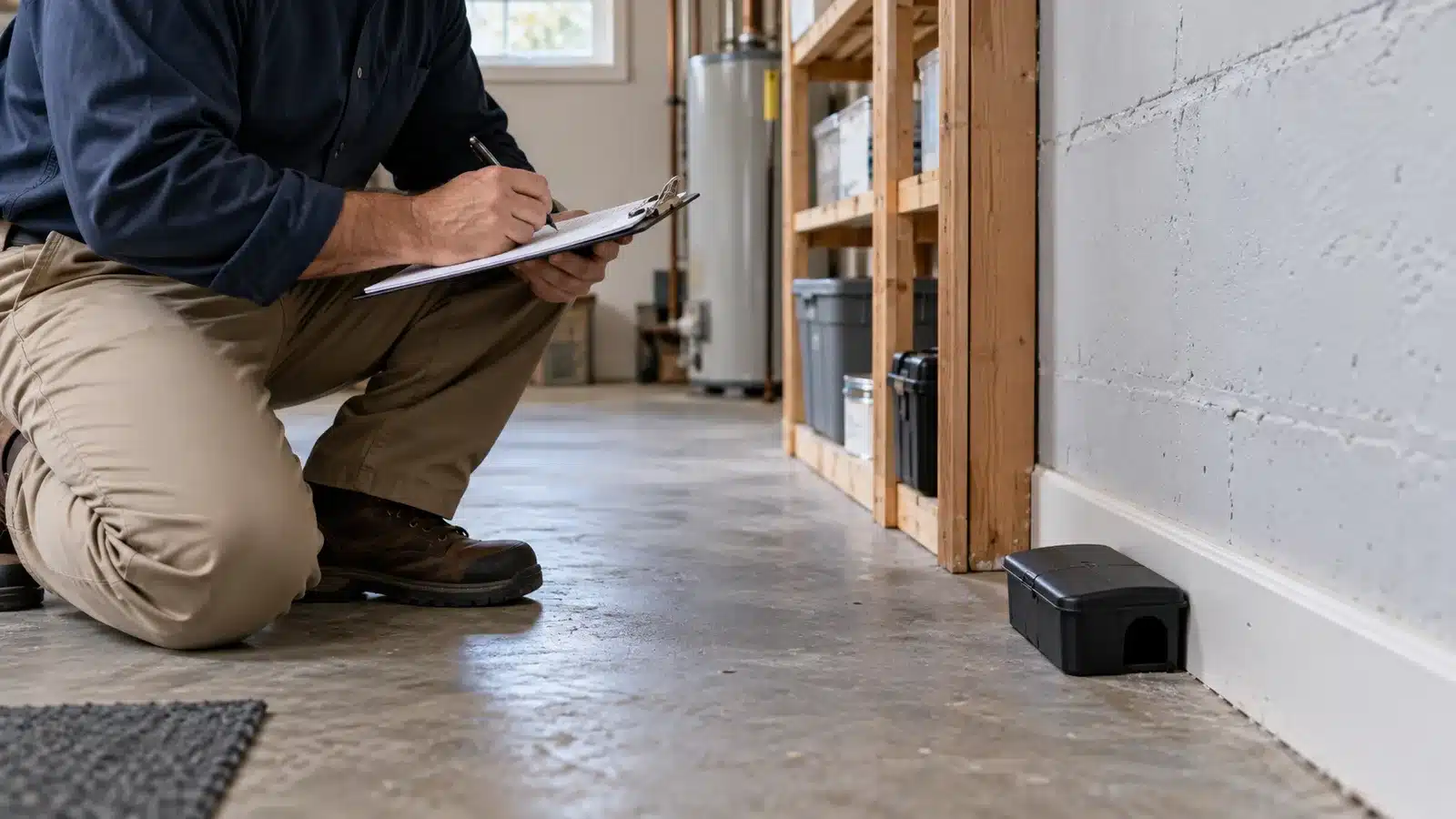
You can be reasonably confident mice are gone when a consistent observation period produces no new droppings, noises, gnaw marks, food damage, or activity in the monitors your pest-control provider asked you to check. One quiet night or one empty trap is not proof. The better test is whether fresh evidence stops appearing across the places where activity was previously found.
In Wilmington and nearby Massachusetts communities, mice may move indoors as outdoor conditions change. That makes a dated record more useful than memory. Keep following the treatment and follow-up instructions you received, and ask the provider how long to monitor for the specific plan used at your property.
Reset the evidence before you start counting quiet days
Old droppings, damaged food packages, and rubbed or gnawed surfaces can remain after active mice have been controlled. If it is safe to do so, document where those signs are before cleanup. Follow the CDC instructions for cleaning rodent-contaminated areas; the agency specifically warns against sweeping or vacuuming dry droppings or nesting material because that can send contaminated particles into the air.
Once an area has been handled according to the appropriate safety guidance, take a photo of the reset location and note the date. That gives you a baseline. Anything that appears later is easier to recognize as new evidence rather than residue from before treatment.
Track five signals instead of relying on sightings
| Signal | What to record | What a change may mean | Next step |
|---|---|---|---|
| Droppings | Location, date, and whether they appeared after a documented cleanup | New droppings are stronger evidence of current activity than old droppings left in place | Photograph the location without disturbing it, then contact the provider if it is new |
| Noises | Time, room, wall or ceiling area, and duration | Repeated scratching in the same route is more useful than a single unidentified sound | Share the pattern and avoid opening walls on your own |
| Gnawing or food damage | Package, shelf, opening, or material affected | A new edge or fresh package damage can indicate continued access to food or a travel route | Secure the food source and report the exact location |
| Monitor or trap activity | Use only the devices and check schedule the provider authorized | A changed indicator or capture can confirm activity even when no mouse is seen | Do not move, open, or reset a professional device unless instructed |
| Direct sightings | Date, time, room, direction of travel, and whether it was indoors or outdoors | A sighting identifies a route but does not by itself measure the size of a problem | Record it and send the details to the provider |
The EPA lists droppings, nesting material, chewing damage, holes, and stale odors as signs of a rodent infestation. After treatment, the same categories are useful only when you separate old signs from newly appearing signs.
Use a simple post-treatment mouse log
A useful log does not need to be complicated. Check only the locations and devices included in your service instructions, then record:
- Date and time: consistency matters more than checking constantly.
- Exact location: use a room plus a landmark, such as “pantry baseboard behind the lower shelf.”
- Type of evidence: droppings, noise, damage, odor, device activity, or sighting.
- New or pre-existing: compare it with the baseline photo.
- Action taken: food secured, photo sent, provider called, or no change.
This record helps the provider see whether activity is declining, concentrated along one route, or appearing in a new area. It also avoids a common mistake: changing several things at once and then losing the ability to tell what worked.
What does not prove the mice are gone?
- No sighting for a day or two: mice can remain hidden and active at times when nobody is watching.
- An untouched device: it may be in the wrong location, or the treatment plan may use a different indicator.
- Old droppings that never disappeared: their presence alone cannot establish when they were left.
- A temporarily quiet wall: plumbing, heating, wildlife, and building movement can create similar sounds.
- Sealing one visible gap: other routes may exist, and closing an opening at the wrong stage can interfere with the provider’s plan.
If you are still trying to locate likely routes, Biggins’ guide to finding mice and their signs around a home explains where evidence commonly appears. Use that information to improve your observations, not to dismantle or relocate professional equipment.
When to call the pest-control provider again
Contact the provider at the follow-up point in your service plan, or sooner if you document a new indoor sighting, fresh droppings after a safe reset, new food or structural damage, repeated monitor activity, a strong unexplained odor, or activity in a room that was not previously involved. Also call if a child, pet, or other household member may have disturbed a device.
Do not wait for a self-imposed deadline if the provider gave you a different check schedule. Different properties, activity levels, treatment methods, and access conditions can change what follow-up is appropriate. There is no single number of days that proves every mouse problem is resolved.
Pair control with access and food-source decisions
Long-term mouse control depends on more than whether an individual mouse is removed. The EPA recommends removing food, water, and shelter opportunities and sealing holes inside and outside the building. The order matters: coordinate repairs and exclusion work with the treatment plan so you do not close a route prematurely or leave an active entry point unaddressed.
Biggins Exterminating provides mouse pest control in Wilmington and surrounding Massachusetts communities. When you request an evaluation or follow-up, share the dated log, photos, affected rooms, and any recent changes to food storage or building access. That gives the technician a clearer starting point than “I think they are gone” or “I heard something once.”
Source note: Rodent signs and prevention guidance are grounded in current EPA material. Cleanup precautions are grounded in the CDC’s current rodent-cleanup guidance. Follow the written instructions from your pest-control provider and every product label that applies at your property.