
The Carpenter Bee Challenge: Pollinators vs. Property
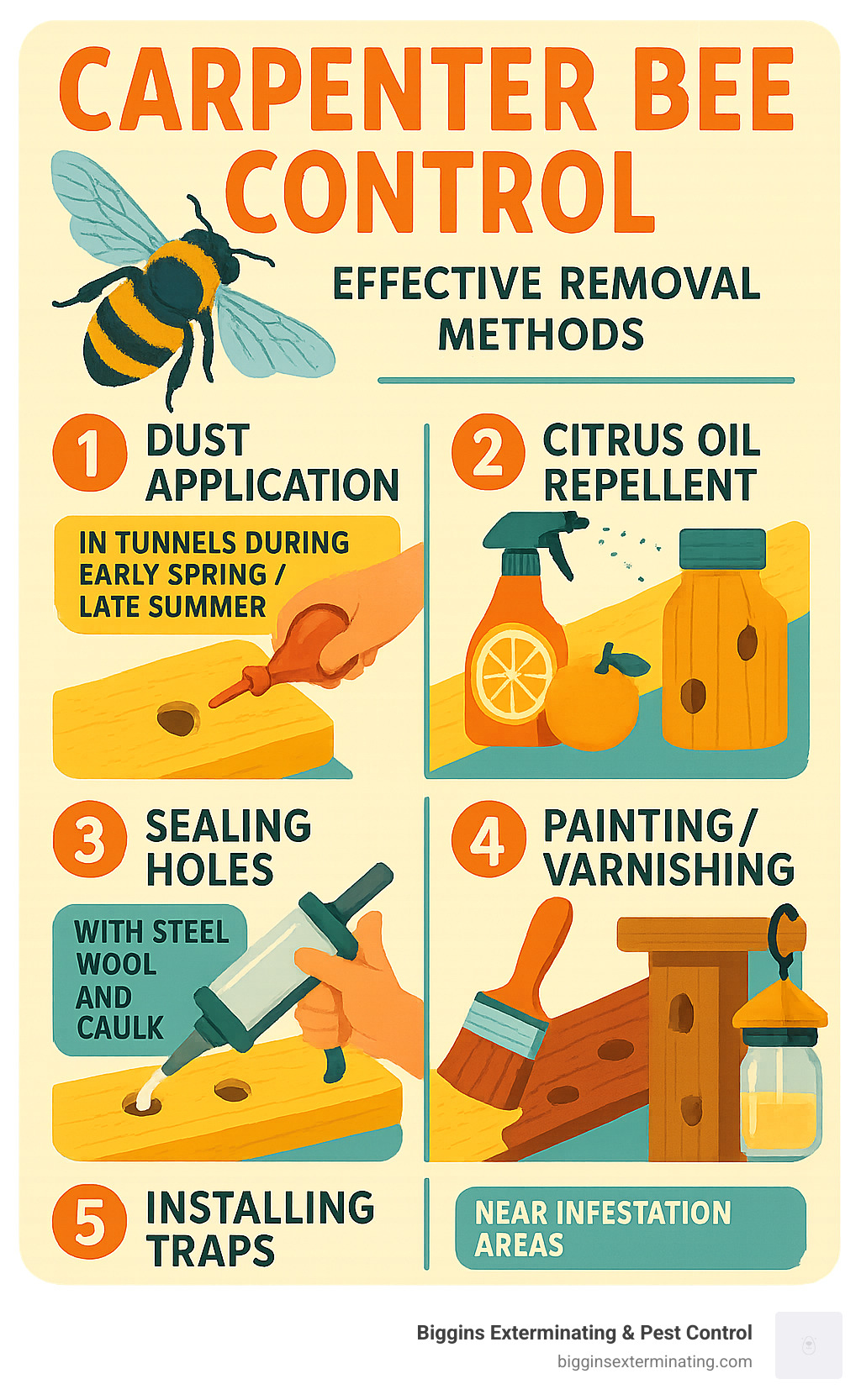
If you need to get rid of wood boring bees quickly, here’s a quick solution guide:
- Treat active tunnels: Apply insecticidal dust into entrance holes in early spring or late summer
- Natural deterrents: Spray citrus oil mixture (1 part citrus oil to 2 parts water) around affected areas
- Seal holes: After treatment, plug holes with steel wool and caulk or wood putty
- Prevention: Paint or varnish exposed wood surfaces, especially eaves and railings
- Traps: Install carpenter bee traps near infested areas to capture bees without chemicals
Finding those perfect half-inch holes in your deck or porch rafters can be alarming. How to get rid of wood boring bees becomes an urgent question when you realize these industrious insects are literally drilling into your home. Carpenter bees (genus Xylocopa) are excellent pollinators that help our gardens thrive, but their nesting habits can cause significant structural damage to wooden structures over time.
Unlike termites, carpenter bees don’t eat wood – they excavate it, creating elaborate tunnel systems for raising their young. A single tunnel might appear minor, but over several seasons, these galleries can extend several feet, weakening support beams, railings, and decorative elements.
I’m Stephen Biggins, owner of Biggins Exterminating Co., and with over 40 years of family experience tackling how to get rid of wood boring bees throughout Massachusetts, I’ve developed effective strategies that balance protecting your property while respecting these important pollinators.
Terms related to how to get rid of wood boring bees:
– carpenter bees control
– carpenter bees under siding
Meet the Culprit: Identification, Life Cycle, and Damage
Before you can effectively tackle a carpenter bee problem, you need to know exactly what you’re dealing with. Many homeowners confuse carpenter bees with bumblebees, but there are key differences that make identification straightforward.
Identifying Carpenter Bees
Carpenter bees measure about ¾ to 1 inch in length and have a distinctive appearance:
That shiny abdomen is the giveaway – unlike fuzzy bumblebees, carpenter bees have a smooth, glossy black rear end that appears almost hairless. We often call this their “shiny hiney” around the office, and it’s the quickest way to spot them. They’re robust insects, similar in size to bumblebees, with most species sporting black bodies and yellow markings on the thorax.
“Male carpenter bees are the ones you’ll most commonly see hovering around your property,” explains our technician Mark, who’s been with Biggins Exterminating for over 15 years. “They’re territorial and will aggressively dive-bomb people, but here’s the good news – they can’t sting! Only females have stingers, and they rarely use them unless directly handled.”
You can tell the difference between genders easily – males often have white or yellow facial markings, while females have entirely black faces. This distinction matters when you’re trying to assess the risk level of the bees buzzing around your deck.
Life Cycle and Behavior
Carpenter bees have a fascinating life cycle that directly impacts when and how you should treat them:
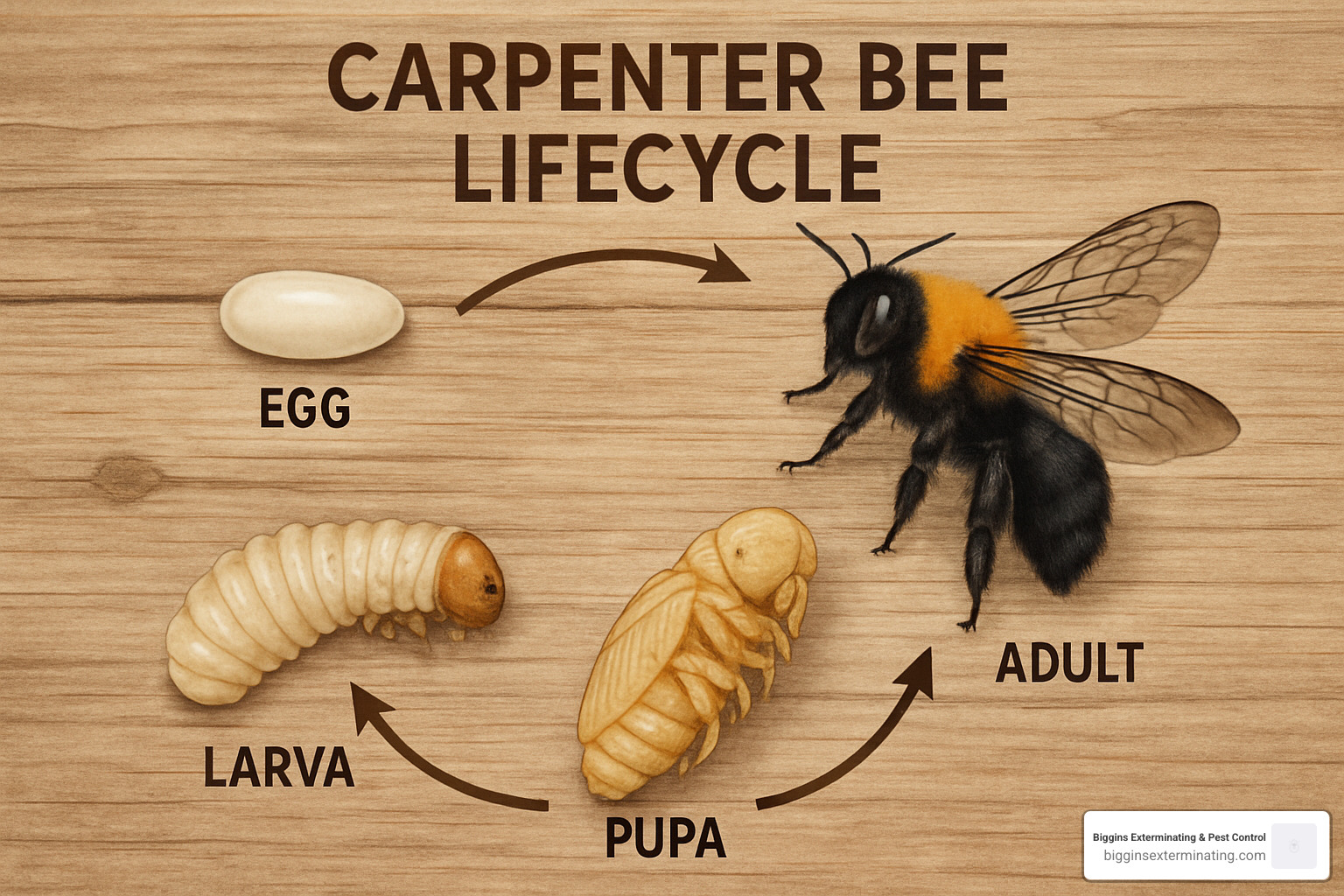
When spring temperatures consistently reach 70°F, adult bees emerge from hibernation ready for action. Females begin drilling their solitary nests in wood while males patrol the territory. Unlike honeybees or bumblebees, carpenter bees are loners at heart – they don’t form colonies, though they may create nests near each other.
Inside these wooden tunnels, females create separate cells, each provisioned with a mixture of pollen and nectar before laying a single egg. The eggs hatch into larvae that happily munch on these provisions before changing into pupae and eventually adult bees by late summer.
There’s typically only one generation per year, but – and this is crucial – their tunnels are often reused and expanded by subsequent generations. This is why what seems like a minor problem one year can become a structural nightmare the next.
“I’ve seen homes where the same spot has been targeted for years,” says Stephen Biggins. “What started as a single hole eventually became a complex network of tunnels that seriously compromised the wood’s integrity.”
The Damage They Cause
Carpenter bee damage is distinctive and progressive:
Those perfect round holes approximately ½ inch in diameter are the calling card of carpenter bees. They prefer the underside of wood where they’re protected from the elements. If you spot fresh, light-colored wood shavings (called frass) beneath these holes, you’ve got active residents drilling away.
While the entrance hole is perpendicular to the wood surface, tunnels quickly turn 90° to follow the grain. This is why the damage can be deceptive – what looks like a simple hole from the outside might actually be the entrance to tunnels extending 6-10 feet in length through continued expansion.
“What many homeowners don’t realize,” says Stephen Biggins, “is that carpenter bee damage often invites secondary problems. Woodpeckers are attracted to the larvae inside tunnels and will cause additional damage trying to extract them. Plus, the tunnels can allow moisture to penetrate, leading to rot and decay that compromises structural integrity.”
| Damage Type | Carpenter Bees | Termites | Woodpeckers |
|---|---|---|---|
| Appearance | Perfect round ½” holes | No visible external holes | Irregular, larger holes |
| Wood residue | Clean sawdust piles | Mud tubes, fecal pellets | Large wood chips |
| Sound | Drilling/buzzing in spring | Silent | Tapping/drumming |
| Location | Exposed wood, eaves, fascia | Often hidden, near soil | Often near bee/insect nests |
| Pattern | Individual holes, not clustered | Widespread damage in wood grain | Multiple holes in concentrated area |
In one particularly severe case we handled in Lexington, MA, a homeowner’s pergola had been infested for over five years. What started as a few holes had developed into an extensive gallery system that had compromised two main support beams. “The damage was so extensive,” recalls our technician, “that when we tapped on certain sections, we could hear the hollow tunnels throughout the wood. That pergola was essentially being held up by paint!”
Understanding carpenter bee biology is crucial to effective control. For more detailed scientific information, the University of Kentucky’s research on carpenter bee biology provides excellent insights into these fascinating but problematic insects.
Now that you know what you’re up against, let’s explore how to get rid of wood boring bees effectively and prevent them from returning.
How to Get Rid of Wood Boring Bees: Step-by-Step
Ready to reclaim your wooden structures from these persistent drillers? As someone who’s helped countless Massachusetts homeowners tackle carpenter bee problems, I’ve found that success comes from a well-timed, systematic approach. Let’s walk through exactly how to handle these wood-boring visitors.
1. Time Your Attack: Best Seasons to Act
Timing truly is everything when it comes to how to get rid of wood boring bees. There are two golden windows of opportunity:
Early spring is your first chance to strike. Here in Massachusetts, that’s typically March through April when temperatures start consistently hitting 70°F. This is when bees emerge from hibernation, still groggy and vulnerable. Taking action now prevents females from establishing new nests and laying eggs.
“We call early spring our ‘prevention window,'” explains our technician Mark. “Treat during this time, and you’ll break their reproductive cycle before it begins.”
Your second opportunity comes in late summer to early fall (August-September) when new adults are preparing their winter hideouts. During this period, bees are focused on finding shelter rather than defending territory, making your treatments more effective and safer to apply.
A client in Lexington told me, “For years I battled bees mid-summer with minimal success. When I switched to treating in early April as Biggins suggested, the difference was remarkable—barely saw any activity all season!”
2. Treat Active Tunnels—How to Get Rid of Wood Boring Bees with Insecticidal Dust
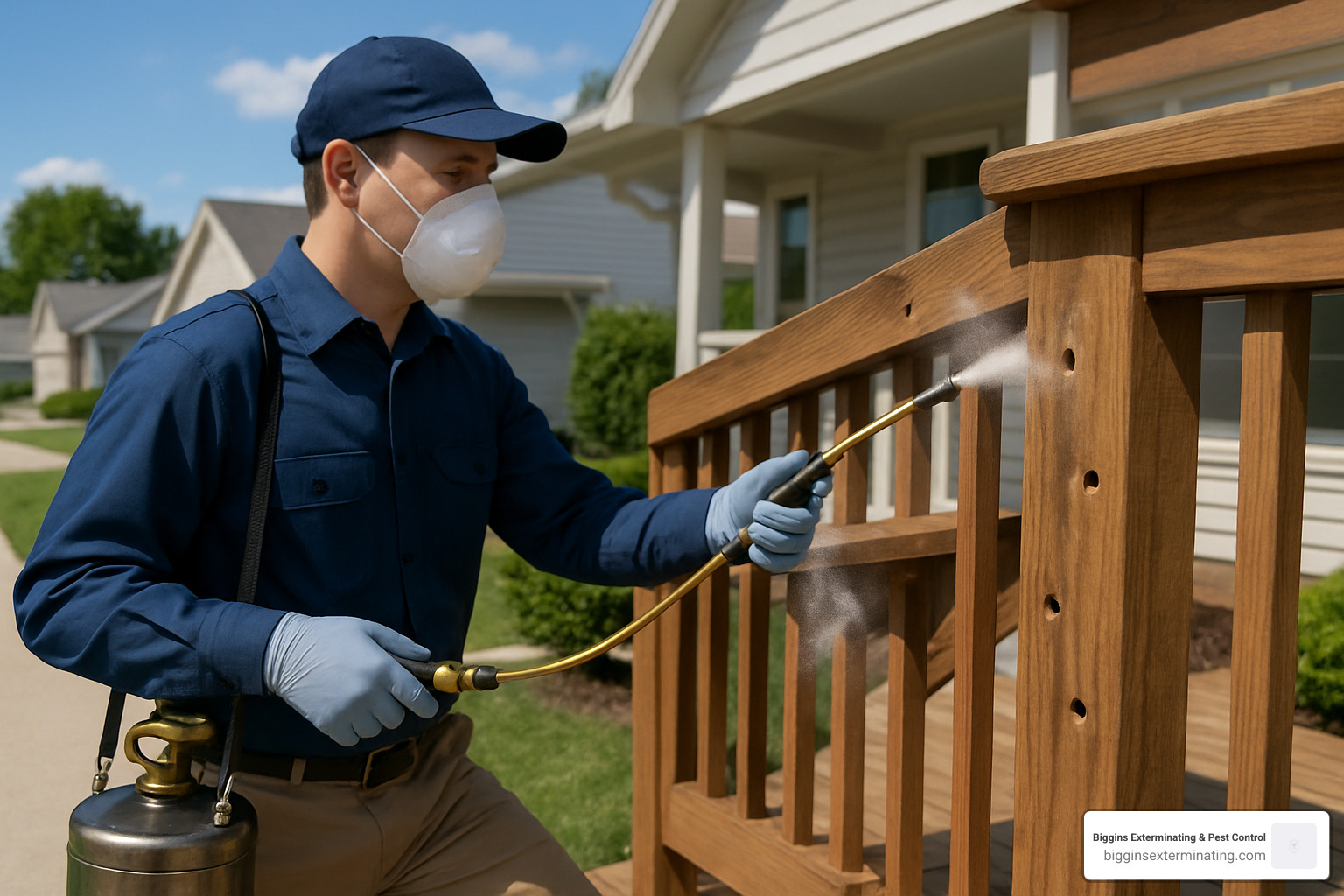
For active infestations, insecticidal dust is your most effective weapon. These specialized powders contain ingredients like borates or pyrethroids that penetrate deep into the galleries where sprays simply can’t reach.
The application technique matters tremendously. Using a hand duster with a narrow extension tube, gently puff a small amount of dust directly into each entrance hole during dusk when bees are inside their nests. The key is light application—you want bees to track through the dust and spread it throughout their tunnels.
Always gear up properly: wear chemical-resistant gloves, safety goggles, and a dust mask. Keep children and pets away from treated areas, and avoid windy days when dust might blow back toward you.
“I tried everything from wasp spray to home remedies,” shared a homeowner from Burlington. “Nothing worked until Biggins used their special duster to apply powder deep into the tunnels. Within a week, all bee activity stopped completely.”
After application, patience is crucial—allow 7-14 days for the treatment to work before moving to the sealing phase.
3. Go Natural: Citrus & Essential Oil Repellents
If you prefer eco-friendly solutions, natural repellents can be surprisingly effective against carpenter bees. The secret lies in certain scents these insects simply can’t stand.
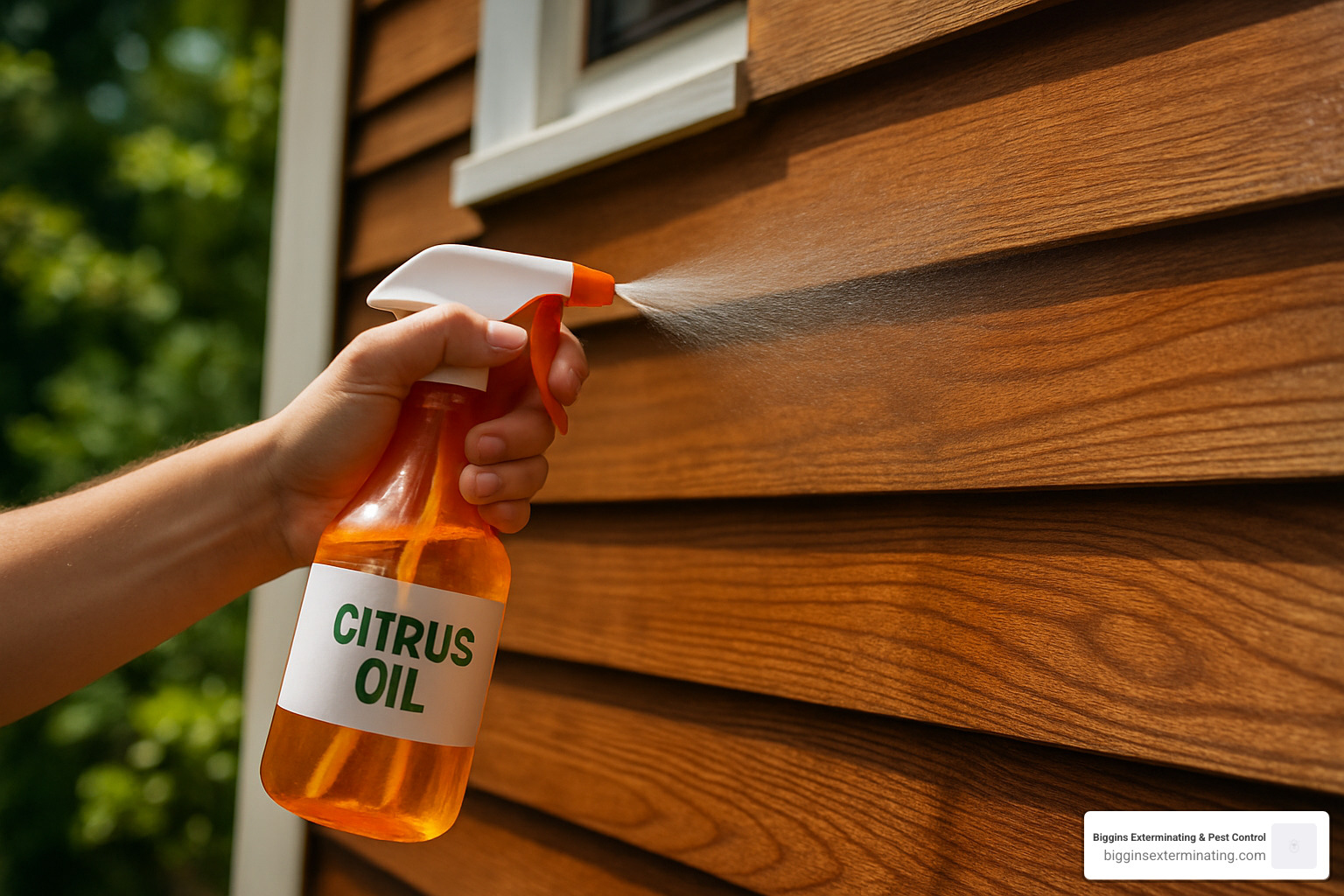
Citrus oil contains d-limonene, which both repels and can be lethal to carpenter bees. Mix one part citrus oil with two parts water in a spray bottle, then apply directly to wood surfaces and around entry holes. For best results, apply in the evening and refresh every few days, especially after rain.
Almond oil serves as another powerful natural deterrent. Simply swab pure almond oil directly onto wood surfaces, focusing on areas with previous damage. Weekly applications during peak season will help maintain protection.
“One of our clients in Reading was concerned about chemicals around her children and pets,” I recall. “We suggested a citrus oil treatment regimen. Though it required more frequent application than conventional methods, she was thrilled when the bees abandoned their tunnels within just three days.”
4. Trap and Relocate Instead of Exterminate
For those who appreciate carpenter bees’ pollination benefits but not their drilling habits, traps offer a humane solution.
Carpenter bee traps exploit the insects’ natural behavior. They enter through angled holes drilled in wood, follow the light into a clear container, and then can’t find their way back out. You can purchase ready-made traps or build your own using a 4×4 piece of untreated wood, a mason jar, and some basic tools.
Here’s a pro tip: place one or two dead bees in your trap. Their scent acts as a powerful attractant, significantly boosting your catch rate. Position traps in sunny spots near existing nests, about 15 feet apart for maximum coverage.
“I was honestly skeptical about these simple wooden contraptions,” admitted a customer from Tewksbury. “But after hanging three around my deck, I caught over 20 bees in just two weeks. It was fascinating watching them enter and then get confused trying to find their way out.”
5. Seal the Deal: Plug, Paint, and Protect
Once you’ve eliminated active bees, proper sealing prevents reinfestation. This critical step transforms your temporary solution into lasting protection.
Patience is essential—wait the full 7-14 days after treatment before sealing anything. Rushing this step is the most common mistake I see homeowners make. If you seal too early, surviving bees will simply drill new exit holes, potentially causing more damage.
Begin by inserting steel wool into deeper galleries to create a physical barrier. Follow with exterior-grade wood putty or silicone caulk to seal the entrance holes completely. Once dry, sand the area smooth and apply at least two coats of exterior paint or varnish.
For visible areas where aesthetics matter, consider color-matched wood plugs or marine-grade epoxy. These options provide both protection and visual appeal.
“After treating our pergola, Biggins showed us exactly how to seal properly,” shared a satisfied client in Andover. “They used steel wool backed with putty that perfectly matched our wood stain. Three years later, we haven’t seen a single new hole!”
By following these five steps, you’ll not only address your current carpenter bee problem but also prevent future infestations. Consistency and timing are your greatest allies in the battle against these persistent wood-boring bees.
Keep Them Out: Long-Term Prevention & Wood Repair
The best way to get rid of wood boring bees is to prevent them from choosing your property in the first place. After decades of tackling carpenter bee problems from Woburn to North Reading, I’ve learned that an ounce of prevention truly is worth a pound of cure.
Protective Finishes
Carpenter bees are surprisingly picky about their homes. They strongly prefer bare, weathered wood that’s easy to excavate:
“I can’t tell you how many times I’ve inspected a property and noticed the bees completely avoided painted surfaces while drilling dozens of holes in the untreated wood just inches away,” says Stephen Biggins. “It’s almost like they can sense which wood will be easier to tunnel into.”
For maximum protection, consider these options:
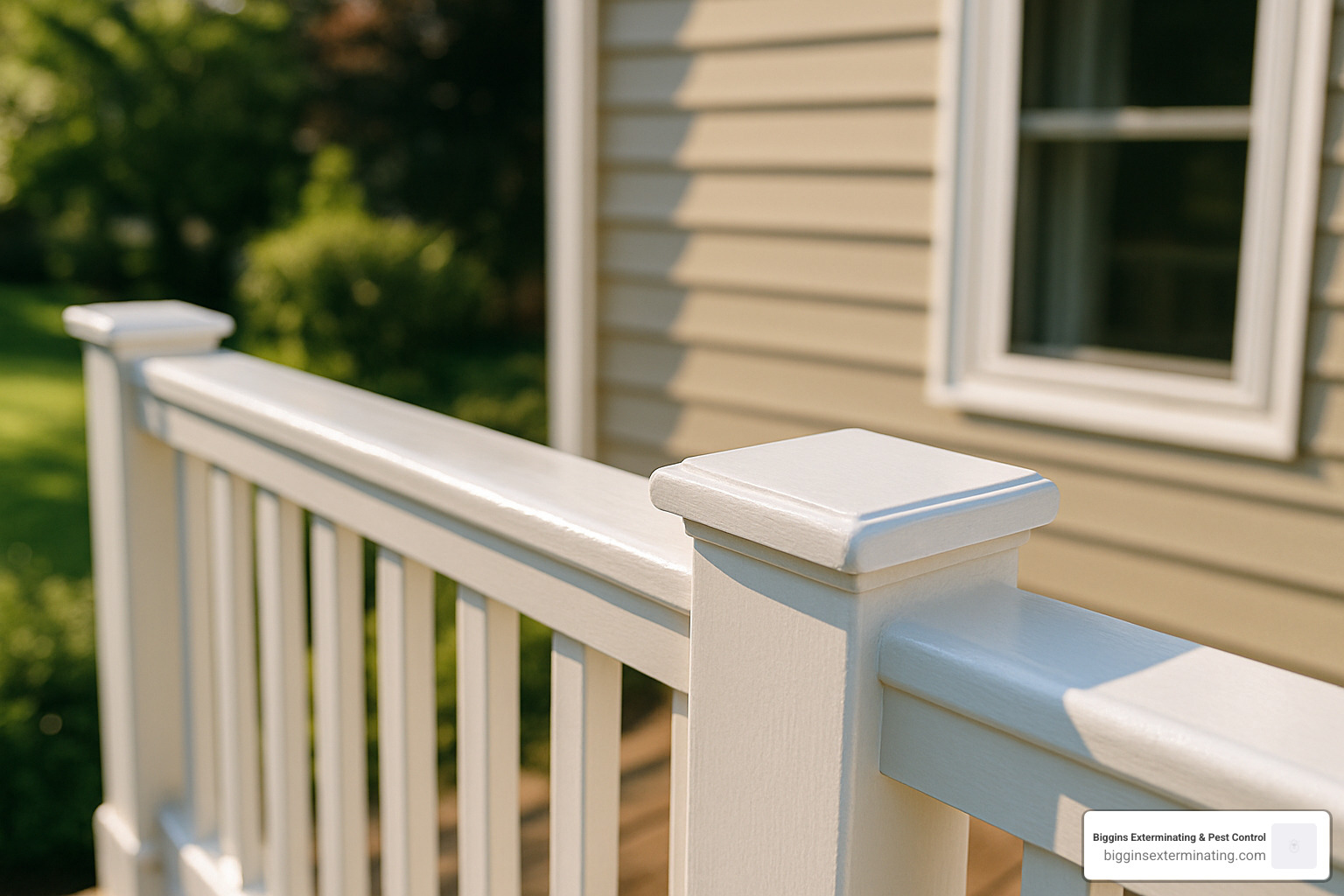
Paint provides the strongest defense against carpenter bees. Two coats of quality exterior paint create a barrier that bees rarely attempt to penetrate. In our experience, glossier finishes seem to deter them even more effectively than flat paints.
Varnish or polyurethane runs a close second to paint and preserves the natural beauty of your wood. A homeowner in Burlington told us, “I didn’t want to paint my cedar pergola, so your team recommended a marine-grade polyurethane. Three years later, and not a single bee hole!”
Stain offers moderate protection, particularly when topped with a clear sealant. While not as effective as paint alone, it’s certainly better than leaving wood untreated.
“South and west-facing wood that gets plenty of sun exposure seems to be particularly attractive to carpenter bees,” notes Stephen Biggins. “These areas should be your first priority when applying protective finishes.”
Strategic Wood Choices
When building new structures or replacing damaged wood, material selection makes a significant difference:
Hardwoods like oak and maple naturally resist carpenter bees better than softwoods like pine and cedar. The denser cell structure makes tunneling more difficult for the bees.
Composite materials have become a game-changer for deck and railing construction. “I replaced my wooden deck railings with composite after battling carpenter bees for years,” shared a customer from Reading. “It was like they disappeared overnight—they simply couldn’t drill into the material.”
Pressure-treated lumber offers some resistance, though determined bees can still penetrate it. It works best when also sealed or painted.
Physical Barriers
Some areas of your home may not be suitable for painting or might be persistently targeted despite treatment. For these trouble spots, physical barriers provide excellent protection:
Metal flashing installed on beam ends and exposed edges creates a surface bees simply cannot penetrate. This works particularly well for pergolas and gazebos where the end grain of beams is exposed.
Wire screening can be discreetly attached to protected areas of wooden structures. We’ve had great success applying fine mesh screening to the undersides of eaves and deck joists.
Aluminum or vinyl siding provides complete protection when installed over vulnerable wooden exteriors. “After we installed vinyl siding on a client’s garden shed in Wilmington, their carpenter bee problem completely vanished,” recalls our technician Mark.
Regular Maintenance
The key to long-term prevention is vigilance. We recommend developing a simple annual routine:
Each early spring, conduct a thorough inspection of all wooden structures on your property. Look for the telltale signs: perfect round holes, fresh sawdust, or buzzing activity.
Touch up any areas where protective finishes have worn away. Even small patches of exposed wood can become entry points for pioneering bees.
Address moisture damage immediately. Replace any wood showing signs of rot or decay, as softened wood is much easier for bees to excavate.
Treat new holes promptly before they can be expanded into extensive gallery systems. “Early intervention is critical,” emphasizes Stephen Biggins. “A single new hole in April can become a major infestation by August if left untreated.”
Case Study: The Lexington Log Home
One of our most challenging cases involved a beautiful log home in Lexington. The owner contacted us after finding dozens of carpenter bee holes throughout the exterior logs.
“When we arrived, the situation looked dire,” recalls Stephen Biggins. “The home had untreated logs with a clear finish that had deteriorated over the years. We counted over 60 active entrance holes.”
Our approach combined immediate treatment with long-term prevention:
1. We treated all active holes with insecticidal dust
2. After waiting 10 days, we sealed each hole with a combination of steel wool and wood-matched filler
3. We applied a borate solution to all wood surfaces as a preventive treatment
4. Finally, we worked with the homeowner to select and apply a high-quality exterior stain with added UV and water protection
“The change was remarkable,” says the homeowner. “Not only did the treatment eliminate the bees, but the new finish refreshed the appearance of our home. In the three years since, we’ve only found two new holes, which we promptly treated using the methods Biggins taught us.”
The Integrated Approach
Research from the University of California’s Integrated Pest Management Program supports our comprehensive approach. Their studies show that combining physical barriers, protective finishes, and targeted treatments provides far better results than any single method alone.
As noted in their research: “Carpenter bees prefer bare, weathered softwoods, so painting or varnishing wood can deter them. However, they occasionally attack stained or painted wood, so multiple prevention strategies are recommended.”
For homeowners dealing with particularly stubborn infestations, especially where bees are finding their way under siding, we offer specialized treatments. Learn more about our approach to Carpenter Bees Under Siding on our dedicated service page.
When it comes to carpenter bees, consistent prevention is much easier than dealing with an established colony. A little attention each spring can save you significant headaches—and repair costs—down the road.
Frequently Asked Questions about How to Get Rid of Wood Boring Bees
After four decades of helping Massachusetts homeowners tackle carpenter bee problems, we’ve heard just about every question imaginable. Here are the answers to what our customers ask most often:
Are carpenter bees dangerous to people or pets?
Despite their intimidating size and behavior, carpenter bees are surprisingly docile creatures.
“I always tell worried homeowners that male carpenter bees are all buzz and no sting,” says our technician Mark with a laugh. “They’ll zoom right at your face like tiny helicopters, but it’s just for show—males physically can’t sting you.”
Female carpenter bees do possess stingers, but they’re remarkably reluctant to use them. In my entire career, I’ve only been stung twice—both times when I accidentally trapped a female bee against my skin while reaching into a tunnel.
For perspective, you’re much more likely to be stung by a yellowjacket at your next barbecue than by a carpenter bee. That said, anyone with known bee allergies should still exercise caution and consider professional removal if bees are nesting near high-traffic areas of your home.
Do painted or pressure-treated boards stop carpenter bees?
The short answer is: it depends on the finish.
Paint is your best defense—two coats of quality exterior paint create a surface that carpenter bees rarely attempt to penetrate. I’ve inspected hundreds of homes where painted sections remained completely untouched while adjacent unpainted areas looked like Swiss cheese.
Stains offer moderate protection, especially when topped with a clear sealer coat. The protection level varies with the thickness and quality of the stain.
Pressure-treated lumber isn’t bee-proof despite what many hardware store employees might tell you. While fresh pressure-treated wood is less attractive to carpenter bees, it becomes increasingly vulnerable as it ages and weathers.
One Burlington homeowner learned this lesson the hard way: “I spent a fortune on pressure-treated lumber for my deck, thinking it would be bee-proof,” she told me. “Two years later, the railings were full of holes. Biggins explained that I should have painted or sealed it—lesson learned!”
When should I call a professional exterminator?
While many wood boring bee situations can be handled yourself, certain scenarios definitely call for professional help:
Call the pros when:
– Bees are nesting in hard-to-reach areas like high eaves or second-story structures
– You find multiple tunnels or signs of structural damage
– You’ve tried DIY methods but the bees return year after year
– Important structural beams are being targeted
– You have allergies to bee stings or aren’t comfortable working on ladders
“What many homeowners don’t realize,” explains Stephen Biggins, “is that visible entrance holes often represent just the tip of the iceberg. When our technicians inspect a property, they frequently find hidden damage that would have gone unnoticed until it became severe.”
A customer from Tewksbury shared: “I spent three summers trying to handle my carpenter bee problem with store-bought sprays. Nothing worked. When Biggins came out, their technician found twice as many holes as I knew about, including some in my main support beam that were causing serious structural concerns. Their treatment plan worked immediately, and they showed me exactly how to prevent future problems. I should have called them years earlier!”
At Biggins Exterminating, we bring more than just treatment to the table. We offer:
– Free, thorough inspections with detailed estimates
– Environmentally responsible treatment options
– Comprehensive prevention recommendations custom to your specific property
– Service warranties without requiring annual contracts
– Same-day emergency service when needed
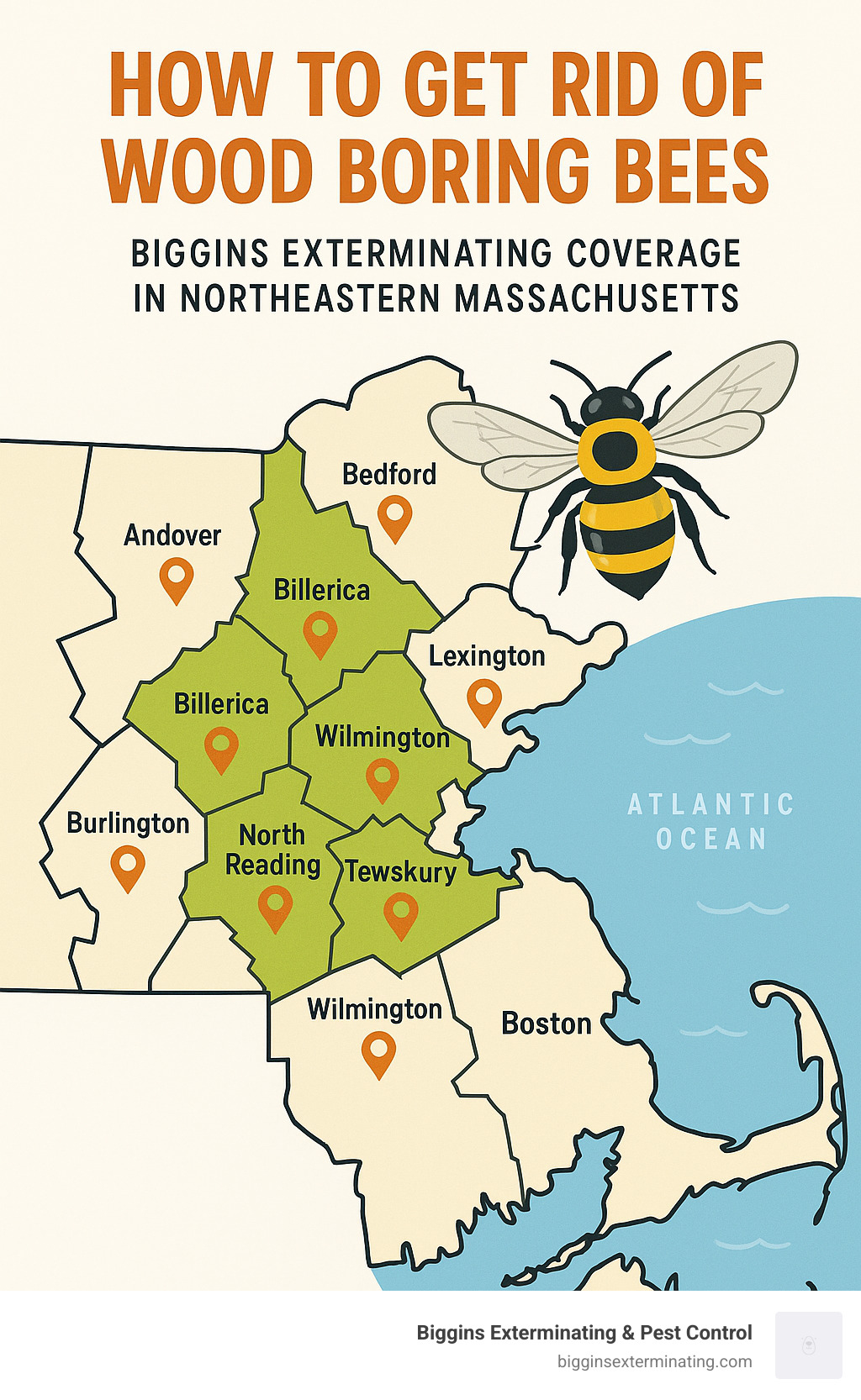
If you’re in Andover, Bedford, Billerica, Burlington, Lexington, North Reading, Tewksbury, Wilmington, or Woburn, our local technicians can typically be at your door within 24-48 hours to help you get rid of wood boring bees quickly and effectively.
Conclusion: Balancing Protection and Preservation
Successfully addressing a carpenter bee problem requires finding that sweet spot between protecting your property and respecting these important pollinators. While they can certainly drill their way through your deck or fascia boards, carpenter bees play a crucial role in our ecosystem—especially for early spring flowers and many vegetable crops.
Here at Biggins Exterminating & Pest Control, our family has spent over four decades developing methods that effectively protect Massachusetts homes while treading lightly on the environment. We’ve seen the unique challenges of getting rid of wood boring bees in our New England climate, with its distinct seasons and traditional wooden architecture.
“What gives me the most satisfaction,” reflects Stephen Biggins, “is teaching homeowners how to manage carpenter bees long-term. When a customer calls to say they haven’t seen a single new hole in years because they’ve followed our prevention advice, that’s when I know we’ve done our job right.”
The approach that works best combines timely intervention in early spring or late summer, using the least toxic effective treatment for your situation. Proper repairs are essential—those holes need to be sealed correctly to prevent the next generation from simply moving back in. And don’t underestimate the power of preventive measures like quality paint and regular monitoring each spring.
Persistence is your best friend when dealing with carpenter bees. These determined insects have been drilling into wood for millions of years (they’re quite good at it by now!), but with the right approach, you can protect your property while allowing these important pollinators to thrive elsewhere—preferably in someone else’s unpainted fence post down the street.
For our neighbors throughout northeastern Massachusetts—from Andover to Woburn and everywhere in between—Biggins Exterminating is always here to help with your carpenter bee challenges. We offer reliable service backed by our satisfaction guarantee, because our family business was built on one simple principle: we treat your home as carefully as we would our own.
The carpenter bees might be persistent, but I promise you—we’re even more persistent about protecting your home.
For more information about our carpenter bee services or to schedule an inspection, visit our carpenter bees control page or contact our office directly.
