Why House Ant Infestations Require Professional Attention
Spotting a trail of ants in your home can quickly turn from a minor annoyance into a major headache. Those tiny invaders aren’t just passing through—they’re setting up shop, and they’ve likely brought thousands of friends along. When facing an ant invasion, finding a reliable House Ant Exterminator often becomes the most effective path to reclaiming your home.
Quick Answer: Finding a Reliable House Ant Exterminator
* Check for licensed, experienced exterminators with positive reviews
* Expect to pay between $80-$500 for professional ant treatment (average $150)
* Look for companies offering species-specific treatments and guarantees
* Schedule an inspection to identify the ant species and locate nests
* Choose exterminators using child and pet-safe treatment methods
That line of ants marching across your kitchen counter isn’t just an unsightly inconvenience—it’s a warning sign of a potentially larger problem lurking within your walls. While DIY solutions might temporarily reduce the number of visible ants, they rarely address the root cause. Professional exterminators target the entire colony, including the queen who can lay up to 800 eggs daily. Without eliminating the source, you’re simply fighting an endless battle.
Many homeowners don’t realize that different ant species require completely different treatment approaches. Carpenter ants, for instance, tunnel through structural wood and may cause thousands of dollars in damage if left untreated. Pharaoh ants can spread harmful bacteria throughout your home, potentially contaminating food and surfaces. Professional House Ant Exterminators have the training to identify the specific species invading your home and implement targeted strategies designed for complete elimination.
I’m Stephen Biggins, owner of Biggins Exterminating Co., and over my 40+ years as a House Ant Exterminator serving Wilmington, MA and surrounding communities, I’ve helped thousands of frustrated homeowners eliminate persistent ant problems. Our approach combines thorough inspection with species-specific treatments that get to the heart of the infestation, not just the symptoms you can see.
When ants invade your home, they’re typically drawn in by food crumbs, standing water, or structural issues like wood rot. Seasonal swarms and sudden weather shifts can also trigger mass migrations indoors. If you’re spotting more than 50 ants daily, noticing damage to wood structures, or finding recurring trails despite your best cleaning efforts, it’s time to call in professional help.
The threshold for professional intervention isn’t just about numbers—it’s about risk. Certain species like carpenter ants can damage wiring and compromise structural integrity, potentially affecting your property value. Multiple rooms affected by ant activity or the findy of satellite nests are clear indicators that the problem has grown beyond DIY solutions.
While borax baits and vinegar sprays might offer temporary relief, their success rates pale in comparison to professional treatments. The time investment required for constant DIY applications often exceeds the cost of professional service, especially when you consider the peace of mind that comes with a service warranty.
For more information about tackling specific ant infestations, check out our resources on Local pest control services and Local ant exterminators.
Understanding Common House Ants and Early Infestation Signs
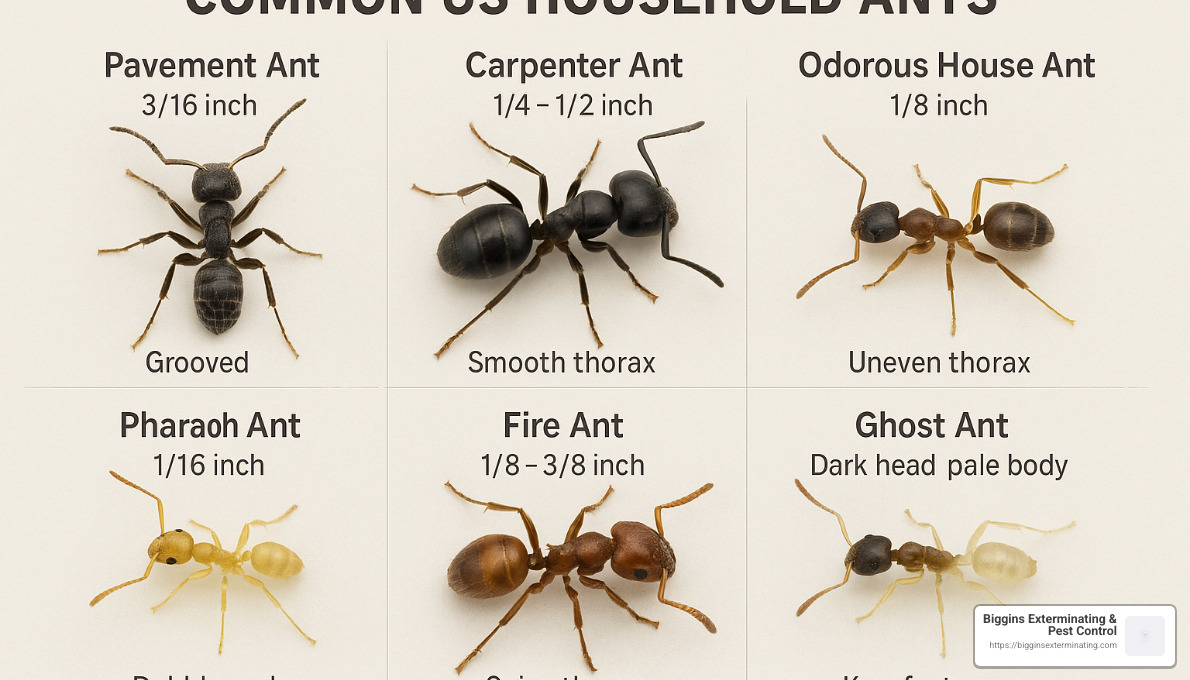
With over 15,000 species of ants worldwide, identifying the specific tiny invader marching through your home is crucial for effective treatment. Here in Massachusetts, we regularly encounter several common household ant species that each require different approaches to eliminate.
Pavement Ants
These small, dark brown to black ants (about 1/10 inch long) are common visitors in Massachusetts homes. They typically nest under sidewalks, driveways, and foundation slabs, creating little dirt mounds between pavement cracks that look like mini volcanoes. When they venture indoors, they’re usually searching for crumbs and sweet residues in your kitchen.
Carpenter Ants
These larger troublemakers (1/4 to 1/2 inch) deserve special attention as they excavate wood to build nests, potentially causing expensive structural damage. Unlike termites, they don’t eat the wood but discard it as sawdust-like material called “frass.”
“Carpenter ants are among the most efficient wood-destroying insects in North America,” our lead technician at Biggins Exterminating often tells worried homeowners. “We typically find them in homes with moisture issues, as they prefer damp wood for their carpentry projects.”
Odorous House Ants
You’ll recognize these small black ants (1/16 to 1/8 inch) by the rotten coconut smell they emit when crushed – hence their nickname “stink ants.” They’re particularly drawn to sweet foods and moisture sources in your home. What makes them challenging is their ability to establish massive colonies with multiple queens, sometimes hosting tens of thousands of workers.
Pharaoh Ants
These tiny yellowish invaders (1/16 inch) might seem harmless, but they’re particularly problematic in healthcare facilities as they can spread bacteria. They’re notorious for their complex colony structures with multiple queens and their clever ability to “bud” new colonies when disturbed by pesticides – meaning improper treatment can actually make the problem worse!
Fire Ants
Though less common in Massachusetts, these reddish-brown troublemakers deliver painful stings that can cause white pustules within 24 hours. Their distinctive mounds can reach 7 inches high and 24 inches wide, becoming especially visible after rain. If you spot these, it’s definitely time to call a House Ant Exterminator.
Ghost Ants
Nearly transparent with dark heads, these tiny specters are difficult to spot as they glide across your countertops. They commonly nest in mulch, rocks, and tree bark outdoors, and in potted plants or cabinets indoors. Their nearly invisible appearance makes them particularly frustrating to track.
Visual & Audible Red Flags
Early detection of ant infestations can save you significant trouble and expense. I’ve helped thousands of homeowners who wished they’d recognized these warning signs sooner:
Night rustling might be more than just your house settling. Carpenter ants are most active between 10 PM and 2 AM, and that faint rustling sound in your walls could indicate a carpenter ant nest busy at work while you’re trying to sleep.
Finding small piles of sawdust-like material (frass) near baseboards, window sills, or door frames isn’t just ordinary dust – it’s a telltale sign of carpenter ants excavating your home’s wood structures.
Noticing ants emerging from electrical outlets and light switches is particularly concerning. This usually indicates a nest within your walls, and in some cases, ants can cause electrical shorts and become a fire hazard.
The presence of winged ants (swarmers) indoors usually indicates a mature colony nearby. Don’t confuse them with termites—ant swarmers have a distinct pinched waist and uneven wing lengths. Their appearance often means the colony is well-established and reproducing.
DIY Inspection Checklist
Before calling a professional House Ant Exterminator, you can conduct a preliminary inspection to gather helpful information:
Grab a flashlight and conduct a nighttime search, focusing on kitchen areas, bathrooms, and around your foundation. Ants are often more active at night, making them easier to spot.
If available, use a moisture meter to check for damp wood, which attracts carpenter ants like a magnet. Areas with readings above 15% moisture content are prime real estate for these destructive pests.
Try following the foragers back to their source. Ants leave invisible chemical trails for others to follow, so tracking foraging ants can help identify possible nest locations and entry points into your home.
Always check common hotspots where ants typically gather: around sinks, dishwashers, washing machines, windows, doors, and areas with water damage or high humidity. These moisture-rich environments are ant magnets.
For more detailed information on specific ant species and how to deal with them, visit our comprehensive resource pages:
– House Ants Pest Control
– Carpenter Ant Pest Control
– Sugar Ant Pest Control
Knowing what you’re dealing with is half the battle. The other half is implementing an effective, species-specific treatment plan – something our House Ant Exterminator team has been perfecting for over 40 years in Wilmington and surrounding Massachusetts communities.
Why Do Ants Invade and When to Call a House Ant Exterminator
Ants are fascinating creatures with simple needs that unfortunately align perfectly with what our homes provide. Understanding their motivation helps explain why they’re such persistent houseguests.
Most ant invasions revolve around three basic necessities:
Food sources are the primary attraction for most household ants. Even microscopic crumbs from your morning toast or that splash of juice that missed the glass can create an ant buffet. Sweet foods particularly drive ants wild – that’s why you’ll often spot them around sugar containers or fruit bowls.
Water access is equally important to ant colonies. That dripping bathroom faucet, condensation under your refrigerator, or even the water dish for your pet provides essential moisture ants need to survive.
Shelter opportunities complete the trifecta. Your warm, protected home becomes especially appealing when outdoor conditions aren’t ideal. Wall voids, spaces behind baseboards, and areas around pipes offer perfect nesting spots.
“In my 40 years as an exterminator, I’ve found countless ant colonies in the most surprising places,” says Stephen Biggins, owner of Biggins Exterminating. “They’re incredibly adaptable – I once found a thriving colony inside a rarely-used toaster!”
Weather and seasonal patterns significantly impact ant behavior too. Here in Massachusetts, we typically see two major invasion periods: spring, when colonies expand after winter dormancy, and fall, when cooling temperatures drive ants to seek warmer quarters. Heavy rainstorms can also trigger sudden indoor migrations as ants flee their flooded underground homes.
Entry points are surprisingly easy for these tiny invaders to find. Microscopic cracks around windows, tiny gaps where utility lines enter your home, and even spaces under doors provide superhighways for ant exploration teams.
Top Signs You Need a Professional House Ant Exterminator
While a few scout ants don’t necessarily signal disaster, certain situations clearly indicate it’s time to call in professional help:
Recurring trails despite your best efforts suggest you’re dealing with the symptoms rather than the source. If you’ve faithfully applied store-bought treatments but keep finding new ant highways a few days later, the colony remains untouched.
Multiple rooms affected usually indicates established colonies with potential satellite nests throughout your home. When ants appear in both your upstairs bathroom and downstairs kitchen, you’re likely dealing with a significant infestation.
Visible wood damage is particularly concerning, especially with carpenter ants. Those small piles of sawdust-like material (frass) near wooden structures aren’t just messy – they’re evidence of potentially serious structural compromise.
More than 50 ants observed daily crosses the threshold from occasional visitors to established residents. Large numbers indicate a thriving colony nearby that requires professional intervention.
Ants in electrical outlets or appliances create genuine safety hazards. Ants can cause electrical shorts and even fires when they nest in switch boxes, outlets, or appliance control panels.
“When a homeowner calls us about sawdust trails from carpenter ants near window frames, we consider it an emergency,” explains our senior technician. “What’s visible is often just a fraction of the damage happening inside the walls.”
DIY vs. Hiring a House Ant Exterminator
Many homeowners understandably try handling ant problems themselves before calling professionals. Common DIY approaches include borax-sugar baits (which can work for some species), vinegar sprays to disrupt scent trails, and commercial ant traps containing insecticides designed to be carried back to colonies.
While these methods occasionally provide temporary relief, they rarely address the fundamental problem. Here’s why professional solutions typically deliver better results:
| DIY Methods | Professional Extermination |
|---|---|
| Targets visible ants | Targets entire colony including queens |
| Temporary results | Long-lasting elimination |
| Limited knowledge of ant biology | Species-specific targeted treatments |
| No warranty | Service guarantees (at Biggins, we offer warranties) |
| Trial and error approach | Systematic, proven methodology |
| Risk of product misuse | Safe, professional application |
The success rates speak for themselves. While DIY treatments might reduce visible ants temporarily, professional treatments typically eliminate 90-98% of colonies by targeting the reproductive members. The time investment differs dramatically too – professionals can often solve in one visit what homeowners struggle with for months.
“We had a customer who spent nearly $200 on various store products over three months before calling us,” recalls Stephen Biggins. “We solved her carpenter ant problem in a single visit for less than she’d already spent, and with our warranty protection.”
For more information on scientific research regarding ant foraging behaviors and why professional approaches work better, you can read this comprehensive guide on ant exterminator costs.
When considering the value of professional treatment, House Ant Exterminators bring not just products but expertise in ant biology, behavior patterns, and effective elimination strategies – knowledge that makes all the difference between temporary suppression and lasting resolution.
Professional Diagnosis & Treatment Methods
When you hire a professional House Ant Exterminator like Biggins Exterminating, you’re getting much more than someone with a spray can. We bring decades of experience, specialized tools, and targeted solutions to your ant problem.
Comprehensive Inspection
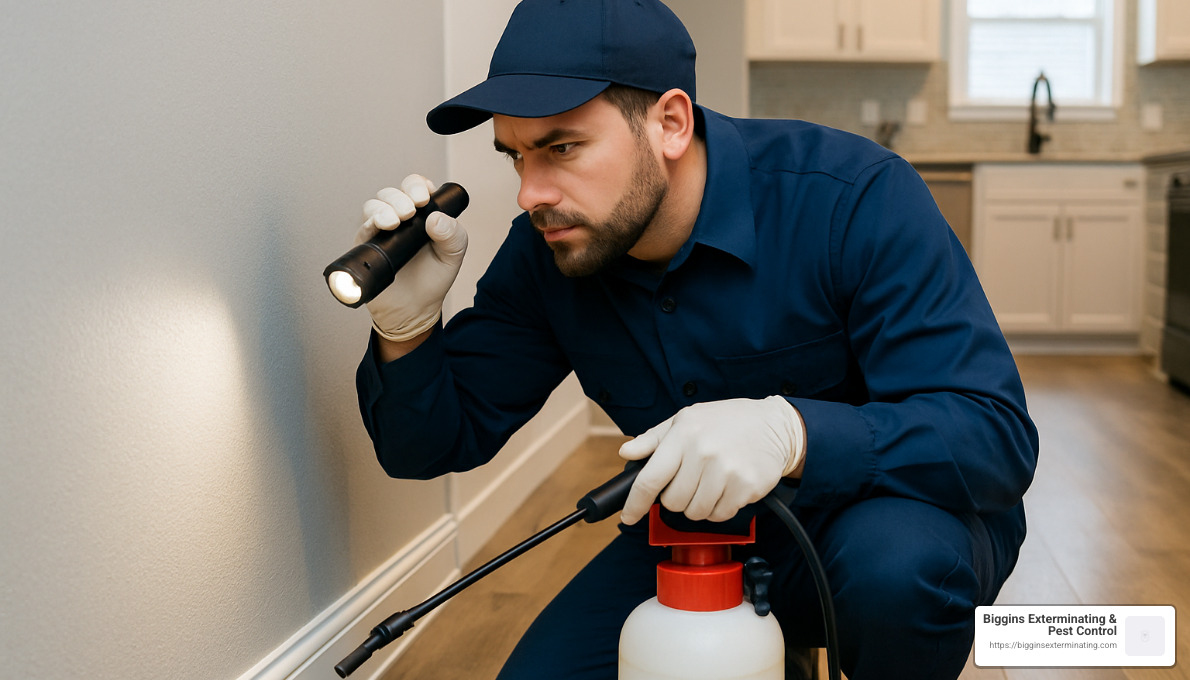
Our technicians arrive equipped with professional-grade tools that help us find what the naked eye might miss:
“Last week, we used our infrared camera to find a massive carpenter ant colony hiding inside a living room wall,” shares one of our technicians. “The homeowner had only seen a few ants crossing their floor, never suspecting the size of the colony behind their drywall.”
We use moisture meters to pinpoint damp areas that attract ants, infrared cameras to detect hidden activity, and our trained eyes to identify specific ant species by their appearance and behavior. This detailed inspection is crucial for developing an effective treatment plan.
Locating the Main & Satellite Nests
Finding and treating the primary colony is the key to successful ant control. Ants are masters at hiding their homes in places you’d never think to look:
Wall voids become perfect ant apartments, hidden from view but allowing easy access to your kitchen. Attic insulation provides cozy nesting material for many species, while beneath concrete slabs offers pavement ants protection from predators and weather. Structural wood, especially when damp, becomes carpenter ant heaven, and many indoor problems actually originate from outdoor parent colonies that send workers inside to forage.
“We once found five separate ant nests between layers of old roofing during a home inspection,” our senior technician recalls. “The homeowner had been battling ants for months without realizing they were living right above their heads.”
Treatment Options Explained
At Biggins Exterminating, we use a multi-faceted approach custom to your specific ant problem:
Non-repellent sprays work like invisible assassins. Unlike store-bought repellents that just scatter ants around, our professional-grade products are undetectable. Ants walk through treated areas, pick up the product, and unknowingly carry it back to their colony, creating a domino effect that reaches the queen and her brood.
Gel baits exploit ants’ social feeding habits. Worker ants find these tasty (but lethal) treats and share them throughout the colony through a process called trophallaxis—essentially, ant food-sharing. We select different bait formulations based on the species in your home, as some prefer sweets while others go for proteins.
Granular baits work wonders around your home’s perimeter and near outdoor trails. They’re particularly effective against fire ants and other outdoor nesters that might be planning an indoor invasion.
Insecticidal dusts provide lasting protection in hard-to-reach spaces. We apply these into wall voids, cracks, and crevices where ants travel and nest, creating barriers that continue working for months.
Perimeter sealing completes our treatment by identifying and closing ant entry points, preventing future invasions before they start.
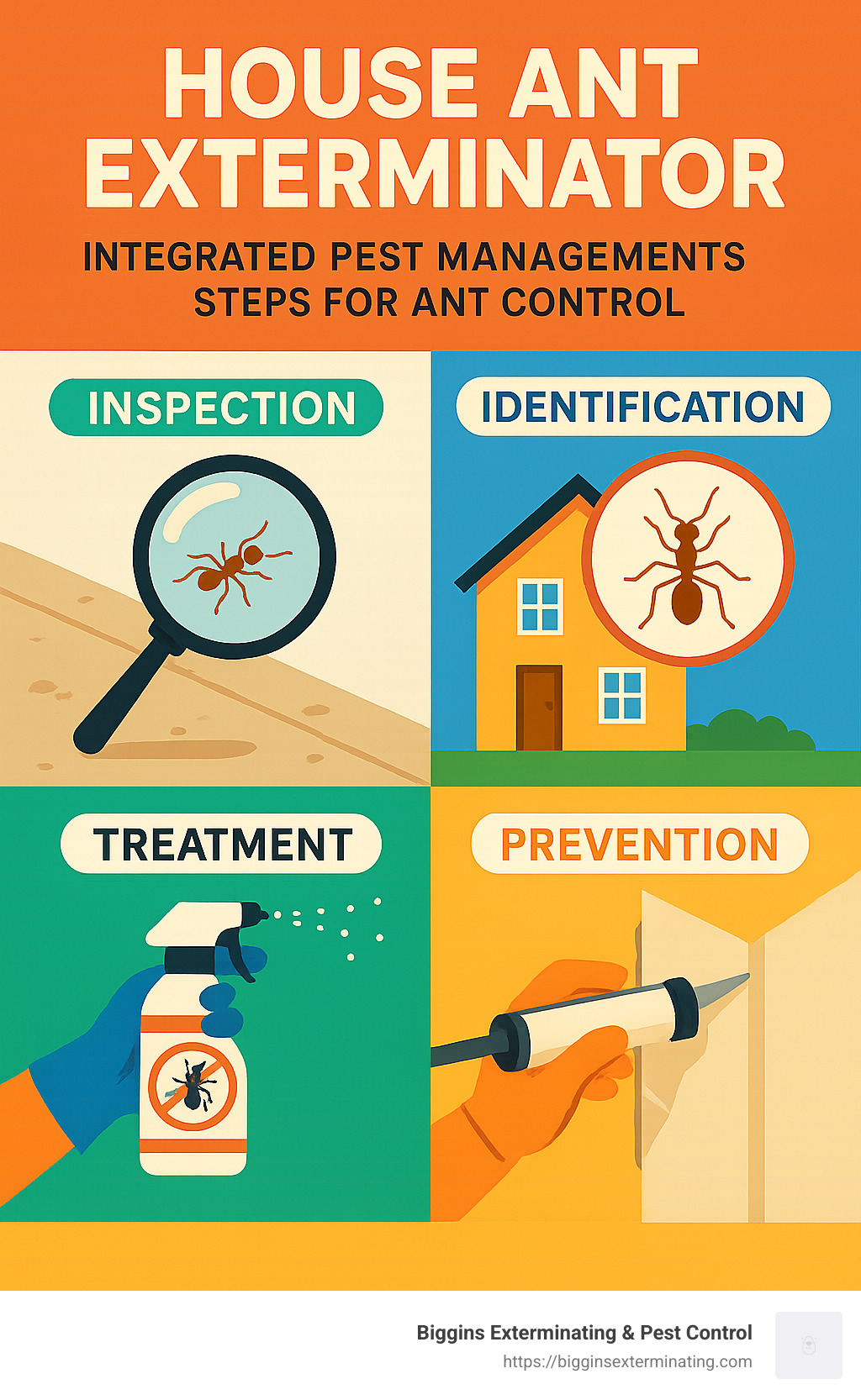
We follow Integrated Pest Management (IPM) principles, focusing on long-term prevention through a combination of techniques with minimal environmental impact. This isn’t just about killing visible ants—it’s about creating a comprehensive solution that addresses current problems while preventing future ones.
For more detailed information about our approach, visit our Ant Control Exterminators page.
Treatment Timeline and Safety Considerations
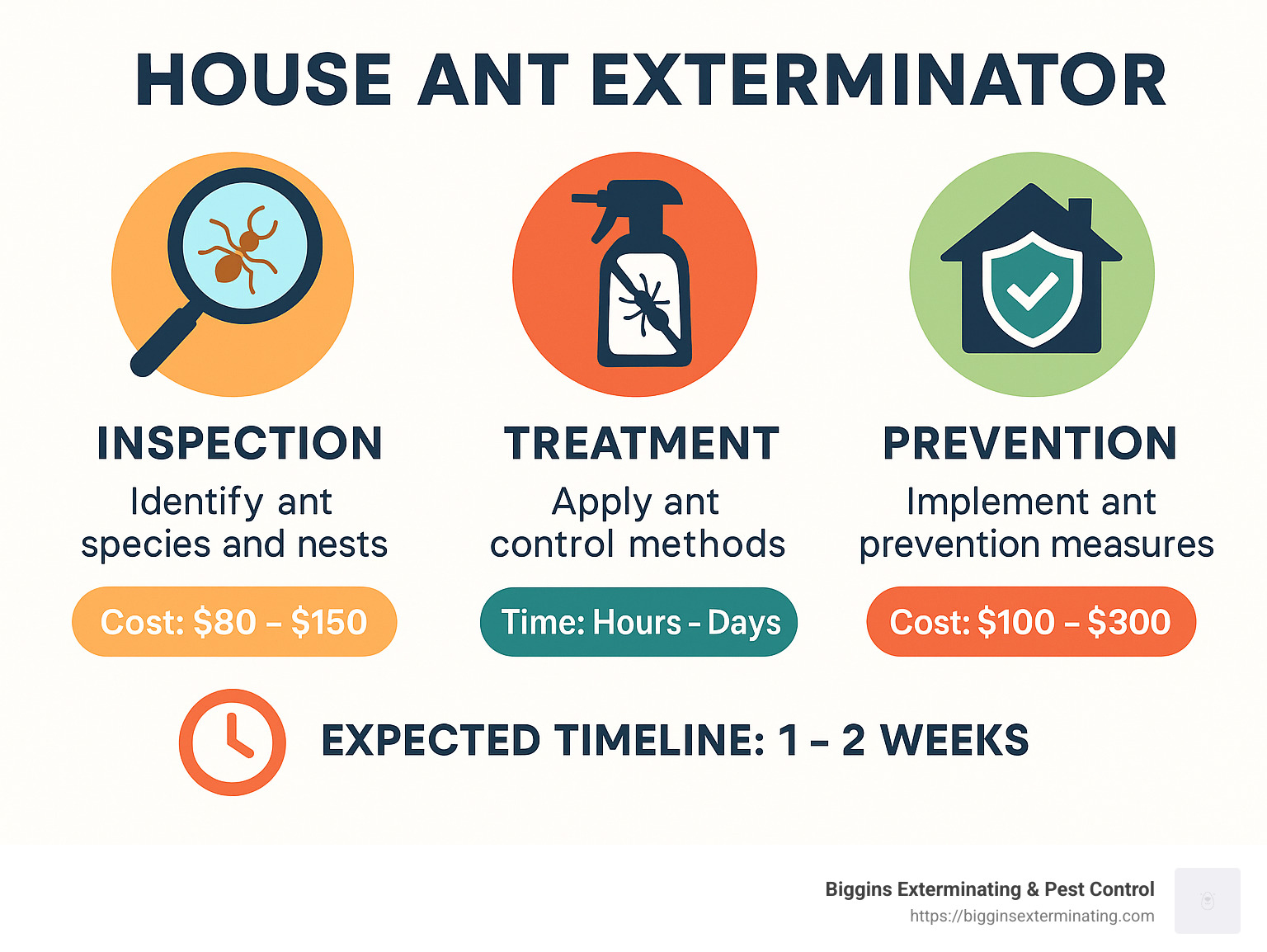
Most homeowners are eager to know: “How quickly will I see results?” You’ll typically notice a significant reduction in ant activity within 48 hours of our treatment. However, complete elimination may take 2-4 weeks depending on colony size and ant species. Some stubborn infestations require follow-up treatments to ensure every last ant is gone.
At Biggins Exterminating, your family’s safety is our top priority. We carefully select products that are effective against insects but safe for humans and pets when properly applied. After treatment, we’ll provide clear guidance on:
When it’s safe to re-enter treated areas (usually just a few hours), how long to wait before cleaning treated surfaces, special precautions for homes with children, pets, or pregnant women, and proper ventilation guidelines to follow after treatment.
“I always tell my customers—we’re not just treating your home, we’re caring for your family,” says one of our veteran technicians. “That’s why we take the time to explain everything and answer all your questions before, during, and after treatment.”
Average Cost & Pricing Factors for Ant Extermination
Let’s talk about what you might expect to pay when calling in the professionals for your ant problem. I know budget concerns are often top of mind when considering pest control services.
Based on national data (not Biggins Exterminating’s specific pricing), most homeowners typically spend between $80 and $500 for professional ant treatment, with the national average hovering around $150 for a standard one-time service call. However, costs can vary significantly depending on several factors.
Carpenter ant infestations tend to be more expensive to treat because of their wood-destroying nature and the potential structural damage they cause. While the average carpenter ant treatment runs about $350, costs can range from $250 up to $1,500 for severe infestations requiring extensive treatment and multiple follow-ups.
“The most expensive ant treatments we see are always the ones that homeowners delayed calling about,” notes our senior technician. “What might have been a $200 treatment can balloon to $1,000+ when carpenter ants have had months to establish satellite colonies throughout a home.”
Fire ant treatments typically fall somewhere in the middle, averaging around $200 but potentially ranging from $100 to $900 depending on the size of the property and extent of the infestation.
For the most current information on industry pricing trends, you can check this resource on extermination costs.
Factors Affecting Ant Extermination Costs
When you receive a quote from a House Ant Exterminator, several key elements influence the final price:
Home Size makes a significant difference in treatment costs. Most professionals charge by square footage, with rates typically ranging from $0.70 to $1.70 per square foot. This means a 2,000 sq ft home might cost around $160 for treatment, while a 3,500-5,000 sq ft home could run closer to $200.
Infestation Severity directly impacts treatment complexity. A small, localized ant problem might require just targeted baiting, while multiple established colonies throughout your home demand comprehensive treatment of both interior and exterior spaces.
Geographic Location affects pricing too. In the Northeast like our service area around Wilmington, MA, you might pay slightly more than the national average due to our specific ant species challenges and seasonal patterns.
Accessibility Issues can add to costs—if nests are located in hard-to-reach areas like deep wall voids, crawl spaces, or high in attic spaces, more labor and specialized equipment may be needed.
Treatment Type varies by situation. Non-toxic or eco-friendly options sometimes cost a bit more than standard treatments but provide peace of mind for families with young children, pets, or environmental concerns.
One-Time vs Ongoing Service Plans
When considering ant control, you’ll typically have a few service options to choose from:
A One-Time Treatment works well for addressing a sudden, isolated ant invasion. You’ll pay a single fee (typically $80-$500) for inspection and treatment. While this approach costs less upfront, it may not prevent future problems since new ant colonies can establish themselves after treatment.
Quarterly Service Plans provide year-round protection with regular preventive treatments, usually costing between $400-$480 annually when paid in full, or broken into quarterly payments. The real value comes from catching potential problems early and having the peace of mind that if ants return between scheduled visits, additional treatments are typically included at no extra charge.
Annual Prevention Programs offer a middle-ground approach with seasonal inspections and preventive treatments, perfect for maintaining an ant-free home after successful initial treatment.
At Biggins Exterminating, we believe in flexibility—that’s why we don’t lock customers into long-term contracts. We’d rather earn your continued business through excellent service than binding paperwork.
Hidden Costs to Watch
When budgeting for ant control, be aware of potential additional expenses that might not be included in the initial quote:
Prep work might be necessary before treatment, such as clearing areas for access or moving furniture. Some companies charge extra for this, while others (like Biggins) consider it part of the service.
Structural repairs following carpenter ant damage can add significant costs. While pest control companies treat the ants, separate carpentry work is usually needed to repair damaged wood.
Moisture remediation is often necessary since many ant species are attracted to damp conditions. Fixing leaky pipes, improving drainage, or addressing condensation issues might be recommended but typically aren’t included in pest control pricing.
Emergency service fees might apply for after-hours or weekend calls, sometimes adding $50-$200 to standard rates.
“Always ask what’s included in your quote,” recommends our customer service team. “At Biggins, we pride ourselves on transparent pricing with no surprises, but not all companies operate this way.”
While the initial cost of professional ant control might seem higher than DIY options, effective professional treatment often saves money in the long run by preventing property damage and eliminating the need for repeated treatments.
Preventing Future Ant Problems After Treatment
Once you’ve tackled your ant problem with professional help, the last thing you want is a repeat performance. Keeping ants away for good requires a partnership between you and your House Ant Exterminator, with both sides playing important roles in maintaining an ant-free home.
Homeowner Prevention Strategies
The battle against ants begins in your kitchen, where most ant problems start. Store all food in airtight containers, especially sweet items that ants find irresistible. That open box of cereal or bag of sugar might as well be a neon “Eat Here” sign for ants!
“I tell my customers that the five minutes it takes to wipe down counters and sweep floors each evening can save them hundreds of dollars in pest control costs,” says Stephen Biggins, our founder. “Ants are incredibly persistent foragers – they can detect even tiny food residues we can’t see.”
Moisture is another ant magnet that many homeowners overlook. Fix leaky pipes promptly, as even slow drips create the damp environment many ant species love. In Massachusetts, our humid summers can create perfect conditions for ants, so consider using dehumidifiers in basements and crawl spaces during warmer months.
Your home’s exterior needs attention too. Create a 6-inch vegetation-free zone around your foundation to eliminate hiding spots for ants. Think of it as a moat around your castle! Trim back any tree branches or shrubs touching your house – these serve as convenient bridges for ants to access your home.
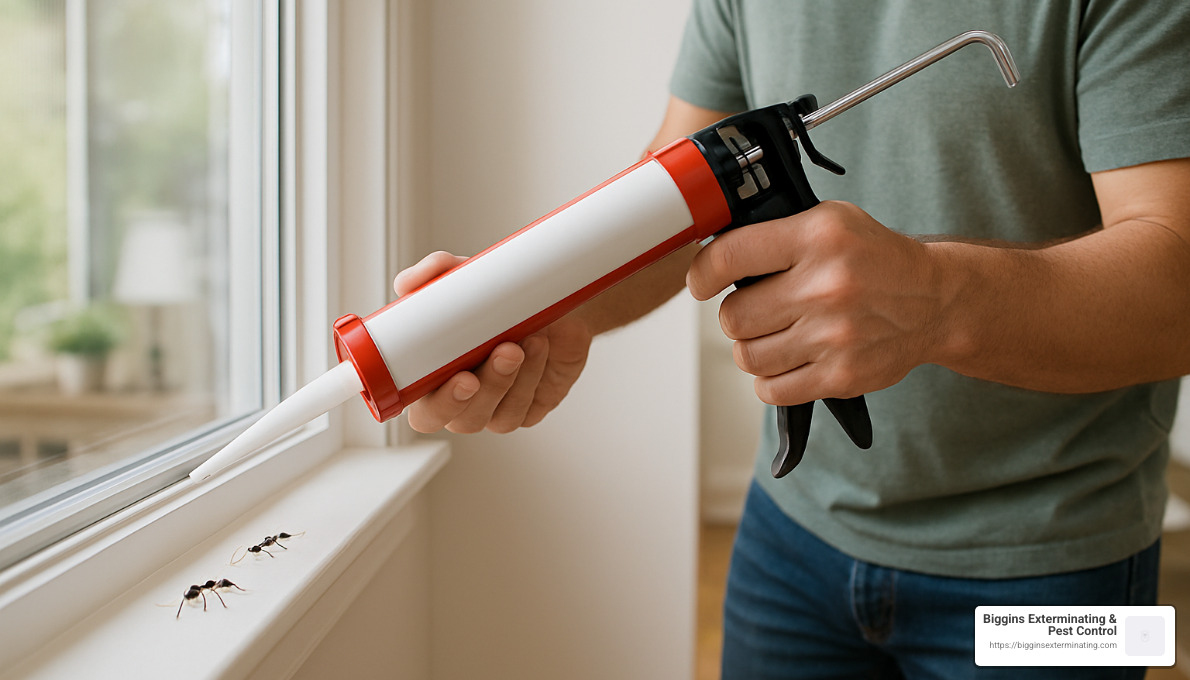
Sealing entry points is perhaps your most powerful prevention tool. Spend a weekend caulking cracks around windows, doors, and foundations. Pay special attention to areas where utility lines enter your home – ants can squeeze through gaps as small as 1/16 of an inch!
“Most recurring ant problems we see result from moisture issues that weren’t addressed,” explains our senior technician. “Fixing that leaky bathroom pipe often does more to prevent ants than any amount of spraying.”
For more detailed prevention strategies, check out our Exterminating Ants resource page.
How Pros Ensure Ants Don’t Return
At Biggins Exterminating, we believe in sustainable, long-term ant control that goes beyond just spraying and hoping for the best. Our professionals use several proven strategies to keep your home ant-free:
We often install monitoring stations at strategic locations around your property. These small, unobtrusive devices help us detect new ant activity before you’re facing another full-blown invasion. Think of them as early warning systems that let us respond quickly if ants start showing interest in your home again.
Our residual barrier treatments create an invisible defensive perimeter around your home. Unlike store-bought sprays that may last days or weeks, our professional-grade products continue protecting your home for months. We carefully apply these treatments where they’ll be most effective while remaining safe for your family and pets.
Regular scheduled inspections are perhaps our most valuable service. During these visits, our technicians check known problem areas and look for new signs of ant activity or conditions that might attract them. We can spot subtle warning signs that most homeowners would miss, allowing us to address small issues before they become big problems.
We also consider the seasonal patterns of ant behavior in Massachusetts when planning targeted maintenance treatments. For example, we know that ants become particularly active in early spring as they expand their colonies, so we time preventive treatments accordingly.
Eco-Friendly & Family-Safe Prevention Tips
If you prefer a more natural approach to ant prevention, we respect that choice and have several effective recommendations:
Diatomaceous earth (food-grade) can be a powerful ally against ants. This naturally occurring powder feels like harmless dust to us but is actually microscopically sharp to insects, damaging their exoskeletons and causing them to dehydrate. Sprinkle it lightly along baseboards and entry points for a non-toxic barrier.
Many homeowners find success with essential oils like peppermint, tea tree, and citrus. Ants dislike these strong scents, which also disrupt their pheromone trails. Mix 10-20 drops with water in a spray bottle and apply to entry points and pathways where you’ve seen ants.
Your garden can help too! Plant ant-repelling herbs like mint, tansy, or pennyroyal around your foundation. Not only do they help deter ants, but they also provide fresh herbs for your kitchen – a win-win solution!
While these natural methods can be effective for prevention and minor problems, they typically aren’t powerful enough to eliminate established colonies. For serious infestations, even our most eco-conscious customers usually need professional intervention.
At Biggins Exterminating, we’re always happy to discuss both conventional and more natural approaches to keeping your home ant-free. After all, we’ve been helping Wilmington families solve pest problems for over 40 years – we understand that every home and every homeowner is unique.
Eco-Friendly & Family-Safe Treatment Options
If you’re like most homeowners I talk with, you probably worry about what chemicals are being used around your family and pets during ant treatments. The good news? Modern pest management has come a long way from the harsh chemicals of yesteryear.
At Biggins Exterminating, we understand your concerns. After all, we go home to our own families and pets each night too!
Professional Eco-Friendly Approaches
Today’s House Ant Exterminator has access to many safer alternatives that still get the job done effectively:
Botanical Insecticides harness the natural power of plants like rosemary, thyme, and clove. These natural oils pack a punch against ants but break down quickly in the environment, leaving no harmful residues behind. They’re perfect for homes where environmental sensitivities are a concern.
Borate-Based Products work by interfering with ants’ metabolic processes. When properly applied, these treatments pose minimal risk to humans and pets while delivering excellent results against persistent ant colonies. They’re particularly effective in bait formulations that worker ants carry back to the nest.
Insect Growth Regulators (IGRs) are like birth control for ant colonies. Rather than killing ants outright, they prevent immature ants from developing properly and stop reproduction. This gentle approach slowly reduces colony size without flooding your home with traditional pesticides.
The application method matters just as much as what’s being applied. Our technicians use targeted application techniques that place products precisely where ants travel rather than broadcasting chemicals across your entire home. This precision approach means we can use less product while achieving better results.

“I’m a father of three with two dogs at home,” shares our lead technician. “I wouldn’t use anything in a customer’s home that I wouldn’t feel comfortable using around my own family. That’s our standard at Biggins.”
Reading Labels & Asking the Right Questions
When your House Ant Exterminator arrives, don’t be shy about asking questions! A professional should welcome your curiosity and concerns. Here are some smart questions to ask:
“Is this product EPA-registered for indoor use?” This registration means the product has been evaluated for indoor safety when used as directed.
“How long should we stay out of treated areas?” Different products have different safety intervals before re-entry is recommended.
“Are there special precautions for my toddler/pregnant wife/elderly parent?” Vulnerable family members sometimes need additional considerations.
“What’s the environmental impact of this treatment?” A good exterminator should be able to explain how the treatments affect local ecosystems.
Understanding product labels gives you power as a consumer. Products labeled with “Caution” have lower toxicity than those marked “Warning” or “Danger.” The active ingredients listed on the label can be researched if you have specific health concerns. And always review application instructions to understand how the product should be safely used.
Balancing Efficacy and Environmental Impact
The sweet spot in ant control balances several important factors. The treatment must actually solve your ant problem (effectiveness), pose minimal risk to your family and pets (safety), reduce impacts on beneficial organisms (environmental impact), and prevent future infestations (long-term results).
At Biggins Exterminating, we practice what’s called Integrated Pest Management (IPM). This approach starts with thorough inspection and proper identification of your ant species. We then consider non-chemical approaches when possible, such as sealing entry points or removing attractants. When treatments are necessary, we select the least toxic effective options and apply them with precision. Finally, we follow up to ensure success and make adjustments if needed.
“One of my customers was extremely concerned about chemicals because her son had severe asthma,” recalls our senior technician. “We developed a custom treatment plan using only botanical products and bait stations in sealed containers. Six months later, they’re still ant-free, and her son hasn’t had a single reaction.”
This balanced approach delivers what matters most: an ant-free home that you can feel good about. Because at the end of the day, pest control should solve problems, not create new ones for your family or the environment.
Frequently Asked Questions about House Ant Exterminators
How long before treatments start working?
You’ll likely see results from professional ant treatments within 24-48 hours, but don’t be alarmed if you actually notice more ants initially! This often happens as worker ants interact with baits or when nests are disturbed during treatment.
Complete elimination typically takes 1-3 weeks, though patience is key. The timeline depends on several factors: the particular ant species invading your home, the size of the colony, the number of queens present, and whether the main nest was successfully located.
“Carpenter ants are particularly stubborn,” explains our senior technician at Biggins. “Their colonies are larger and their nesting habits more complex, so complete control might take up to 4 weeks. But the wait is worth it for permanent relief.”
Are professional products safe for kids and pets?
This is one of our most frequently asked questions, and I completely understand the concern. Modern ant control products, when properly applied by licensed professionals like our team at Biggins Exterminating, pose minimal risk to your family members and pets.
We prioritize your family’s safety by:
– Using the least toxic effective options available
– Applying products in targeted locations away from common contact areas
– Providing clear instructions about re-entry times (typically just 1-4 hours)
– Offering specialized pet and child-friendly treatment options
Before treatment, always let your House Ant Exterminator know about children in the home (especially infants), pets (including fish tanks and exotic animals), family members with respiratory conditions or chemical sensitivities, and any pregnant or nursing women. This information helps us customize the safest approach for your situation.
What can I do between visits to keep ants away?
The partnership between homeowner and exterminator is truly the secret to lasting ant control. Between our professional visits, you can dramatically improve results by taking a few simple steps.
Keep your kitchen spotless by wiping counters, sweeping floors, and cleaning spills immediately. Even tiny crumbs can attract new ant scouts. Store all food (including pet food) in airtight containers, and don’t leave pet bowls out overnight.
Watch for new ant activity and let us know right away if you spot anything concerning. This early warning helps us address problems before they escalate. Also, be sure to complete any home maintenance tasks our technicians recommend, such as sealing entry points or addressing moisture issues.
“Our most successful treatments happen when customers actively participate in prevention between our visits,” our customer service manager often tells new clients. “We’re a team working toward the same goal—your ant-free home.”
How can I tell if an ant exterminator is reliable?
Choosing the right House Ant Exterminator makes all the difference between temporary relief and lasting results. Here’s what to look for in a quality professional:
Look for proper licensing and insurance—this is non-negotiable. The exterminator should have specific experience with ant species common in your area and be willing to identify the exact ant species before proposing treatment.
A thorough inspection process is crucial. Be wary of anyone who immediately starts spraying without a complete assessment. The exterminator should clearly explain their treatment methods and safety protocols while providing written estimates and service guarantees.
Check for positive reviews, ask for references, and look for membership in professional associations. These indicate a commitment to industry standards and ongoing education.
At Biggins Exterminating, we’ve built our reputation on these principles over our 40+ year history serving Wilmington and surrounding Massachusetts communities.
Will I need multiple treatments for complete ant control?
While everyone hopes for a one-and-done solution, the truth is that many ant infestations—particularly those involving carpenter ants or multiple colonies—require follow-up treatments for complete elimination.
Several factors determine whether you’ll need multiple visits: the ant species (some are naturally more persistent), whether the queen(s) were eliminated in the initial treatment, the severity of your infestation, the time of year treatment begins, and environmental factors like ongoing moisture issues.
A reputable House Ant Exterminator will be upfront about treatment expectations from the beginning. At Biggins, we include any necessary follow-ups in our service plans because we’re focused on results, not just completing a service call.
“When dealing with carpenter ants in older homes, we’re honest with customers that we’ll likely need to return for a follow-up,” shares our operations manager. “It’s better to set realistic expectations than promise impossible one-visit miracles.”
Conclusion
After battling an ant invasion, there’s nothing quite like the peace of mind that comes from a truly ant-free home. Finding a reliable House Ant Exterminator is your best path to lasting relief from these persistent pests.
Professional ant control simply works better than DIY approaches. When you partner with experienced professionals, you benefit from their ability to properly identify the specific ant species invading your home. They can locate and treat hidden nests that might be tucked away in wall voids or beneath your foundation – places most homeowners can’t access or even know to check.
“Most homeowners are shocked when we show them where the ants are actually coming from,” says our lead technician. “It’s rarely where they expect, which is why DIY treatments often fail.”
Professional exterminators also have access to commercial-grade products that simply work better than what’s available at your local hardware store. They apply these treatments with precision, targeting the entire colony – including the all-important queen – rather than just the visible worker ants marching across your counter.
At Biggins Exterminating & Pest Control, we’ve spent over 40 years perfecting our approach to ant control in Wilmington and surrounding Massachusetts communities including Andover, Bedford, Billerica, Burlington, Lexington, North Reading, Tewksbury, and Woburn. Our family-owned business understands that you’re not just looking for temporary relief – you want those ants gone for good.
Our comprehensive approach combines three essential elements:
– Thorough inspection to identify entry points and nesting sites
– Targeted treatments using the most effective methods for your specific ant species
– Preventive strategies to ensure the ants don’t return
We’re proud to offer our services without requiring long-term contracts. Instead, we stand behind our work with solid warranties and a satisfaction guarantee. If the ants come back during the warranty period, so do we – at no additional cost to you.
Don’t wait until you’re seeing ant trails throughout your home. Early intervention can prevent minor ant problems from becoming major headaches. When you start noticing increased ant activity, that’s your cue to contact a professional House Ant Exterminator who can assess the situation and develop a customized treatment plan before the problem escalates.
For more information about our ant control services, visit our Ant Control Exterminators page or contact us for a consultation. With the right professional partner, you can finally enjoy an ant-free home and the satisfaction of knowing those tiny invaders won’t be coming back anytime soon.