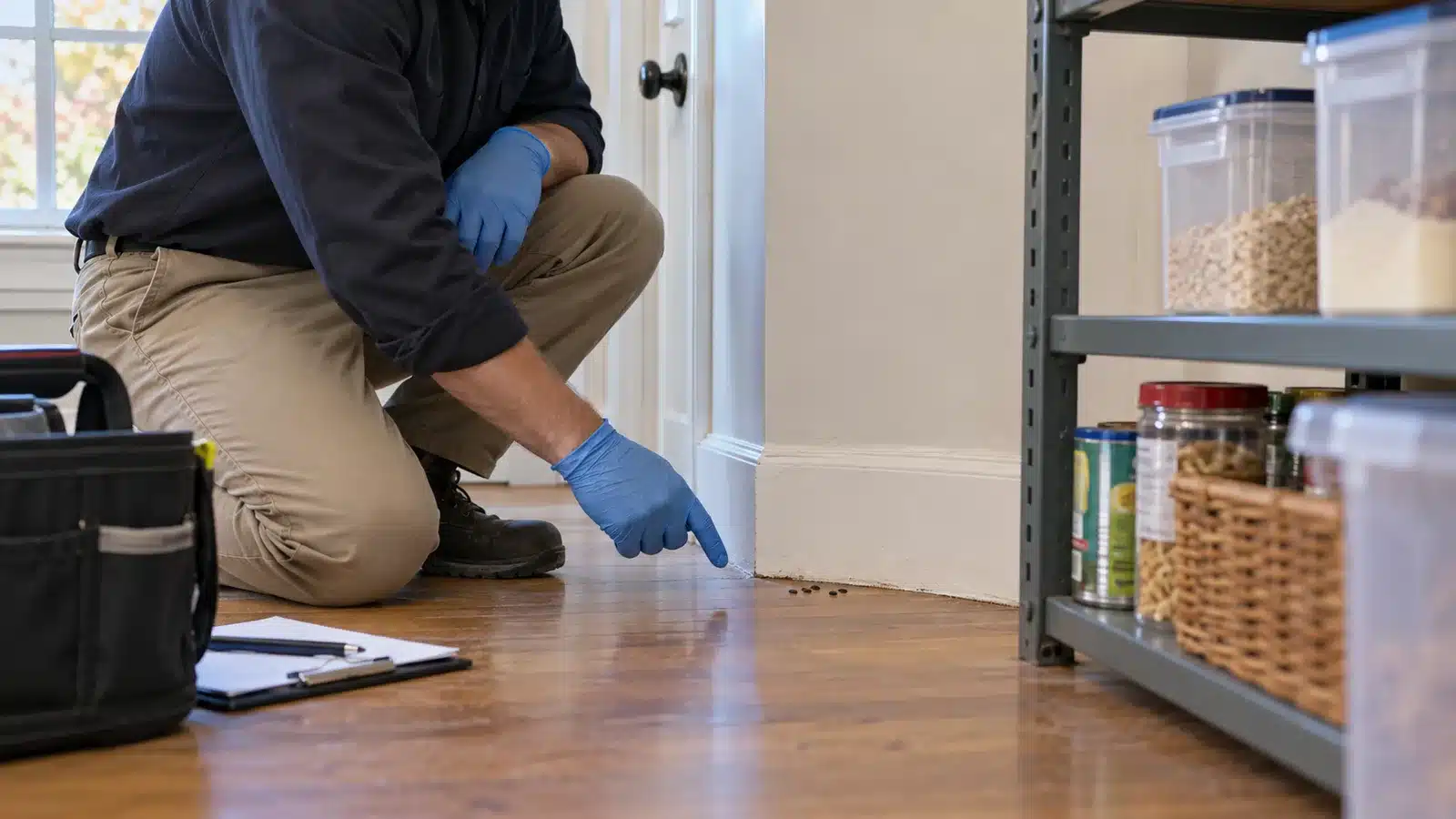
Some exterminators clean up mouse droppings, but cleanup is not included in every pest-control service. A company may inspect, trap, bait, monitor, or address entry points while leaving sanitation, contaminated insulation removal, or building repair to the property owner or a separate cleanup contractor. Confirm the written scope before service rather than assuming “mouse treatment” includes every part of the job.
If droppings are present now, do not sweep or vacuum them dry. The CDC’s current rodent-cleanup guidance explains how to prepare the area, wet contaminated material with an appropriate disinfectant, and clean it without stirring dry particles into the air. Heavy infestations require additional precautions.
Separate pest control from contaminated-material cleanup
“Exterminator” describes a provider category, not one universal service package. The useful question is: Which tasks are included in this proposal, which are excluded, and who owns each remaining step?
| Work category | What it may include | Question to ask | Possible responsible party |
|---|---|---|---|
| Inspection and monitoring | Locating signs, travel routes, food sources, and likely entry points | Will I receive findings and a follow-up plan in writing? | Pest-control provider |
| Population control | Traps, secured devices, or another property-specific control method | Who checks the devices, and on what schedule? | Pest-control provider, according to the service plan |
| Light surface cleanup | Limited removal and disinfection in accessible areas, if explicitly offered | Does the quoted price include droppings removal and surface disinfection? | Provider or property owner, depending on scope |
| Heavy contamination | Large accumulations, widespread nesting material, or difficult enclosed spaces | Does this condition require specialized protective equipment or a separate remediation contractor? | Qualified specialty cleanup provider |
| Insulation or material removal | Removal and disposal of contaminated porous building materials | Who removes, disposes of, and replaces the material? | Remediation or insulation contractor |
| Exclusion and repair | Sealing access points or repairing damaged building components | Which openings are included, and is finish carpentry or structural repair excluded? | Pest-control, exclusion, or building contractor |
The last column is a planning guide, not a promise about any company’s services. Capabilities and quoted scopes vary. A provider should be able to identify what it will do, what it will not do, and whether another trade is needed.
Ask these questions before approving mouse service
- Does the proposal include any droppings or nesting-material cleanup? Ask for the rooms, surfaces, and volume covered.
- Is disinfection included? Removal and disinfection are separate tasks; make sure the wording is clear.
- What happens in wall voids, attics, crawlspaces, or insulation? These areas may need a different contractor or safety plan.
- Who removes captured rodents and services devices? Do not assume the homeowner is expected to handle a professional station.
- Are entry-point repairs included? List each opening and the material proposed for it.
- What must happen before and after cleanup? Active mouse control, source removal, sanitation, and exclusion need a coordinated order.
- What conditions would change the price or scope? Hidden contamination and damaged insulation are common reasons an initial estimate may not cover the entire project.
A written answer makes quotes easier to compare. Biggins’ rodent treatment cost guide explains the factors that can affect a rodent-control estimate. Use the scope list above to check whether two proposals actually cover the same work before comparing the totals.
What to do before anyone cleans the droppings
First, preserve enough information for the inspection. Note the location and take photos from a safe distance without stirring the material. Keep children and pets away. Avoid moving professional devices or sealing suspected entry points until the provider has explained the sequence of work.
For cleanup, use the CDC procedure that applies to the affected space and level of contamination. Its household guidance calls for rubber or plastic gloves, wetting urine and droppings with a disinfectant until very wet, allowing the required contact time, wiping the material with paper towels, disposing of it, disinfecting the surface, and washing gloved and bare hands in the stated order. The CDC also directs readers to use additional precautions for heavy infestations.
Do not substitute this summary for the full CDC instructions or the product label. If the affected area is extensive, has limited ventilation, involves insulation or ductwork, or creates a health concern for someone in the home, pause and ask an appropriate professional or local health authority what level of cleanup is needed.
Cleanup alone does not solve active mouse entry
Droppings are evidence of a condition, not the whole condition. Removing them does not remove mice, secure food, or close an entry route. The EPA recommends looking for droppings, nesting material, chewing damage, holes, and odors, then reducing food, water, shelter, and building access.
The sequence should connect four decisions:
- Confirm where current activity is occurring.
- Control the active mouse problem under a defined service plan.
- Clean contaminated areas using the appropriate safety procedure and provider scope.
- Coordinate exclusion and repairs so new activity is less likely to restart.
If cleanup happens without monitoring, new droppings may be missed. If openings are sealed without coordinating the active-control plan, mice may remain inside or use another route. Ask one provider to identify the handoff points even when more than one company performs the work.
Confirm Biggins’ scope for your property
Biggins Exterminating provides mouse pest control in Wilmington and surrounding Massachusetts communities. Because cleanup needs can range from a few accessible droppings to contaminated insulation or a heavily affected enclosed area, ask what is included for your exact property. Share photos, locations, access constraints, and any known building damage when requesting an evaluation.
The most useful outcome is not a generic yes or no. It is a written plan that names the pest-control work, the cleanup work, any exclusion or repair work, the responsible party for each step, and the point when follow-up will confirm that fresh activity has stopped.
Source note: Cleanup precautions in this article are grounded in the CDC’s current rodent-cleanup guidance. Rodent signs and prevention actions are grounded in current EPA guidance. Service scope varies by provider and property; verify every inclusion before work begins.