Seeing Carpenter Ants Inside in Winter? What It Means for Your Massachusetts Home
Learn why carpenter ants show up indoors during the cold months, what that says about a possible nest in your walls, and the practical steps to take next.
The short answer
- Outdoor carpenter ant colonies in Massachusetts go dormant in cold weather, so ants active indoors in November or December are usually living inside your heated home.
- Repeated sightings in the same room, especially at night, point to a nest in a wall, floor, ceiling or attic, often in wood softened by moisture.
- Rule out firewood or a stray brought in from outside first. If the ants keep showing up, assume there's a nest.
- Skip the spray can. Track where you see them, save a specimen, fix moisture problems and have a professional locate and treat the nest.
Why carpenter ants usually disappear when it gets cold
Carpenter ants are cold-blooded, so outside temperatures control how active they are. Through spring and summer, colonies living in stumps, fallen logs, landscape timbers and hollow trees send workers out to forage, sometimes right into your kitchen. Once a Massachusetts fall turns cold, those outdoor colonies slow down and go dormant until the weather warms again.
That's why a few big black ants on the counter in July can be easy to explain. They may be scouts wandering in from a woodpile or a tree near the house. In November and December, though, ants from an outdoor nest aren't marching across frozen ground to get to your sink. When you see active carpenter ants inside during the cold months, the explanation is usually a lot closer to home.
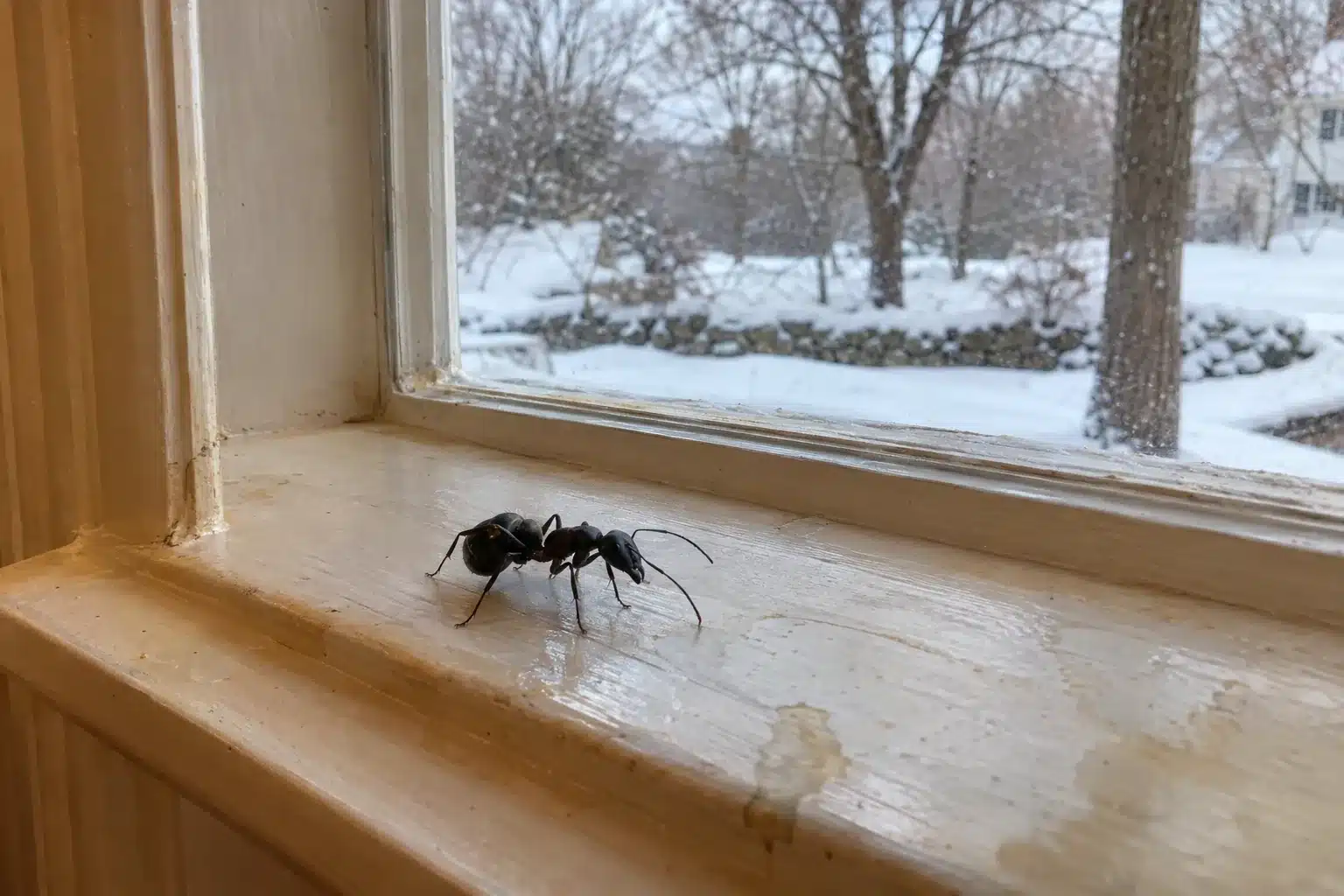
An ant or two in summer can come in from outside, but carpenter ants walking around indoors in December are usually living in the house.
What it means when you see them inside in November or December
In most cases, winter activity means there's a carpenter ant nest inside the heated part of your home. A wall void, a space under a floor or a section of attic near warm air can stay comfortable enough to keep a colony going all winter while its outdoor relatives sleep.
That indoor nest is often a satellite colony. Carpenter ants commonly keep a parent colony, which holds the queen, eggs and young larvae, in damp wood outdoors. They also build satellite nests, sometimes inside a house, that hold workers and older larvae and pupae. Sometimes the parent colony itself is inside the structure. Either way, worker ants moving around in winter tell you they are living indoors, not just visiting.
Patterns that point to an indoor nest
- You see ants in the same room or area over several days or weeks.
- Activity picks up at night, when carpenter ants do most of their foraging.
- Ants trail along baseboards, cabinet edges, window trim or plumbing lines.
- You find winged ants indoors in late winter or early spring. These are swarmers from an established colony. Our post on what winged carpenter ants in the house mean covers this in more detail.
Other explanations to rule out first
Before you decide your walls are full of ants, check a few simpler explanations.
Firewood brought inside
Carpenter ants often nest in stacked firewood. Bring a log in next to a woodstove or fireplace and the dormant ants inside can warm up and wander out. If your sightings started after you brought wood in and they cluster near the hearth, firewood is a likely source. Keep the woodpile outdoors, off the ground and away from the house, and bring in only what you'll burn that day.
Plants or items brought in from outside
Potted plants moved in from a porch, or boxes stored in a garage or shed, can carry a stray ant or two. A single ant that never reappears usually isn't cause for concern.
A different kind of ant
Not every winter ant is a carpenter ant. Carpenter ant workers are large, roughly a quarter inch to half an inch long, usually black or black and reddish. Seen from the side, the middle body section has a smooth, evenly rounded top. Much smaller ants trailing to sweets in the kitchen may be a different species, such as odorous house ants, and those call for a different approach.
If you've removed firewood and ruled out a hitchhiker but large ants keep appearing, it's safest to assume a nest is somewhere in the structure.
If ants keep showing up after the firewood is gone, the source is probably inside your walls, not in the woodpile.
Where winter nests tend to hide in Massachusetts homes
Carpenter ants don't eat wood. They tunnel through it to make galleries, and they strongly prefer wood that has been softened by moisture. In New England homes, winter brings its own moisture problems, and those spots are where indoor nests often turn up:
- Window and door frames, where condensation or old leaks have softened sills and trim.
- Bathrooms and kitchens, under floors or behind walls near tubs, showers, toilets, sinks and dishwashers with slow leaks.
- Roof edges and attics, where ice dams push water under shingles and into eaves. Ants also nest in attic insulation near damp sheathing.
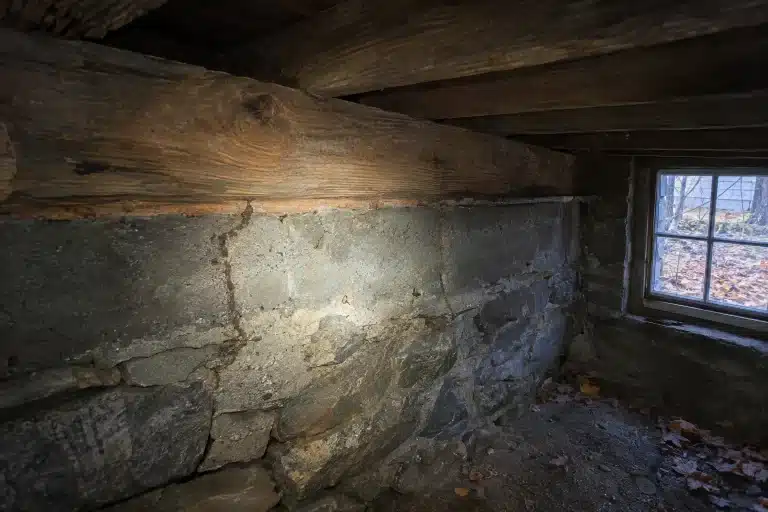
- Sill plates and rim joists in basements and crawlspaces, especially where soil, mulch or snow sits against the foundation.
- Wall voids near chimneys and additions, where flashing or rooflines meet and water can get in.
- Hollow spaces such as hollow-core doors, porch columns and foam insulation behind siding.
Clues to look and listen for
- Frass: small piles of coarse, sawdust-like material, often mixed with bits of dead insects, below tiny slits or openings in wood or drywall.
- Sounds: a faint rustling or crinkling inside a wall or ceiling, most noticeable at night when the house is quiet.
- Concentration: ants that keep showing up in one room rather than scattered around the house.
For a step-by-step approach to tracking a colony, see our guide on how to find where carpenter ants are nesting.
A wet spot from an ice dam or a slow plumbing leak is exactly the kind of softened wood a carpenter ant colony looks for.
What to do right now (and what to skip)
Seeing ants on a winter night can make you want to grab the nearest spray. Here's a better plan.
- Don't spray the ants you see. Store-bought sprays kill a few foragers but never reach the nest inside the wall. Repellent products can also scatter the colony into new spots, which makes the nest harder to find.
- Keep a simple log. Write down where you see ants, what time and roughly how many. Check with a flashlight after dark, when carpenter ants are most active. Patterns help pinpoint the nest.
- Save a specimen. Put one or two ants in a sealed bag or stick them to clear tape so they can be identified. If you find winged ants, save one of those too.
- Photograph any frass or damage. Note where it is before you clean it up so it can be checked later.
- Deal with moisture. Fix dripping pipes, check under sinks, watch for ice dams and water stains on ceilings, and run bathroom fans. Drier wood is less attractive to ants.
- Move firewood out. Keep it stored outside and away from the foundation.
- Bring in a professional if the sightings continue. A satellite nest in a wall won't go away on its own over the winter.
Hold off on the spray can. Killing the ants you can see does nothing to the nest in the wall and can push the colony deeper into the house.
How a professional handles carpenter ants in winter
Winter is a good time to deal with carpenter ants. Outdoor colonies are dormant, so the ants you're seeing are almost certainly coming from inside. That makes the trail easier to follow. The colony is also concentrated in one place instead of spread across your yard.
A professional visit typically includes:
- Inspection: following activity patterns, frass and moisture clues to narrow down where the nest is.
- Targeted treatment: treating the nest area and the voids around it directly, and using bait the workers carry back to the colony, rather than spraying broadly around rooms.
- A look at the exterior: checking for a parent colony and for conditions that invite ants back in spring, such as wood touching soil, overhanging branches or damp trim.
- Practical advice: pointing out moisture problems and damaged wood that you or a contractor may need to repair.
Biggins Exterminating is based in Wilmington, MA, and handles carpenter ant extermination for homeowners in Wilmington, Andover, Bedford, Burlington, Billerica, Lexington, Tewksbury, Woburn and North Reading. You can read more about our carpenter ant pest control service. When you're ready to have someone take a look, contact us to schedule a treatment. Have your notes and saved specimens handy so we can get started quickly.
Common questions
Will carpenter ants die off on their own as it gets colder?
Not if they're nesting inside a heated home. Outdoor colonies go dormant in the cold, but an indoor nest stays warm enough to keep going through the winter. The colony can keep expanding its galleries until spring.
Is it okay to wait until spring to deal with them?
You can, but the colony will keep tunneling all winter, and a mature indoor colony may release winged swarmers in late winter or spring. Winter is often an easier time to find and treat the nest, because the only active ants are the ones inside. Waiting rarely makes the job smaller.
How much damage can a winter nest do?
Carpenter ants work slowly, so a single season usually isn't a structural emergency. Over months and years, though, their galleries can weaken sills, joists and framing, especially wood that's already damp. The sooner a nest is found, the less wood is affected.
Could the ants I'm seeing actually be termites?
Termite workers rarely wander in the open the way carpenter ants do. You're more likely to notice termites from mud tubes on the foundation or from swarmers in spring. Carpenter ants have a pinched waist and elbowed antennae, while termites have a thick waist and straight antennae. If you're not sure, save a specimen so it can be identified.