
Your Guide to Carpenter Ants in Bedford
Carpenter ant control Bedford homeowners need starts with understanding what you’re up against. If you’ve noticed large black or reddish-black ants trailing across your kitchen counter at night, found small piles of sawdust near wooden beams, or heard faint rustling sounds inside your walls, you likely have a carpenter ant problem that requires immediate attention.
Quick Answer: How to Control Carpenter Ants in Bedford
- Locate the nest – Follow ant trails at night to find parent or satellite colonies
- Eliminate moisture – Fix leaks, improve ventilation, replace water-damaged wood
- Seal entry points – Caulk cracks, gaps around pipes, and utility line openings
- Remove attractants – Store firewood away from the house, trim vegetation, clean up food sources
- Call a professional – For guaranteed elimination, especially when nests are hidden in walls or structural wood
Carpenter ants don’t eat wood like termites do—they excavate it to build their nests. This means they’re creating smooth, clean galleries inside your home’s structural timbers, window frames, door jambs, and anywhere moisture has compromised the wood. Bedford’s older homes, many built between the mid-1800s and early 1900s, are particularly vulnerable because they often have the combination of wood framing and moisture issues that carpenter ants love.
The number of carpenter ants is on the rise across Massachusetts, and Bedford is no exception. These pests are active year-round, though you’ll see the most activity from spring through early fall. Finding winged ants (swarmers) indoors between April and June is a strong sign that a mature colony—at least three years old—is living somewhere in your house.
Why This Matters for Bedford Homeowners
Unlike other nuisance ants that just raid your pantry, carpenter ants pose a real threat to your home’s structural integrity. A single colony can house thousands of workers steadily hollowing out beams, joists, and framing. Left unchecked for years, this damage can weaken critical support structures and lead to costly repairs that far exceed the cost of professional pest control.
I’m Stephen Biggins, owner of Biggins Exterminating Co., and I’ve been helping Bedford families with carpenter ant control Bedford residents trust for decades—it’s one of the most common calls we receive every spring. Our family-owned company has over 40 years of experience protecting Massachusetts homes from wood-destroying pests.
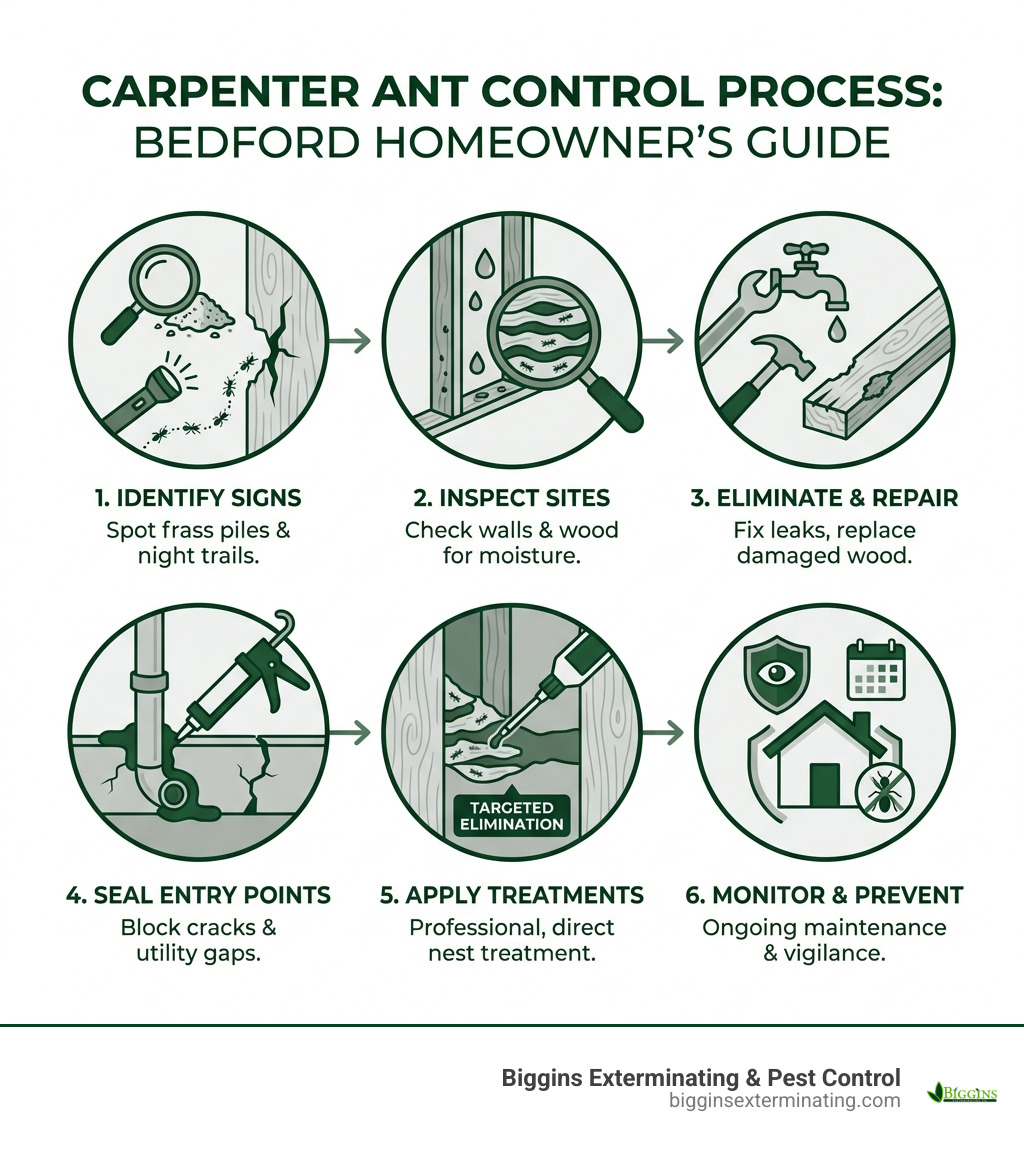
Quick carpenter ant control Bedford terms:
Identifying a Carpenter Ant Problem in Your Bedford Home
Recognizing the early signs of a carpenter ant infestation is crucial for protecting your Bedford home from extensive damage. These diligent excavators often work silently within your walls, making their presence known only through subtle clues. Our experience in Bedford has shown us that homeowners often overlook these critical indicators until the problem becomes severe.
Telltale Signs of an Infestation
The first step in effective carpenter ant control Bedford homeowners can take is learning to identify the signs. If you notice any of these, it’s time to investigate further:
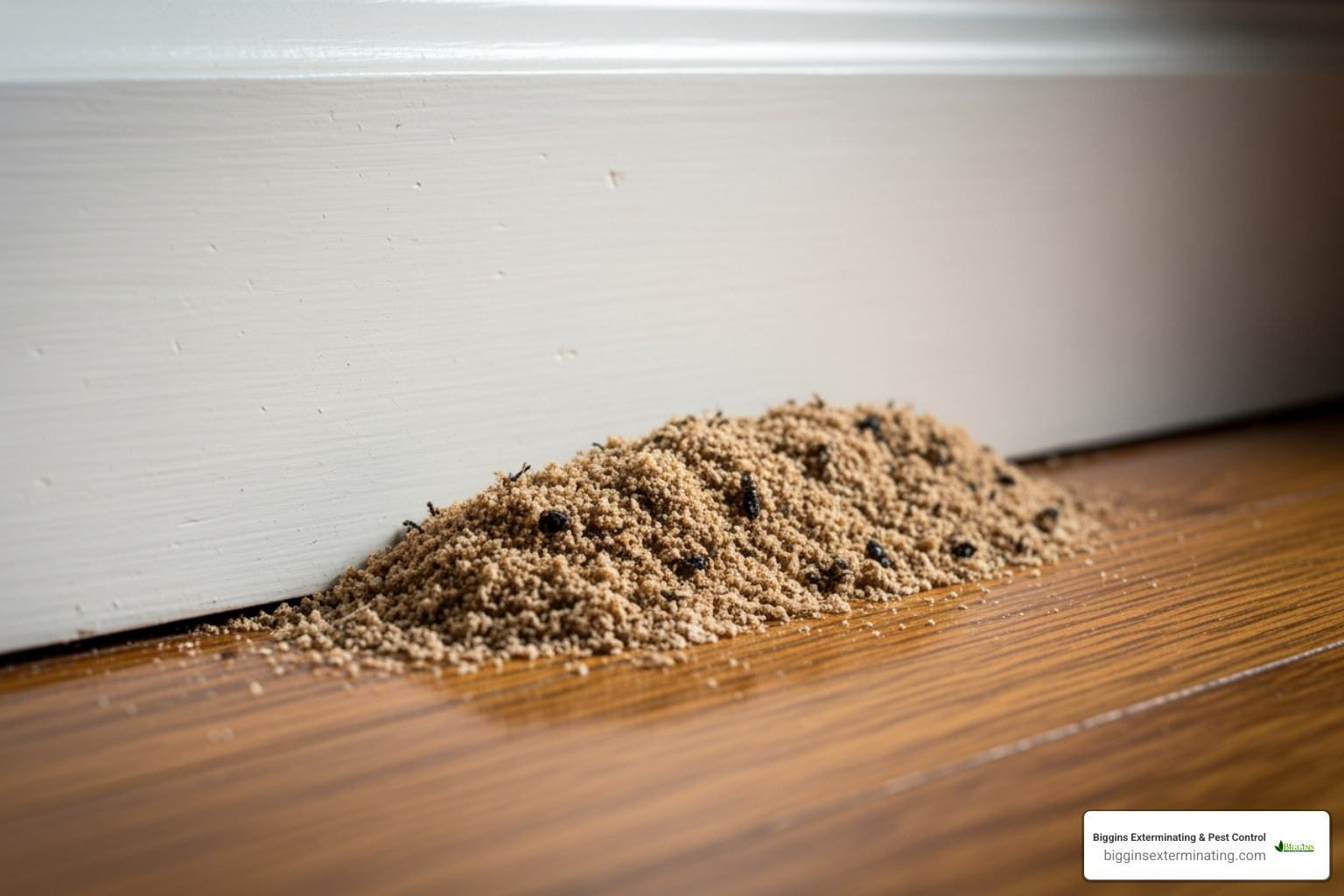
- Sawdust Piles (Frass): Carpenter ants don’t eat wood, but they certainly chew through it. As they tunnel, they push out wood shavings mixed with insect body parts and insulation fragments. These small piles, known as “frass,” often appear near kick-out holes in wooden structures, window sills, baseboards, or doorframes. Think of it as their construction debris.
- Faint Rustling Sounds: If you listen closely, especially at night when your home is quiet, you might hear a faint, crinkling, or rustling sound coming from within your walls, floors, or wooden beams. This is the sound of a busy carpenter ant colony at work, excavating their galleries.
- Foraging Ants at Night: Carpenter ants are primarily nocturnal. Seeing large, black, or reddish-black ants foraging in your kitchen, bathroom, or other areas of your home, particularly between sunset and midnight, is a strong indicator of an indoor nest. They can forage up to 100 yards from their nest in search of food.
- Winged Swarmers Indoors: Finding winged reproductive ants, also known as “swarmers,” inside your home, especially during late winter or early spring (April to June in Massachusetts), is a definitive sign of a mature, established colony within your structure. These swarmers are looking to mate and establish new colonies. Their presence indicates a colony that is at least three years old.
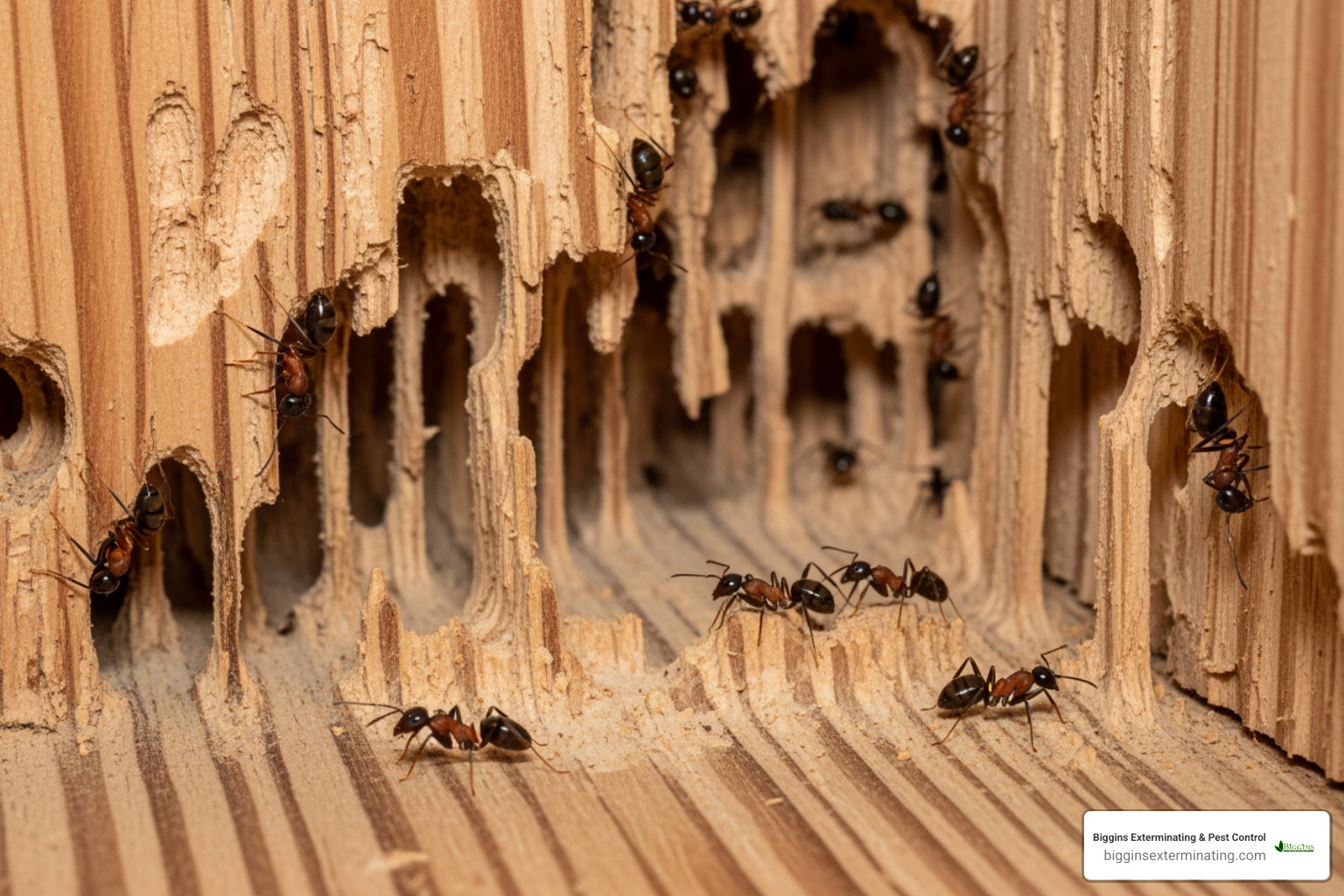
- Smooth Wood Galleries: If you uncover an active carpenter ant nest, you’ll see galleries that are smooth and clean, as if they’ve been sanded. This is a key difference from termite damage, which often includes mud or dirt.
Carpenter Ants vs. Termites: Knowing the Difference
Many homeowners confuse carpenter ants with termites, as both can damage wood. However, understanding the distinctions is vital for proper identification and effective treatment. We’ve compiled a quick comparison to help you tell them apart:
| Feature | Carpenter Ants | Termites |
|---|---|---|
| Antennae Shape | Sharply bent or “elbowed” | Straight, beaded antennae |
| Waist Size | Constricted, narrow waist with a single node (bulge) between the thorax and abdomen | Broad waist, nearly uniform in width from head to abdomen |
| Wing Appearance | Two pairs of wings, with the front pair noticeably longer than the hind pair | Two pairs of wings, both pairs equal in length and shape |
| Body Color | Typically black, reddish-black, or brownish-black | Pale, whitish, or translucent (worker termites) |
| Damage Type | Excavate clean, smooth galleries in wood; produce sawdust-like frass | Eat wood, creating mud-lined tunnels and galleries; produce pellet-like droppings |
| Diet | Do not eat wood; feed on sweets, proteins, and other insects | Eat wood (cellulose) |
If you’re still unsure whether you’re dealing with carpenter ants or termites, don’t hesitate to call us. Our experienced technicians can provide an accurate identification and recommend the best course of action for your Bedford home.
The Carpenter Ant Lifecycle and Seasonal Activity in Massachusetts
Understanding the life cycle and habits of carpenter ants is key to effective carpenter ant control Bedford. These social insects operate within a complex colony structure, and their activity patterns are often influenced by the seasons in our Massachusetts climate.
A carpenter ant colony consists of a queen, worker ants, and eventually, reproductive males and females. The queen is the heart of the colony, responsible for laying eggs. Worker ants, which are wingless and typically ¼ to ½ inch long, perform various tasks like foraging for food, caring for the young, and excavating galleries. Once a colony is mature (around three years old), it begins to produce winged reproductives, or swarmers, which are larger (½ to ¾ inch long) and are responsible for mating flights. The entire cycle from egg to adult can take about three months.
Where Do Carpenter Ants Nest?
Carpenter ants, unlike termites, don’t consume wood for nutrition; instead, they excavate it to create their nests. They have a strong preference for wood that has been exposed to moisture, making damp or decaying wood ideal nesting sites.
Common Indoor Nesting Sites in Bedford Homes:
- Moist Wood Preference: Carpenter ants are highly attracted to wood softened by water. This includes areas with leaky roofs, plumbing leaks, condensation issues, or poor ventilation.
- Wall Voids: Areas behind bathroom tiles, near dishwashers, under sinks, or around leaky pipes are prime locations for satellite nests. They can also be found in insulation.
- Window Sills and Door Frames: Wood that has been repeatedly exposed to moisture from rain or condensation can become soft enough for ants to tunnel through.
- Attics and Basements: Poorly ventilated attics can accumulate moisture, as can damp basements or crawl spaces, creating inviting conditions for carpenter ants.
- Hollow Doors and Beams: Even seemingly sound wood can be compromised if there’s an internal moisture source.
Common Outdoor Nesting Sites in the Bedford Area:
- Tree Stumps and Decaying Wood: Outdoors, they frequently establish parent nests in rotting tree stumps, fallen logs, and dead trees.
- Firewood Piles: Storing firewood directly against your home or on the ground can invite carpenter ants to establish a colony, which can then easily migrate indoors.
- Decks and Porches: Wooden decks and porches, especially where they meet the house or are exposed to consistent moisture, are common outdoor nesting sites.
A large colony can have a “parent nest,” often outdoors, where the queen resides, and several “satellite nests” indoors in drier locations. Finding the parent nest is the key to complete eradication. You can learn more about effective ant exterminator services on our website.
When Are Carpenter Ants Most Active in Bedford?
Carpenter ant activity in Bedford and throughout Massachusetts is largely seasonal, driven by temperature and moisture.
- Spring Emergence (March – May): As temperatures rise, carpenter ants emerge from dormancy. This is when you’ll start to see increased foraging activity as they seek food sources to support their growing colony.
- Mating Swarms (April – June): This period marks the peak of mating season. If you see winged swarmers indoors during this time, it’s a strong indicator of a well-established colony within your home, ready to expand.
- Summer Foraging (June – August): Activity remains high throughout the summer as workers continuously forage for food. You’re more likely to spot them at night during these warmer months.
- Fall Preparation (September – October): As temperatures cool, ants may increase their foraging to store food for the winter.
- Winter Ant Sightings: While carpenter ants typically become dormant in winter, finding them indoors during colder months is a significant red flag. It almost certainly means you have an active nest inside your heated home, as they wouldn’t be foraging outdoors in the cold. These indoor nests will continue to excavate wood year-round.
For more detailed information on carpenter ant behavior, the University of Minnesota Extension offers valuable insights: Carpenter ants- University of Minnesota Extension.
How to Prevent Carpenter Ants from Invading Your Home
Prevention is your first and best line of defense against carpenter ants. By taking proactive measures, Bedford homeowners can significantly reduce the risk of an infestation and the costly damage that comes with it. We believe in empowering our customers with knowledge, and these tips are foundational to effective carpenter ant control Bedford residents can implement.
Eliminating Moisture and Rotted Wood
Since carpenter ants prefer damp wood, controlling moisture is paramount.
- Fixing Leaks: Regularly inspect and promptly repair any leaky roofs, plumbing fixtures, or pipes. Even small, consistent leaks can create the moist conditions carpenter ants crave.
- Improving Ventilation: Ensure attics, basements, and crawl spaces are well-ventilated to reduce humidity and prevent moisture buildup. Consider using dehumidifiers in particularly damp areas.
- Replacing Damaged Wood: Remove and replace any water-damaged, decaying, or rotting wood in and around your home. This includes window sills, door frames, fascia boards, and structural timbers.
- Gutter Maintenance: Keep rain gutters clean and ensure downspouts direct water away from your home’s foundation. Clogged gutters can cause water to overflow and seep into your walls.
- Crawl Space Moisture: If you have a crawl space, ensure proper drainage and consider installing a vapor barrier to control ground moisture.
Blocking Entry Points and Removing Attractants
Even with perfect moisture control, ants can still find their way in if entry points are open or attractants are present.
- Sealing Cracks: Caulk and seal any cracks or gaps in your home’s foundation, around windows and door frames, and where utility lines (pipes, wires) enter the house. Even tiny openings can provide access.
- Trimming Vegetation: Keep tree branches, shrubs, and other vegetation trimmed away from your home’s exterior. These can serve as “bridges” for ants to access your roof or siding. Maintain at least a 2-foot gap between vegetation and your home.
- Firewood Storage: Store firewood at least 20 feet away from your house and off the ground. Never store it directly against the foundation or indoors, as it’s a common harborage for carpenter ants.
- Food Sanitation: Carpenter ants are attracted to various food sources, including sweets, proteins, and pet food. Store all food in airtight containers, clean up spills and crumbs immediately, and regularly clean kitchen surfaces and appliances.
- Pet Food Management: Don’t leave pet food dishes out for extended periods. Clean them regularly and store pet food in sealed containers.
By diligently following these preventative measures, you can make your home far less appealing to carpenter ants. For more comprehensive strategies on keeping your home pest-free, explore our residential pest control services.
A Homeowner’s Guide to Professional Carpenter Ant Control in Bedford
When carpenter ants have established themselves in your Bedford home, especially if you’re seeing signs of an indoor nest, professional intervention becomes essential. DIY methods, while tempting, often fall short of completely eliminating the problem, leading to recurring infestations and continued damage.
Why Professional Carpenter Ant Control is Essential
We understand the desire to tackle pest problems yourself, but with carpenter ants, the stakes are high, and the challenges are significant.
- Locating the Nest: This is the most critical step, and often the most difficult. Carpenter ants can build parent nests outdoors and satellite nests in various hidden, inaccessible spots within your home—wall voids, under floors, in ceilings, even behind insulation. Our technicians are trained to identify subtle clues, use specialized equipment, and employ their knowledge of ant behavior to pinpoint these elusive nests. Spraying foraging ants you see will do little to eliminate the colony if the nest remains untouched.
- Comprehensive Treatment: Once located, the nest requires direct treatment with professional-grade insecticides. These are often applied as dusts or liquids directly into the nest or galleries, ensuring the queen and entire colony are affected. We also implement perimeter treatments and targeted baiting strategies to address foragers and prevent future entry.
- Expertise in Colony Removal: Our team at Biggins Exterminating Co. has over 40 years of experience dealing with carpenter ants in Massachusetts. We understand the biology, habits, and vulnerabilities of these pests, allowing us to devise the most effective and safe treatment plan for your specific situation.
- Limitations of DIY Approaches: Store-bought sprays typically only kill the ants you see (the foragers), leaving the hidden nest intact to continue producing more ants. Baits can be effective, but require careful placement, patience, and the right formulation, which can be challenging for homeowners. Without eliminating the queen, the problem will persist.
- Ensuring Complete Elimination: Our goal isn’t just to reduce ant sightings; it’s to eliminate the entire colony, including the queen, to ensure the infestation is truly resolved. We provide warranties on our services because we stand by our work.
When to Call a Professional for Carpenter Ant Control in Bedford
While preventative measures are crucial, certain situations strongly indicate that it’s time to call in the experts for carpenter ant control Bedford:
- Large-Scale Infestation: If you’re consistently seeing many ants, especially large numbers of foragers or winged swarmers indoors, it suggests a significant, well-established colony.
- Difficulty Finding the Nest: If you’ve tried to locate the nest yourself without success, or suspect it’s in an inaccessible area like deep within walls or structural beams.
- Suspected Structural Damage: Any visible signs of wood damage, sagging floors, or compromised wooden elements should prompt immediate professional inspection.
- Recurring Problems: If you’ve attempted DIY treatments and the ants keep coming back, it’s a clear sign that the source of the infestation hasn’t been adequately addressed.
- Guaranteed Results: Professional pest control services offer the peace of mind of guaranteed results, ensuring the problem is resolved and often providing follow-up treatments if necessary.
Don’t let carpenter ants jeopardize the structural integrity of your home. If you suspect an infestation, contact us today. We are the local, family-owned Massachusetts pest control company with over 40 years of trusted, high-quality service, committed to protecting the Bedford community. You can find more information about our services here: More info about ant exterminator services.
Frequently Asked Questions about Carpenter Ant Control
We often get asked similar questions by homeowners in Bedford concerned about carpenter ants. Here are some of the most common ones, along with our expert answers:
Do carpenter ants eat wood?
No, carpenter ants do not eat wood. This is a common misconception! They get their name from their habit of “carpeting” or excavating wood to create nests and galleries. They chew through the wood, creating smooth tunnels, and then push out the chewed wood fibers (frass), which resembles sawdust. Their diet actually consists of sweet foods, other insects, and honeydew from aphids. While they don’t consume the wood, the damage they cause by tunneling can still be significant and compromise the structural integrity of your home over time.
How long does it take to get rid of carpenter ants?
The time it takes to completely get rid of carpenter ants can vary significantly depending on several factors:
- Colony Size and Maturity: A small, newly established colony will be easier and quicker to eliminate than a large, mature colony with thousands of individuals and potentially multiple satellite nests.
- Nest Location: If the main nest (where the queen resides) is easily accessible, treatment can be faster. However, if nests are hidden deep within walls, under floors, or in other inaccessible areas, it can take longer to locate and treat effectively.
- Treatment Method: Professional treatments, which often involve targeted applications directly to the nest and strategic baiting, are typically the fastest and most effective way to ensure complete eradication. DIY methods usually take longer and are less likely to fully resolve the issue.
Generally, with professional carpenter ant control Bedford, you can expect to see a significant reduction in activity within days to weeks, but complete eradication of the entire colony might take several weeks to a few months to ensure all eggs and larvae are eliminated. We provide follow-up visits to ensure the problem is fully resolved.
Are carpenter ants dangerous to people or pets?
Carpenter ants are generally not considered dangerous to people or pets in the same way that venomous spiders or disease-carrying rodents might be.
- Bites: They can bite if they feel threatened, and their bite can be painful, but they are not venomous. They may also spray formic acid into the wound, which can cause a burning sensation. However, these bites are rare and typically only occur if you directly disturb a nest or handle the ants.
- Disease Transmission: Unlike some other pests, carpenter ants are not known to transmit diseases to humans or pets.
- Structural Risk: The primary risk associated with carpenter ants is the structural damage they cause to your home. By excavating wood for their nests, they can weaken wooden beams, joists, and other structural elements, potentially leading to costly repairs and compromising the safety of your home if left unchecked for years. This is a significant risk that homeowners in Bedford should take seriously.
Your Partner for a Pest-Free Home in Bedford
Dealing with carpenter ants can be a stressful and damaging experience for any homeowner. The risks associated with an infestation, from compromised structural integrity to the persistent nuisance of foraging ants, highlight the importance of prompt and effective carpenter ant control Bedford.
At Biggins Exterminating Co., we are dedicated to providing long-term solutions that protect your most valuable asset—your home. As a local, family-owned, and operated Massachusetts pest control company, we bring over 40 years of experience and a deep understanding of the unique pest challenges faced by residents in Bedford and the surrounding communities of Andover, Billerica, Burlington, Lexington, North Reading, Tewksbury, Wilmington, and Woburn.
Our commitment to professionalism, expertise, and customer satisfaction means you can trust us to identify, treat, and prevent carpenter ant infestations with the highest quality service. We don’t believe in one-size-fits-all solutions; instead, we tailor our approach to the specific needs of your home and the extent of your infestation. We offer reliable pest and rodent control services without requiring contracts, provide warranties, and ensure your satisfaction.
Don’t let carpenter ants chew away at your peace of mind or your home’s structure. If you’ve spotted the signs of an infestation or simply want to take proactive steps to prevent one, we are here to help.
Contact a professional pest control company near Bedford, MA today for a thorough inspection and a customized plan to keep your home pest-free. We’re ready to be your trusted partner in maintaining a safe and sound home for your family.
