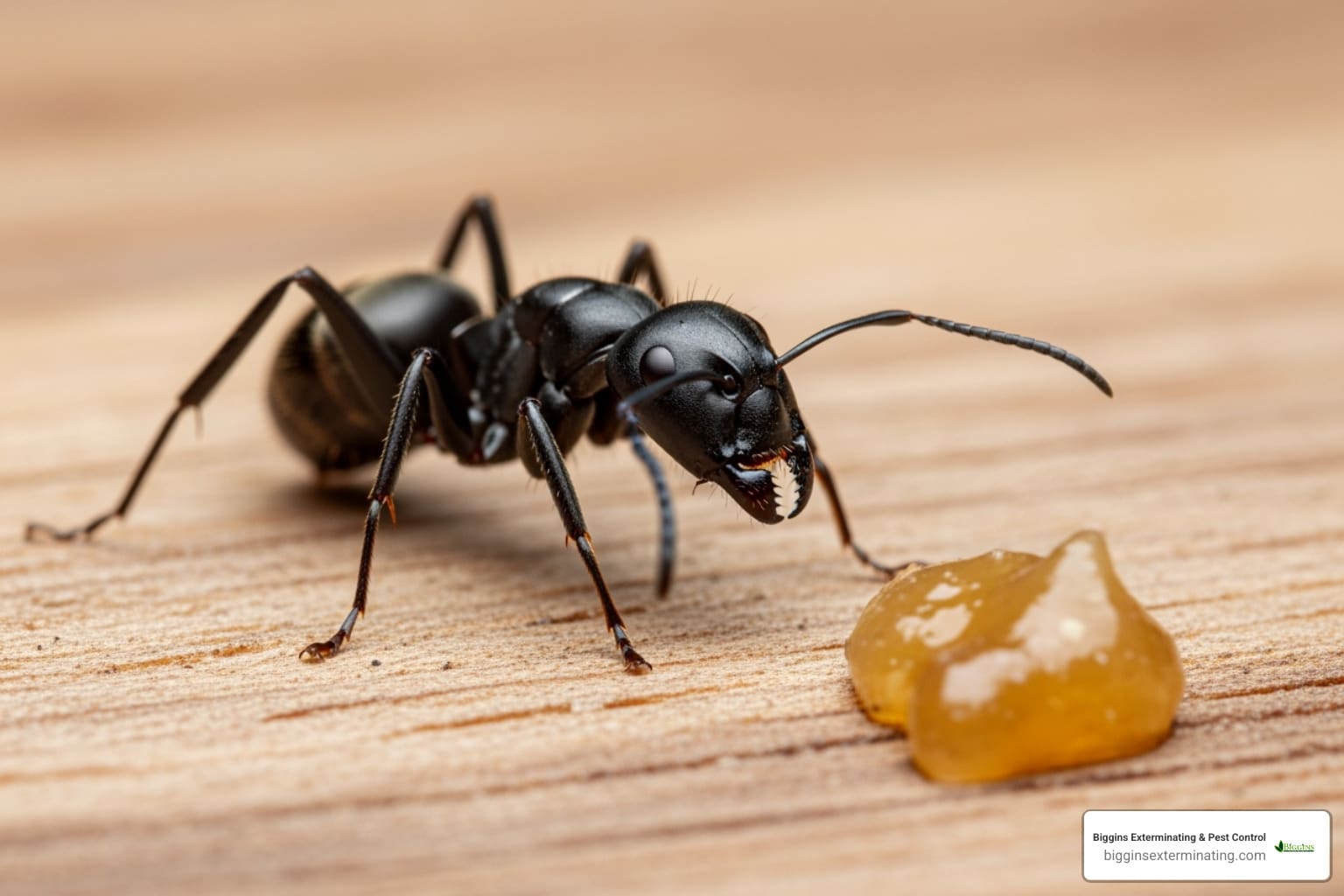
The Silent Destroyers in Your Home
Carpenter ant baits are pest control products that use a slow-acting poison combined with an attractive food source to eliminate entire ant colonies. Here’s a quick overview:
Top Carpenter Ant Bait Types:
- Granular baits: Best for outdoor use.
- Liquid baits: Effective for sugar-seeking ants.
- Gel baits: Ideal for cracks and crevices.
- Bait stations: The safest option for homes with children and pets.
Key Active Ingredients:
- Abamectin (highly effective)
- Fipronil (slow-acting, non-repellent)
- Boric acid (natural option)
- Indoxacarb (targets multiple species)
Unlike sprays that only kill visible ants, baits use a “Trojan horse” approach. Worker ants carry the poison back to the nest, sharing it with the queen and larvae, which eliminates the entire colony over several weeks.
The main challenge is that carpenter ants are picky eaters. As one forum user noted, “Terro isn’t going to take care of carpenter ants” because they often prefer protein over the sugar-based baits that work on other species. Carpenter ants excavate wood to build nests, leaving behind fibrous sawdust piles called frass.
Choosing the right bait depends on the ants’ current feeding cycle and proper placement. Only about 10% of carpenter ants forage at any time, making colony-wide baiting crucial.
I’m Stephen Biggins, and in over four decades at Biggins Exterminating, I’ve seen that success with carpenter ant baits comes from matching the bait to the infestation and understanding that these ants require different strategies than typical household ants.
Similar topics to carpenter ant baits:
Understanding the Enemy: Identifying Carpenter Ants and Their Damage
Carpenter ants are destructive pests that excavate your home’s framework to build their nests. Unlike termites, they don’t eat wood, but their smooth, hollowed-out galleries can cause significant structural damage over time. To use carpenter ant baits effectively, you must first identify your foe.
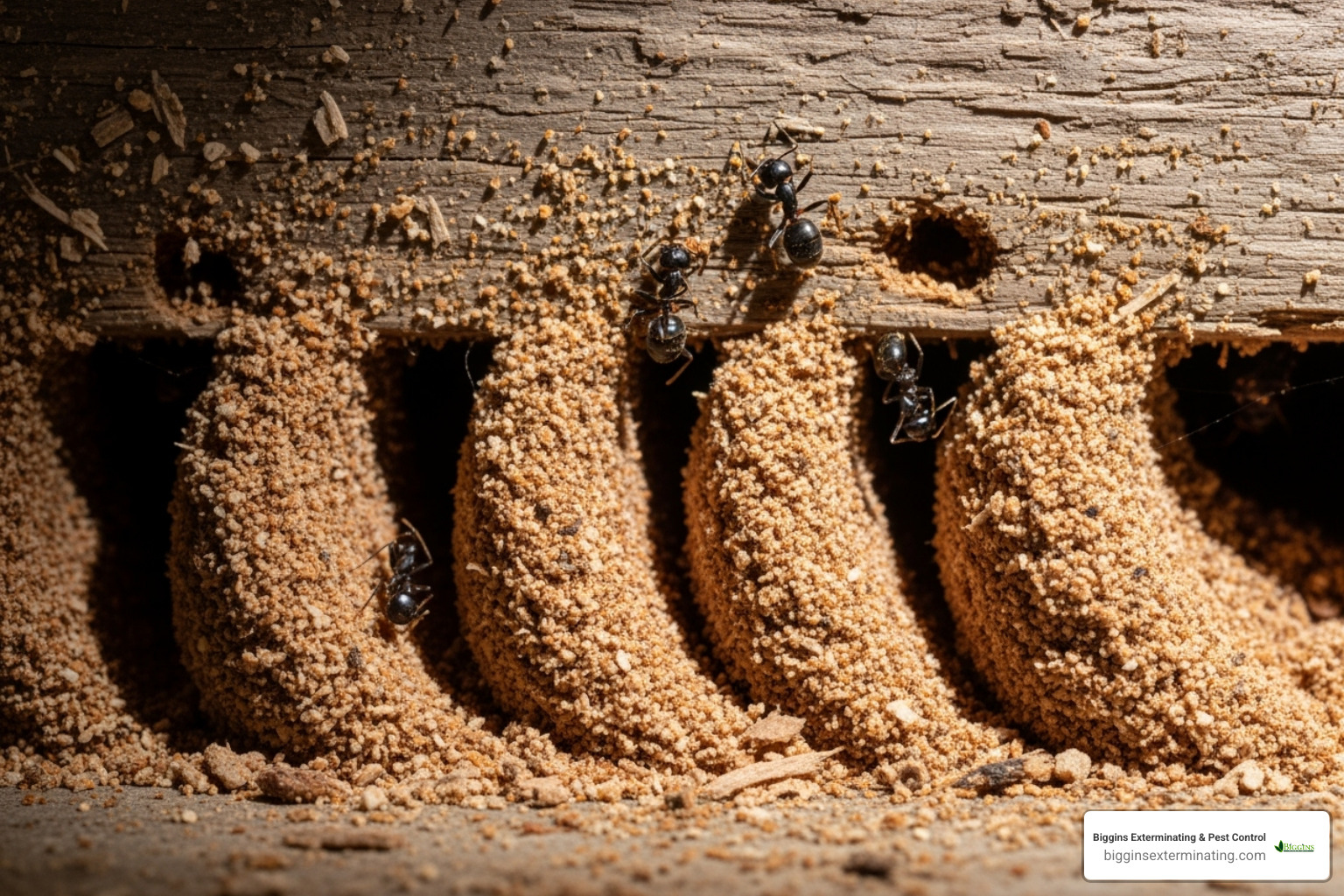
Spotting carpenter ants is straightforward once you know their key features. They are large ants, typically 1/4 to 1/2 inch long. While often black, they can also be red and black or dark brown. Look for a single bulge at their narrow waist and a rounded back profile.
Winged carpenter ants have unequal wing sizes (front wings are larger than back wings), which distinguishes them from termites, whose four wings are all the same length. For a detailed comparison, see our guide on How to Distinguish Carpenter Ants from Termites: Identifying the Menace in Your Home.
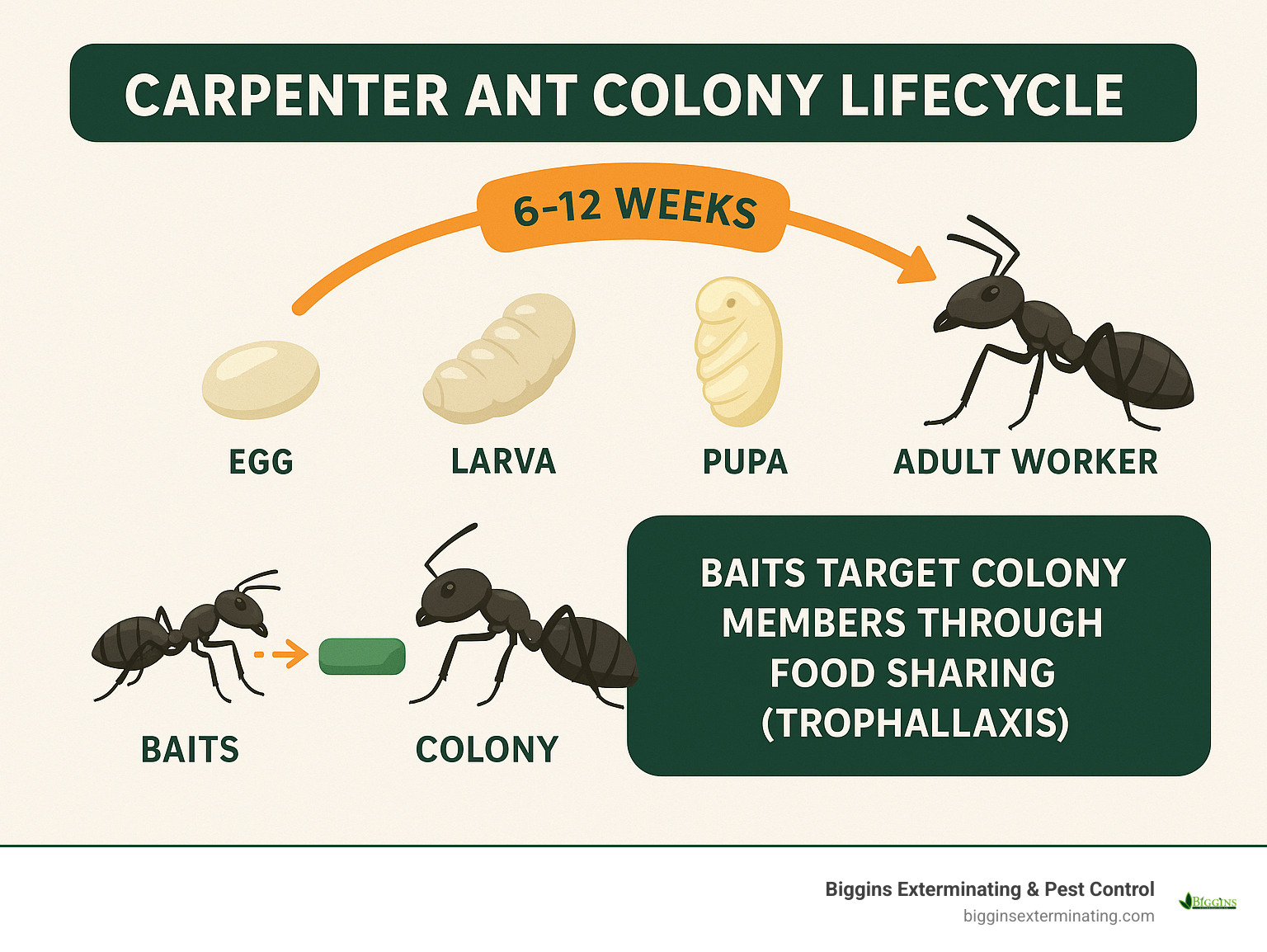
The most obvious sign of infestation is frass—fine, sawdust-like shavings found near baseboards or window sills. Frass is a mix of wood particles, insulation, and dead insect parts that ants push out of their tunnels. You might also hear faint rustling or scratching sounds in walls at night as they work.
Finding the nest is crucial for bait placement. Carpenter ants prefer damp wood, so check around leaky pipes, poorly sealed windows, or areas with roof damage. Indoors, they favor wall voids, attics, and hollow doors. Outdoors, look in firewood piles, deck timbers, and tree stumps.
The best time to find them is at night. Use a flashlight to follow foraging workers back to their entry points. For more tips, see our guide on how to Find Carpenter Ant Nest.
Since only about 10% of a colony forages at once, the other 90%—including the queen—remains in the nest. This is why carpenter ant baits are the superior choice for long-term colony elimination.
The “Trojan Horse” Strategy: How Effective Carpenter Ant Baits Work
Unlike sprays that kill only on contact, carpenter ant baits use a “Trojan horse” strategy to eliminate the entire colony. This is essential because killing only the visible worker ants won’t solve the underlying problem.
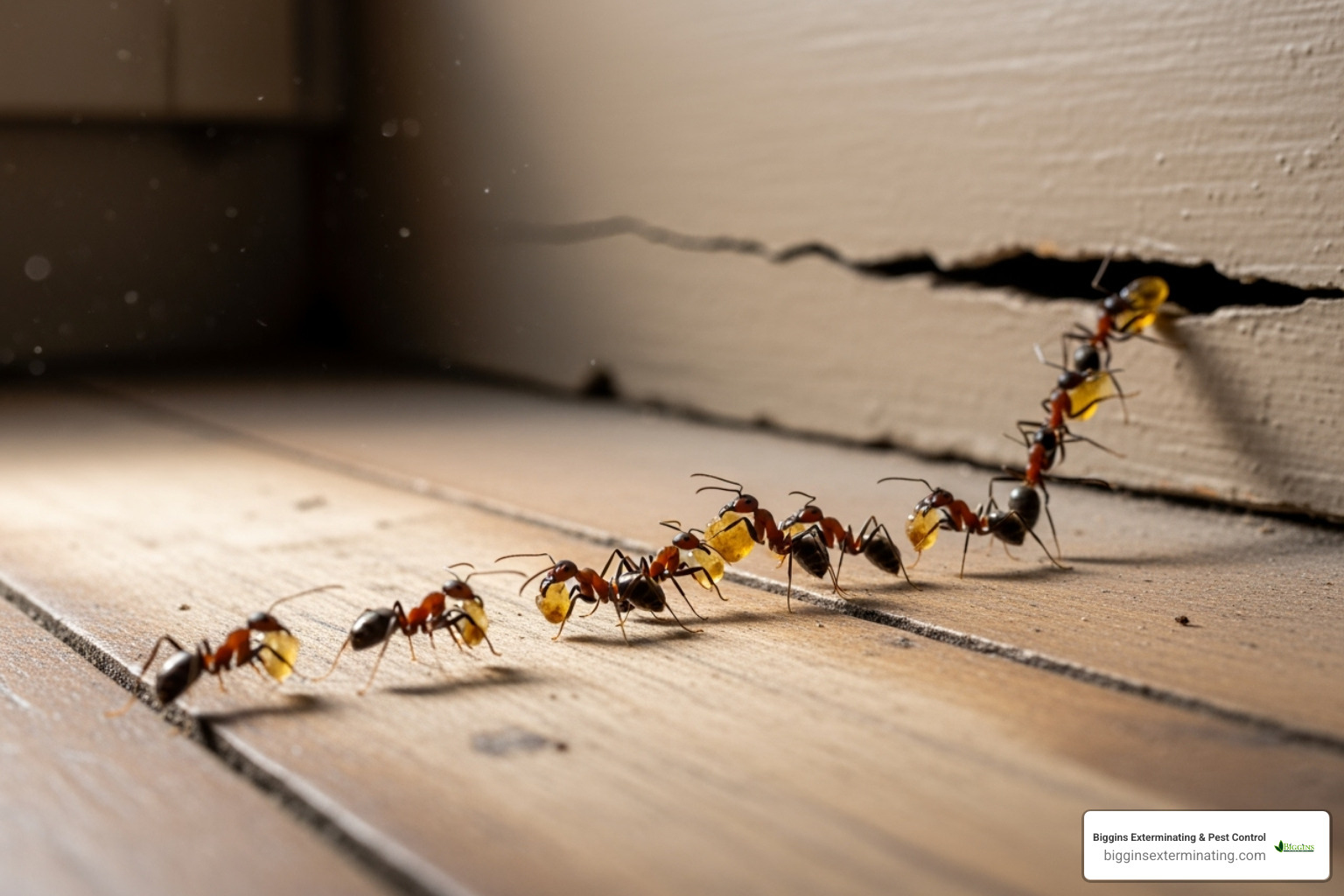
The strategy relies on two principles:
- Slow-Acting Poison: The bait’s active ingredient is designed to work slowly. This gives the foraging ant time to carry the toxic meal back to the nest and share it before dying.
- Trophallaxis (Food Sharing): Ants are social insects that share food mouth-to-mouth. When a worker brings the bait back, it’s distributed to other workers, larvae, and the queen. This targets the colony’s reproductive engine, stopping egg production and ensuring the colony dies out. This systemic approach is why baits are more effective than contact sprays, a principle used in professional pest management as noted in resources like Residential, Industrial, and Institutional Pest Control.
Choosing Your Weapon: Types of Carpenter Ant Baits
Selecting the right carpenter ant baits is critical, as these ants can be picky eaters whose preferences for protein or sugar change with the seasons. Understanding this is key to choosing an attractive bait.
Here are the primary types of carpenter ant baits:
- Liquid Baits: A sugar-water solution mixed with a toxicant. Highly attractive when ants seek carbohydrates for energy.
- Granular Baits: Small, solid particles infused with an attractant (often protein) and a toxicant. Excellent for outdoor use and durable in various weather conditions.
- Gel Baits: A sticky gel that can be applied directly into cracks, crevices, and other hard-to-reach areas.
- Bait Stations: Enclosed containers that hold bait, protecting it from the elements and keeping it inaccessible to children and pets.
If one bait type isn’t working, the ants may be in a different feeding cycle. Trying a combination of bait types can be most effective.
| Feature | Liquid Baits | Granular Baits |
|---|---|---|
| Pros | Highly attractive to sugar-seeking ants; Easy for ants to consume and transport; Often comes in pre-filled, user-friendly stations. | Excellent for protein/fat-seeking ants; Durable and weather-resistant for outdoor use; Larger particles attractive to carpenter ants; Can be broadcast or applied to trails. |
| Cons | Can dry out quickly, especially in hot, dry conditions; Less effective if ants are seeking protein; Can be messy if spilled. | May not be as appealing if ants are primarily seeking sugar; Can be challenging to apply precisely indoors without specialized equipment. |
| Best Use Cases | Indoor foraging trails, especially in kitchens/pantries; When ants are observed feeding on sweets. | Outdoor perimeter treatments, around trees, woodpiles, and foundations; When ants are seeking protein or fats. |
Decoding the Label: Key Ingredients in the Best Carpenter Ant Baits
Understanding the active ingredients helps you select the most effective product. All share the trait of being slow-acting to allow for transfer within the nest.
- Abamectin: A highly effective ingredient often found in granular baits. It’s a slow-acting nerve agent that allows worker ants to carry it back to the queen, halting egg production and eliminating the colony.
- Fipronil: A non-repellent, slow-acting insecticide that disrupts the ant’s nervous system. Ants unknowingly carry it back to the nest, spreading it throughout the colony. It’s a common choice for professional-grade products.
- Boric Acid: A natural stomach poison that slowly disrupts an ant’s metabolism. It’s a common ingredient in many baits but generally works more slowly than synthetic options.
- Indoxacarb: A pro-insecticide that becomes toxic only after an ant ingests it. It targets the nervous system and is effective against a wide range of ant species.
Beyond the active ingredient, the attractants (sugars, proteins, fats) are equally important to lure the ants. High-quality baits use a proprietary blend of attractants to be irresistible to carpenter ants.
Strategic Deployment: Applying Baits for Maximum Impact and Safety
Proper placement of carpenter ant baits is the key to success. You must place baits directly in the path of foraging ants.
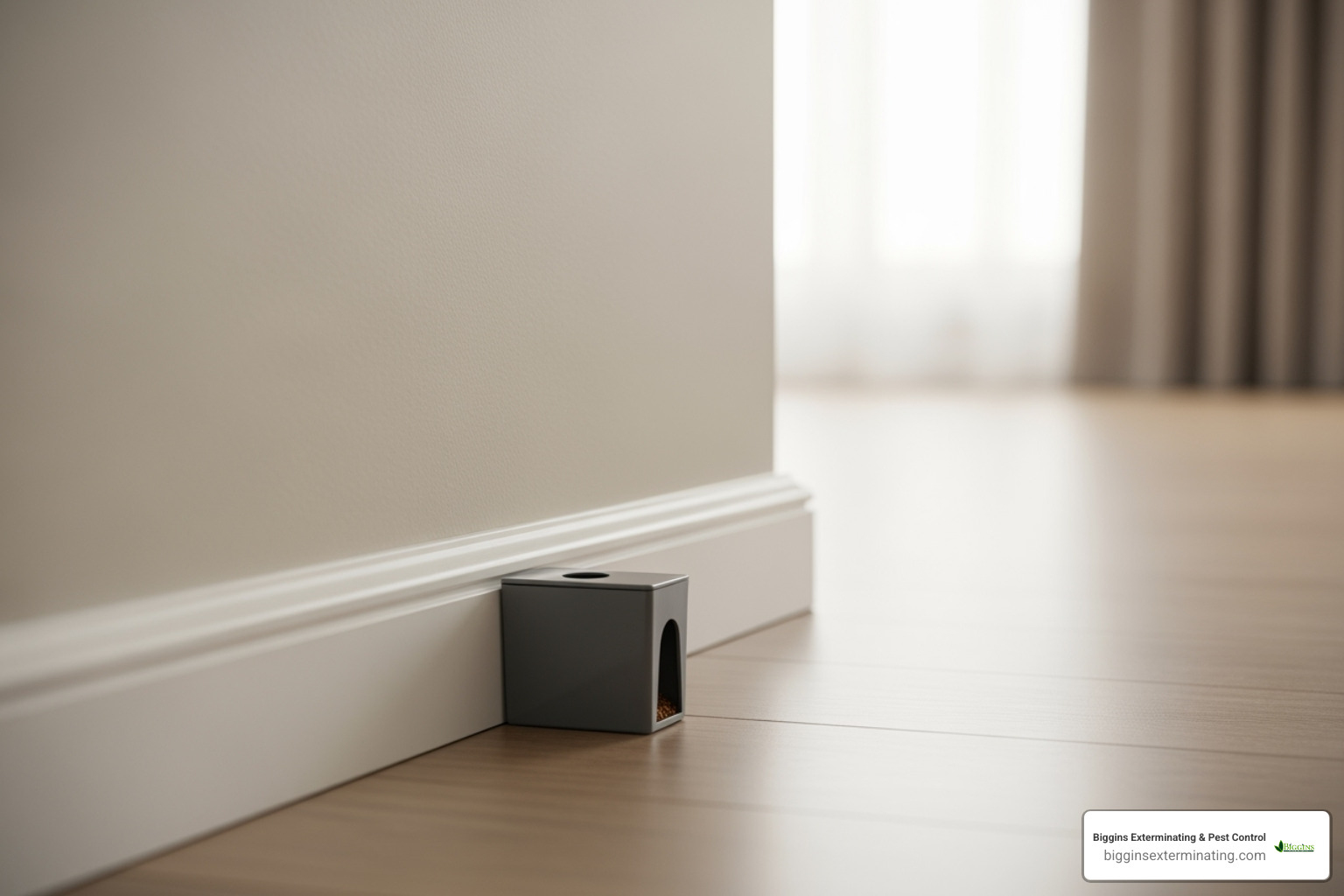
The golden rule is to follow the ant trails. Since carpenter ants are most active at night, use a flashlight to observe their travel routes and place baits there. Patience is key, as only about 10% of the colony forages at once.
Indoor Placement:
- Kitchens/Bathrooms: Place gel baits or bait stations near sinks, dishwashers, and other moisture-prone areas.
- Attics/Basements: Use granular baits in protective stations in undisturbed corners where ants forage.
- Wall Voids: If you hear rustling, carefully apply gel baits into small openings or use a bulb duster to inject granular baits.
Outdoor Deployment:
- Foundation Perimeter: Apply granular bait in a 1-2 foot band around your home’s foundation to intercept ants.
- Trees and Woodpiles: Place granular bait around the base of trees showing decay and near firewood storage areas. Keep firewood liftd and away from the house.
A critical mistake is contaminating the bait area. Do not use sprays or strong cleaners near your carpenter ant baits, as the scent will repel the ants and render the bait useless.
Safety always comes first, especially with children and pets. Always read the product label for application rates and safety precautions. Place baits where ants can find them but children and pets cannot, such as inside cabinets, behind appliances, or in secure, child-resistant bait stations.
After handling baits, wash your hands thoroughly. Store products in their original containers in a cool, dry place, out of reach of children and pets to maintain effectiveness.
For more comprehensive strategies, see our guide on How to Kill Carpenter Ants.
When DIY Baits Aren’t Enough: Professional Carpenter Ant Control
Even the best carpenter ant baits can fail against large or well-hidden infestations. Some situations are too complex for DIY solutions and require professional intervention.
When DIY Methods Hit Their Limits
The biggest challenge is reaching hidden nests deep inside walls, under floors, or in attics where baits may never be found. A mature colony can contain thousands of ants across multiple satellite nests, making it nearly impossible to eliminate with store-bought baits alone. Furthermore, carpenter ants are picky eaters and may suddenly ignore a bait if their dietary needs change.
Red Flags That Signal Professional Help
- Persistent Activity: If you still see ants after several weeks of proper baiting, the colony is likely too large or hidden for DIY methods.
- Regular Frass: Finding new sawdust piles after cleaning indicates that ants are actively expanding their tunnels.
- Visible Damage: Swollen woodwork or structural issues require immediate professional assessment. One homeowner’s delay in addressing these signs led to $41,000 in repairs.
The Professional Advantage
At Biggins Exterminating & Pest Control, our 40+ years of experience in Wilmington, MA, and nearby towns like Andover and Lexington, means we know how to find and eliminate carpenter ant colonies. Our trained technicians use specialized tools and knowledge of ant behavior to locate both parent and satellite nests.
We practice Integrated Pest Management (IPM), which involves addressing moisture issues, sealing entry points, and using professional-grade products unavailable to homeowners. We have access to potent formulations and equipment like dusters to treat wall voids. Our goal is complete colony elimination, backed by a warranty.
As a family-owned business, we offer reliable solutions without contracts. When carpenter ant baits aren’t enough, we’re here to finish the job. For more on our methods, visit Can Pest Control Get Rid of Carpenter Ants?.
Frequently Asked Questions about Carpenter Ant Baits
After four decades of helping homeowners, I’ve heard every question about carpenter ant baits. Here are answers to the most common concerns.
How long does it take for carpenter ant baits to work?
Patience is essential. Carpenter ant baits are designed to work slowly, taking anywhere from several days to several weeks for complete colony elimination. The timeline depends on the colony’s size and the bait’s active ingredient. A large, mature colony will take longer to eradicate than a small, new one. You might see an initial increase in ant activity around the bait—this is a good sign that they are taking it back to the nest.
Why are the ants not taking the bait I put out?
If ants are ignoring your bait, there are a few likely reasons:
- Picky Eaters: Carpenter ants’ dietary needs shift between protein and sugar. If they ignore your sweet gel bait, they may be seeking protein. Try switching to a protein-based granular bait, or vice versa.
- Contamination: Ants have sensitive antennae and will avoid baits contaminated with scents from cleaners, smoke, or even your hands.
- Stale Bait: Baits can dry out or go stale, losing their appeal. Always use fresh bait and replace it as needed.
Are carpenter ant baits dangerous for my pets?
Modern carpenter ant baits are formulated with very low concentrations of active ingredients, making them significantly safer for mammals than insects. However, safety is paramount.
- Read the Label: Always follow the manufacturer’s safety guidelines.
- Use Bait Stations: Use enclosed, child-resistant bait stations to prevent pets from accessing the bait.
- Strategic Placement: Place baits in areas your pets cannot reach, such as inside cabinets or behind heavy appliances.
The active ingredients are often used in such small amounts that they pose minimal risk. For example, Fipronil is the same active ingredient in many topical flea and tick treatments for pets, just in a different formulation. If you suspect your pet has ingested bait, contact your veterinarian immediately. For more information on ant behavior, see our guide on Do Carpenter Ants Bite?.
Conclusion: Reclaim Your Home with the Right Strategy
The battle against carpenter ants is winnable. With the right knowledge and tools, you can protect your home from their silent destruction.
As we’ve seen, carpenter ant baits are a powerful tool, using a “Trojan horse” strategy to eliminate the entire colony by targeting the queen. Success depends on matching the right bait type to the ants’ current needs—whether protein or sugar—and placing it strategically along their trails. Patience is crucial, as these slow-acting baits need time to work.
However, DIY efforts can fall short. For massive colonies, hidden nests, or stubborn infestations, professional intervention is essential to prevent costly structural damage. A professional can ensure complete eradication.
At Biggins Exterminating & Pest Control, we have spent over 40 years helping families in Wilmington, MA, and surrounding communities like Andover, Bedford, and Lexington reclaim their homes. Our family-owned business provides thorough inspections and targeted treatments with warranties, all without requiring lengthy contracts.
When you need the Best Exterminator for Carpenter Ants, our experienced team is ready to help you achieve the peace of mind that comes with a truly pest-free home.