
Why Identifying Carpenter Bee Colors Matters for Your Home
Black and yellow carpenter bee identification is crucial for Massachusetts homeowners who want to protect their wooden structures while understanding which bees are beneficial pollinators versus potential pests.
Quick Identification Guide:
- Carpenter Bee: Shiny, bare black abdomen with yellow thorax (fuzzy chest area)
- Bumblebee: Completely fuzzy body with yellow and black stripes throughout
- Male Carpenter Bee: Yellow or white face patch, cannot sting
- Female Carpenter Bee: All-black face, can sting but rarely does
- Nesting: Carpenter bees drill round holes in wood; bumblebees nest underground
Large bees buzzing around your deck or eaves in spring often cause confusion. Are they helpful pollinators or wood-destroying pests? The answer lies in their appearance and behavior.
Carpenter bees measure about 3/4 to 1 inch long and resemble bumblebees at first glance. However, their distinctive shiny black abdomen sets them apart from the completely fuzzy bumblebee. While males aggressively hover and dive-bomb (but cannot sting), females quietly excavate perfectly round holes in wooden structures.
These native bees serve as important pollinators for open-faced flowers, yet they can cause structural damage when left unchecked. Understanding the difference between beneficial bees and potentially problematic ones helps you make informed decisions about your property.
I’m Stephen Biggins, owner of Biggins Exterminating, and I’ve been helping Massachusetts homeowners identify and manage black and yellow carpenter bee issues for over four decades. My experience has shown that proper identification is the first step toward effective, targeted pest management that protects both your home and beneficial pollinators.
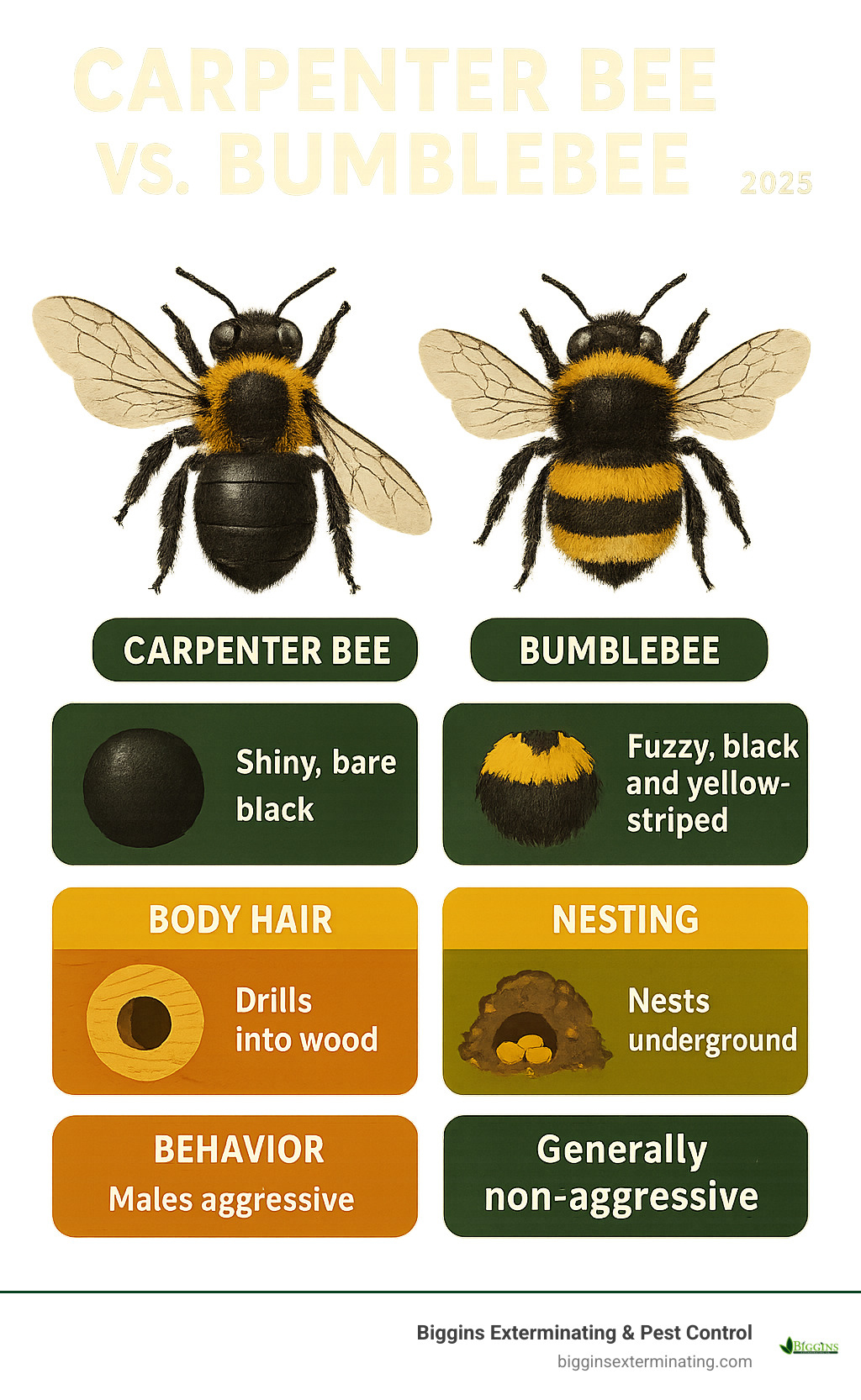
Simple guide to black and yellow carpenter bee:
Carpenter Bee vs. Bumblebee: Telling Them Apart
Spotting a large, buzzing bee near your deck can be alarming. Is it a harmless pollinator or a wood-destroying pest? Telling a black and yellow carpenter bee from a bumblebee is simple once you know the key differences. Though similar in size and color, a few distinct features will help you identify them correctly every time.
Here’s what separates these busy buzzers:
| Feature | Carpenter Bee | Bumblebee |
|---|---|---|
| Abdomen | Shiny, bare, hairless (usually black or dark blue) | Fuzzy, hairy with yellow and black stripes |
| Fuzziness | Only fuzzy on chest area | Fuzzy all over like a flying teddy bear |
| Nesting Location | Drills perfectly round holes in wood | Lives in ground holes or existing cavities |
| Social Behavior | Solitary workers | Social colonies with queens and workers |
| Size | About 3/4 to 1 inch long | About 3/4 to 1.5 inches long |
| Stinging | Males can’t sting but act tough; females rarely sting | Females can sting multiple times but are generally gentle |
The Telltale Abdomen: Shiny vs. Fuzzy
The abdomen is your best clue for telling these bees apart. Think of it as nature’s way of giving them different “outfits.”
The black and yellow carpenter bee sports what I like to call the “business formal” look. Their abdomen is completely smooth and shiny, almost like polished metal. Most Eastern Carpenter Bees have a striking black or dark blue rear end that gleams in the sunlight. All their fuzziness is concentrated up front on their thorax (that’s the chest area), creating a distinctive two-toned appearance.
Bumblebees, on the other hand, are dressed for a cozy winter day. They’re completely fuzzy from nose to tail, covered in dense, soft hair that makes them look like flying stuffed animals. Their yellow and black stripes continue all the way down their abdomen, giving them that classic “bee” look we all recognize.
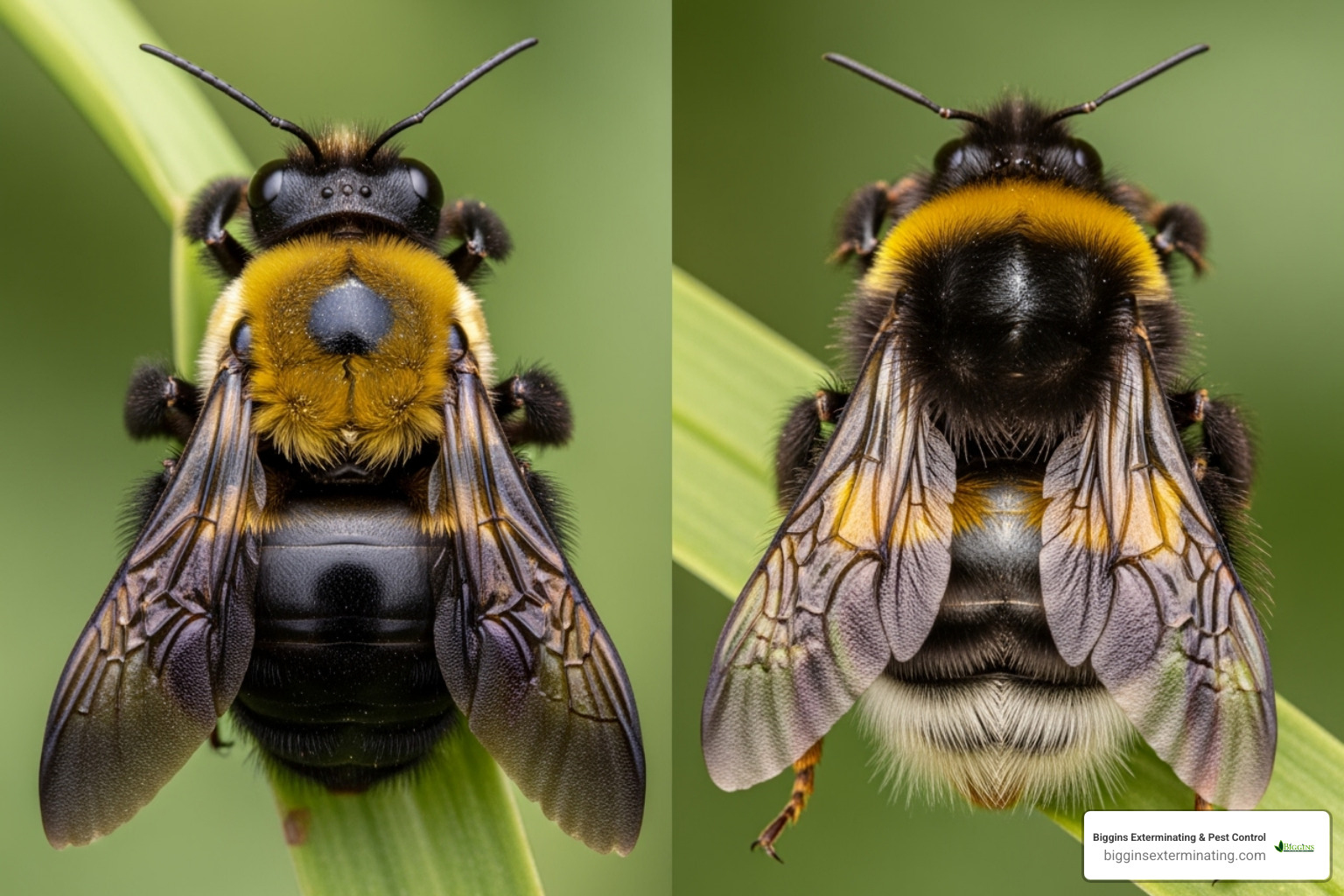
Once you spot that shiny black abdomen, you’ll know you’re dealing with a potential wood-borer rather than a ground-dwelling pollinator.
Nesting Habits: Wood Driller vs. Ground Dweller
The biggest difference between these bees isn’t just how they look—it’s where they choose to call home.
Black and yellow carpenter bees are the power tool enthusiasts of the bee world. Female carpenter bees use their strong jaws to drill perfectly round holes about half an inch wide into wooden surfaces. They’re not eating your deck for lunch like termites would—they’re creating nurseries for their babies. These solitary bees work alone, excavating tunnels that can extend up to 10 inches deep in untreated, unpainted, or weathered wood.
Your deck railings, eaves, fascia boards, and even that wooden patio furniture are prime real estate for these industrious insects. Each female is essentially a single mom, handling all the construction and childcare duties herself.
For more detailed information about these wood-boring behaviors, check out how to get rid of wood boring bees.
Bumblebees take a completely different approach to housing. These social bees prefer the underground lifestyle, setting up colonies in abandoned rodent holes, dense grass clumps, or other existing cavities. Think of them as the “fixer-upper” enthusiasts—they’d rather renovate an existing space than build from scratch.
Their colonies are much smaller than honeybee hives, typically housing 50 to 400 bees with a queen and her workers. If you see bees going in and out of a hole in the ground or a gap in your foundation, you’re probably watching bumblebees commute to their underground headquarters.
Understanding these different lifestyles helps you quickly assess whether you’re dealing with a potential structural concern or simply observing beneficial pollinators going about their business.
The Black and Yellow Carpenter Bee: A Closer Look at Males vs. Females
If you’ve watched black and yellow carpenter bees, you’ve likely noticed they don’t all look or act alike. This is due to sexual dimorphism, where males and females have distinct appearances and behaviors. Knowing these differences—from color patterns to stinging ability—can help you react appropriately and avoid unnecessary panic when a bee buzzes near.
The key differences affect everything from their territoriality to their mating behavior, and knowing these can help you respond appropriately to each encounter. For a deeper dive into whether these bees are friends or foes, check out this fascinating read: The Good and the Bad of Carpenter Bees: Can We Get Along?.
Identifying the Female Black and Yellow Carpenter Bee
The female black and yellow carpenter bee is the real worker of the family – she’s the one doing all that wood drilling you’ve been hearing about.
Her most distinctive feature is her all-black head and face, which makes her look quite serious and business-like. She’s typically the larger of the two sexes, with a robust, sturdy build that reflects her role as the family architect. Her body gleams with that characteristic shiny black abdomen, while her thorax (chest area) sports a bright patch of yellow fuzz.
Here’s what matters most to homeowners: the female does have a stinger, but she’s remarkably docile by nature. She’s far too busy with her nest excavation projects to bother with humans. You’d really have to go out of your way to provoke her – like grabbing her with your bare hands or blocking her nest entrance aggressively.
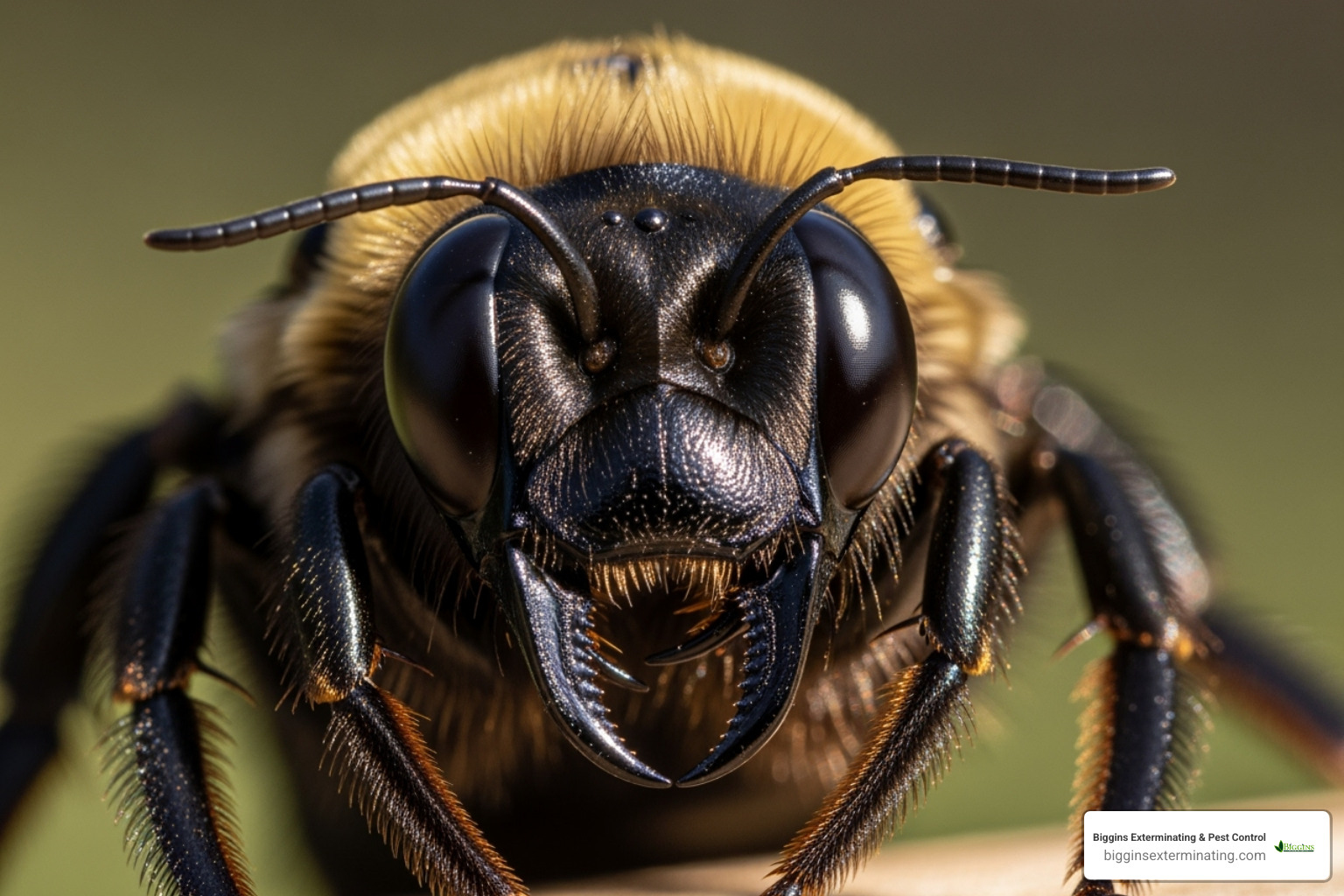
Those powerful mandibles you see in the photo? They’re perfectly designed for chewing through wood to create those neat, round holes. She’s essentially a living power drill, focused entirely on creating the perfect nursery for her young.
Behavior of the Male Black and Yellow Carpenter Bee
Now here’s where things get interesting – and often scary for homeowners. The male black and yellow carpenter bee is like that neighbor who talks tough but is actually harmless.
You can spot him immediately by the bright yellow or white face patch that makes him look like he’s wearing a mask. His large eyes are much more prominent than the female’s, giving him an almost comical appearance. Some males are so fuzzy they look like flying golden teddy bears!
Here’s the most important fact about male carpenter bees: they have no stinger. Zero. None. They’re completely harmless to humans, despite putting on quite the intimidating show.
And what a show it is! Males are incredibly aggressive in their dive-bombing behavior, especially during spring mating season. They’ll hover right in front of your face, buzz loudly, and seem to chase you around your deck or patio. This territorial behavior is all about guarding nests and impressing potential mates – it’s pure theater.
Think of it this way: he’s like a security guard with no actual authority. All bluster, no bite. His job is to patrol the area around the nest and look intimidating, which he does quite well. But when push comes to shove, he’s got nothing but his impressive flying skills and loud buzzing.
If you’re dealing with these aerial acrobats and want some relief, our guide on carpenter bee deterrents offers practical solutions that won’t harm these interesting (if annoying) insects.
Signs of Carpenter Bee Activity and Potential Damage
Spotting black and yellow carpenter bee activity early can save you from costly repairs down the road. These industrious insects leave behind unmistakable calling cards that homeowners need to recognize.
The most obvious sign is those perfectly round holes that look like someone took a drill bit to your wood. These entrance holes measure about half an inch across and appear remarkably precise – nature’s own power tool at work!
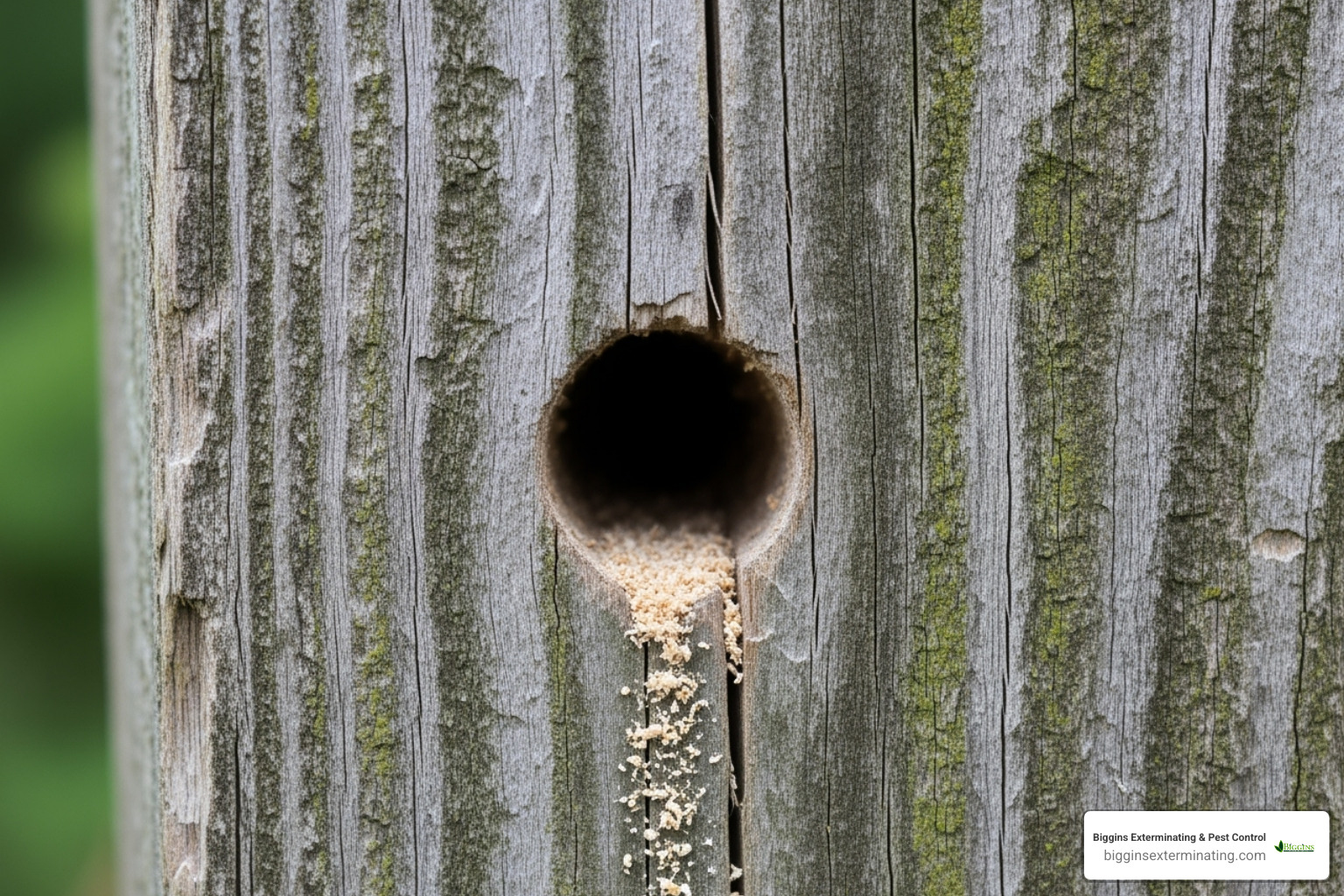
Look for sawdust piles beneath these holes – that’s the frass (wood shavings) the female bee pushes out while excavating her tunnels. You might also notice fan-shaped yellow or brown stains on the wood surface. These unsightly marks are actually bee excrement, and they’re a dead giveaway that carpenter bees have moved in.
Black and yellow carpenter bees have particular tastes when it comes to real estate. They prefer softwoods like pine, cedar, redwood, and cypress. Untreated wood is their favorite, followed by unpainted wood or surfaces where the finish has weathered away. Think deck railings, eaves, fascia boards, and that outdoor furniture you’ve been meaning to stain.
From Nest Tunnels to Structural Weakness
Once a female carpenter bee drills that initial hole, she doesn’t just stop there. She makes a sharp right turn and starts excavating parallel to the wood grain, creating nest galleries that initially stretch 4 to 6 inches.
Here’s where things get concerning for homeowners. These bees are creatures of habit who appreciate good real estate. They often return to the same tunnels year after year, expanding them with each generation. What starts as a modest 6-inch tunnel can eventually reach lengths of up to 10 feet!
Inside these galleries, the female creates individual nursery cells. She stocks each one with a protein-rich mixture of pollen and nectar, lays a single egg, and seals it up. The life cycle progresses from egg to larva to pupa to adult over several weeks. New adults often overwinter in these same tunnels before emerging to start their own families the following spring.
The cumulative effect of multiple tunnels, especially those reused and expanded over several seasons, can seriously weaken wood structures. While one tunnel won’t bring down your deck, a network of interconnected galleries can compromise the structural integrity of beams, posts, and siding.
For detailed information about how these pests specifically target your home’s exterior, check out our guide on carpenter bees in wood siding. You can also find comprehensive information in this resource about Structural Pests: Carpenter Bees.
Secondary Damage: Woodpeckers and Moisture
The problems don’t stop with the bees themselves. Black and yellow carpenter bee tunnels attract unwanted attention from another source – hungry woodpeckers.
These birds have excellent hearing and can detect the sounds of developing bee larvae inside the wood. Once they locate a tunnel full of protein-rich treats, woodpeckers will hammer away at the wood to extract their meal. The result? Woodpecker predation creates much larger, more unsightly damage than the original bee holes.
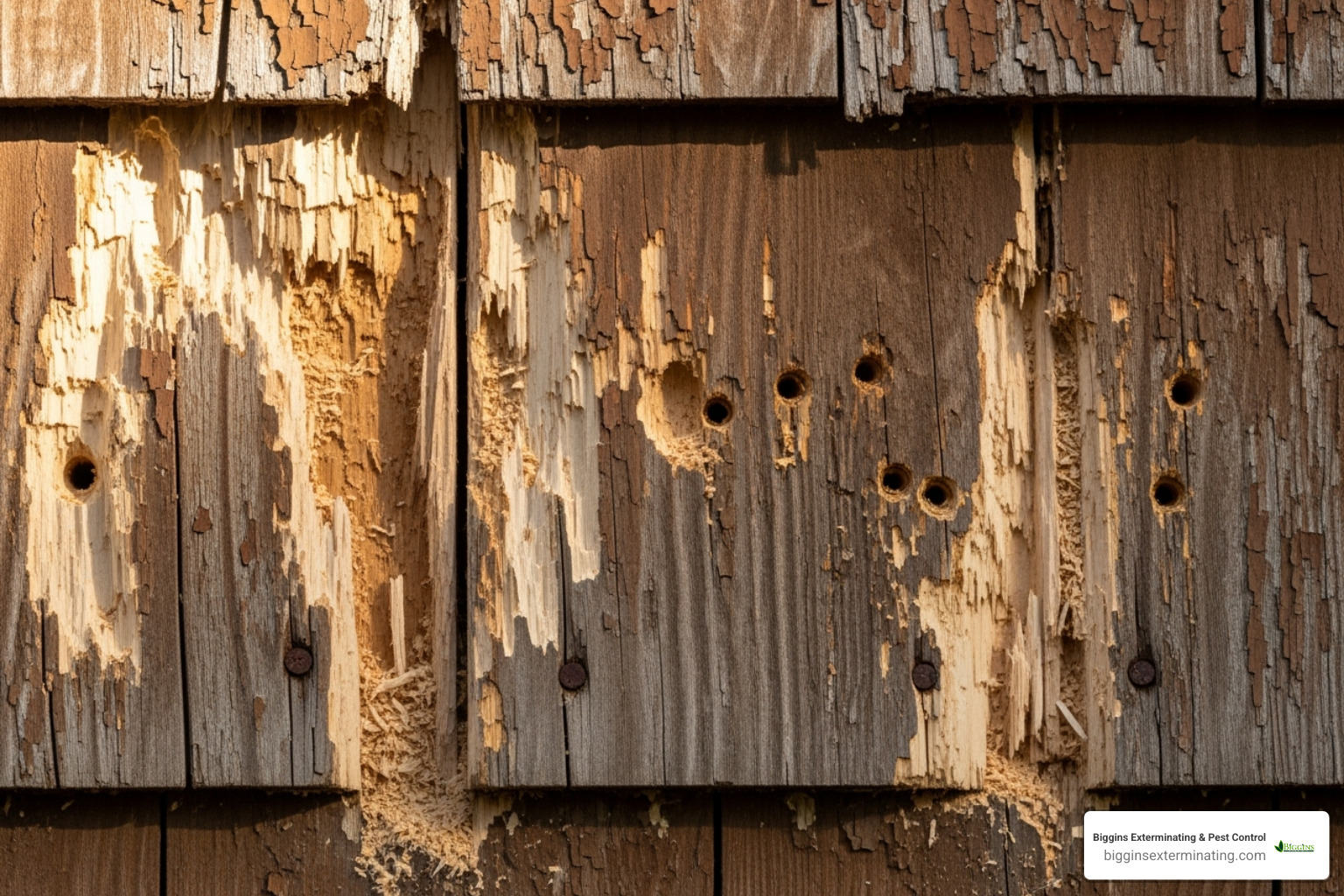
The open tunnels also create pathways for moisture intrusion. Water can penetrate deep into the wood through these holes, and combined with bee excrement and leftover pollen, creates perfect conditions for wood decay and mold growth.
What started as a simple bee problem can quickly escalate into expensive structural repairs. It’s like watching dominoes fall – one problem leads to another, then another. The key is catching carpenter bee activity early before these secondary issues take hold.
Prevention and Professional Carpenter Bee Management
The good news about black and yellow carpenter bees is that prevention is highly effective. Their predictable preferences for wood mean you can take steps to make your home less appealing before they start drilling.
Painting and staining your wood surfaces is your best defense against carpenter bees. These insects strongly prefer raw, weathered, or unpainted wood. A good quality paint or stain creates a barrier that makes the wood much less attractive for nesting. The key is maintaining these finishes over time, as old or peeling paint loses its protective power.
Sealing up existing cracks and holes eliminates the starter spots that carpenter bees love to expand into full tunnels. Use wood putty or caulk to fill any nail holes, cracks, or unsealed joints you find during your regular home inspections.
When possible, consider non-wood alternatives for areas that get hit repeatedly by carpenter bees. Vinyl siding, composite decking, or aluminum trim simply can’t be drilled by these insects. They’ll give up and look elsewhere.
Timing matters tremendously when dealing with existing infestations. The most effective treatment windows are late summer through early fall, when the new generation of adult bees is still in their tunnels, or early spring before they become active. Treating during peak activity in late spring and early summer is less ideal.
When to Call an Exterminator
While some homeowners successfully manage minor carpenter bee issues on their own, certain situations really call for professional expertise. After four decades in the pest control business, I’ve seen when DIY approaches work and when they fall short.
Hard-to-reach nests present both safety and effectiveness challenges. If carpenter bees are boring into your second-story eaves or complex rooflines, attempting to treat them yourself can be dangerous. We have the proper equipment and experience to safely access these areas and ensure thorough treatment.
Large or widespread infestations require a comprehensive approach that goes beyond treating individual holes. When you’re seeing extensive damage across multiple structures or dozens of active bees, it indicates a well-established population that needs systematic management. We can assess the full scope of the problem and develop a targeted treatment plan.
Recurring problems year after year suggest there’s something about your property that keeps attracting these bees back. Maybe it’s untreated wood in hidden areas, or existing tunnel systems that weren’t properly sealed. Our experience helps us identify these underlying issues and implement long-term solutions.
Safety concerns are always valid reasons to call professionals. While female carpenter bees rarely sting, some family members might have bee allergies, or you might simply feel uncomfortable dealing with large, buzzing insects. There’s no shame in leaving it to the experts – that’s what we’re here for.
Ensuring complete removal is where professional treatment really shines. We don’t just kill the current bees; we seal the tunnels, treat the wood to prevent re-infestation, and provide guidance on preventing future problems. It’s the difference between putting a band-aid on a problem and actually solving it.
We’ve been protecting homes in Wilmington, Andover, Bedford, Billerica, Burlington, Lexington, North Reading, Tewksbury, and Woburn for over 40 years. We offer reliable service without requiring long-term contracts, and we back our work with warranties because we stand behind what we do.
Frequently Asked Questions about Black and Yellow Carpenter Bees
After helping Massachusetts homeowners deal with black and yellow carpenter bees for over four decades, I’ve heard just about every question you can imagine about these fascinating yet sometimes problematic insects. Let me share the answers to the questions that come up most often during our service calls.
Are black and yellow carpenter bees good pollinators?
Here’s something that might surprise you: black and yellow carpenter bees are actually fantastic pollinators! While we spend a lot of time talking about the damage they can cause to your deck or siding, these bees play a crucial role in keeping our local ecosystems healthy.
What makes them special as pollinators is their size and technique. These robust bees are perfectly built for open-faced flowers – think sunflowers, daisies, and many wildflowers. Their large bodies allow them to easily access nectar and pollen that smaller bees might struggle to reach.
But here’s where it gets really interesting: carpenter bees are masters of something called buzz pollination. They grab onto a flower and vibrate their powerful flight muscles, creating vibrations that shake loose pollen that would otherwise stay trapped. This technique is absolutely essential for plants like tomatoes, blueberries, and various beans and peas. Without buzz pollination, these plants would struggle to reproduce.
Now, I have to mention their one slightly sneaky habit – nectar robbing. When faced with deep, tubular flowers where they can’t easily reach the sweet nectar, carpenter bees sometimes take a shortcut. They’ll chew a small hole at the base of the flower and steal the nectar without doing the pollination work. It’s like sneaking into a movie through the back door! While this doesn’t help that particular flower, their overall contribution to our local ecological role is still tremendously positive.
Do all black and yellow carpenter bees bore into wood?
This is a great question that gets to the heart of what makes these bees so unique. The black and yellow carpenter bee you’re dealing with here in Massachusetts – the Eastern Carpenter Bee (Xylocopa virginica) – absolutely does bore into wood. That’s their signature move and exactly why they’re called carpenter bees in the first place.
All the carpenter bees in our region belong to the genus Xylocopa, and wood-boring is what they’re famous for. They’re incredibly skilled at excavating those perfectly round holes and creating intricate tunnel systems in wooden structures. This is their natural nesting in wood behavior, and it’s been working for them for millions of years.
Here’s where it gets interesting from a scientific perspective: there are actually around 500 species of carpenter bees worldwide, and while the vast majority are wood-borers, there are a few exceptions in other parts of the world. Some species nest in soil in very arid regions, but these are quite rare and definitely not the bees you’ll encounter around your home.
The regional differences matter too. In our Eastern US climate, you can be confident that any large black and yellow carpenter bee you see investigating your wooden structures is indeed looking for a place to drill. They’re not going to suddenly decide to nest in your garden soil instead – wood is their preferred real estate!
Can a male carpenter bee sting you?
This question usually comes up right after someone has been “attacked” by what seems like an aggressive bee near their deck or porch. I can offer you immediate peace of mind: no stinger means no sting – male carpenter bees are completely harmless.
Male carpenter bees are like that neighbor’s dog who barks ferociously from behind the fence but wouldn’t hurt a fly. They put on quite a show with their defensive hovering and dramatic dive-bombing displays, but it’s all bluster. They’re guarding their territory and showing off for potential mates, but they literally cannot back up their threats with any actual sting.
The territorial behavior can be pretty intense, though. A male carpenter bee will hover right in front of your face, buzz loudly, and seem to chase you around your yard. It’s their job to patrol the area around active nests and ward off anything they see as a threat. Think of them as tiny, flying security guards who are all about the intimidation factor.
Only female stings are possible, and even then, it’s extremely rare. Female carpenter bees are focused on their nest-building work and will only sting when provoked – meaning if you grab one, step on one, or try to block her nest entrance with your hand. Even then, many females will try to escape rather than sting.
So the next time a black and yellow carpenter bee with a yellow face patch comes buzzing aggressively toward you, you can confidently know it’s just a male putting on a show. Take a step back, let him have his moment of glory, and remember – he’s completely harmless!
Conclusion
Identifying a black and yellow carpenter bee versus a bumblebee doesn’t have to be a guessing game anymore. It all comes down to that telltale shiny abdomen – if it looks like it’s been polished to perfection, you’re looking at a carpenter bee. If it’s fuzzy all over like a tiny flying teddy bear, that’s your friendly neighborhood bumblebee.
We’ve also finded that in the carpenter bee world, appearances can be deceiving. Those aggressive-looking males with their yellow face patches are all bluster and no bite – literally! They’re the harmless neighborhood watch, while the quiet, all-black-faced females are the ones actually doing the drilling. It’s like nature’s version of “the quiet ones you have to watch out for.”
The relationship between carpenter bees and homeowners is genuinely complicated. These native pollinators do important work for our ecosystem, especially with their unique buzz pollination technique. Yet when they decide your deck railing is the perfect spot for their nursery, the friendship can get strained pretty quickly.
Black and yellow carpenter bees represent that classic friend-versus-foe dilemma. They’re beneficial pollinators that we want to support, but not when they’re turning our wooden structures into Swiss cheese. The key is recognizing when their presence has shifted from beneficial to problematic.
Early detection makes all the difference. Those perfectly round holes and little piles of sawdust are your early warning system. Address the issue promptly, and you can prevent those tunnels from becoming highways that weaken your home’s structure or attract hungry woodpeckers looking for a carpenter bee snack.
At Biggins Exterminating, we’ve spent over four decades helping Massachusetts families steer these delicate situations. We understand that every homeowner wants to protect their property while being responsible stewards of our local ecosystem. Sometimes that means learning to coexist, and sometimes it means taking action to protect your investment.
For persistent carpenter bee problems that threaten your property’s integrity, professional help ensures your property is protected. Our family-owned business has the experience to assess your specific situation and recommend the most appropriate course of action for your home and your peace of mind.
Contact us for professional carpenter bee control.
